Not Bad for a Bunch of Old Folks
They tag us with the label "The Elderly." Fair enough. The gray hairs outnumber the rest, the knees lodge a formal protest on every staircase, and standing up from an armchair produces sound effects like a transmission slipping into reverse. But that label misses the real story entirely.
We are the very last generation that holds the memory of an analog planet. We grew up when "Googling" something was impossible because the word didn't exist. If curiosity struck, you pulled a heavy volume of the encyclopedia off the shelf or tracked down someone who genuinely knew their stuff.
Childhood was an outdoor sport. The curfew was the flicker of the streetlights. Water came straight from the garden hose, disputes were settled right on the driveway instead of in a comment section, and our social network was simply called the front porch.
We gathered around fuzzy black-and-white screens to watch footprints planted on the Moon. We listened to music on vinyl, bulky 8-tracks, magnetic tapes, shiny compact discs, and now out of thin air via invisible radio waves.
Romance didn't come from an algorithm; it came from looking someone in the eye. We waited a week for a handwritten letter without flinching, while folks today lose their composure if a text message sits unread for forty seconds.
In a single lifetime, we crossed the chasm from rotary dials to pocket computers, manual typewriters to artificial intelligence, and folded paper roadmaps to a dashboard voice politely informing us we missed the turn. And through every single leap, we didn't get left behind—we adapted.
We bridged two centuries, navigated monumental shifts in history and technology, buried dear friends, welcomed new generations, and earned the perspective to know that tomorrow's catastrophe is rarely remembered next year.
We aren't museum pieces. We're living proof that you can welcome the future without surrendering common sense.
So whenever someone smiles and calls us "elderly," smile right back. Behind that word is an entire era of grit, evolution, and grace.
Not bad at all for a bunch of old folks.
A 10-hour crossing on a packed mega-dinghy. RNLI boats from the Isle of Wight pick them up and bring them into Portsmouth.
No sinking, no Mayday that the public saw just another delivery. They were not rescuing lives at risk. They were completing the journey the gangs started.
Total disgrace.
The RNLI used to launch for fishermen, sailors and idiots in kayaks. Now a huge chunk of the anger is because crews are being sent to collect overcrowded inflatables organised by criminals and land the passengers in the UK.
Super dinghies, 140 at a time. That’s not the charity people thought they were funding.
Satan is not opposed to good morals.
He’s opposed to Jesus Christ.
Read that again because most Christians miss this completely.
Satan doesn’t care if you’re a “good person.” He doesn’t care if you volunteer at the food bank, recycle your trash, and help old ladies cross the street. He doesn’t care if you’re kind, generous, and well-liked by everyone in your community.
He cares that you don’t bow the knee to Jesus.
Here’s the deception that’s damning millions:
Satan has convinced people that morality equals spirituality. That being a “good person” is the same as being a Christian. That if you just live right, treat people well, and avoid the “big sins,” you’re acceptable to God.
This is a lie straight from the pit of hell.
The Pharisees had impeccable morals. They followed the law meticulously. They were respected, disciplined, and religiously devoted.
Jesus called them children of the devil.
Why? Not because their morals were bad. Because their morals replaced Christ.
Satan’s greatest trick isn’t making bad people worse. It’s making good people think they don’t need a Savior.
Think about it:
The atheist who feeds the homeless thinks he’s good enough without God.
The Buddhist who meditates and practices compassion thinks she’s enlightened without Christ.
The Muslim who prays five times daily thinks he’s righteous without Jesus.
The moral Christian who goes to church, pays his tithe, and avoids scandal thinks he’s saved without surrender.
All of them are headed to the same place: eternal separation from God.
Because morality doesn’t save. Jesus saves.
“For by grace are ye saved through faith; and that not of yourselves: it is the gift of God: Not of works, lest any man should boast.” Ephesians 2:8-9
Satan loves moral people who reject Jesus. They’re his best advertisement for the lie that you can earn your way to heaven.
They’re living proof that you can:
•Be kind without Christ
•Be generous without God
•Be disciplined without the Holy Spirit
•Be respected without redemption
And still be lost.
The most dangerous people in hell won’t be the murderers and rapists. They’ll be the moral, upstanding citizens who thought their goodness was good enough.
Their morals became their idol. Their goodness became their god.
And Satan smiled because he’d accomplished his goal: Keep them from Jesus.
Here’s what most Christians don’t understand:
Satan doesn’t need to make you do bad things. He just needs to keep you from doing the ONE thing that matters: surrendering to Christ.
If he can get you to:
•Trust your morals instead of Christ’s sacrifice
•Rely on your goodness instead of God’s grace
•Believe in your works instead of Jesus’ finished work
He’s won.
You can live a moral life and still die lost. You can be a good person and still face judgment. You can avoid all the “big sins” and still end up separated from God forever.
Because the only sin that damns you eternally is rejecting Jesus Christ.
“He that believeth on the Son hath everlasting life: and he that believeth not the Son shall not see life; but the wrath of God abideth on him.” John 3:36
Not the murderer who repents and believes in Christ is damned.
Not the thief who turns to Jesus on the cross is damned.
Not the prostitute who washes Jesus’ feet with her tears is damned.
The moral, religious person who rejects Christ is damned.
That’s why Satan loves morality without Jesus. It sends people to hell with a smile on their face, convinced they were good enough.
Stop trusting your morals. Start trusting Jesus.
Your goodness won’t save you. Your works won’t redeem you. Your morality won’t justify you.
Only the blood of Jesus Christ can wash away your sin and make you acceptable to a holy God.
Everything else is just Satan’s distraction from the one thing that actually matters.
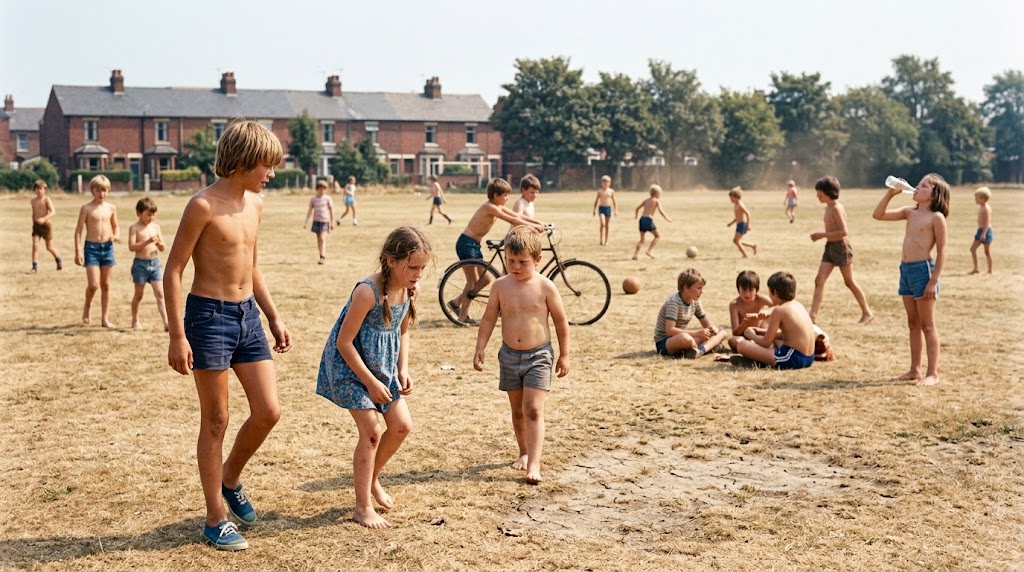
The summer of 1976 was the last one Britain spent outdoors without a bottle, and nobody came home from it blistered.
Fifteen days over thirty degrees. The reservoirs cracked into plates. Standpipes on the pavement in Devon and the Welsh valleys, and a Minister for Drought appointed in August, three days before the rain came and made him look like a genius.
You were out at eight and in at dark. The playing field went the colour of a digestive and stayed that way till September. The tar on the road went soft enough to take a footprint and your mother shouted about it.
Ladybirds. Millions of them, on every windowsill, in your hair, in the Tizer.
Nobody owned sunscreen. There was a bottle of Ambre Solaire in the bathroom that smelled of coconut and belonged to your auntie, and it went on in Spain, once, for the first afternoon. The word factor had not arrived. If it had a number on it the number was two.
Shirts came off in the first week of June and did not go back on. The men on the site worked in vests and came home the colour of a saddle. Farmers cut the hay with their backs bare. The lifeguard at the lido was brown as a conker by July and nobody thought he was doing anything brave.
You went pink once, early on, and then you did not. Your skin did what skin did: it darkened, it thickened, and it was fine for the rest of the summer.
And the chip pan on the stove was full of lard. Beef dripping in the tin under the sink. Butter on everything. Rapeseed was a crop on a few thousand acres that nobody had thought to eat, and the oil in the cupboard, if there was any, was for the Sunday roast tin and lasted a year.
That was the summer. Every hour of daylight, no cream, no shade, and a country built out of animal fat.
Fifty years on, the same sun, half the exposure, factor fifty on the school run, and skin that blisters walking to the car.
The sun did not change. The cupboard did.
The first Christian was a felon.
Not Peter.
Not Paul.
Not your pastor.
A criminal. Hanging on a cross. Hours from death.
He beat everyone to paradise.
Before the disciples figured out the resurrection.
Before Paul got knocked off his horse.
A thief looked at Jesus and said, "Remember me."
And Jesus said, "Today."
The first Christian had no church.
No baptism.
No 6-week membership class.
He had nails in his wrists and six hours to live.
And he's been in paradise for 2,000 years.
Meanwhile.
You've been in church for 20 years.
You can articulate penal substitutionary atonement.
And you're still wondering if that guy who prayed last week really "got it."
The first Christian didn't "get it."
He got HIM.
He didn't understand substitution.
He didn't understand justification by faith alone.
He understood one thing:
The man next to him was a King.
And he wanted in.
"Lord, remember me when thou comest into thy kingdom."
That's the whole conversion.
No altar call.
No follow-up email.
Just a criminal, a King, and a request.
And here's the part that should wreck you:
His theology was WRONG.
"When you come into your kingdom."
He got the timeline completely wrong.
And Jesus saved him anyway.
He didn't correct his eschatology.
Didn't say, "Well actually..."
He just said, "Today."
The first Christian had bad theology and a good King.
Some of you have great theology and no King at all.
You've won every argument.
And you've never once said "remember me" like you meant it.
The first Christian wasn't impressive.
He was desperate.
And desperation got him further than your diploma.
2,000 years of church history.
Councils. Creeds. Confessions.
And the first one through the door was a dying criminal who couldn't even fold his hands.
You scrolling through X right now with your Reformed credentials and your theological hot takes...
The guy who beat you to paradise couldn't read.
He knew one thing:
He was dying.
And so was Jesus.
And Jesus was still a King.
That's faith.
Not a system. A surrender.
Not knowledge. Recognition.
Not performance. Desperation.
The first Christian.
A felon.
A failure.
A man with hours to live and nothing to offer.
And he's been home longer than anyone.
What's your excuse?
In the coming days they will try a huge msm push to get your sons to agree to be funnelled into the Ukrainian drone meat-grinder under the guise of ww3.
Tell them bollocks.
There will of course be endless msm propaganda - those who are stupid enough to go to “fight”will be paraded as heroes as they are killed off.
Those who see through the lie will be labelled as cowards and traitors and those who lose their foolish sons will be angry with those who see through the lie - simply for not being stupid enough to go, because stupidity is what will kill those that do.
See it for what it is.
Many will turn on those who refuse to go in the exact same way they did with covid and their poison “vaccines” and the weakest minds will be convinced as their own sons are sacrificed in a Ukrainian dugout by drone or artillery.
They will no doubt roll out threats and penalties for those that wont fight their fight - when there is no real fight at all, it’s simply an extension of the cull using a different method.
Stick to your moral guns as you did with the vaccines and tell them a consistent and firm “bollocks”.
As I will, as my family will.
Let those who wage wars fight them, I will,never take any part in it.
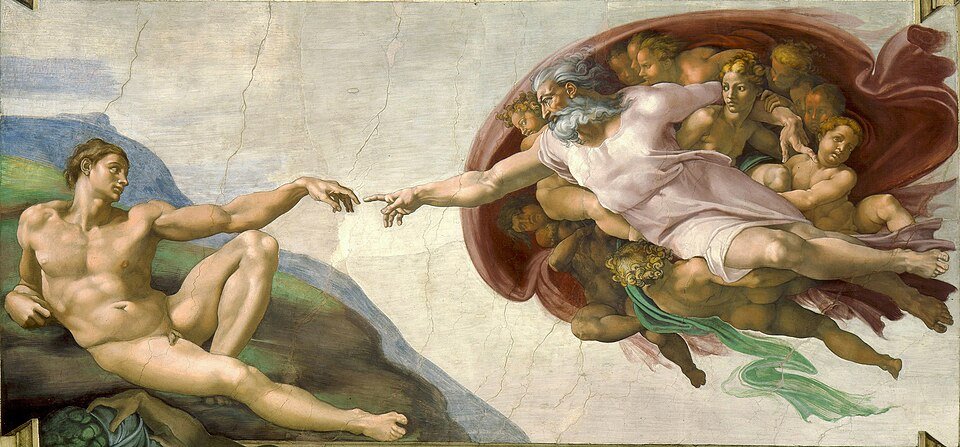
Four hundred million people have this image on their phone, a mug, or a T-shirt.
Almost none of them have noticed what's wrong with Adam's hand.
Look at the two arms.
God is horizontal. Launched. Every tendon in His arm at full stretch, hair and mantle blown back by His own speed, angels straining under the weight of carrying Him because He is the one moving. He has crossed the entire sky to get to this moment. His finger is extended as far as a finger goes.
Now Adam.
Draped on a hillside. Propped on one elbow. Leaning back. His arm isn't reaching; it's resting on his own knee. The wrist is slack. The finger droops.
The Creator of the universe is straining like a man reaching for someone going over a cliff.
And the man can't be bothered to straighten one finger.
Michelangelo painted that on purpose. And he painted it in agony, four years on scaffolding under that ceiling, head cranked back, paint dripping into his beard. He hated it enough to write a poem about it, complaining that his spine had bent like a bow and he could no longer read a letter without holding it above his head.
Four years of that. To say one thing:
You did not climb to God. God dove to you.
Every religion on earth is a ladder. Purify yourself, discipline yourself, ascend. Michelangelo put the opposite on the ceiling of the most important church in the world: man reclining, barely participating, and God closing the distance at speed.
Genesis 2:7. And the LORD God formed man of the dust of the ground, and breathed into his nostrils the breath of life; and man became a living soul.
God breathed. Adam received. That's the whole transaction. Adam contributed the dust.
Now look under God's left arm.
There's a woman tucked against His side. His arm is wrapped around her. And she isn't watching the miracle; she's looking past God's shoulder, straight at Adam.
The oldest reading says that's Eve.
Not yet created. Not yet formed. Already held. Already watching the man she'll be given to, from inside the embrace of God, because she existed in His mind before she existed in the world.
Jeremiah 1:5. Before I formed thee in the belly I knew thee.
Ephesians 1:4. He hath chosen us in him before the foundation of the world.
You were in that mantle once before your parents met, before anything.
And about that mantle, in 1990, a physician named Frank Meshberger was studying the fresco and published something that made art historians sit down. Trace the outline of the crimson cloak, the angels, the whole swirling mass around God.
It matches a cross-section of the human brain. The fissures. The lobes. The stem.
Michelangelo dissected corpses. He knew human anatomy better than most surgeons of his century. Whether he hid it there deliberately is argued to this day, but if he did, the sermon is staggering: God isn't just handing Adam a heartbeat. He's giving him a mind. The image of God. The capacity to know his Maker.
So God has crossed the sky. Arm at full extension. Nothing left to give. He has closed all the distance that can be closed from His side.
And the fingers don't touch.
Michelangelo froze them apart forever. A half-inch of empty plaster carrying more weight than the rest of the ceiling combined.
Because look whose finger has slack left in it.
Not God's.
Adam could close that gap by straightening one knuckle. One. The remaining distance is his, the smallest movement in the painting, and the only one God will not make for him.
That half-inch is free will. God will cross a universe. He will not cross your consent.
But here's what the ceiling can't show you, because it happened fifteen centuries after Genesis and Michelangelo painted the before.
The touch happens.
God's hand and human flesh finally meet not above the clouds, but in Bethlehem, when the hand that flung the stars became a hand small enough to grab Mary's finger. God stopped reaching across the gap and stepped into it. Took a body. Took a hand.
And when that hand was finally stretched out as far as human arms go, extended like the arm on the ceiling, full reach, nothing held back.
We nailed it there.
That's where the two fingers meet. At the cross. God at full stretch and man at his worst, touching at last through an iron spike.
And three days later that hand was moving again. Folding grave clothes. Cooking breakfast. Offering its scars to a doubter.
It's still extended. The ceiling is still true. He has done all the reaching, crossed all the sky, closed all the distance that love can close without your permission.
The last half-inch has always been yours.
Lift your hand.
Of all the miracles of Jesus, one stands apart as the point of no return. It was this miracle, John records, that made the death of Jesus certain, the act so public, so undeniable, and so threatening that the ruling council met immediately afterward and formally decided He must die. It was not a healing or an exorcism that sealed the cross. It was a man walking out of his own tomb.
Start with what makes this account different from the other raisings. Jesus had raised the dead before: the daughter of Jairus, only minutes gone, and the widow's son at Nain, on the same day of his death. In both cases, a skeptic could whisper about mistaken death, a coma, a swoon. Lazarus removes every escape route. When Jesus finally arrives in Bethany, Lazarus has been in the tomb four days. This detail is not incidental, and John repeats it deliberately. In the Jewish thought of the period, there was a popular belief that the soul lingered near the body for three days, after which death was absolute and irreversible. Martha states the physical reality with brutal frankness: "Lord, by this time there will be an odor, for he has been dead four days." Decomposition had begun. Everyone present knew exactly what four days meant.
Now notice the strangest detail in the story: Jesus caused the four days. When word first reached Him that Lazarus was gravely ill, John writes something startling: "Now Jesus loved Martha and her sister and Lazarus. So, when he heard that Lazarus was ill, he stayed two days longer in the place where he was." So. Because He loved them, He stayed. He deliberately arrived after all hope was gone. To the sisters, the delay looked like indifference, and both of them greet Him with the same wounded words: "Lord, if you had been here, my brother would not have died." Every believer who has prayed urgently and heard silence knows that sentence from the inside. But the delay was not neglect. Jesus tells His disciples plainly: "Lazarus has died, and for your sake I am glad that I was not there, so that you may believe." Some things God allows to fully die so that what He does next cannot be explained by anything but Him.
At the tomb comes the shortest verse in all of Scripture, and one of the most profound: "Jesus wept." Stand back and look at how strange this is. He knows what He is about to do. He knows that within minutes Lazarus will be alive and the mourning will turn to astonishment. And still He weeps. The Greek around this scene is even stronger: twice John says Jesus was "deeply moved," a word that in classical Greek describes the snorting of a warhorse, an inward shuddering of anger and grief together. Jesus stands at the grave of His friend and is furious, not at the sisters, not at the crowd, but at death itself, the intruder that has terrorized every family since Eden. He does not float above human grief; He enters it, shares it, and shakes with it, even knowing the ending. That is the God the Gospels give us: one who weeps with you at the very grave He is about to empty.
Then the confrontation. "Take away the stone." Martha protests, the odor, the four days, and Jesus answers, "Did I not tell you that if you believed you would see the glory of God?" They roll the stone. He prays aloud, briefly, and John tells us why: "on account of the people standing around, that they may believe that you sent me." And then three words into the darkness of the tomb: "Lazarus, come out."
The old preachers loved to say that Jesus had to call Lazarus by name, because if He had simply said "Come out," every grave on earth would have emptied. The man who had been dead four days came out, still bound hand and foot in the grave clothes, his face wrapped in the cloth. "Unbind him," Jesus says, "and let him go."
Notice the contrast John is quietly drawing, because it pays off two chapters later. Lazarus exits his tomb still tangled in his wrappings, raised but still wearing the uniform of death, and someone must free him. When Jesus rises, the grave clothes are left behind, lying in place, the face cloth folded separately. Lazarus was resurrected, brought back to this life, to die again one day. Jesus was resurrected, through death and out the other side, never to die again. Lazarus needed unbinding; death had no claim left on Jesus at all.
The aftermath is where the story turns cold and political, and it is the part most retellings skip. This happened in Bethany, two miles from Jerusalem, before a large crowd of mourners from the city, many of them connected to the religious establishment. There was no possibility of hushing it up. John records the council's emergency session, and their reasoning is chilling in its honesty: "What are we to do? For this man performs many signs. If we let him go on like this, everyone will believe in him." They do not dispute the miracle. They cannot. Their problem is precisely that it happened. And so Caiaphas delivers his verdict that one man should die for the people, and from that day, John writes, they made plans to put Him to death. They also, almost unbelievably, plotted to kill Lazarus as well, because on account of him many were believing in Jesus. The man freshly rescued from death was marked for death, for the crime of being alive.
To the world, the raising of Lazarus is the easiest miracle to dismiss, because it is the biggest. But look at what the enemies of Jesus did with it. They were there, two miles from the tomb, with every motive and every resource to expose a fraud, and their response was not "it did not happen." Their response was to convene a council and plan two murders. Men do not plot to kill a walking man to suppress a story about him unless the man is, in fact, walking.
Jesus said to Martha, before the stone ever moved, the words that tower over the whole account: "I am the resurrection and the life. Whoever believes in me, though he die, yet shall he live." Not "I will perform resurrections." I am the resurrection. It is not a power He uses; it is who He is. And then He asked her the question the entire Gospel of John is built to ask every reader: "Do you believe this?"
Whatever has been four days dead in your life, whatever you have already wrapped, mourned, and sealed behind a stone, hear this: His delays are not His absence, and nothing is too far gone for the one who is Himself the resurrection. He weeps with you at the tomb, and then He calls into it.
"Do you believe this?" The question is still open, and it is addressed to you.
Jesus is the Resurrection and the Life. Thank You, Jesus.
Intelligent people live a boring life. They go to bed at 10. Wake up at 6. Eat simple foods. Go for long walks. Read thick books. Say no to things that drain them. The world chases excitement. But they chase calm. Things that align with their soul. A calm routine. A quiet mind. A healthy body. Meaningful work. A small circle. A private life. Their life may look boring from the outside. But from the inside, they experience a kind of freedom most people spend their entire lives searching for.
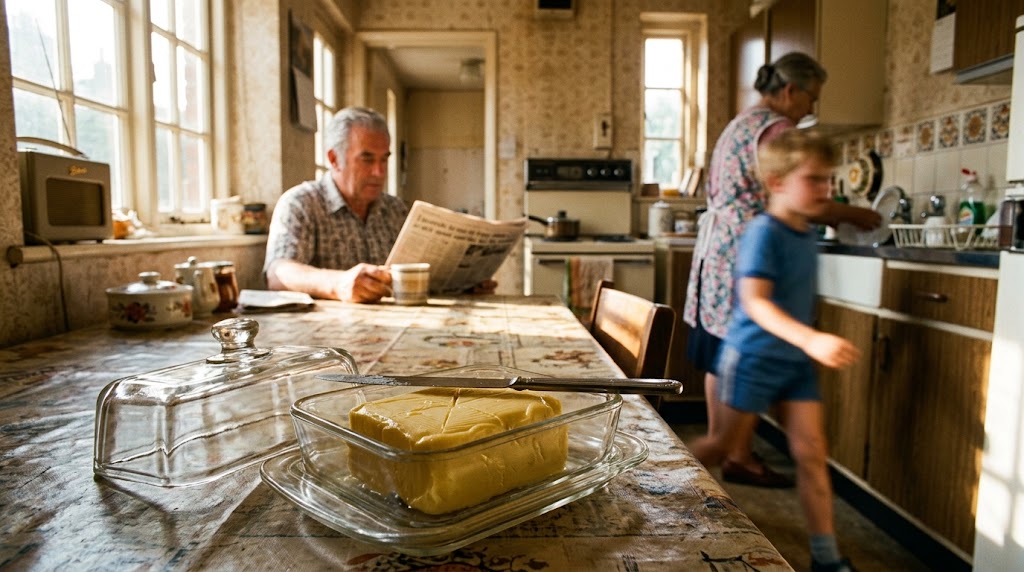
Butter did not live in the fridge in this country until the mid eighties.
It lived on the table. Under a little lid, or a bell of frosted glass, and it stayed put from breakfast to supper. It got a top-up, never a wash and a fresh pack. When it ran low, more went in. It was there the way the salt was there and the teapot was there, and nobody in that house gave it a second thought.
And it was soft. You pulled it straight across warm toast without tearing a hole in the middle, without the wait, without the cold shrapnel that comes off a fridge-hard block.
It sat out through a July afternoon and nothing happened. It sat out through Christmas week beside the cake and nothing happened. Your grandmother kept butter on the side for fifty years and buried nobody.
Butter is around eighty per cent fat, and the water in it is locked in droplets inside that fat with the salt dissolved in them. Bacteria need free water and there is almost none to be had. The fat is the thing keeping it safe.
The fat. The exact property they spent forty years telling your mother would kill her is the property that lets butter sit on a table all summer and behave itself.
She knew none of that and she was right anyway.
Then the government's committee on nutrition reported in 1984, the country was told to cut the fat out, and inside about three years the dish was in a cupboard and there was a tub in the fridge door with a sunflower on the lid.
Butter out of a fridge cannot be spread. It tears the bread and sits on the knife in a lump. The tub beat butter on exactly one thing, which was that it came out already soft, and it only had that advantage because the competition had just been sent somewhere cold on doctor's orders.
Clover launched in September 1983, made by Dairy Crest, which was the processing arm of the Milk Marketing Board. The dairy industry's own company sold Britain the tub.
Then it sold the fix. Spreadable butter is butter with rapeseed oil blended through it so it comes out of the fridge soft, and the market leader runs at sixty four per cent butter to twenty three per cent oil. It costs more than the block it is diluting.
There is a generation now that flinches at a fat left out at room temperature, and the same people will eat mayonnaise out of a jar that has been sat on a warehouse shelf since March.
Leave a dish of it out tomorrow. Watch it sit there all day doing absolutely nothing, then spread it without a fight.
Your fridge is full of things that would have you on the floor by Thursday. The butter was never one of them.
A tale of two countries: London and England. I’ve had the most perfect week on my little sailing boat in England. Mooring up in Woodbridge, Suffolk and others along the River Deben, then visiting Constable country around Dedham. Every village was beautiful. Every place was clean and tidy. Free of litter and graffiti. Every place was all white people. British people. People who spoke English. Villages with little honesty boxes to leave your money and take the home grown produce. The National Trust at Flatford Mill where Constable painted the haywain didn’t have books on how all white people are terrible. It had books on Constable, the beauty of his work and the beauty of the countryside. It had people enjoying tea and sandwiches sitting in the gardens in the sunshine enjoying their surroundings. It took a few days to realise the complete and utter difference between these places and London. This was England, full of the English. Then, as I came back into London, I left England and arrived back in the third world. The people weren’t English. They weren’t British. They had zero affinity with England. I was a foreigner. This is now their land, given to them by successive governments. Given to them along with the free houses and healthcare and money for life. Not in exchange for any added contribution to this country, but just for being here. Given to them with money from the sweat and toil and stress of making ends meet of the British people over hundreds of years. Walking around most of London, you would be hard pressed to know which third world country you were in. There are still some white ghettos remaining: Chelsea, Highgate, Hampstead, Kensington and Chiswick. All predominantly white areas. All the areas that given enough money, you’d choose to live. That’s not a coincidence. It’s not a coincidence that you’d choose to live in Kensington rather than Shepherd’s Bush. The English living in the villages and towns I visited are loving life. They have no idea that very soon the government will dump thousands from the third world onto them and every town like them. They will call me racist right now because to them, they have nothing to worry about. They can’t see the imminent destruction of their way of life. In the 1930s, Churchill warned that Germany was gearing up for war and people said, oh don’t be silly, it’s lovely that Germany is building so many roads and ships and planes. Once people realised why they’d built them, it was too late. Once the beautiful people in the villages of England realise they’ve been taken over and they live in the third world suddenly, it will be too late. I loved visiting England. I’m back in London now and please don’t tell me that London is in England. They’re two very different countries.
Thirty-six years ago, two men dressed as police officers cut Jesus out of His frame with a blade.
March 18, 1990. Boston. 1:24 in the morning.
They walked into the Isabella Stewart Gardner Museum, tied up the guards, and spent 81 minutes taking whatever they wanted. Thirteen works of art. Half a billion dollars.
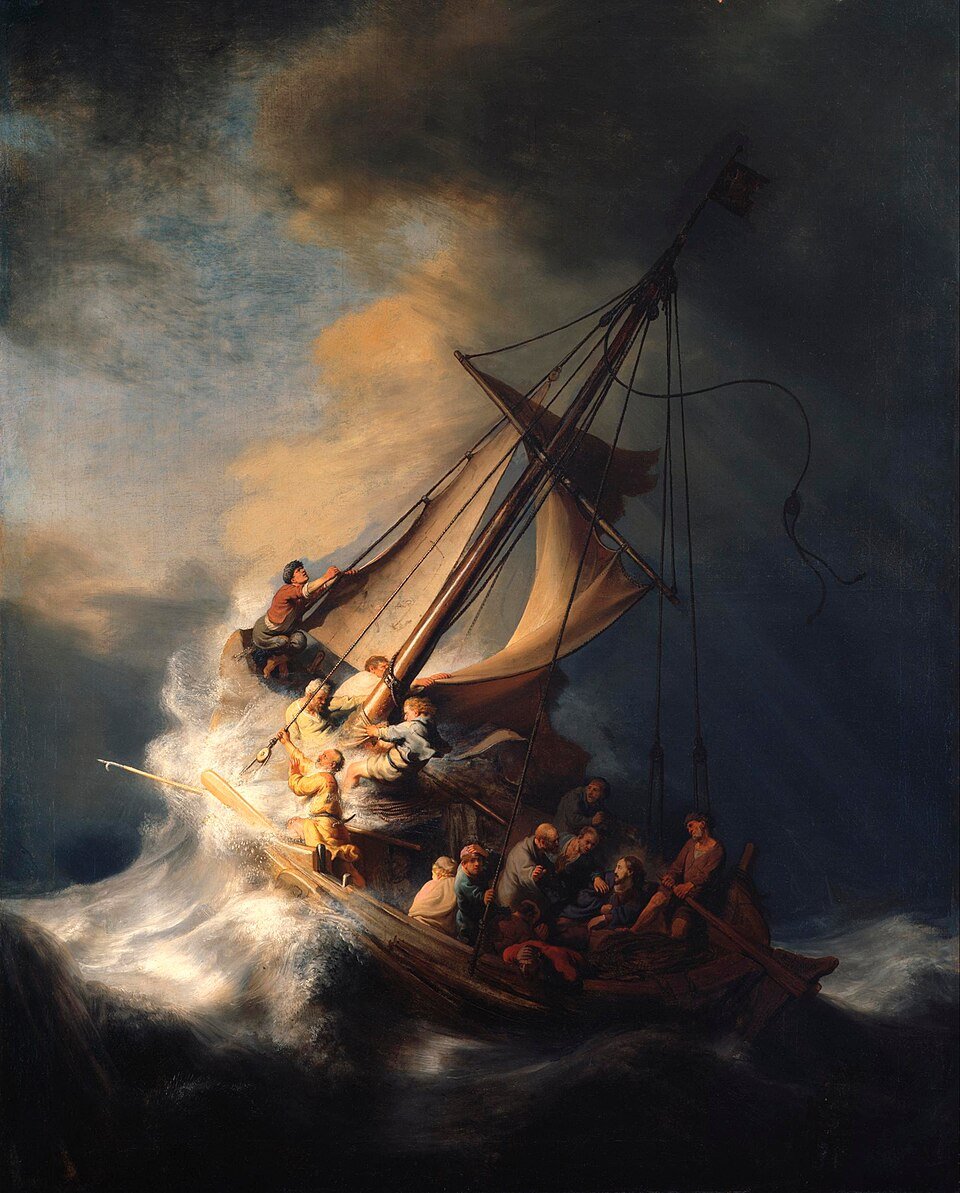
One of them was Rembrandt's The Storm on the Sea of Galilee.
Painted in 1633. The only seascape Rembrandt ever made. And he spent it on Mark chapter 4.
Look at what he painted.
A fishing boat tipped almost sideways. A wave breaking over the bow like a fist. The sail tearing loose. Men hauling on ropes that are winning against them. One disciple leaning over the rail, sick into the sea. Grown men. Fishermen. Men who had worked that water their whole lives, and their faces say they know this is the night it kills them.
And in the stern, in the one patch of calm light in the whole canvas, Jesus.
Asleep.
Mark 4:38. And he was in the hinder part of the ship, asleep on a pillow: and they awake him, and say unto him, Master, carest thou not that we perish?
Carest thou not?
That's not a question. That's an accusation. Screamed over wind by men who watched Him heal lepers a week earlier.
Now count the men in the boat.
Twelve disciples. Plus Jesus. That's thirteen.
Rembrandt painted fourteen.
Look at the middle of the boat. One man is holding the rigging with one hand and his cap with the other. He isn't fighting the sail. He isn't bailing water. He isn't looking at the wave, and he isn't looking at Christ.
He's looking straight out of the canvas. At you.
It's Rembrandt. He painted his own face into the storm.
A 27-year-old Dutchman put himself in a boat on the Sea of Galilee sixteen centuries after the fact, because he understood something most people miss when they read Mark 4.
This story doesn't have thirteen men in it.
It has every man in it.
You're in the boat. You've been in the boat. The night the phone rang. The diagnosis. The marriage taking on water faster than you can bail. Wind you didn't ask for and can't argue with. And the same accusation rising in your throat that rose in theirs:
Carest thou not that I perish?
And He stood up in the boat, and rebuked the wind, and said unto the sea, Peace, be still. And the wind ceased, and there was a great calm.
Then He turned to them and asked the question that should still sting:
Why are ye so fearful? How is it that ye have no faith?
Not: Why did you wake me? Not: Why are you in a storm?
Why are you afraid with Me in your boat?
The painting has never been found.
The FBI searched for decades. Ten-million-dollar reward. Nothing. Somewhere in the dark: a warehouse, an attic, a wall it was never meant to hang on, that storm is still frozen mid-wave. And the museum never replaced it.
The empty frame still hangs in the same spot on the same wall in Boston. It has hung there empty for thirty-six years. Waiting for what belongs in it to come home.
Sit with that.
Because that's God.
He doesn't take the frame down. He doesn't hang something else in your place. However long you've been missing, however dark the room they're keeping you in, the space you were made for is still on the wall.
Thieves can steal the painting.
Nobody has ever stolen the Man in it.
He's still in the stern of every boat that carries His people. And the storm still needs His permission.
Peace. Be still.
The Home Office leaflets educating migrants on topics like consent, women’s rights and child abuse is evidence to me that we are in the last stages of a failed experiment.
The mask is off. The pretence is gone.
The Government can no longer, pretend multiculturalism is a strength and simultaneously issue ‘do not rape’ literature to the members of those new cultures.
The British do not want this. In fact we explicitly stated multiple times across multiple General Elections we want the exact opposite.
This government is weak.
It has no great plan. No great mandate. No great lead in the polls.
Labour will ferret around with what little time they have in office. They will try to woo voters with mini trinkets knowing they can’t fix the fundamental issues Britain faces because their voter base and their back benchers won’t let them, and we, the British, will endure the last few years of this great migration betrayal.
Then. Change will come. Swiftly.
➡️Detain. Deport.
The “elites” want a slurry of brown NPCs, docile, interchangeable bodies that labor, consume, and obey without ever organizing or resisting.
Perfect cattle for the permanent managerial class.
That’s why they’re hell-bent on destroying White civilization.
We’re the only population left with the intelligence, historical memory, and residual solidarity to obstruct the project.
Everyone else is already soup.
Demographic replacement, cultural pathologization, and propaganda that paints White existence as original sin are the tools.
The brown horde itself is useless as any independent force: too low-IQ to reverse-engineer the systems they flood, too short-time-preference and consumer-addicted (phones, fast food, sportsball) to care about the long game.
They’re just raw material. The “elites” know it. We know it.
Only the trained useful idiots still call noticing this “hate.”
They need you afraid of the sun, so you'll stay covered through July, and go short of the one vitamin it was handing you for nothing.
They need you afraid of dirt, so you'll wipe every surface twice, and raise a generation that can't sit in a room with a peanut.
They need you afraid of hunger, so you'll eat every ninety minutes, and never once find out what your body does when it's left alone.
They need you afraid of the farm gate, so you'll drink milk heated twice and driven two hundred miles, and call the churn a mile away dangerous.
They need you afraid of the offal, so you'll take the lean fillet, and bin the only part of the animal carrying the vitamins.
They need you afraid of the dripping, so you'll pour it from a bottle instead, and buy that same fat back off a wellness brand in twenty years.
They need you afraid of the bone, so you'll drop in a stock cube, and feed your family salt and palm oil where a stockpot used to sit.
They need you afraid of the fat on your chop, so you'll trim it into the bin, and drink a shake at four to put the calories back.
They need you afraid of your own thirst, so you'll carry a bottle everywhere, and override the one system in your body that already had the answer.
They need you afraid of a number on a printout, so you'll take the tablet until you die, and never once get asked what you had for breakfast.
Every fear on that list is of something old, free and outdoors.
Sunlight. Dirt. Hunger. Fat. Bone. A cow down the road. None of it has a shareholder, a patent or a man on a salary whose job is to defend it. Everything you swapped it for has all three, and you have been paying the wages.
So stop. Stop apologising for wanting the fat. Stop flinching at the yolk. Stop treating the sun like an assailant and your own appetite like a fault to be managed.
You were not built by a laboratory. You were built by fire, weather, animals and hunger, and every one of those is still available to you, and none of them is for sale.
Go and get them back.
AN OPEN LETTER TO ANDY BURNHAM AND THE LABOUR TRAITORS
From the People You Were Elected to Serve
Andy. Read this carefully. Read it twice. Because the England you inherited is not the England you will leave behind, and the reckoning you cannot see is already gathering in kitchens, pubs, factory canteens, and farmyards across this country.
We are the people you dismissed. The ones your focus groups labelled "left behind." The ones your candidates were coached to avoid mentioning by name. We built this country. We defended it. We buried our fathers in its soil. And we have watched, in silence, as you and your party have conducted the most systematic betrayal of a native population in modern European history.
The silence ends now.
On the charge of open borders. You inherited the Rwanda deterrent. You destroyed it in your first weeks. Since then over 30,000 Iranians have arrived by small boat. The Telegraph confirmed the IRGC, a terrorist organisation your own government proscribed, now owns the trafficking routes into Britain. Iranian intelligence operatives have been intercepted. The National Crime Agency confirms lorries move migrants in and out of the country like a logistics depot. You call this humanitarianism. We call it treason.
On the charge of two-tier justice. Lucy Connolly received 31 months in prison for a deleted tweet. Rapists and paedophiles have received shorter sentences. Peter Lynch died in his cell. Labour councillor Ricky Jones, filmed calling for throats to be cut, walked free. Henry Nowak was stabbed to death by Vickrum Digwa and handcuffed by police as he bled out because his killer cried racism first. You have built two systems of justice: one for the natives, one for everyone else. And your judges cite "diversity and inclusion" from the bench as they hand down the sentences.
On the charge of grooming gang cover-up. Rotherham. Rochdale. Telford. Oldham. Bradford. Sunderland. Your councils buried the reports. Your MPs blocked the inquiries. Your party protected the perpetrators because the electoral maths required it. Bridget Phillipson tweets about wildfires whilst her department reviews CSE data from her own constituency. Thousands of British girls raped, and you have the audacity to lecture us about "Islamophobia."
On the charge of economic destruction. Britain now pays the highest industrial electricity prices in the developed world. 63% higher than France. 27% higher than Germany. One in ten factories faces closure. Miliband's net zero fantasy will cost £125 billion this decade. You are deindustrialising the nation that industrialised the world, and you call it progress. The pensioners you stripped of winter fuel payments freeze whilst you subsidise hotels for men of fighting age from countries we do not recognise.
On the charge of housing displacement. You imported the demand. You accelerated the family reunion scheme from 4,300 to 20,600 in eighteen months before suspending it when the numbers became visible. Now you propose to concrete over the green belt to house the population you should never have admitted. British children are priced out of the villages their grandfathers were born in. This is not a housing crisis. This is a population transfer.
On the charge of speech suppression. Graham Linehan was arrested at an airport for a tweet. Non-Crime Hate Incidents were only scrapped after international humiliation. Bank accounts closed for wrong opinions. Fathers arrested at their doors for social media posts whilst grooming gangs operated openly for decades. You have criminalised dissent whilst decriminalising invasion.
Now hear this, Andy. And every Labour MP reading over your shoulder.
You believe you are safe because we have been quiet. You have mistaken our restraint for consent. You have confused our patience for approval. You have watched us bury our dead, watch our daughters violated, watch our industries collapse, watch our borders dissolve, and you concluded we would never wake.
We are awake now.
Look at Brussels. Look at the tractors. Look at the farmers who decided they had nothing left to lose. Look at eight thousand men in one city bringing the EU to a standstill because Mercosur and CAP cuts were the final indignity. That is what happens when producers realise their governments have declared war on them.
England is next. And it will not be tractors.
It will be the pubs where the conversation is already happening. It will be the WhatsApp groups your surveillance state cannot fully monitor. It will be the workmen and the fishermen and the farmers and the veterans and the mothers whose daughters were failed. It will be the millions who voted Brexit and were betrayed. The millions who voted Reform and are watching. The millions who have not voted in years because they saw no point, and who are about to discover the point.
You have one opportunity. One. To stop the boats, not with speeches but with force. To open every grooming gang file. To end the two-tier justice. To restore the deterrent. To close the borders. To put British families first in the country their ancestors built.
If you refuse, if you continue this managed decline, if you continue to hide behind bus timetables and breakfast clubs whilst the nation is dismantled around you, then understand this:
You will not be forgiven. You will not be forgotten. And you will not remain.
Listen now. Or we make you listen.
The conversation is happening. The mood is turning. The patience is spent.
England is watching. England is remembering. England is coming.
Signed, the people you were elected to serve.
The ones you thought would never speak.
The ones you are about to hear from.
Three traps of the devil that you fall into every day. You will notice them yourself now.
The first is fear of the past: mistakes, sins, grievances.
The second is fear of the future: what will happen tomorrow, what will people think, and what if everything collapses?
The third is ingratitude to God for the present. This is where despair begins: anxiety, panic, fear of acting.
How to get out?
The past: the devil brings you back to old sins and whispers: "God will not forgive you." And a person believes not in God's mercy, but in this whisper. This is no longer repentance, but disbelief. The saints simply said: if you have sinned, stop, repent, and move on. The Lord is waiting for you to rise.
The future: the devil wants you to go through terrible scenarios and get tired in advance, so that you do not pray and do not come to God. But it is said: do not worry about tomorrow. The future is not here yet, and fear is already stealing today.
The present is the most dangerous trap: we do not thank God for what we have. The past is no longer there, the future is not yet there, and the present is the only thing we have: this morning, the sky, the roof, food, life. You wake up — and you already have something to say: praise be to God.
All three traps converge in one — in despair. It diverts you from prayer, from work, from loved ones. It speaks of the past: "You can't fix anything." Of the future: "You won't succeed." And it paralyzes you now.
But we have a weapon — as the elder Anatoly of Optina taught: the Jesus Prayer. Lord Jesus Christ, have mercy on me, a sinner.
It returns you to God — not to the past or to the fear of the future, but here, to the present.Repent for the past. Trust in God for the future. For today — be thankful.
And stand up. And go on. And fear nothing.
"In the last days, a true, seasoned saint of God who walks with God is more anointed than any other person in Church history. You know why? The ONLY way you and I will stay faithful in these last days is by the power of the Spirit of God. It will be that wicked. It will be so vile, wretched, awful and hard to stay right with God, it will have to be the power of the Spirit of God." - Pastor Tyler Gauldin
I daresay that in these days, if you are not feeling totally out of step with culture, if you are not sickened daily at what you see and hear and feel TOTALLY out of place, you are not walking in step with God and are being deceived.