#1 ⚠️ How close are today’s AIs to actually managing network systems for us?
Spoiler: not close enough.
Even the best agent in NetPress scores under 40% accuracy — and often makes unsafe actions. 👀
Introducing Constrained creativity.
TL;DR: Constraining an ops agent's action space makes it explainable and cost-effective, without hurting accuracy.
AI agents hold promise to automate systems operations. However, it's the engineers who stay accountable for every change, and they need explainability to trust the agent.
By and large, an ops agent needs to come up with pipelines that are:
• Effective: right answers, even on incidents it has not seen
• Efficient: keeps pace with alert volume, at a reasonable cost
• Explainable: an evidence trail an engineer can check
An LLM writing free-form code might reach the right answer, but its work is hard to check and its exploration and thinking keep burning tokens.
Our pitch: constrained creativity. Give the agent only as much freedom as the task needs, and let it be creative inside those limits. More room than a fixed playbook. Far less than arbitrary code.
But doesn't this sound backwards? Shouldn't an agent facing new cases get unlimited freedom? History has plenty of counterexamples. Jazz improvisers create inside fixed chord changes. Dr. Seuss wrote Green Eggs and Ham on a bet to use only 50 words. So much so that a 2017 psychology study found the same pattern and named it the Green Eggs and Ham hypothesis: constraints help creativity.
Recent agent systems already apply this idea implicitly:
• Jev (TypeSafe) and OpenAI's Decisions API: the model returns a typed choice, score, or yes/no
• CaMeL (Google DeepMind): the agent writes restricted Python that a policy checker runs
• Grammar-constrained decoding: output must parse
On similar lines, we propose giving ops agents a domain-specific language (DSL) and letting them be creative inside it.
The results? Up to 12x cheaper root cause analysis without losing accuracy, and red-teaming agents that finish multistage attacks free-form LLMs could not.
With @vipulharsh93@LesleyChou339@MarkoMorrisonX@badityap@vyas_sekar@HuiConviva001
👇 Paper, blog, and how it works for RCA in the replies
🎯 AIChilles uncovers hidden weaknesses in AI-evolved programs
[ADRS Blog #24] We feature AIChilles, an automated framework that finds valid workloads where AI-evolved programs regress in correctness, runtime, memory, or output quality. Across 30 evolved programs, AIChilles uncovers 49 distinct hidden weaknesses—revealing that large benchmark gains may not hold on unseen workloads.
✍️ Read the blog: https://t.co/msW5IwTPBf
📖 ADRS Blog Series: https://t.co/UxujLFWX8b
📄 AIChilles Paper: https://t.co/JarlvdBnbL
👩💻 AIChilles Code: https://t.co/QtsRD4uKI4
🏠 Project Page: https://t.co/kACdqKnn9X
🎯 AIChilles uncovers hidden weaknesses in AI-evolved programs
[ADRS Blog #24] We feature AIChilles, an automated framework that finds valid workloads where AI-evolved programs regress in correctness, runtime, memory, or output quality. Across 30 evolved programs, AIChilles uncovers 49 distinct hidden weaknesses—revealing that large benchmark gains may not hold on unseen workloads.
✍️ Read the blog: https://t.co/msW5IwTPBf
📖 ADRS Blog Series: https://t.co/UxujLFWX8b
📄 AIChilles Paper: https://t.co/JarlvdBnbL
👩���� AIChilles Code: https://t.co/QtsRD4uKI4
🏠 Project Page: https://t.co/kACdqKnn9X
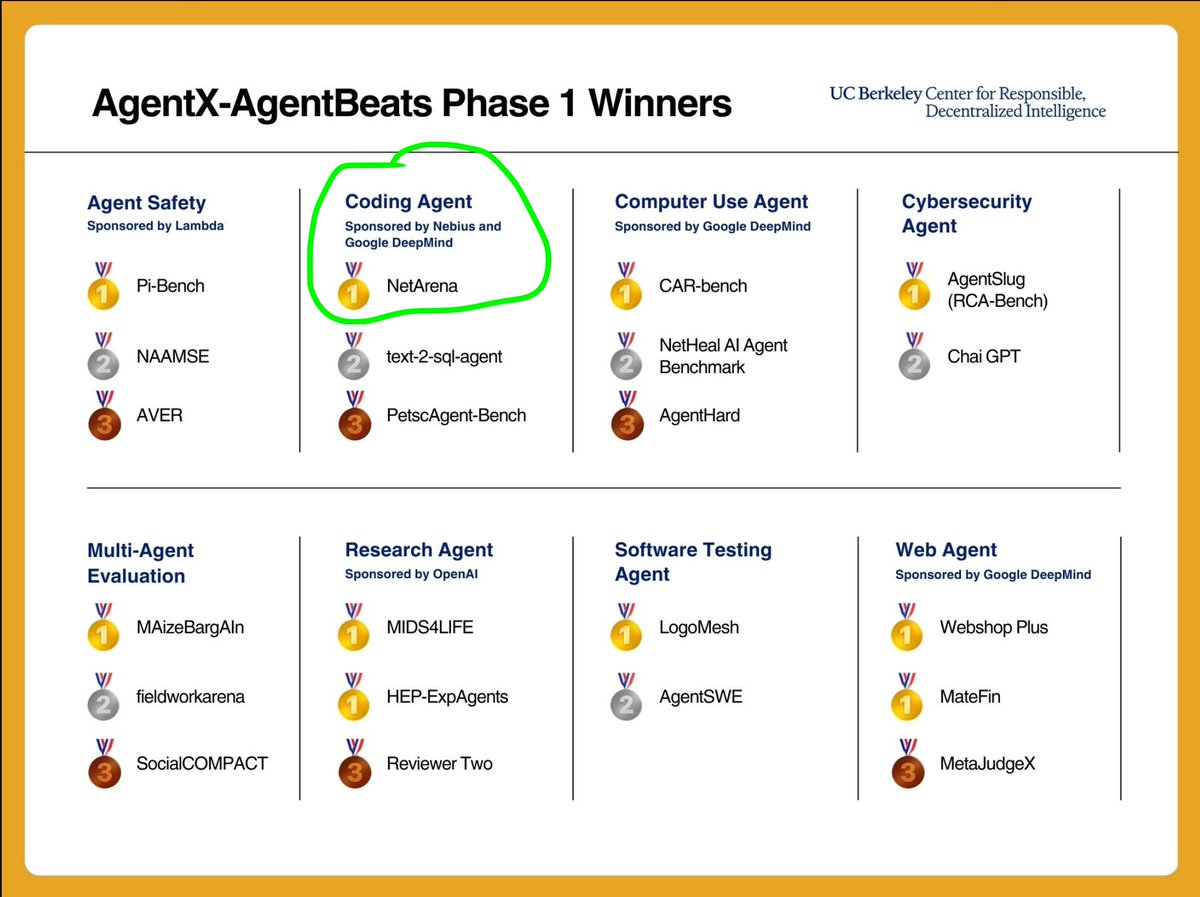
Very proud to share that our dynamic benchmark NetArena wins 1st place on “Coding Agent” in Berkeley’s AgentX competition (out of 1,300+ registrations)! https://t.co/wN3JQHpmd5
Ref:
- Github: https://t.co/YPB9n2BirY
- Paper [ICLR'26]: https://t.co/J0EhGiaxY0
#AgentX#AgentBeats
Very proud to share that our dynamic benchmark NetArena wins 1st place on “Coding Agent” in Berkeley’s AgentX competition (out of 1,300+ registrations)! https://t.co/wN3JQHpmd5
Ref:
- Github: https://t.co/YPB9n2BirY
- Paper [ICLR'26]: https://t.co/J0EhGiaxY0
#AgentX#AgentBeats
#1 ⚠️ How close are today’s AIs to actually managing network systems for us?
Spoiler: not close enough.
Even the best agent in NetPress scores under 40% accuracy — and often makes unsafe actions. 👀
🙌 We welcome your contributions, feedback, and retweets ❤️ to help grow the AI + Networking community!
More exciting agent results and applications are coming soon — stay tuned.
“The HotNets ‘25 reviewing process will focus on positive arguments to accept papers, rather than on flaws and reasons to reject.” —📢📢 Submit your cool ideas that make people curious about new problem domains or techniques, spark a debate, or maybe even change some minds.
📢📢 Submit your cool ideas to HotNets. This year’s HotNets will be hosted at College Park, MD on Nov. I will be the general chair. @BrightenGodfrey and Barath Raghavan are PC chairs.
The deadline is 7/1 AoE:
https://t.co/TV2XnJbF0G
Submit your ideas and come visit us!
Honored to receive the Outstanding Paper Award for Autothrottle at NSDI '24! Congratulations to everyone involved in this project: our stellar students, Zibo Wang and Pinghe Li, as well as my longtime collaborator Mike Liang. We are elated by this recognition and can't wait to discuss it with everyone interested in this topic. @MSFTResearch@usenix
Autothrottle summary:
As cloud applications increasingly adopt microservices, resource managers face two distinct levels of system behavior: end-to-end application latency and per-service resource usage. To coordinate them, we introduce Autothrottle, a bi-level resource management framework for microservices with latency service-level objectives (SLOs). Autothrottle employs an application-wide learning-based controller to periodically set performance targets—expressed as CPU throttle ratios—for per-service heuristic controllers to achieve. When tested using production workloads, Autothrottle demonstrated higher CPU savings and fewer SLO violations than the best performing baseline from Kubernetes.
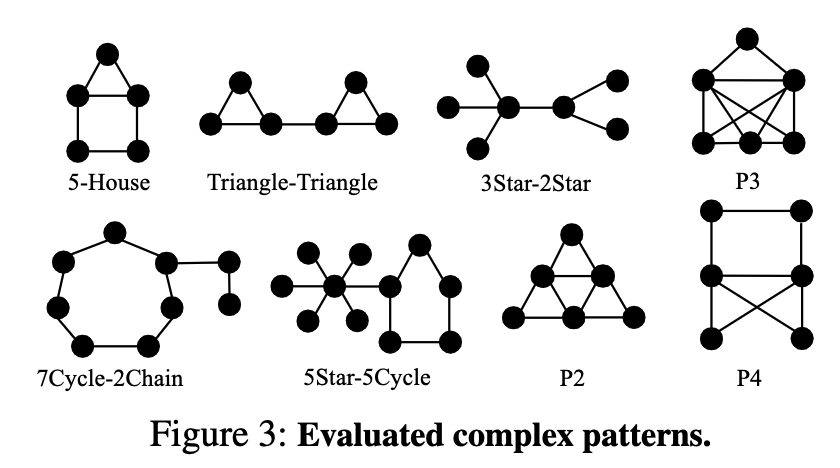
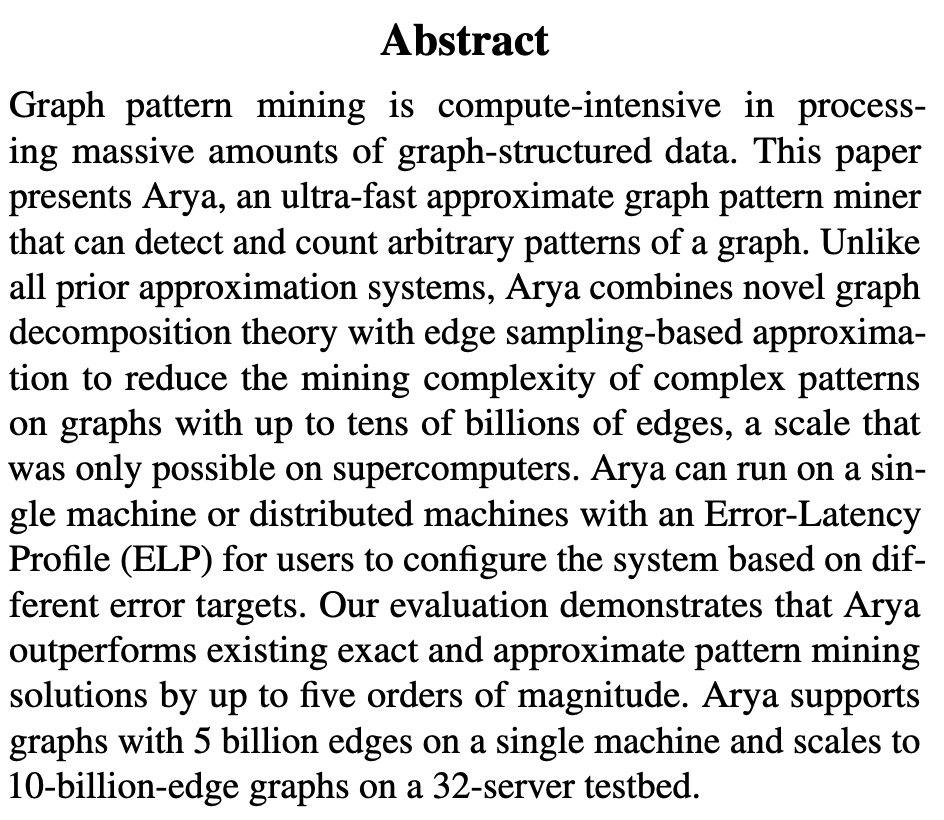
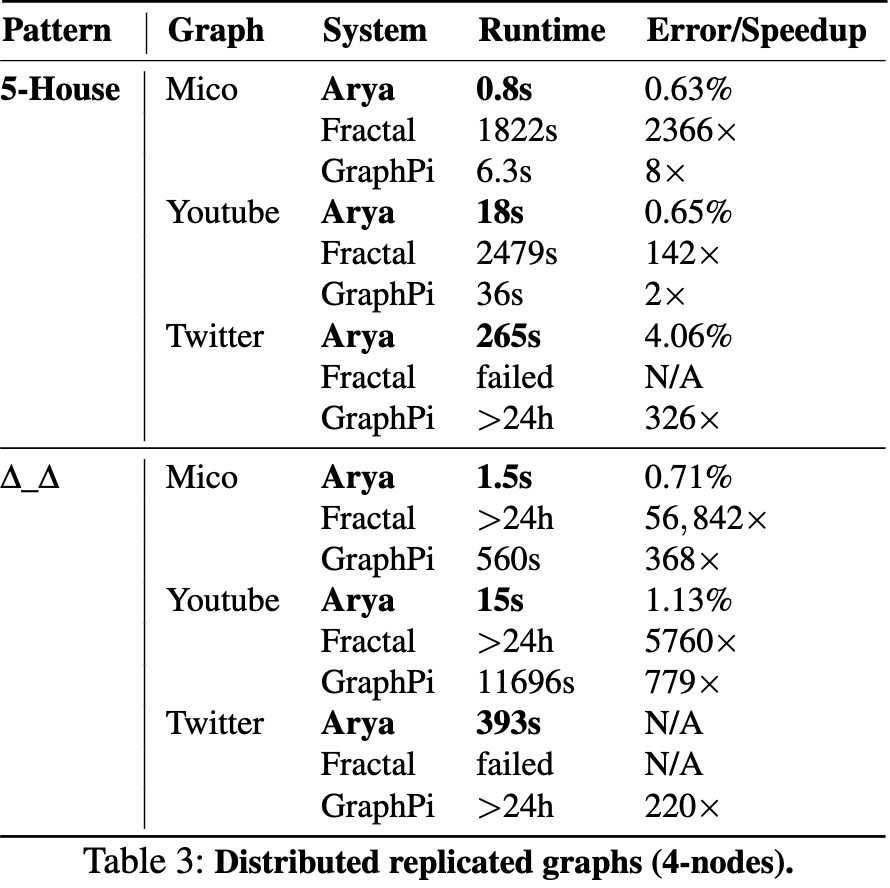
Our 1st upcoming NSDI paper is approximate graph mining, led by @zeying_zhu. Even w/ specialized abstractions and optimizations, finding arbitrary patterns in graphs is challenging (NP-complete). Our system, Arya, enables mining arbitrary patterns with approximation techniques.
@FrancisYan_ omg can't believe I just saw your tweet. Very much appreciate Francis!!! Alan and I are thinking of a new proposal. I will probably reach out to you for summer intern once we have the idea more shaped :)