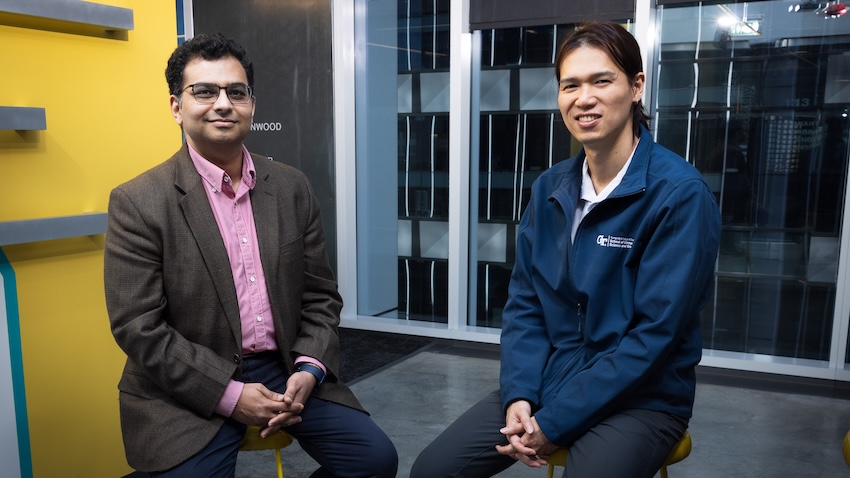
"Ultimately, this advances precision medicine and ensures equitable healthcare access for diverse populations," said CSE Asst. Prof. Kai Wang (@kaiwang_gua)
Check out how multi-armed #AI models are helping doctors improve diabetes treatment! 🔗👇
📰: https://t.co/YX14fDfidw
@RamaswmySridhar I'd add a fourth indicator: How much revenue ultimately comes from independent end customers rather than financial relationships within the AI ecosystem?
How can AI help make chronic disease care more personalized? 🤖🏥
CSE researchers Kai Wang and B. Aditya Prakash are using a $1.2M @NIH R01 grant to build #AI models that help guide interventions for people with Type 2 diabetes! Find out how in the 🔗👇
https://t.co/YX14fDfQ34
Introducing Constrained creativity.
TL;DR: Constraining an ops agent's action space makes it explainable and cost-effective, without hurting accuracy.
AI agents hold promise to automate systems operations. However, it's the engineers who stay accountable for every change, and they need explainability to trust the agent.
By and large, an ops agent needs to come up with pipelines that are:
• Effective: right answers, even on incidents it has not seen
• Efficient: keeps pace with alert volume, at a reasonable cost
• Explainable: an evidence trail an engineer can check
An LLM writing free-form code might reach the right answer, but its work is hard to check and its exploration and thinking keep burning tokens.
Our pitch: constrained creativity. Give the agent only as much freedom as the task needs, and let it be creative inside those limits. More room than a fixed playbook. Far less than arbitrary code.
But doesn't this sound backwards? Shouldn't an agent facing new cases get unlimited freedom? History has plenty of counterexamples. Jazz improvisers create inside fixed chord changes. Dr. Seuss wrote Green Eggs and Ham on a bet to use only 50 words. So much so that a 2017 psychology study found the same pattern and named it the Green Eggs and Ham hypothesis: constraints help creativity.
Recent agent systems already apply this idea implicitly:
• Jev (TypeSafe) and OpenAI's Decisions API: the model returns a typed choice, score, or yes/no
• CaMeL (Google DeepMind): the agent writes restricted Python that a policy checker runs
• Grammar-constrained decoding: output must parse
On similar lines, we propose giving ops agents a domain-specific language (DSL) and letting them be creative inside it.
The results? Up to 12x cheaper root cause analysis without losing accuracy, and red-teaming agents that finish multistage attacks free-form LLMs could not.
With @vipulharsh93@LesleyChou339@MarkoMorrisonX@badityap@vyas_sekar@HuiConviva001
👇 Paper, blog, and how it works for RCA in the replies
@mattpocockuk@poteto@mattpocockuk could not agree more! in many threads our work in computer systems, we find an emergent paradigm of "constrained creativity" that giving high level abstractions to agents is actually more efficient and accurate! https://t.co/TfbFgwWhvy
A lot of time-series work stops at model accuracy. In the real world, that’s often where the hard part begins.
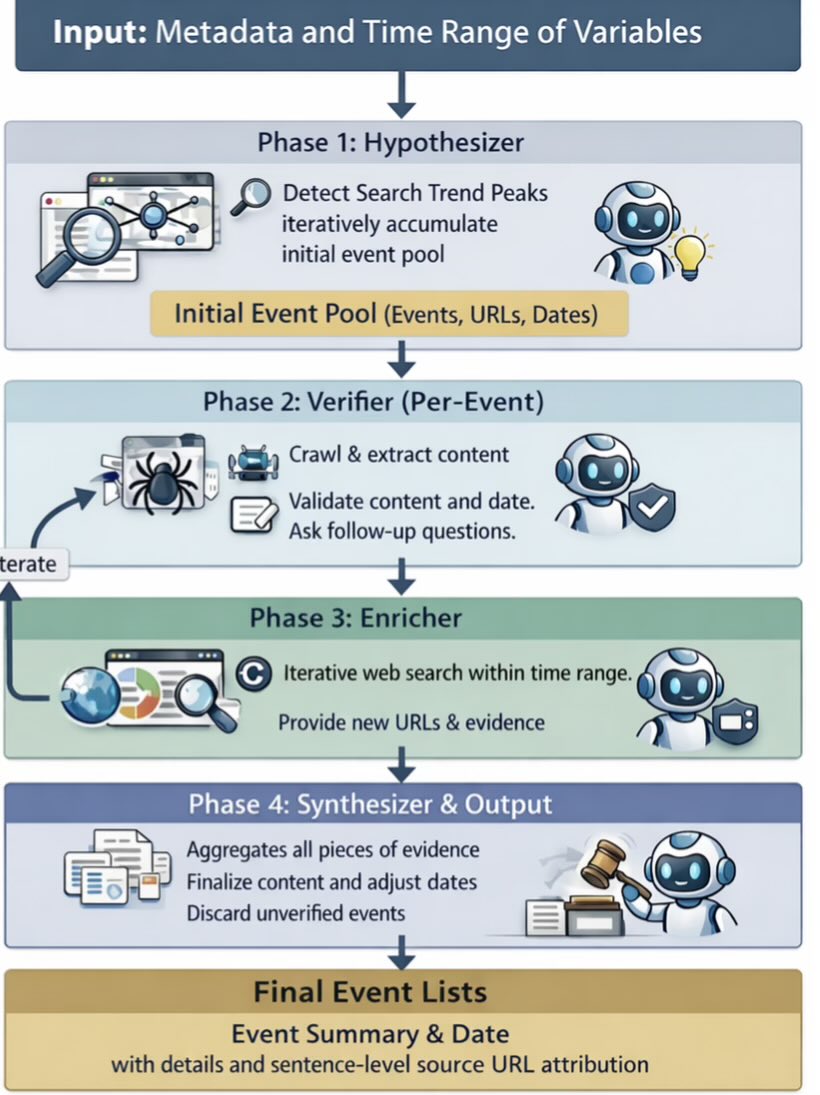
Data arrives continuously, systems change, configurations change, and weeks later you want to ask: what would have happened if we had done something differently?
Our #KDD2026 paper AHA tackles this “alternative history” problem for operational time series. 🧵
I’ll miss beautiful Jeju next week, but check out our work on building operational time series applications at real time scale (interesting ‘aha’ problem we call alternative history analysis w @conviva@CarnegieMellon led by @Harsha_64, Sayan) & @EpidamikW aI+public health event!
See you next week at #KDD2026!
Congratulations to CSE faculty B. Aditya Prakash, Kai Wang, and Xiuwei Zhang, along with their students, alumni, and collaborators presenting the latest advances in data mining and knowledge discovery! 🥳
Details: 🧵👇
Come to our poster @icmlconf from 10:30am today on rethinking multimodal time series model evaluation from the ground up! Work led by @gtcomputing PhD student @HessianLiu and from @GoogleResearch Rajat Sen, Yichen Zhou and Abhimanyu Das. @mlatgt@GTCSE
https://t.co/xFe3rKCD5O
We received several requests for additional time, so we are extending the deadline to May 20.
Excited to see your submissions!
#KDD2026#DataScience#AI#PublicHealth
4. April 26, Sunday, 9am.
Rethinking Multimodal Time-Series Forecasting Evaluation
Work led by Haoxin Liu, Yichen Zhou, Rajat Sen, Abhimanyu Das. @GoogleResearch
Paper: https://t.co/8iz5QyFzbJ
3. April 25, Saturday, 10:30am-1pm. P3-1317.
Tackling Time-Series Forecasting Generalization via Mitigating Concept Drift
Work led by Zhiyuan Zhao and Haoxin Liu
Paper: https://t.co/hcDE8kj3ya Code: https://t.co/HeUzmATBO8
Improve forecasting generalization under concept drift.
2. April 24, 3:15-5:45pm TimeRecipe: A Time-Series Forecasting Recipe via Benchmarking Module-Level Effectiveness. Work led by Zhiyuan Zhao. Paper: https://t.co/G30H6nXoaK
Code: https://t.co/77GdOKlVnS
Practical 'recipes' for building good forecasting models for new data.
1. April 24, 10:30am - 1pm. Beyond Magic Words: Sharpness-Aware Prompt Evolving for Robust Large Language Models with TARE. Work led by Guangchen Wan and Lucheng Fu. Paper: https://t.co/HElS2cKwpj SOTA derivative free frameworks for prompt evolving.
In beautiful Rio @iclr_conf till April 28. Have 4 papers on topics ranging from AI for time-series, prompt evolution, and multi-modality. Happy to chat about these, how to build the future of the generalized time-series intelligence stack, or anything else under the sun! @GTCSE
In beautiful Rio @iclr_conf till April 28. Have 4 papers on topics ranging from AI for time-series, prompt evolution, and multi-modality. Happy to chat about these, how to build the future of the generalized time-series intelligence stack, or anything else under the sun! @GTCSE
4. April 26, Sunday, 9am.
Rethinking Multimodal Time-Series Forecasting Evaluation
Work led by Haoxin Liu, Yichen Zhou, Rajat Sen, Abhimanyu Das. @GoogleResearch
Paper: https://t.co/8iz5QyFzbJ