'The Skukuza Regional Court has scheduled May 28 and 29 for the continuation of the long-running rhino poaching trial involving former KNP ranger Rodney Landela and former State Veterinary employee Kenneth Motshotsho.' #RhinoPoaching
https://t.co/AsBeagxwGP
Hi everyone be part of the change. This govt has no idea about how to solve anything as far as I can see. Give them a hand and respond to the consultation link below. Well done @HuntSabs 👏👏👏
Africa Day 2026. Africa is full of talented, motivated, insightful, and hard working people. Leaders. I am very honoured that the charity I co-founded - The Born Free Foundation - is lucky enough to employ 100+ such individuals. They help make us who we are. W @bornfreeFDN
For all the milk and medicine, sometimes their new family can make the difference in survival for the orphans in our care.
Take our newest orphan to adopt, Wangalla. Like many others, she struggled during teething. But she had fight in her, and we weren't going to give up. Greens also help, as they help bolster a calf’s biome and provide vital nutrients. But not every orphan is willing to start greens early, no matter how they’re presented.
When Wangalla resisted greens, Misheck turned it into a ritual. Framed by the setting sun, he would pull his chair outside her stable, armed with a bushel of fresh greens. One by one, he would pluck every leaf off the branches, selecting only the best. Then, he would hand-feed each individual leaf to Wangalla. At first, we celebrated when she relented to eat two or three. As the days and weeks passed, she developed a voracious appetite for greens — provided they were hand-presented by Misheck!
Now you can play a part in Wangalla's recovery by adopting her: https://t.co/loS0hJV6JZ
🌎
This is an orphaned Amazonian manatee—rescued frightened, dehydrated, and suffering severe sunburn after illegal hunters had brutally harpooned her mother.
She was airlifted 620 miles to the nearest care facility in Brazil, where the long road to recovery begins.
Caring for orphans like her is an extraordinary commitment. Staff work 15-day stints, feeding her three times a day and cleaning the pool every 48 hours—for two years.
Rising temperatures and drought mean river water is shallower — making it easier for hunters to find the defenseless animals, and leaving them no escape from the sun's searing heat.
Their future depends on water temperatures remaining within their thermal limits, and education programs to teach local children that to save the species, they must become manatee guardians, not their exterminators.
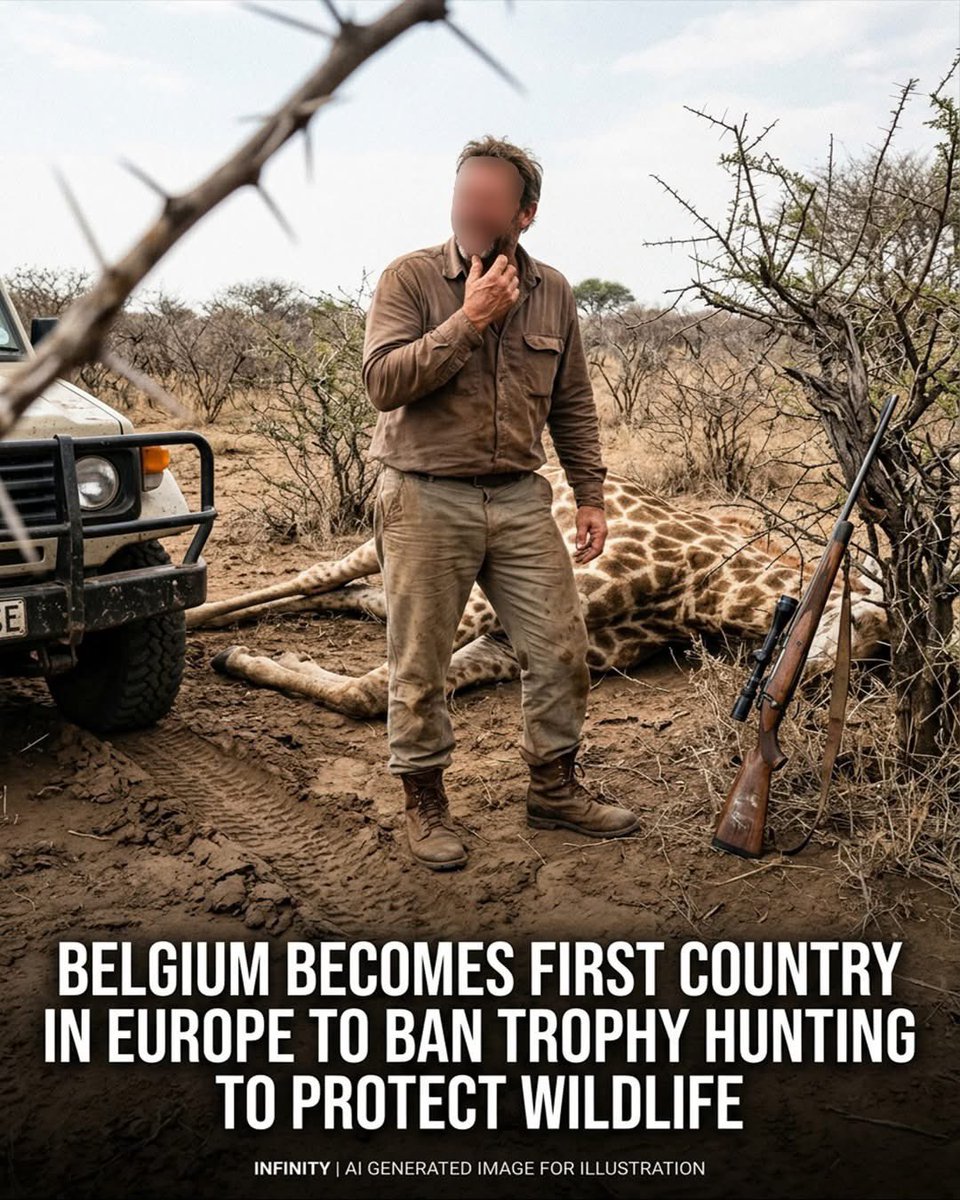
Well done Belgium 🇧🇪.
In late January 2024, Belgium's Parliament voted unanimously to ban the import of hunting trophies from endangered and threatened species. The vote reflected public opinion: 91 percent of Belgians oppose trophy hunting and 88 percent supported the ban.
Belgium's own Environment Minister was candid about the law's limits: "It's a political signal." Import licences could still be issued by other EU countries — and from 2014 to 2022, only around 500 out of 25,000 trophies imported across the EU entered through Belgium.
On December 18, 2025, Belgium's Constitutional Court upheld the law, rejecting a legal challenge and confirming protections for elephants, lions, rhinos, and dozens of other at-risk species. The law now stands on firm legal ground.
At the same time, South Africa — one of the world's largest trophy hunting destinations — has moved in the opposite direction, reopening its doors to trophy hunters as Belgium was closing its own.
An EU-wide import ban has not materialized. The European Parliament called for one in October 2022. Nothing has happened since. Loopholes in existing EU law still allow trophies to enter as "personal items" with the right permits.
Belgium's ban holds. The EU-wide gap does not.
Sources:
Humane World for Animals: Belgium bans the import of hunting trophies
Species Unite: While Belgium Protects Wildlife, South Africa Opens the Door
World Animal News: Victory — Belgium Bans Trophy Hunting Imports
🐝 Happy World Bee Day!
Today we celebrate the incredible bees that are essential to the health of our planet and ecosystems.
This year’s theme, “Bee Together for People and the Planet - A partnership that sustains us all,” highlights the powerful connection between humans and bees, working together to support people and the environment.
In Meru National Park, Kenya, bees are doing far more than pollinating crops and producing honey - they also help protect wild elephants. Through Born Free’s beehive fence project, we’ve supported local farmers in installing beehives around their farms - a natural and effective way to deter elephants, who instinctively avoid bees.
The result? Crops are protected, farmers feel safer, retaliation against elephants is reduced, and communities can coexist more peacefully with wildlife.
The project also creates sustainable income through honey production and encourages farmers to grow a greater diversity of plants, supporting both bee populations and habitat restoration.
What a perfect example of nature, people, and wildlife working together! 🐘🐝
Tigers should not be kept in captivity for so called entertainment. It’s terribly cruel & poses a major public safety risk should they escape the enclosure
A TIGER on the loose sparked terror after it mauled a 73-year-old man before being hunted down and shot dead by armed police.
The fully grown predator broke free from its enclosure at a controversial private facility near Leipzig, releasing chaos as it rampaged towards nearby allotment gardens.
'Willie Aucamp, has unveiled a new national plan to safeguard South Africa’s rhinos, positioning conservation as both an ecological and economic project and signalling a shift toward broader public and private participation in protecting the species.'
https://t.co/Qzu3WQ4W25
Please RePost this far and wide. And whose voice is it right at the end? Let me know who you think it is! Happy Sunday - and good luck to all our wonderful @LondonMarathon runners today! Thank you. @BornFreeFDN Wx