Before deploying a backported fix, ask: which package changed, what build produced it, how do you roll back, and when do you return to upstream?
Echo's compatibility and timing claims are company-reported; LDS did not test a patch.
A security patch can stop the exploit you tested and still leave the flaw open.
In an LDS Exclusive, @Follow_our_Echo security researcher Yuval Saggie explains what a fix must prove before you trust it, sometimes before a CVE number exists.
https://t.co/Ib8v02YlH9
Key points:
• Reproduce the original failure first, then test the fix against it.
• He describes a patch that blocked the exploit while a modified input could still crash an app.
• Two public OpenEXR advisories credit his findings and still list no CVE ID.
His rule of thumb: code helps once the evidence exceeds a single read or the answer runs past a few dozen rows.
Caveats: Nimble picked the 50 tasks, ran each setting once, and the interview doesn't name the model. Results are company-reported; LDS did not rerun them.
In Nimble's test, two web agents had the same Python data. One stopped at 153 of 375 rows after 13 minutes. The other wrote code and got all 375 in 90 seconds.
In an LDS Exclusive, @nimble_search's Yuval Bertocchi explains when agents should run code.
https://t.co/CwdznJ0ugE
Key points:
• Both had the full feed within about 30s; the gap came after retrieval.
• "The model never retyped a row; it handed the output files over."
• Over 50 tasks, LLM spend fell from $7.78 to $4.52 (tokens only).
• About 97% of returned rows were correct either way.
Free to play, no purchase necessary. 18+, one account per person, open worldwide where lawful. Winner reviewed for fair play. If Claude Max can't be redeemed where you live, the prize is US$100 cash.
Funded by Let's Data Science. Not sponsored by or affiliated with Anthropic.
The prize is Claude Max. The catch: no Claude, or any AI, while you play.
Four free AI news games, one October leaderboard. Top player wins a month of Claude Max 5x (US$100 value).
Under 10 days left. Leader: 580 points. Over 3,000 still in play.
https://t.co/7uPFohS5Nv
How it works:
1) AI News Quiz, daily
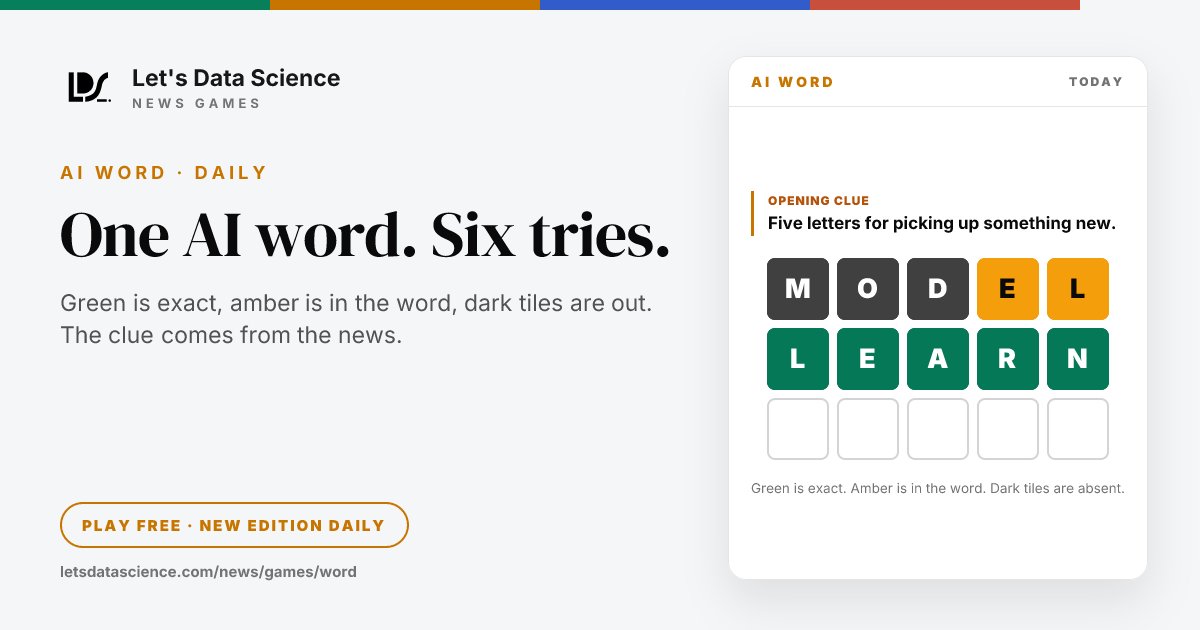
2) AI Word, daily
3) AI Mini crossword, daily
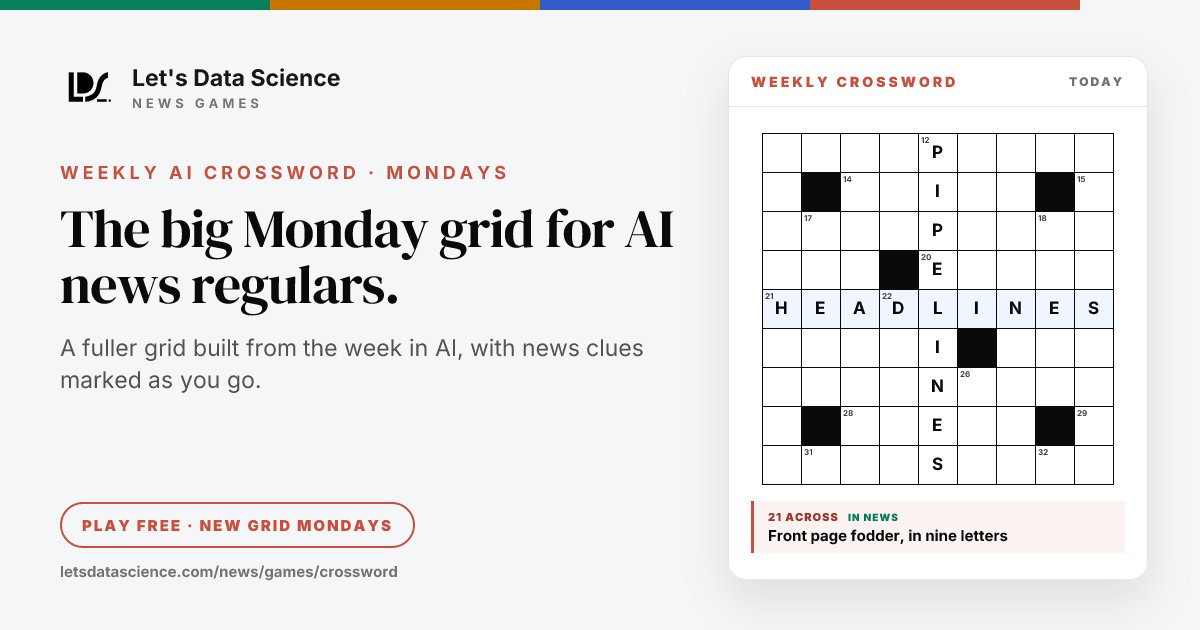
4) Weekly AI Crossword, Mondays
Up to 100 points per edition, all added up. Free account needed; guest play doesn't count. First attempt only, no hints.
Rules: https://t.co/Y5Po9XyOxv
95% accuracy, zero positives found. In this synthetic 100-case example, always predicting negative misses all five positives. Put the confusion matrix in your ML portfolio.
https://t.co/dQYRNDgpUU #DataScience
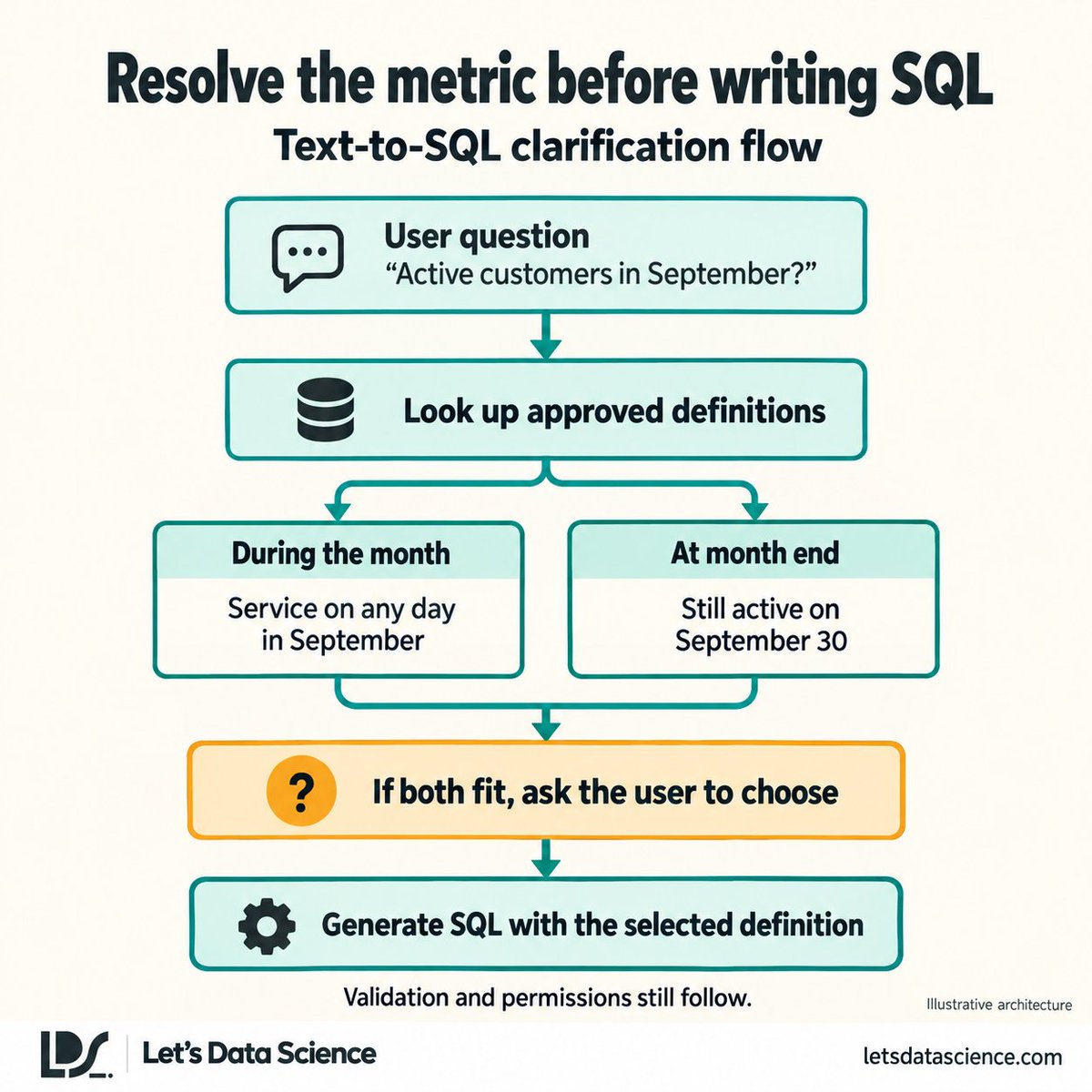
"Active in September" can mean any service during the month or still active on September 30. An AI analyst should resolve that choice before writing SQL.
https://t.co/1AmMH1hqEu #DataScience
Google is adding Gemini scam checks and copied-command warnings to Chrome Enhanced Protection. The server-side model runs when defined scam signals trigger.
https://t.co/sLBEWMGsSq
#DataScience
One $100 order, two line items, a $200 sum. The join repeated an order-level measure at item grain. Add a before/after total check to your analytics engineering portfolio.
https://t.co/eJXqx0ae6n #DataScience
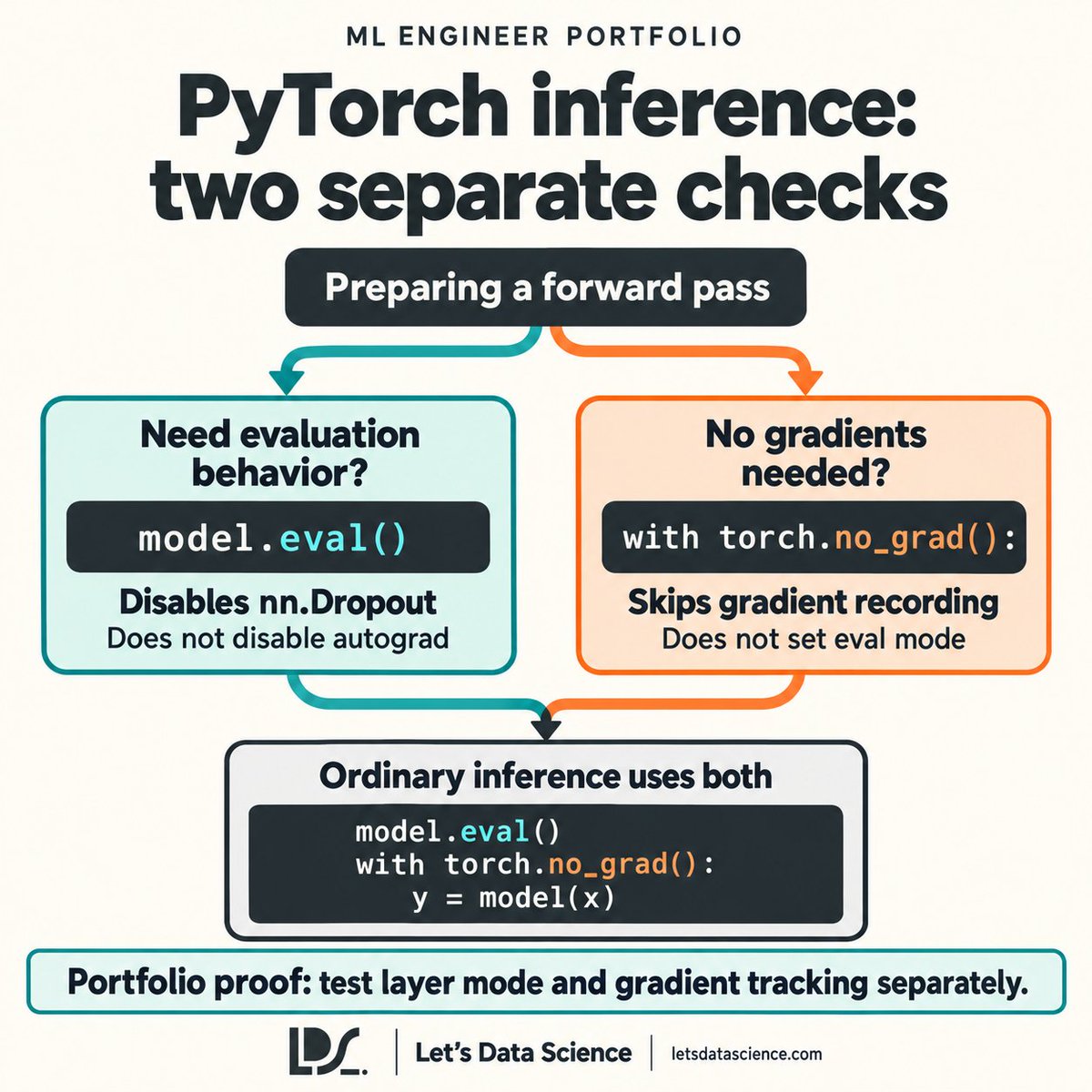
model.eval() does not turn off autograd. https://t.co/Y7tuE148Cr_grad() does not turn off nn.Dropout. Test both controls in your ML serving portfolio.
https://t.co/OJFmrkliaW
#DataScience
Meta says phase one of Prometheus is complete. Its Ohio AI cluster is scaling toward roughly 1 million GPUs, with over 85% pre-training goodput reported on Muse runs.
https://t.co/Fo3P6UrdPv
#DataScience
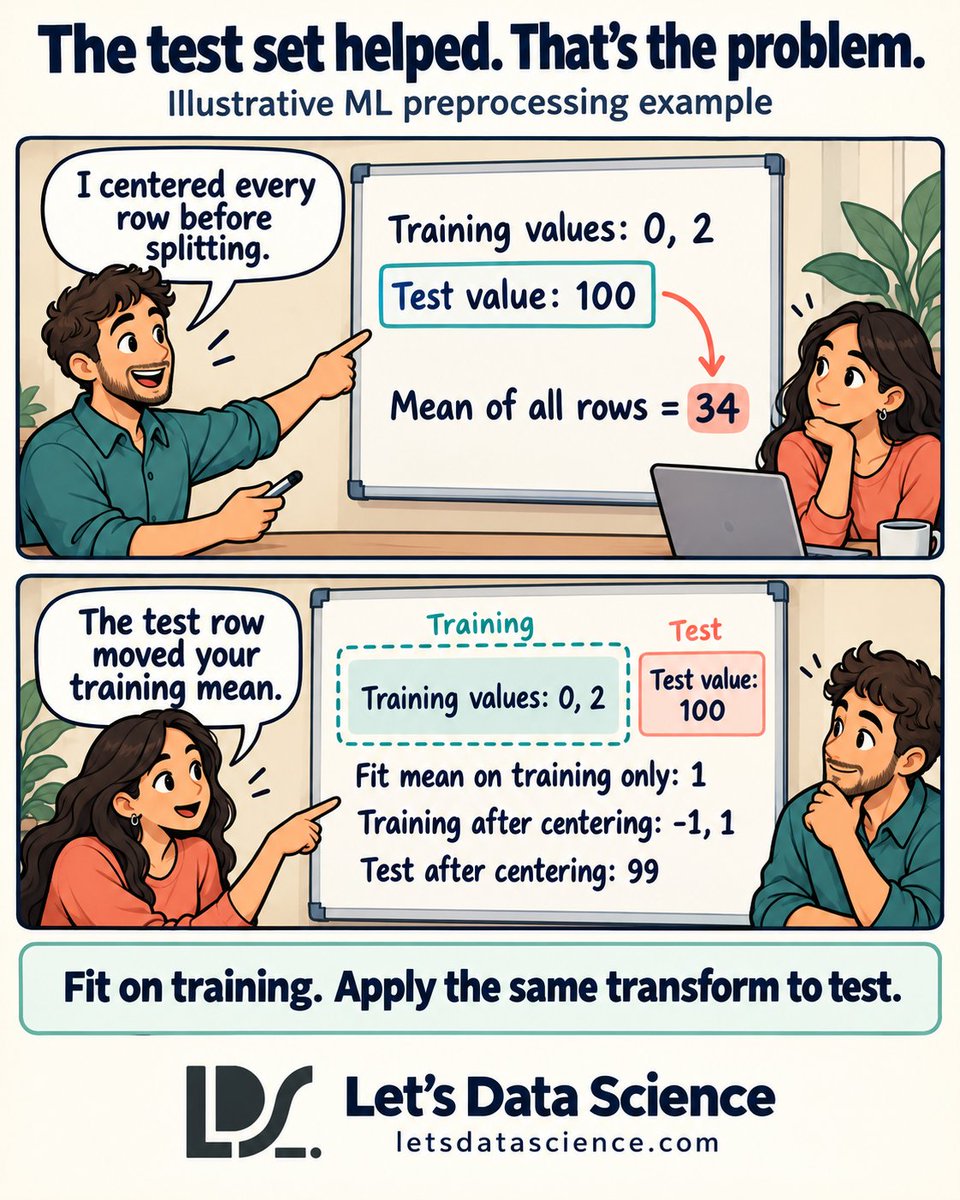
Your test label stayed hidden. Its feature value still leaked into the training mean. Split first, fit preprocessing on training, then transform test with the same fitted rule.
https://t.co/XNiIUOPsux
#DataScience
Trace a residual update: [2, -1] + [0.5, 0.25] = [2.5, -0.75]. In this Pre-LN branch, only the update path is normalized. Set the update to zero to check the skip path.
https://t.co/AA5jeRe2CP
#DataScience
Microsoft exits Nscale's planned Essex AI data center as anchor tenant. Power supply remains unresolved; Nscale says it still plans to develop the site.
https://t.co/siMfjYTEnS
#DataScience#AI
At T = 1, token A has 60% probability. Lower T to 0.5 and it becomes 78.3% in this three-token example. Square, then normalize. Sampling can still pick B or C.
https://t.co/32ltOcczqJ
#DataScience
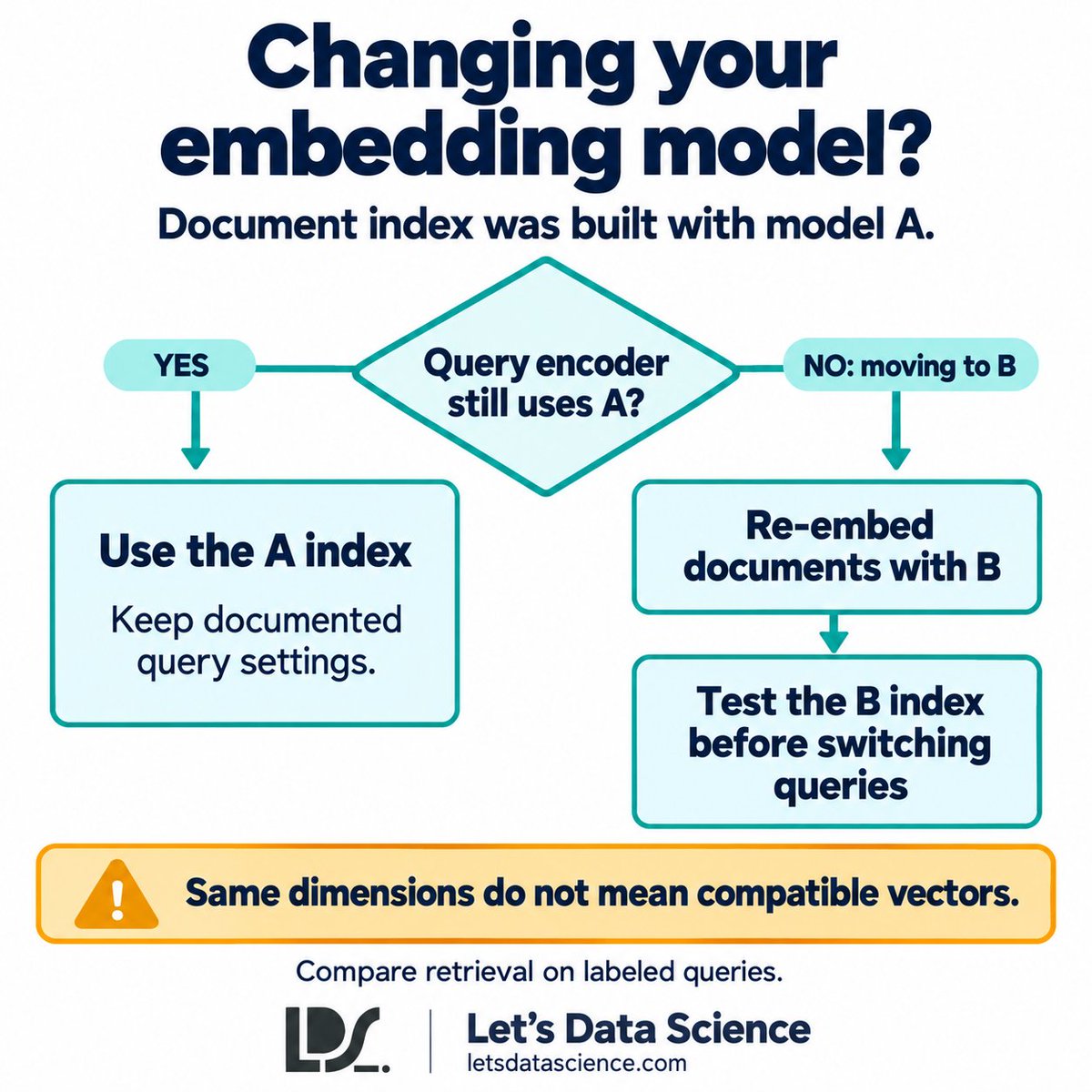
New embedding model, same dimensions? The old index is still incompatible. Re-embed documents for the new model and test retrieval before switching queries.
https://t.co/Osue8miknF
#DataScience








![letsdatascience's tweet photo. Trace a residual update: [2, -1] + [0.5, 0.25] = [2.5, -0.75]. In this Pre-LN branch, only the update path is normalized. Set the update to zero to check the skip path.
https://t.co/AA5jeRe2CP
#DataScience https://t.co/wCFLjqBiS1](https://pbs.twimg.com/media/HVAJnecW4AAO-07.jpg)