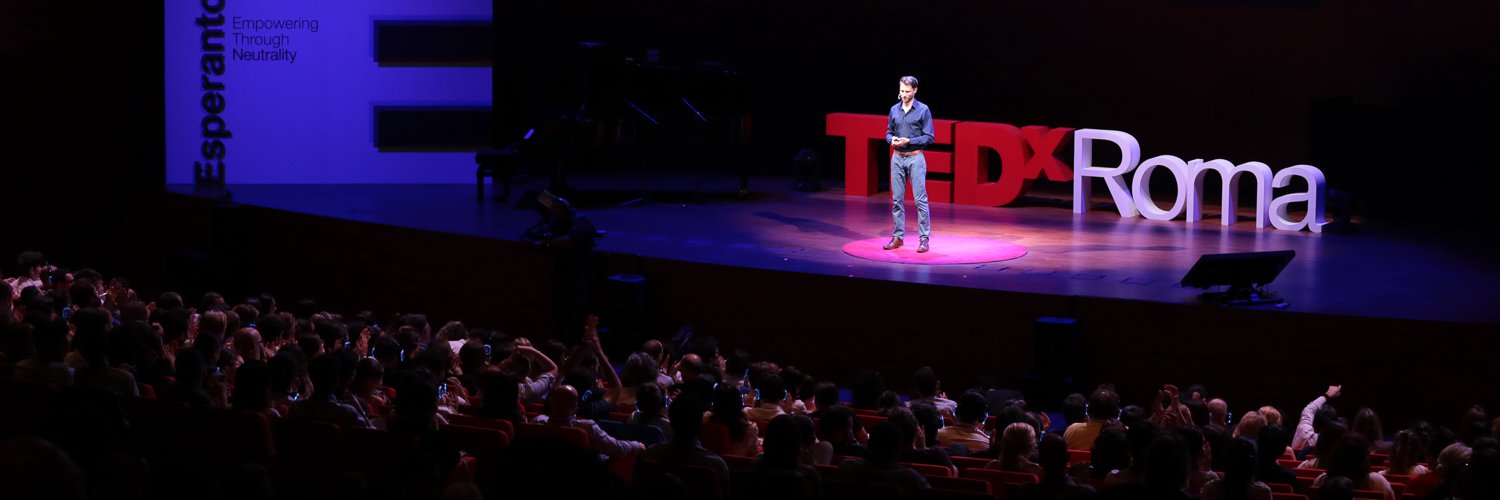
At @SD_LDF I talked about how we can create momentum in collaborative projects - and if you liked the taste of it then my TEDx is a good compliment on the dynamics of groups and how we can have better conversations #sdff2019#sdff https://t.co/L3RQxF6YjT
Nathan to Liz (Amanda): “Billy created an AI version of you that can say whatever he wants it to say” IMMEDIATELY after he edited the script so Amanda (his avatar of Liz) says exactly what he wants her to say, is quite the move.
#YouCanSeeEverything
hot take: the idea that good style requires originality is a byproduct of our increasingly individualistic culture. historically, "good style" was often understood as mastery of a shared aesthetic language. now people conflate "personal style" with originality or uniqueness.
@nosilverv You mean back to ready to hand! I spent ages making this video to make this distinction graspable but it somehow got criminally low traction
https://t.co/PUsGZ27OtL
Dusting off this tweet from April because this gap in shared understanding of LLM capability is *widening*. It's now less "two groups of people speaking past each other" and more a sharp funnel.
- Napkin math somewhere around 6B people (~75% of the population) have barely come in contact with LLMs at all.
- Around 1-2B (~20%) are casual and infrequent users of free-tier ChatGPT-like products. This group sees derpy chatbots and treats them a bit like a better Google search, a writing aid, or etc. Maybe an agent tries to book you a flight. I have non-tech friends who (reasonably, imo) say they have not much use for it at all. Even many professionals outside of math&code are in this tier. For example, execs and many other functions spend a lot of their time talking to other people, so while they understand what is happening intellectually, it is still second-hand and a bit abstract.
- Now we get to professional use of frontier-grade LLMs in math&code. Somewhere around 20M people (0.2%) see first-hand that large, complex projects that used to take them weeks/months can now be completed by agents with a prompt. Building apps, copying apps, translating apps, decompiling apps from binaries... This has all happened very quickly and recently - less than 1 year ago, I was writing code manually by hand, typing memorized computer code commands into a code editor character by character, occasionally pressing Tab to autocomplete a little chunk of code.
- And finally we get to the ~5,000 people (~0.00006%) with access to frontier-grade systems internally. The external world has seen the preview. It looks like swarms of thousands of agents collaborating over weeks on software mega projects: minting zero days, running cyber attacks and defenses at machine speeds, discovering new science, advancing the frontier of mathematics. Things that would have taken top professionals in the industry years of work. Meanwhile, human review and comprehension are starting to fall behind. For example, people are still involved in the "archeology" of the OpenAI-HF incident from many months ago. Mathematicians may be poring over the 722 manuscripts on frontier mathematics for a while.
The funnel is driven by a combination of factors:
1. The impact scales with ambition, problem size, and horizon. A question with a paragraph answer barely stresses the system. You need a reservoir of big, difficult problems that you really care about. This aspect drives the consumer / professional dimension of the funnel.
2. The jaggedness of the system (which I have written about a lot separately). Capability peaks in domains that are digital, verifiable and economically valuable. This is because LLM capability emerges from reinforcement learning on verifiable rewards on a curated environment mixture driven by revenue potential. This aspect primarily drives the area (e.g. math&code) dimension of the funnel.
3. Access. Free-tier, paid-tier, internal.
So this is the weirdness of the moment. The general public has mostly not interacted with these systems. When they have, it looks like a derpy chatbot. The majority of professionals still see only a modest uplift. And a small sliver of professionals are experiencing the vertigo of the curve going vertical. And it is all happening at the same time.
@TylerAlterman It’s so good you start to believe in coffee, that if you keep consumption down you might retain its power, its grace, but no. coffee always fades into the background, unless you give it up again. Truly a plant medicine.
@olivertraldi@TheAnnaGat I’m interested that different people have different cycle lengths and that the pattern can hold and break. FWIW I did two very clear 8 year cycles then my pattern broke.
@TheAnnaGat For me my first two major jobs were 8 years and then I fell off rhythm by doing 3 then 10. I guess in popular culture “decades” do this mythological work for us but I’m with you - my phases don’t sync up with the metric system.
@TheAnnaGat Calling them ‘chapters’ might be because you read a lot of books, but life moves in phases/cycles in bunch of traditions. In Chinese medicine women move in 7 year cycles while men take 8. Rudolf Steiner has 7 year cycles, and Saturn’s quarter turn is 7.5.
@MasterTimBlais Hmmm… I dunno… “the cold approach problem” seems to me more like a “not being able to tolerate some disapproval” problem - maybe mixed with a “not responding to signals” problem and a “not being able to generate warmth” problem
@aodhanpmoran There’s a book called my baby week by week. It’s 1 chapter per week which is as much as anyone can digest and it walks you through those first months where you have no idea at all about what you are doing. It touches on medical developmental and emotional stuff in a grounded way
Ok so for an LLM tokens ARE time - the substrate upon which things happen - whereas time is not really a dimension that matters, apart from that tokens are processed IN time. Right?
@RichDecibels I believe - I think form and message and interaction are necessarily different vs x - and certainly haven't fully found "what works" - but I want a space where grounded wisdom and exploration is alive and helpful - wanna speculate about it?
@RestIsFootball@GaryLineker Think the answer is in better governance structure to hold power to account, not better intentioned people (who will always be corrupted by power)