I rode into suuuuch a middle of nowhere.
And it was sooo beautiful there. Just wow.
Still preparing for my first Ironman 70.3. It is NOT going easily. Today was also NOT easy.
Today was a bike training day. I rode ~78 km. So far, I still haven’t managed the full distance. Work in progress, you know.
Of course, I’m taking care of my knees and joints. But that’s not really the point.
I notice that it’s easier for me to share either when something worked out (more often), or when I’m unpacking some kind of fuckup (less often).
Although all the most interesting, difficult and alive stuff is somewhere “in the process”.
Like today - the ride was both hard (and this summer with its heat has arrived too😁), and beautiful (summer has finally arrived too😁).
Workaholism is not a disease.
It’s a way to deal with uncertainty. Things can be complicated, but at least it’s more or less clear what to do. That grounds you.
Observation.
Sometimes it’s easier to schedule something work-related than an opera, like today 😁
Last time I went was to The Marriage of Figaro in Vienna, I think last year. It always leaves a very pleasant aftertaste. The plan was worth it.
Dreaming-machine
vs. living-machine
This rhetorical question has been hanging in my head after the Mgzavrebi concert in Belgrade.
It’s curious, and partly not easy to admit to myself, that before I used to strive and dream more. And live less. Including the dreams that were becoming reality.
The transition was neither easy nor fast. And yes, there are people I’m very grateful to for helping me make it.
It’s still not autopilot. It’s intentional attention to bright moments during an ordinary day, and regular planning of bright flashes like today.
Just a few blurry photos - and somehow they are exactly about the brightness and the now. The focus was on good music, emotions, new people. Not capturing it with the phone, but living it through myself.
What am I getting at?
Of course, it’s not an “either/or” or a “vs.”
You need both - to dream and to live now.
What’s your balance between dreaming and living?
One step from love to hate.
Two steps from terrible to beautiful.
...ringing silence, smooth water, heavy air, an empty promenade, boats rocking against the mountains in the background, gravel crunching under my feet, 2.2 km already behind me.
That’s how the second morning began. The first half hour, I was in bed trying to convince myself that this was worth it.
From “I don’t feel like it” to “I’m glad I’m here” is literally two steps: get out of bed and leave the house.
They can be hard.
My morning run was worth it.
Parkinson.
One word.
Two entities.
One outcome - nothing good.
After a hyper intense week and an AI day at the company, Friday feels like slamming the brake pedal to the floor. Everything seems frozen - no emails, no messages, tons of time for deep work. Right? Well...
When I studied in France, I noticed a pattern. There was little time for everything (literally everything! - studying, socializing, job hunting), but somehow you managed to fit it all in. Every 5 minutes felt like luxury. No unnecessary dancing around the point.
Working efficiently and staying in deep flow is a skill too. And a trainable one. During the first half of the day, I felt myself starting to soften up... there was “plenty of time” for everything after all. But after lunch I noticed it and pulled myself together.
Parkinson isn’t just a disease of the body. It’s also the law that work expands to fill the time available for its completion. And just like the disease, Parkinson in work progresses too - one task starts taking more and more time.
Luckily, Parkinson at work is reversible. When it feels like there’s too much to do and too little time, it’s a good moment to play devil’s advocate. Maybe it only feels that way. Maybe all the important things actually fit into the time you have. And maybe the rest was never worth the attention in the first place?
“We’re not behind because there are no winners yet”
Today we had AI Day at the company. And this thesis described the state of the market very well.
Agentic AI appeared only around a year ago. So there are no players who are 2-3 years ahead yet (I’m talking about the market overall; excluding exceptions and major AI labs). Because 2-3 years ago this technology simply did not exist.
But one thing is clear - the world is changing very fast. And what matters more is not knowing one specific tool (it will become outdated within a few quarters), but having a native understanding of how AI works, what it can and cannot do, and how this will +-change tomorrow.
And today everyone put their work aside for a practical deep dive into AI.
No theory. Only practice.
For those who had not seen terminal Claude yet - see it, get scared, get used to it, move on with life.
For those already familiar - search for and exchange use cases.
If you read Telegram channels and Substack, this is now the main focus.
The technology has huge potential, but adoption is difficult.
I took one thing from this day for myself - the right bubble matters. When you are one-on-one with your usual routine and processes, it is hard to find the time and energy to try something new. When you are with others, it is easier to gain speed. And then good inertia kicks in.
I went through two hands-on trainings (joined them quite randomly). In January and March (which feels like a very long time ago!). Without them, I would probably have been in the newbies group today. It is definitely better to start at some point than not at all. But finding the right bubble now is simple, and waiting until the mass adoption wave catches up makes no sense.
Delegate at work and in life... ...is something you need to know how to do.
That’s my insight from day two of the training. This is especially important for me because I’m looking for and hiring people who are like a Swiss Army knife. You can send him or her into any task, and the person will figure everything out on their own.
But as often happens, there are nuances and a fine line. And it looks like this ->
What delegation does not look like: there is topic X, you need to figure it out and make sure the result is great. Good luck!
What delegation looks like: here is topic X, here is the context, here is what success looks like, here are the deadlines and resources, any questions? Now - good luck!
Managers delegate poorly - that’s true. But usually people mean that they don’t let go and keep tasks under tight control. It was valuable to see myself from the outside - I also have something to improve in delegation, but from a completely different angle.
The topic of self-awareness and growth is endless, and it requires vulnerability and courage. Especially the older a person gets. It’s impressive to see how more mature people around me step into it without blinking. Respect.
“Choose a 6-month commitment. Its goal should be a need of your team that you will work on.”
This is how the first workshop ended today - for a pilot group of leaders from headquarters and regional offices. Ahead of us are 4 months of work.
There are about 10 of us. From conversations with everyone in the mini group, one trend is clear: we understand ourselves and other people’s strengths quite well (we went through the CliftonStrengths results), but it is much harder to verbalize actual needs. Both our own needs, and especially the needs of our teams.
And here, something like Maslow’s hierarchy also comes into play - needs have a hierarchy and grouping. They differ depending on the level of role, function, geography, etc.
Among the most discussed were:
stability of work right now
stability of career in the future
trust
empathy/support
match with the company’s goals
I keep running into this insight again and again: one of the most valuable skills is understanding other people’s needs (humans are self-centered!). And if you can also speak their language - that’s top-level mastery.
And regardless of the specific needs, everyone first of all values feeling heard. That is a huge step toward building trust and finding solutions.
This will be my focus for the near future.
What are the top 2 needs you and the people closest to you have right now?
People are gathering at the station. It was 20:31 when I started writing this text. The train home is already 18 minutes late. The dilemma in my head - wait, or go back to the office and pick up the car.
It feels like a lot of time has already passed and the probability that the train will leave is only growing. And the longer you wait, the further away that moment when you should have taken the car seems. That moment is long gone.
This is exactly how I perceive the moment when I should have started learning German seriously.
This is exactly how I feel about the moment when I should have started planning the onsite with my team, which is already in 3 weeks.
It’s amazing how distorted our perception of time and the opportunities connected to it can be. And how easy it is sometimes to agree with the idea that the “moment” for something in our life has already passed.
Although we clearly underestimate how much time we still have ahead - to enjoy both the process now and the result later.
So, using the moment, I’m dusting off my long-forgotten course 🙂 Spreche fließend Deutsch is not far away. And my train is arriving right now - 25 minutes will go to something important.
7:27 Sunday
I’m finishing my matcha, looking out the window
I notice... suspicious clouds
Weather check. Shit. By 12 the sky will be covered
7:33 I’m in the car, driving to the train station
Definitely making the direct train to the mountains near Garmisch-Partenkirchen
Today - success. It turned into a great hike. And the weather ended up better than the forecast.
It’s around 12 now, I’m sitting on the terrace of a mountain hut / alm, eating apple strudel, looking at the town below and the mountains ahead.
But it’s not always like this. It wasn’t before, and it isn’t now.
Adult life somehow slows us down, makes us heavier. Some knowledge / skills are useful - avoiding impulsiveness, chaos, etc. But some of it is exactly that - weight.
And sometimes I feel this conflict between my inner lightness to get up and go, and the realities of life. For me, as someone prone to overthinking, these kinds of decisions and - most importantly! - actions made in a split second are extremely valuable.
They strengthen the bridge between I want to + I have the chance. Instead of getting stuck on one side.
The task for this weekend: choosing a motorcycle.
This is one of those long-time wishes.
And one where the homework has already been done - I got my license a few years ago.
Scrolling through websites and stopping by Honda and BMW dealerships, I noticed something.
The brain only wants to move forward.
The comparison base is always ahead.
Because I can feel irrational wants inside myself.
(The goal “motorcycle” has already expanded into “I want a cruiser and a scrambler”, and we haven’t even gotten to choosing the color yet.)
Why?
Because it compares “tomorrow” with “the day after tomorrow” (= the next step is not enough for it)
And not “tomorrow” with “today” (= which would be logical, but only for me - not for my brain🙈)
In this context:
.we had zero chance of NOT discovering America
.we could NOT have failed to learn how to make fire
.zero opportunity to fuck up the creation of electricity
You get the point.
This is a very cool feature built into us.
I interpret it as something in our nature - to find a way out of any situation and move toward something better (despite any pauses, stops, detours).
The main task is not to crash physically and not to burn out emotionally along the way.
That’s both the task and the main skill to keep sharpening.
Where you were born is (not) where you belong forever.
That’s what I’m observing from a restaurant veranda, looking at a busy street near Lake Starnberg - one of those wealthy, postcard-perfect areas outside Munich.
Who/what I see:
people in convertibles / regular cars
locals / visitors
people on their own / with someone
sporty people / not so much
A normal picture, right?
Yes. And that’s the whole point. Every person is in their place. Literally every person.
the grandpa on a Harley, and the grandpa in a worn-out Volkswagen
the person walking a dog with joy, and the person struggling with it
the person walking down the street like they are at home, and the one walking like they are a guest
And all of this is visible on the face, in the walk, in the gestures. You can see that the inner state attracts the outer world. Not the other way around.
And if a person does something / makes a choice that does not match their inner state, this contradiction is visible too (the dog is a burden, kids are a pain, etc.).
The world around us keeps accelerating. A long lunch without a phone is luxury now. But it gives you a chance to notice moments like this.
(well, and thanks to me for forgetting to charge my phone before the trip, so airplane mode was not a choice😁)
Do you have a sufficient level of intelligence?
That’s the subtext I keep hearing in hiring, promotion discussions, and team development.
I started wondering - how do you actually measure it (and is it even possible)?
IQ tests are basically gone. Everything shifted toward EQ, Clifton, MBTI, etc. But the core is the same. It’s about potential potential.
I hire and interview people all the time. And with people you don’t know, it’s even more visible. The real intelligence test is what you actually have (not your plans!) in your life right now - regardless of your background.
And the second, more important test - regardless of what you have in your life, how happy is it?
That’s it. I see both juniors and more experienced/mature people. 10 minutes + the question “tell me about yourself” (an open question) is enough to get a pretty accurate picture of a person’s success in a social context and their own perception of success.
This is not about being smart or not - it’s about how well someone can use their abilities.
It’s interesting how strong our tendency is to overcomplicate things and try to measure everything precisely.
While it can be simple and elegant.
"03:41 Had insomnia tonight
Will be online later than usual
Since I couldn’t sleep, I managed to draft this..."
This was the first message I read in the corporate messenger this morning. And the first thing I offered was to talk through whatever was worrying them and keeping them awake. If that was the reason.
"I’ll find time in my calendar, just let me know." For my people, time will be found even where there is none.
I value “my people” a lot for the following reasons:
1. There is a feeling that I’m not the only one trying to move corporate, lead-heavy mountains. And there is a lot in that - support, criticism, laughter.
2. Work stops being just work. It becomes another place of meaning in life, where people on the same wavelength are doing something cool together.
So where am I going with this?
Any company is an organized group of people. And a small part of them really wants to + can move mountains both in startup land and in the corporate world.
And the question here is - what leadership style fits them / works with them?
And an even more important question - what kind of leader am I, so I can avoid an inner conflict with myself?
About myself - I know that, among other things, servant leadership comes naturally to me. Meaning I amplify others instead of being “on the cover” all the time.
People don’t talk much about the first one. The second one is basically the leadership stereotype - some macho figure in the foreground, confidently looking into the distance + hands on hips / power pose.
It took me years to realize and accept my own style. I won’t hide it - up to a certain point, I wanted to be like Musk or Jobs, not me🙈
And now I know that my strength is in supporting and amplifying the person who wrote that message at 03:41. Not in being present myself in 100500 places where these team members are moving mountains.
Victory does not equal being on the cover.
One simple sentence - years of a journey to get there.
How do you amplify your group - whether at work, in a hobby, or in family?
Are you a peach or a coconut?
I’m a peach with a coconut instead of a pit.
What am I talking about?!
One of the first onboarding topics inside international companies is communication in a multicultural environment. I had the same topic in France during my MBA.
Peaches are warm and open from the very first words. But becoming a real friend, a truly close person, is hard. There is a hard pit inside. Example - English-speaking countries.
Coconuts do not look like “let’s chat” from the outside. Getting them to open up may not be easy. But once it happens - a wide soul, a smile, and warmth open up. Inside the coconut, it is soft and tasty. Example - Eastern Europeans.
Most people have had this kind of manager in life - “what a complete asshole” 😁. I am sure I am no exception for someone on my team. That is okay.
What I noticed about myself - I am very flexible and I evolve quickly on the fly in my position. But at some point, the person hits a wall.
I am not ready to move even one step.
But! Recently, there was a conversation about the structure of one team and hiring an operator for AI products. I was firmly in favor of hiring this person into the operations team. But I left the meeting with the decision to hire into the project team.
Why - does not matter.
What matters is this: some people are not trying to simply break you. They are trying to get you to open up. And in an honest exploratory conversation, a new point of view can be born.
For me, it is valuable to know my own nature. So I can be an open leader, have boundaries that can be revisited, and know where the red flags are.
Instead of simply becoming “that manager.”
What do you know about yourself that helps you build relationships with people?
If it’s not working out and you’re not 10 years old - just remember: you need to make a few more attempts. It will work out.
A few months ago my team and scope of responsibility expanded significantly. Nice.
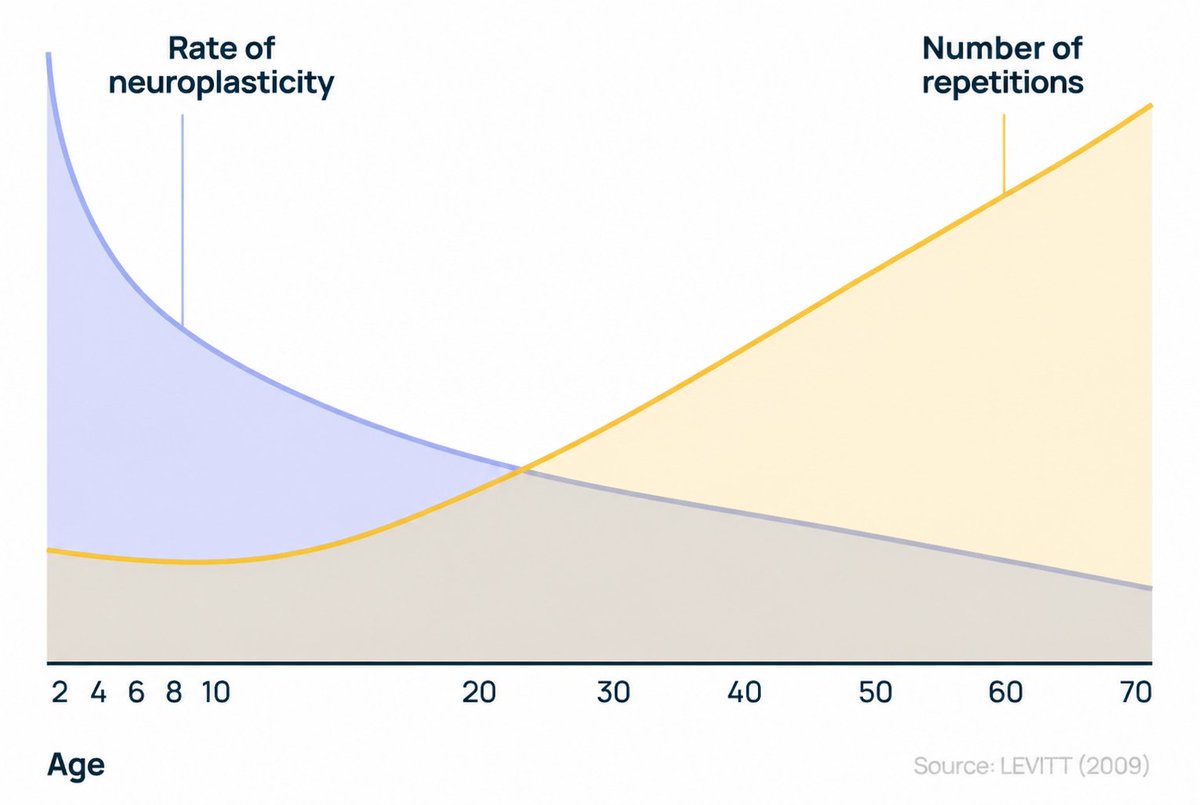
But along with that, the boundaries of my workday expanded too 🙈. One of my new tasks is figuring out how to do more in the same amount of time and without personal involvement, because I still want to dive deep into every project and topic. The new neural pathways just won’t settle into a groove yet.
At some point I thought I had adapted. But over the last two weeks I’ve been leaving the office late again. Eh.
Looked at the chart. Tomorrow I’ll try again to build an autobahn between unconnected neurons.
Am I a dog?!
Looks like… yes.
Yesterday I was coming back from a workout. Rode ~52 km. Not easy, I admit. This year I’m preparing for a half Ironman Triathlon. I’m still far from ready. Yikes.
But this isn’t about that. This morning at breakfast I realized something. When I got home yesterday, I felt something unfamiliar - and only now I can name it. I was tired, seriously tired - but my mind felt fresh, and my body felt light.
I’ve been thinking about getting a dog for a while. One of the favorites is the Australian Shepherd. But there’s one Big (capital B) challenge with it. The dog is smart and full of energy. If you don’t walk it enough and don’t give it mental stimulation, it goes crazy. And drives everyone around it crazy too.
So yesterday I realized - my psychotype is basically that Shepherd 😁
I need regular physical activity and something to engage my brain. Otherwise I start climbing the walls. And people around me too. Sorry.
It’s a funny realization. But also a deep one for me. Being a 109% logic-driven person in the past, it’s still not easy for me to recognize internal signals. The kind you can only feel, not put into a pros/cons table.
Plus, I naturally think in images and analogies. So realizing that inside I’m basically an Australian dog - it gives me a smile on the street and a sense of inner calm about how I’m wired. The black box inside me is becoming more transparent.
Which animal do you associate yourself with the most?
Environment is both a force for us and a mirror of us
“Go to this café (Feinkost Caffe Giovanna). It’s top.” a couple told me.
Late spring in Munich - warm, sunny, a bit lazy. I decided to go for a long cycling session - a full loop around Lake Starnberg.
At some point I stopped to take photos. A couple on road bikes stopped nearby and we started chatting. They’re from Canada, but have lived here for a long time. They love nature and… good food.
The café turned out to be a top Italian place. I had the most delicious pasta in years (!). And the funny part is - it’s located at the far end of the lake (the most “German” part), and from the outside I would never have guessed it’s a “must stop” place.
How good was it? It was a very slow lunch, no phone, no thinking. Pure enjoyment of food. Super rare moments, since food is often functional in modern life.
Your people and your […] can be found in many places. And it matters to look for them and actually find them. It brings your life much closer to its “own” best version.
P.S. no food photos. Just trust me - it was very tasty and looked amazing. Someone even came up to me to ask what I was eating so they could order the same pasta 😁
The 1-9-90 paradox
Many people know this pattern:
1% create and share
9% give feedback
90% consume
Yesterday we had a regular work meeting - 10 participants. Only ~3 were active. It really got me thinking.
And it’s like this in everything. Or almost everything.
The paradox is that stepping onto the “stage” with your opinion takes courage. Each moment like that can feel especially anxiety-inducing. "As if" (the quotes matter) you’re being judged.
And at the same time, we know that (leaving aside extreme opinions and ideas), half an hour later no one even remembers the meeting or that moment. We know this - because we don’t remember such meetings where someone else was “on stage.” Life looks forward, not backward.
Each of us is focused on ourselves and our own world. A normal, healthy self-centeredness. But that same thing can stop us from putting ourselves at the center.
No matter the context, anyone who expresses themselves in front of others is a brave person. And that courage often carries zero real risk. Easy to understand - harder to do. That’s the paradox.
Rationalism has been getting a lot of criticism lately. Many people say it’s important to feel and read emotions - your own and others’.
And the narrative usually goes like this:
emotions are a way to stay in touch with yourself
logic is about what you “should” do, not what you “want”
emotions prevent stress from boiling inside
logic risks leading you into illusions
etc.
There’s truth in this. It’s even more of a skill (not just an idea) - the ability to not live only in your head. But there’s a big “but.”
Life, by default, is messy.
And it’s no longer about daily survival in a cave.
Throughout the day, we face many situations that invite our emotional side in - to engage, to fight, to push back until the end.
But do we really need to?
Not every situation requires our attention or a “win.” And this is where rationalism actually helps.
A personal example: my developer (the building isn’t finished; mistakes on top of mistakes). Almost every message from them feels like a perfect invitation to jump in and prove they’re wrong. And honestly, it’s very hard to resist 😁
But do I actually need that? In a calm state, the answer is clearly no. I have more valuable situations to focus on - ones that can have a real 10x impact on my life.
And that’s hard to do without logic.
Everything has its time and place.
As for the developer: small losses don’t matter. For big wins - there’s a lawyer.
So how do you, so to speak, pick your battles?