Half right — beneficiaries get a credit for the trustee’s 30%, so no double tax on paper. But the credit is non-refundable, meaning a beneficiary earning under 30% never sees the difference back: the government keeps it. And bucket companies get no credit at all — taxed twice, by design, and they’re calling that fairness.
@JEChalmers@lesstenny Record company registrations in July.
Not in the press release:
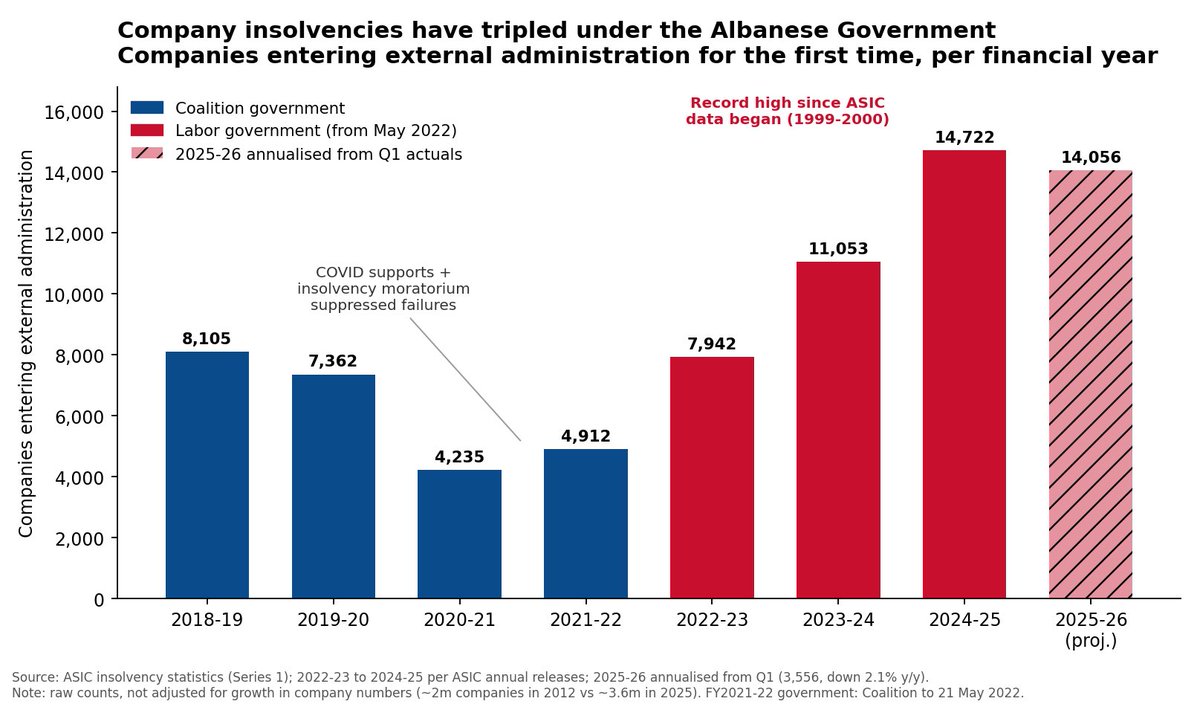
• 14,011 company collapses in FY26 — second highest on record
• 14,722 in FY25 — the highest ever
• 370,500 businesses exited in FY25
Record in, record out.
That’s not a boom. It’s a turnstile.
These figures are misleading. Most new business are workarounds to avoid the crippling tax environment executed on the Australian business community without a mandate. They have been created to circumvent penalising trust tax changes and the like.
Registering a company takes 15 minutes and $636.
ASIC is minting 40,000+ a month. The ABS counted 190,546 new company businesses actually trading in 2024-25.
Registration is not trading.
And labour productivity is down 5.7% since March 2022.
ACNs aren’t an economy.
It’s is tone deaf at best and narcissistic at worst.
Labor didn't lose control of migration — they CHOSE it. A record 538,000 net arrivals in one year, poured onto a housing shortage they knew about. Result: worst rental affordability on record. You're paying the rent on their decision. #auspol https://t.co/mx2H75W6d3
The flag Australians keep choosing, and the @AustralianLabor party that keeps trying to change it.
For nearly half a century, Roy Morgan has put a simple question to Australians: should the national flag be changed? For nearly half a century the answer has been a steady, no. Across every survey since 1979, a majority has said keep it, with one solitary exception.
In February 1998, support for retaining the flag fell to 44 per cent, the only reading in the entire series to slip beneath a majority. It did not happen by accident, and it did not happen in a vacuum. It happened at the peak of a Labor project to remake the nation's symbols from the top down.
@PaulJKeating government made the flag a political target, tying it openly to the republican campaign and to a self-imposed deadline of the Centenary of Federation. Australians were told their flag was a colonial embarrassment. For a brief window, the relentless messaging worked: retention support cratered, and the country was talked into a fight it had never asked to have.
Then the pressure came off, and the public snapped straight back. After the 1999 republic referendum was defeated, the manufactured urgency collapsed, and support for the flag did not merely recover but climbed to a decades-high 66 per cent by 2010!
Left to their own judgement, Australians chose the flag by the widest margin Morgan had recorded in thirty years. The lesson is hard to miss: division on this question is not the natural state of the country. It has to be imported, and it is imported from one side of politics.
The most recent numbers confirm the pattern rather than break it. In October 2024, 61 per cent of Australians still wanted to keep the flag. But look underneath the headline and the fault line is unmistakably partisan. Among Coalition voters the flag is close to unanimous: 76 per cent of Liberals, 89 per cent of One Nation voters and 97 per cent of Nationals want it retained. It is Labor and the Greens who break the other way, with 56 per cent of ALP voters and 72 per cent of Greens voters now agitating for a new design.
In fairness, those pushing for change do not describe it as division. They argue an independent, multicultural Australia deserves a flag without the Union Jack, one that recognises Indigenous heritage. It is a sincere case, and it deserves to be answered rather than dismissed. But the polling record answers it plainly enough. Ordinary Australians of every age group and both sexes back the flag they have.
The appetite for tearing it down does not rise from the suburbs, it is generated, repeatedly, by the political class of the left and pressed onto a public that keeps saying no.
A flag is meant to be the one thing a nation shares. On the evidence of five decades of polling, most Australians already share this one. The question Level21 puts back is a fair one: why does one side of politics keep working so hard to divide us over it?
On a $1M wage bill, the SG's rise to 12% now costs a small business ~$20,000 more super a year - about $70,000 since 2022.
For balance: the 10-12% schedule was legislated in 2021, not by Labor. Payday super & the under-18 change are Labor's.
Level21 analysis
ANALYSIS: Labor's National Conference has backed super for every under-18, scrapping the 30-hour rule - a fair goal for young savers (Super Members Council: ~515,000 teens, ~$405m/yr denied super).
But for small business it stacks onto an already-rising super bill.
Analysis: ~112,000 homes behind the 1.2m Accord target, 2 yrs in — May apartment approvals fell 30%. Subsidies can't fix a shortage we won't build. Clear planning & land supply. Builders face real costs — that's the case for reform. Credible, or theatre? https://t.co/hZLi0AHeyi
@ParkTheBus15@Adam_Creighton@grok Our team used the following and built the math around that for the modelling.
https://t.co/jvvadzCkhZ
https://t.co/lNp60uZb7h
https://t.co/tUbkJxc0CF
https://t.co/QzBJ7do9OL
https://t.co/pbDjOwCpQ5
Analysis — Labor's National Conference opens in Adelaide today: 400 voting delegates, a 126-page platform, motions described as binding.
Implementation stays with the parliamentary party. A gas export tax was dropped before the May budget.
Binding on whom?
Source: Roy Morgan Poll, Finding 10291, 20 July 2026 (n=1,679, fieldwork 13-19 July 2026). Conference detail: AAP, 23 July 2026.
https://t.co/mbD36a9i1j
- Level21 Team
THE COALITION'S PROBLEM IS NOT LABOR
Analysis | Level21 Team
Nearly six in ten Australians say the country is heading in the wrong direction.
The Coalition is polling 23 per cent.
A thread on the central fact of Australian politics in 2026.
Conservatives should say this out loud rather than leave it to others.
An opposition this weak is bad for the country, not merely for the Coalition. Governments sharpen under pressure and drift without it. This one faces none.