I recently spoke at IPAM's Naturalistic Approaches to Artificial Intelligence Workshop, and shared some of the programmatic perspectives we're exploring in reinforcement learning research.
https://t.co/uZCrJupBA2
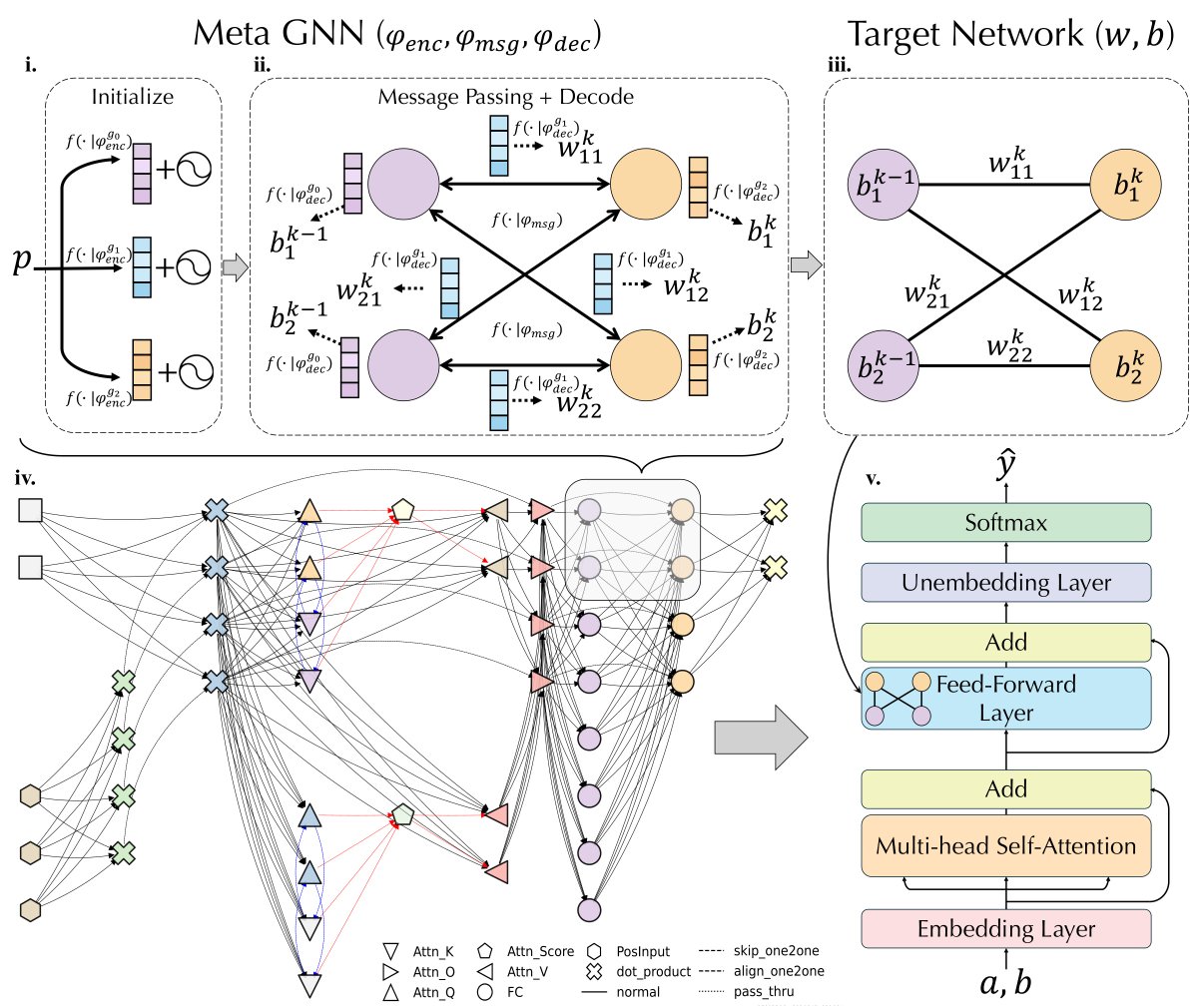
One application of weight-space programming is out-of-parameter (OOP) generalization: synthesizing programs for task parameters not seen during training.
For example, after learning ARC-style tasks that move an object right by various distances, can we predict the weights of a Neural Program for an *unseen* distance at test time, zero-shot?
We show this is possible with a symmetry-aware graph hypernetwork in our @yudongxuwil@lyeskhalil@ScottSanner ICLR 2026 work: https://t.co/onVnXNOKml
The Department of Computing Science at the University of Alberta is hiring for two new tenure-track positions this year. Please spread the word:
- Computer Systems for AI and High-Performance Computing: https://t.co/rMJoJXwJFs
- AI for Health: https://t.co/SHBJYJdqIP
📢 The Department of Mathematical and Statistical Sciences at @UAlberta is hiring a tenure-track Assistant Professor this cycle, specializing in Mathematical Foundations of AI and Formal Reasoning!
If you know anyone who might be a good fit, I'd love to hear your suggestions or get connected!
https://t.co/p1ijVvLCft
I will present this paper during the COLM poster session #4 Wednesday (today!) afternoon at location #29. Please come and chat about formal verification for large software repositories!
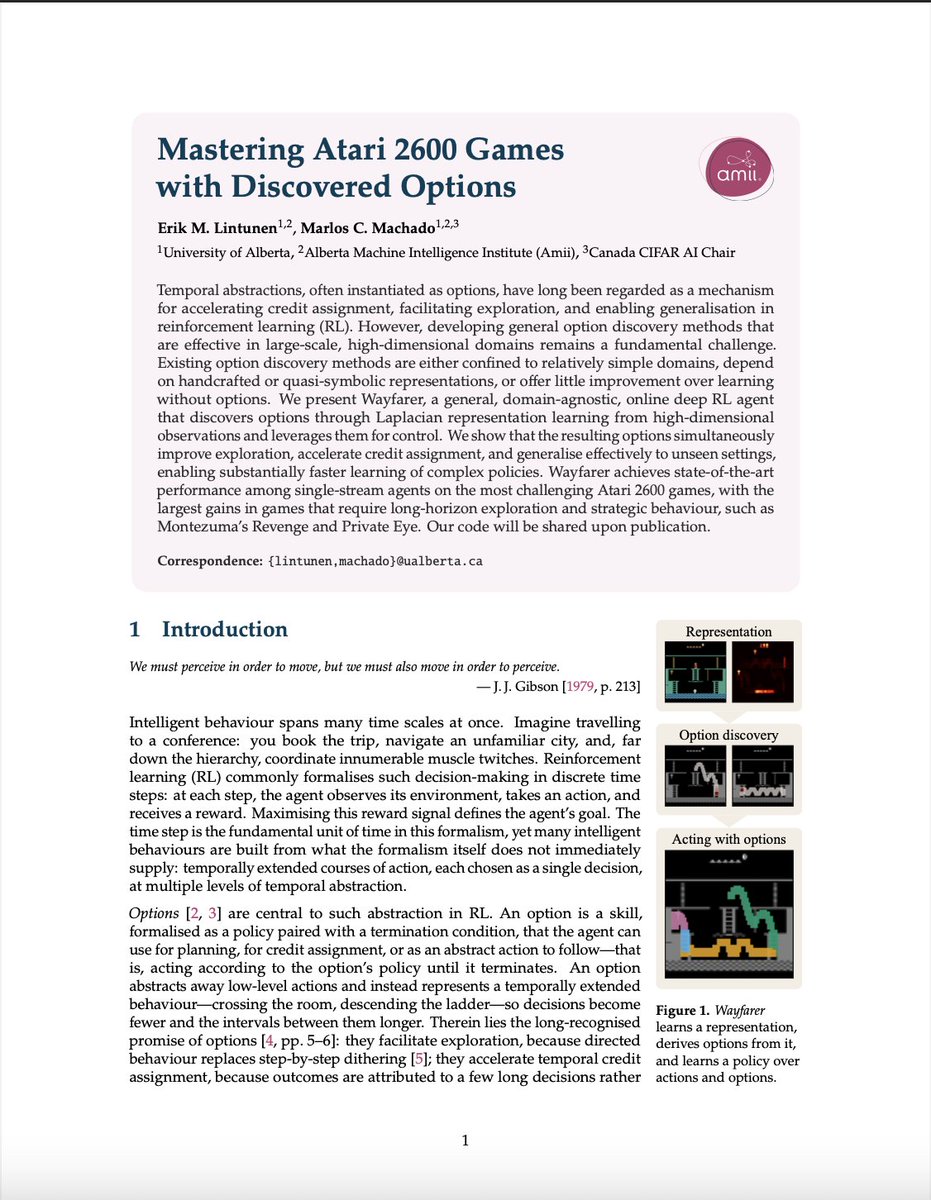
I'm excited to share Erik's work!
Mastering Atari 2600 Games with Discovered Options
We have a general-purpose option-discovery method that works w/ high-dimensional observations, tabula rasa, using a single stream of experience! It outperforms DreamerV3, Rainbow, and IQN! 1/9
@kenneth0stanley@BlackstoneAudio Ah, this is great. I've always wanted to read your book, and an audio version makes it so much easier for me. Happy to see it is out!
I am looking forward to seeing what AfterLabs will come up with! @MattVMacfarlane and @ClementBonnet16 are wonderful researchers who are bringing novel and important ideas to the table.
Current models rely on brute-force RL training to adapt to new tasks and environments. However, intelligent systems should be able to learn on the fly in a sample-efficient manner, continuously refining their understanding of the world through their interactions.
After Labs is developing models with built-in adaptation mechanisms rather than treating adaptation as an afterthought. This new generation of models will start a new era of curious agents that may not possess all the world's knowledge but will have the crucial ability to learn in real time.
Today, we are happy to announce that After Labs has been selected as one of 10 AI labs to join NFAI and receive €3M in additional funding. This support will accelerate our mission to build models that continuously learn about the world. We will be contributing to open science along the way, so stay tuned and follow us on our journey to develop AI that augments human understanding of the world 🌍
@ClementBonnet16 and I started After Labs with a simple conviction. The next leap in AI will not come from models that merely store more knowledge or bake more task-specific skills into their weights. It will come from systems that can continually learn and refine their understanding of the world through interaction.
At After Labs, we are singularly focused on developing world models with the ability to adapt with every new data point instead of staying static. These adaptation mechanisms need to be built into the model during training and not bolted on as an afterthought.
Stay tuned as we pursue this mission of building curious agents that never stop learning 💡
Interesting to see more work in the inductive neural architecture space.
This builds on NLI, presented at ICLR 2026, which used an approximately discrete latent space to enable compositional generalisation via test-time latent search, while still leveraging gradient-based optimisation: https://t.co/a9Kkz7PsGo
NLI itself extends Latent Program Networks (NeurIPS 2025), which introduced the application of semi-amortised variational inference (test-time search in latent space) to the learning of programs themselves: https://t.co/bArMtRUAvD
There is still a lot to explore in Latent Program Network style architectures, from different structures of latent spaces to better test-time search methods. This is a hugely promising approach for sample-efficient learning and inference-time adaptation, all without parameter updates, leading to architectures where adaptation is built in during training rather than added as an afterthought.
I can nominate one Canada Impact+ postdoc candidate at UAlberta. Please reach out only if you have a strong theory track record (learning theory/bandits-RL theory/LLM reasoning). Deadline: May 10 (23:59 MT. Email: CV + best papers + brief pitch. Pls RT https://t.co/pnRmnxPyCi
I'm in Brazil for ICLR! 🇧🇷
Presenting our paper "Gradient-Based Program Synthesis with Neurally Interpreted Languages" (https://t.co/a9Kkz7OUQQ) on Thursday, April 23rd, 10:30 AM – 1:00 PM at Pavilion 3, P3-#215.
If you want to chat about world models, test-time adaptation or continual learning lets set up a chat or come say hi!
I’m headed to Brazil for #ICLR2026 and looking forward to seeing old friends and making new ones. Please drop me a line if you’d like to chat about program synthesis, programmatic reinforcement learning, or programmatic representations more broadly.
A couple of months ago, we released a preprint of one of my favourite papers I’ve ever written. It lies at the intersection of representation learning and neuroscience. I have now written a blog post about it.
Preprint: https://t.co/vtDeBzvjsq
Blog post: https://t.co/d5rPZHoGaC
Amii is hiring a Machine Learning Resident (1-year term) to work with ConeTec! Help solve critical safety challenges in geocharacterization using LLMs, OCR, and Deep Learning.
📍 Edmonton (Hybrid)
📅 Apply by March 4, 2026
🔗 https://t.co/0uUbzh65PG
Amii is hiring a Machine Learning Scientist to lead our ML Educators and scale AI literacy across Canada.
If you have a background in ML research, people leadership, and a passion for AI for good, apply now: https://t.co/nntmTsPYIa
Insightful thread about world models with ideas that very few people in the industry understand!
Building static, giant world models is a dead end for achieving human-level adaptation to new tasks. Instead, it's all about efficiently adapting local models of the world. The community should develop systems that produce world models (a la program synthesis) rather than static models.