$ETH went from a consensus hold to a contrarian bet in 2-3 years.
Some of this was market driven, some was self-inflicted:
1) The EF pushed the L2 scaling roadmap after failing to scale the L1.
It doesn't matter whether that came from lack of motivation, skills, or available tech and research at the time.
Now the EF is scaling the L1, but even with gas limit increases, Ethereum will never be faster or cheaper than most competitors.
And that's okay, because maximizing decentralization and censorship resistance requires tradeoffs.
The problem is that market participants are giving it lower valuation multiple than in the past.
And it's dead annoying though that full ERC-20 deposits to CEXs still take ~13 minutes (no 1-slot confirmation) and that approve + action still requires two txs across DeFi, despite years of 'account abstraction' upgrades.
Watching EF members leave one by one isn't helping the sentiment either.
2) Ethereum can be slower and pricier than other chains, but the market now wants revenue to back valuations.
$HYPE is generating 2x-3x the fees of Ethereum despite trading at ~5% of its market cap.
Even more humiliating is $TRX, up 5x while ETH is down 40% over 5 years.
Ethereans mocked TRX as a copy/paste vaporware scam, but Tron dominates retail stablecoin payments... The sector EF pushed for years and failed to capture, because Ethereum was simply too expensive and slow for adoption.
Ouch.
I believe Ethereum had it good with the ultrasound money narrative.
Quickly deflating supply is the sexiest narrative that even BTC bulls would love.
But it needs a massive pick up in txs numbers to generate the fees that burn ETH.
And Glamsterdam just cut fees by ~78% (gas limit will go from 60M to 200M per block), which means transactions need to pump by 4.6x just to keep the burn flat.
If onchain activity doesn't pick up to compensate, Ethereum's revenue drops further.
Sure, Ethereum still dominates TVL but the ratio dropped from 96% in Jan 2021 to 52% today.
And even with that, TVL monetization mostly flows to protocols and stablecoin issuers, not the L1.
L2s aren't taxes either.
----
So what's the bullish case for Ethereum here?
EF has partly got the message.
The cypherpunk manifesto is personally very appealing to me, with its mission to promote privacy, self-sovereignty, and independence in an increasingly unstable world.
I hope that recent departures from the EF is simply a realignment period.
Pivoting to L1 scaling is the also right move, but UX needs to drastically improve, especially as more corpo-slop chains and institutions enter the market.
EF is taking the quantum threat seriously, unlike the mixed reaction from Bitcoin core devs.
But that all takes time, and if the market's demand for revenue doesn't subside, Ethereum simply needs to bring more users and transactions to the chain.
The real ultrasound money narrative, while being the most decentralized chain, would do the trick.
But we're far from ETH being deflationary again.
People are still sleeping on just how unimaginably poor LayerZero opsec actually was:
In their apology blog, LayerZero describes the one multisig signer trading memecoins as a single isolated event just involving one person.
However, as CLG points out via the onchain evidence:
In reality, the multisig signer attempted multiple memecoin trades over the span of a year and stayed on the multisig for nearly two years after the first memecoin trade, before finally being rotated off
Furthermore, there were actually 3 signing addresses that were engaged in non-multisig related activity (memecoin trading, DEX swaps, bridging, LP provisioning) on a 2-of-5 Gnosis Safe multisig.
So, there were *THREE* addresses doing clown fiesta stuff over the course of *YEARS.* LayerZero's blog only briefly mentioned what one address was doing. They entirely avoided even discussing the others.
So, LayerZero's private key incompetence is a pick your poison adventure:
They either had three highly irresponsible people on their multisig for years
OR
They put what is supposed to be three separated private keys in the hands of *ONE* person
Either way, they showed they have absolutely zero regard for security.
Heeaaaaaaaaated debate broke out in the ETHSecurity Community Telegram earlier today between LayerZero’s Bryan and security researchers.
TLDR summary:
- $3 billion+ of LZ OFTs were recently at risk of being compromised due to a default library contract that LZ Labs could upgrade instantly with no timelock to forge messages (like what happened with rsETH hack)
-According to Banteg, major projects like Ethena and EtherFi were STILL using this default library contract as of a few weeks ago
- There is still $178 million in value exposed to being compromised from projects using default library (look at quote tweet)
- LZ Labs doesn’t need to be malicious for this be risk, they have history of poor opsec (in addition to being hacked by North Korea):
- Onchain data shows LZ Labs multisig signers were engaging in non-multisig signing activity like trading memecoins, swapping on DEX, bridging. All major phishing risks as this mean production multisig keys were connected to websites, not just used for signing
- LZ Labs handled private keys like a high schooler, trading memecoins on production multisig keys, no wonder they got targeted by North Korea, who knows what other poor opsec they have?
THREAD BELOW
.@arbitrum Security Council took emergency action to freeze 30,766 ETH held at the Arbitrum One address linked to the @KelpDAO exploit.
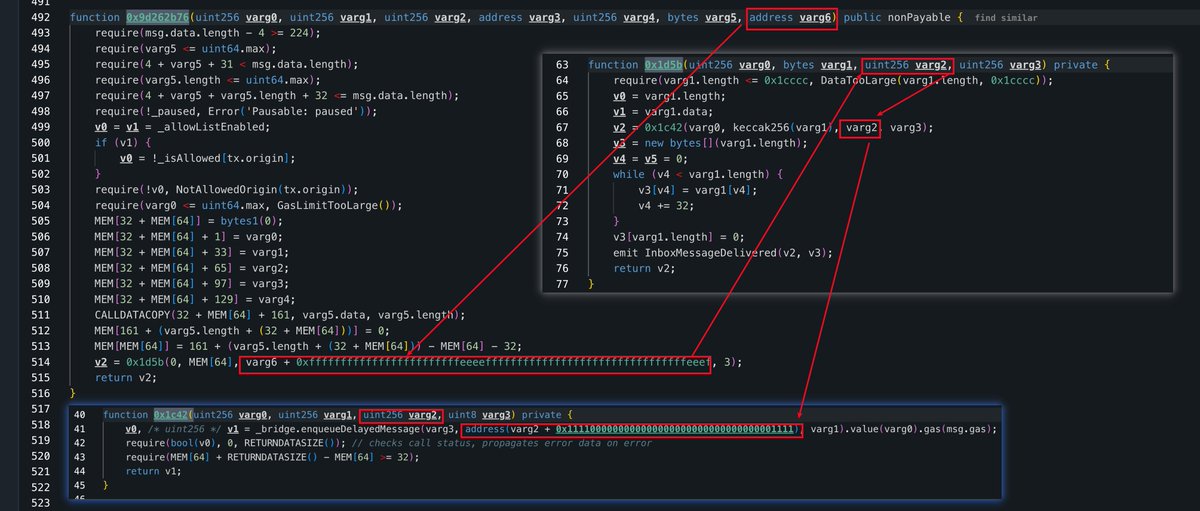
The key technical point is how this was executed: it was not a normal transfer signed by the exploiter's key.
Based on the on-chain trace, this appears to have been executed from Ethereum (L1) via governance-level emergency upgrade powers. The Upgrade Executor temporarily upgraded DelayedInbox, invoked a temporary entrypoint to enqueue a delayed L1→L2 message via Bridge.enqueueDelayedMessage(kind=3, ...), and then restored the original implementation.
The critical logic change was that the sender input shifted from the standard msg.sender path to a caller-controlled parameter (then transformed via L1→L2 aliasing), allowing the injected message to carry exploiter-linked sender context. Also, kind=3 maps in Nitro to L1MessageType_L2Message, which allows L2MessageKind_UnsignedUserTx execution on L2, i.e., this path does not require a user signature check.
So the L2 transaction view (“from exploiter to 0x…0DA0”) reflects a chain-level forced state transition, not a standard user-signed transfer.
TX on L1: https://t.co/Jlp5NbjWTV
TX on L2: https://t.co/FAzUkpGdQK
deSPXA takes off on Aerodrome 🛫
The 1st licensed S&P 500 index fund token, deSPXA, just launched on @Base, with Aerodrome as its onchain trading venue.
Unlike other SPX products, @centrifuge is building the ETF fully onchain, directly from the source.
Swap & LP $deSPXA today.
Another acquisition in the books!
10,253 veAERO has been acquired at a 20% discount and removed from circulation forever.
New Total: 848,087.
The flywheel tightens. Aerostrategy is inevitable. 🛫
Buybacks don’t make sense for every protocol, but crypto startups and token designs aren’t created equal.
For Aerostrategy, buybacks are core to the mechanism design and directly ascribe value to $AEROSTRAT. Paired with burns, they continuously strengthen liquidity - not just reduce supply or provide marketing hype.
Because Aerostrategy’s veAERO earns continuous yield, a growing treasury also means larger daily buybacks and deeper LP, enabling bigger players to enter with less slippage.
Since launch, Aerostrategy has accumulated 837k veAERO, burned ~1.4% of supply, and injected ~$17k into LP.
Treasury growth continues daily, which positions buybacks/burns and liquidity growth to accelerate as $AERO continues its recovery.
Phase 1 (ICOs): tokens were scarce, which gave the limited number speculative value.
Phase 2 (Launchpads): The bar to tokenize is lowered significantly, tokens flood the market, all diluting each other regardless of function.
-we are here-
Phase 3 (Fee Generation): Tokens are evaluated for their fee generation prospectives and value capture. Revenue generating assets are deemed to have value, most others are further diluted.
Tokens can either be productive or fade into oblivion.
That was quick... The flywheel grows stronger by the day!
29,371 veAERO accumulated for 24.7K $AERO, bringing total holdings to 709K veAERO.
In just two weeks, Aerostrategy has become the 130th largest veAERO holder.
When top 100?
Just unlocked my Gas ID via ETHGas 🪪
I'm a Teen Jack with 0.797 ETH spent on gas since Beacon Chain - now fueling my climb to the Gasless Future and earned 350 Beans already.
Reveal yours at https://t.co/DzCavNKPjy