To draw travelers, digital nomads and new residents, cities need a new Department of Hospitality for the remote work age, write @levkushner and @Greg_Lindsay https://t.co/5GwlsdQXNz via @CityLab
This looks exactly like the (currently disastrous) Powell Street BART Station in SF, which goes to show you how much housing policy impacts spaces like these.
Copenhagen South will open in 2024 and become a new hub for:
🚇 Metro (1 direction)
🚊 S-Train (3 directions)
🚆 Intercity and Regional trains (4 directions)
📸 @ramboll and GottliebPaludan
@MattDoyle76 Oh good.
And while I'm at it, Mikael Uhre has got to be a candidate for face of the week after Jose Martinez's goal today. Hands to face in awe.
Dumb question: could you convert Westfield mall to a university campus? Turn every store into a classroom, the walkways in between become common space…
Insightful piece on the new frontiers AR opens up in cities by my friend @Greg_Lindsay. Should AR uses be taxed? How can cities ensure public safety? The different approaches cities take could have massive impacts on the lived experience of residents. https://t.co/sB9xvlzaJ4
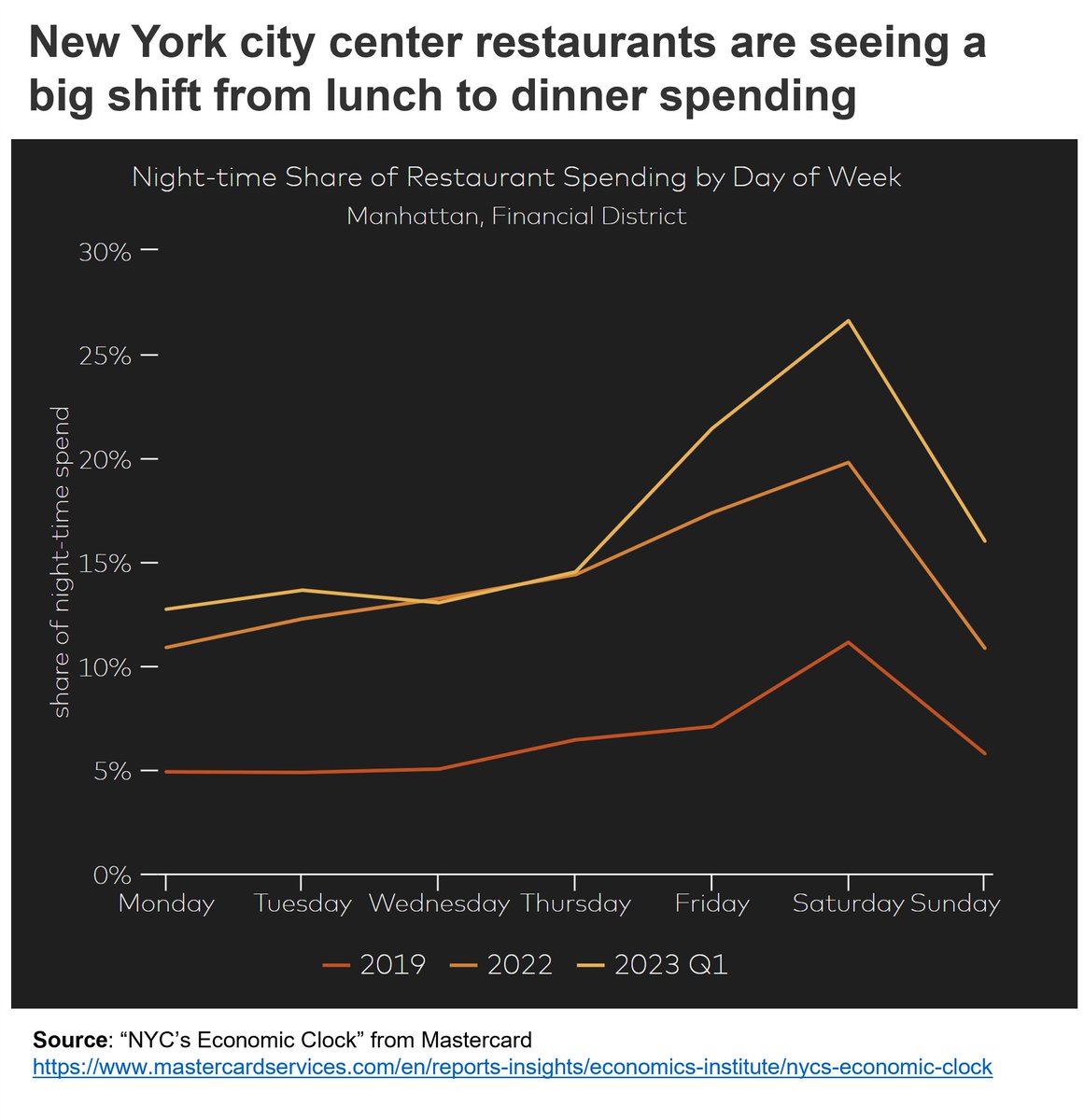
WFH is shifting city centers activity from daytime to nighttime. WFH employees are heading into town after work, particularly on Friday and Saturday night.
For example, New York financial district restaurants have doubled night-time spending share since 2019.
@DKThomp This exactly mirrors Prof Steven B Smith's writing comparing nationalism (lone ranger) vs. patriotism (relational). The former is fear based, the latter is founded in self-appreciation and the desire to improve. See his book "Reclaiming Patriotism in an Age of Extremes"
The internet’s ability to deliver rapid-fire national attention to every local controversy that occurs in a giant country makes federalism really really really hard to sustain.
We need clarity on when human contact is valuable during the ritual of commerce.
For low-value transactions, customer service is valuable up front to advise decision-making (clothing, meals, etc.). For high value ones, human hand holding during the actual purchase is critical.
Too many restaurants have it backwards with QR code menus and paper checks.
Pulling up a menu on your phone to zoom in and out of a digital PDF, when printed paper exists: absurd
"scan this code to find and pay your check whenever you want": brilliant!
https://t.co/CKHjCVIB2M
"We live in a noisy world where it's increasingly hard to predict which cultural products will resonate. Online, this problem is solved by producing lots of content and seeing what sticks. Offline, it's much harder to experiment or change course. Every mistake is expensive."
@drorpoleg it's the middle ones that are truly screwed: too old to be attractive as offices but not old enough to have any charm or convertible floor plates.