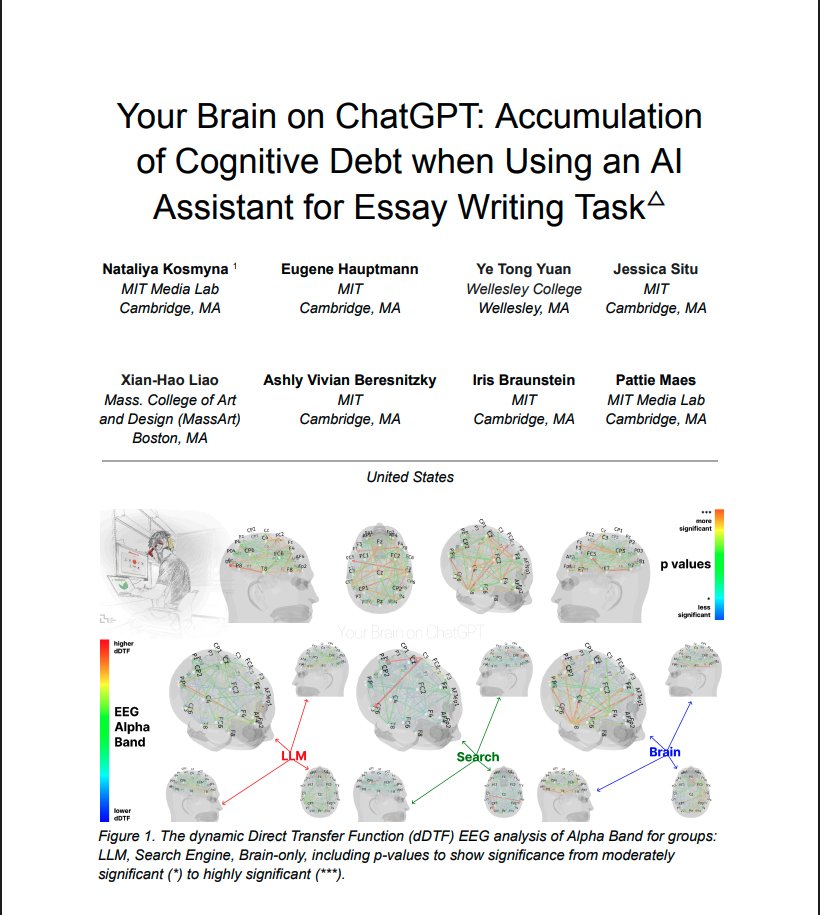
BREAKING: MIT just completed the first brain scan study of ChatGPT users & the results are terrifying.
Turns out, AI isn't making us more productive. It's making us cognitively bankrupt.
Here's what 4 months of data revealed:
(hint: we've been measuring productivity all wrong)
My first time-lapse. Thanks to some instruction and tips from @Astro_Ayers, I caught my first aurora. After seeing the result, I told her this felt like fishing. Prepping the camera, the angle, the settings, the mount, then setting your timer and coming back to hope you got a catch. And after catching my first fish, I think I’m hooked. Thanks, Vapor!
Beautiful auroras passing over southeastern Asia and Australia.
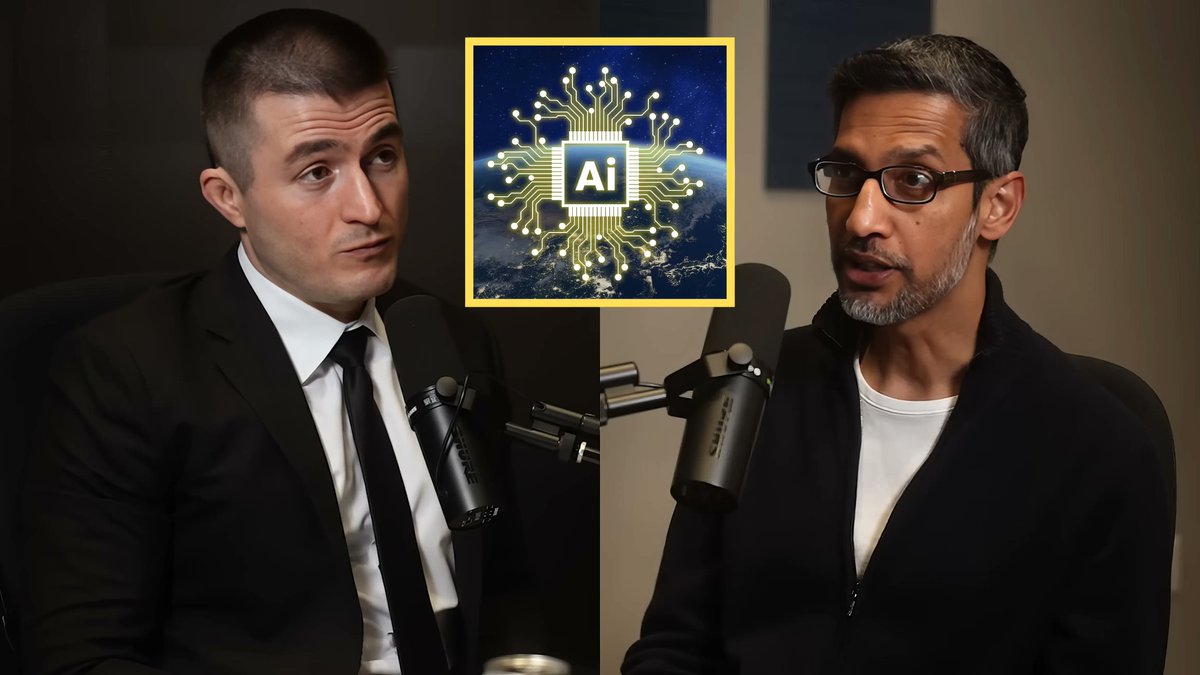
Google's CEO just had the most important AI interview of 2025.
He revealed mind-blowing facts about artificial general intelligence that 99% of people wouldn't know...
Including when the singularity actually happens.
Here are my top 8 takeaways:
(No. 6 will terrify you)
It's only been a day since Anthropic dropped Model Context Protocol (MCP) with Claude, like universal plug for AI.
Now AI connects to tools and data insanely easier.
And people can't stop getting creative with it to do your work.
10 wild examples:
Peter Theil says the reason the Paypal mafia exists today isn't because of his hiring techniques but how he managed those people.
Things like extreme bias for action, cult-like company culture, and "one thing" management philosophy. Founders must understand how it works:
These diagrams from “How they make money” are absolutely brilliant at pointing out the zero sum nature of some of the world’s most disruptive companies. (And by disruptive I mean unsustainable - just try getting a cab in central London these days? ) As costs bite and investors start to demand some sort of return beyond mere zero sum growth, these things will topple, because they just burn cash.
The man who can predict the future:
Balaji.
He was an early investor in Bitcoin, Ethereum and Eight Sleep.
He just said, "Social media is about to become far, far more lucrative than people realize."
His 4 shocking predictions on the future of social media & wealth creation:
It is done
Nine years of combing the Internet, spanning 330 BC to 2023—the ultimate reading list for the aspiring writer or polymath
For those who hate clicking through, I’ve compiled 200 of the greatest books in thread-form below
20 genres. Find yours
https://t.co/breXpMjB50
This masterclass from @shreyas on building your 'product sense' is so so good that I wonder why it is free :-)
I especially loved the part where he goes deep into how managers with a project mindset think differently from managers with a product mindset.
The crux is this slide about how they ask different questions.
📏Project thinkers
Main Questions:
• When: When does this need to be done? Focuses on deadlines and schedules to ensure timely delivery.
• Who: Who will do it? Assigns responsibilities to team members to streamline execution.
Secondary Questions:
• What Else: What else is like this that we can use as a playbook? Seeks similar past projects to replicate processes and avoid reinventing the wheel.
• How: How will we do it? Details the step-by-step plan to achieve the project goals efficiently.
🎥Product thinkers
Main Questions:
• Why: Why is this important? Explores the underlying reasons and motivations for undertaking the project.
• What: What are our goals? What does it look like? Defines the end objectives and envisions the final product’s impact and appearance.
Secondary Questions:
• What Else: What else could happen here? What are some second-order and third-order effects? Considers potential consequences and broader implications of the product decisions.
• How: How will we differentiate? Strategizes ways to make the product stand out in the market and add unique value.
Not to say that a project mindset is not needed, but in high-pressure, high-velocity environments, product thinking can unblock more situations and improve the effectiveness of teams, rather than just project thinking.
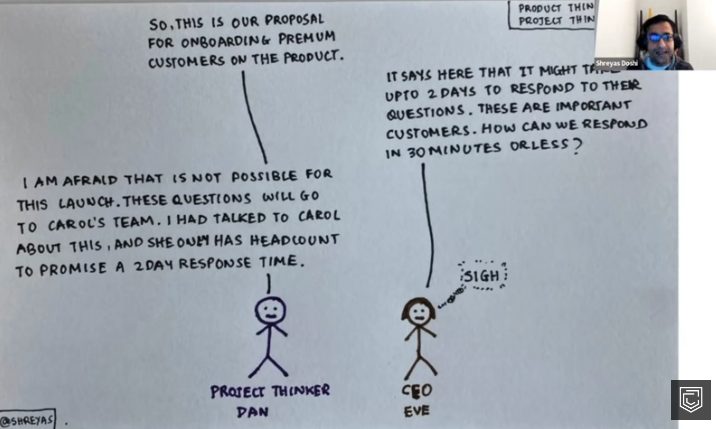
Here's an example Shreyas shared.
In the artifact below, Dan is showing only project thinking, thus frustrating the CEO Eve.
Here's how a product thinker, Pat, approaches the same situation.
By asking the right questions - Why is this important; what is our goal; what else can be done - Pat is able to offer a useful solution to the CEO and, at the same time, articulate the resources needed to meet the goals.
The Blank Sheet Method by @shaneparrish
It transforms passive reading into active learning. It forces you to engage deeply with the material, visualize your learning, and reinforce what you already know, allowing you to internalize content more effectively.
- Before reading, write what you know about the subject on a blank sheet.
- After each reading session, add new information in a different color.
- Review the sheet before your next reading session.
- Store completed sheets in a binder for periodic review.
The method primes your brain for what you’re about to read and shows you what you’re learning.
Less than 24 hours ago, Anthropic dropped Claude 3.5 Sonnet.
And people are coming up with wild use cases that is taking over GPT-4o with the new Artifacts feature.
10 examples:
This has gone semi-viral, and a lot of people think I just pulled these out of nowhere, or that I’m totally bullshitting.
That isn’t the case — serious thinking went into this. I’ll explain the rationale for each standard.
1/