A good deed never dies,they may forget what you gave,but they will never forget how you made them feel,
Keep doing good,even when no one claps for you 👏 🙌 👌
Day 2 of the Cashi Writing Contest! Six creators are walking away with $100 each!
STORY PROMPT
Write about Ada, a young woman who starts earning from an international company while still living at home. Her story should touch on opportunity, independence, and finally getting paid what her work is worth.
HOW TO ENTER
✅ Repost or quote the official Cashi announcement post below.
✅ Publish your original 250–300 word story on Medium, LinkedIn, or Substack with the hashtag #CashiWritingContest
✅ Post a summary of your story (with the link) on X or LinkedIn, tagging @Cashi and @AmieWind, with #CashiWritingContest
✅ Submit your entry in the submission form: https://t.co/qNvsIYzC5D
✅ Have a verified Cashi account to receive your prize if you win. Get it here: https://t.co/7bHA01ZO6p
Join the community https://t.co/5zMmyWEzgT for support.
Deadline is 30th September, 2026.
Love yourself a little harder, speak to yourself more kindly, and choose what brings you peace. You deserve the same love you so freely give to others 🙏
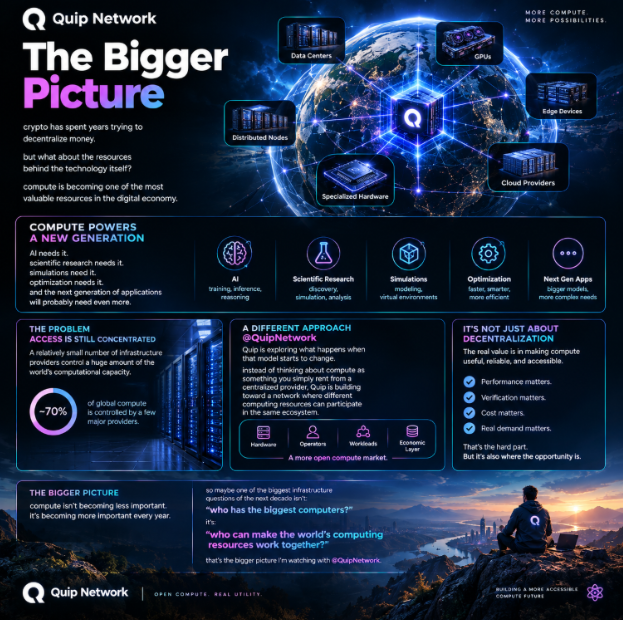
crypto has spent years trying to decentralize money.
but what about the resources behind the technology itself?
compute is becoming one of the most valuable resources in the digital economy.
AI needs it.
scientific research needs it.
simulations need it.
optimization needs it.
and the next generation of applications will probably need even more.
the problem is that access to compute is still heavily concentrated.
a relatively small number of infrastructure providers control a huge amount of the world's computational capacity.
@quipnetwork is exploring what happens when that model starts to change.
instead of thinking about compute as something you simply rent from a centralized provider, Quip is building toward a network where different computing resources can participate in the same ecosystem.
and I think the interesting part is not “decentralization” by itself.
it's the possibility of creating a more open compute market.
hardware can contribute.
developers can consume.
workloads can move through the network.
and the economic layer can coordinate the whole thing.
of course, that's easier to describe than to build.
performance matters.
verification matters.
cost matters.
real demand matters.
but if those pieces come together, the opportunity goes beyond crypto.
because compute isn't becoming less important.
it's becoming more important every year.
so maybe one of the biggest infrastructure questions of the next decade isn't:
“who has the biggest computers?”
it's:
“who can make the world's computing resources work together?”
that's the bigger picture I'm watching with @quipnetwork .