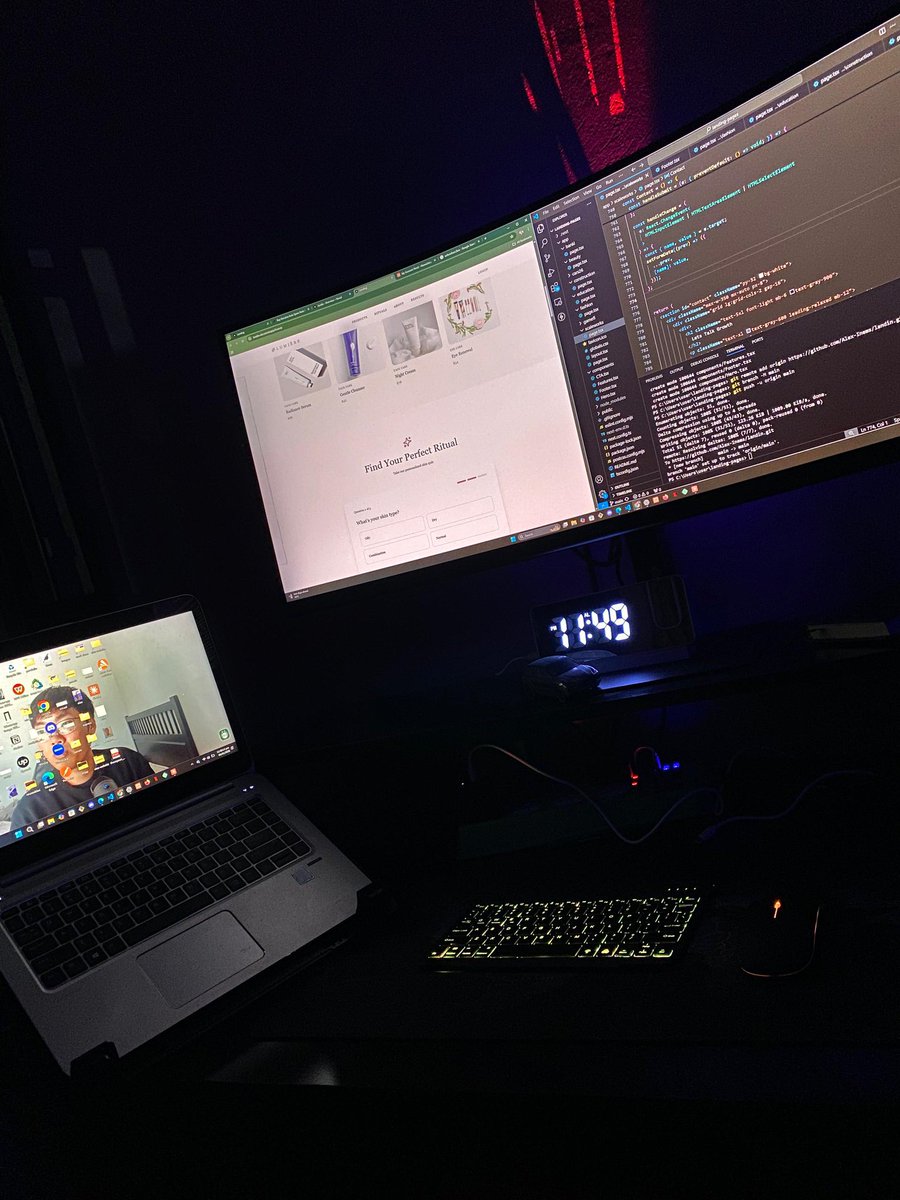
Hi, I’m Alex Thompson.
Full-stack developer.
I build scalable products using:
Next.js, React, TypeScript, Firebase (and whatever tools are necessary to ship the best solution).
I’m currently focused on building systems that real users rely on.
I share:
- dev insights
- lessons from building
- tools I find useful
Portfolio: https://t.co/TtR9iKqHUg
Let’s build something interesting.
Imagine getting 5,000 visitors to your website every month but struggling to get clients.
Here’s what the numbers might look like:
5,000 visitors.
200 contact form submissions.
20 paying customers.
That’s a 4% visitor-to-lead conversion rate and a 10% lead-to-customer conversion rate.
Now, imagine trying to fix this by spending more money to attract even more visitors.
What if the problem isn’t your traffic?
What if visitors don’t understand your offer, don’t trust your business, or find it difficult to contact you?
Traffic measures how many people show up. Conversions measure how many take the action you want.
A conversion doesn’t always mean a sale. It could be a signup, a booking, or a project inquiry.
Sometimes, the biggest growth opportunity isn’t getting more visitors.
It’s turning more of the visitors you already have into customers.
Imagine getting 10,000 visitors to your website every month and still struggling to get clients.
Now imagine a competitor getting just 1,000 visitors but consistently closing deals.
The difference might not be traffic.
It could be what happens after someone lands on their website.
Your visitors might be struggling to understand your offer, find the information they need, or trust your business enough to take the next step.
More traffic won’t necessarily fix that.
Sometimes, the biggest growth opportunity isn’t getting more people through the door.
It’s figuring out why the people already walking through it aren’t buying.
Have you ever stopped to think about why someone actually needs your technical skills?
Not what you can do with them.
But why someone would need you to do it in the first place.
Think about it.
You could spend years learning programming languages, mastering frameworks, building projects, and becoming exceptionally good at writing code.
But none of that automatically explains why someone should pay you.
Let’s take web development, for example.
A business owner doesn’t wake up every morning thinking about how badly they need React, Next.js, or a beautifully written codebase.
They have other concerns.
They want potential customers to find their business.
They want people to understand their products and services.
They want to establish credibility when someone searches for their brand.
They want a reliable way to generate enquiries and receive orders.
These are business objectives.
And sometimes, a website is part of the solution.
Your technical skills become valuable when you can connect them to these objectives.
That’s the difference between knowing how to build something and understanding why someone needs you to build it.
Don’t just learn what your skills can do.
Learn where they become useful, whose problems they solve, and why solving those problems matters.
That’s how you begin to understand the value of what you offer.
Imagine building a website for $100.
Six months later, that same website is helping the business generate thousands of dollars in sales.
The business keeps benefiting from something you built two weeks ago.
Meanwhile, you’re already looking for another $100 project.
And here’s where things get interesting…
You don’t even feel underpaid.
You feel like $100 is fair because you’re measuring the project by the hours you spent building it, the difficulty of the code, and how much you think the client can afford.
You haven’t learned to look at it from the business owner’s perspective.
You understand the technical work.
But you haven’t fully understood the business value of the solution.
Let me explain.
When a business approaches you for a website, they’re not simply looking for someone to write code.
They’re trying to solve a business problem.
They want more customers to discover their products.
They want visitors to understand what they offer.
They want potential customers to trust them enough to make a purchase.
They want a system that makes it easier for people to do business with them.
Your code is simply the means through which some of these problems are solved.
But if all you think about is how many hours it will take you to build the website, you’ll naturally price yourself around your effort.
And that’s where you get it wrong.
You’re thinking about the cost of building.
The business owner is thinking about what the solution can do for their business.
Learn to understand that difference.
It will change how you approach pricing, communicate with clients, and position your services.
Your expertise might be worth thousands of dollars.
But if your website doesn’t communicate what you do, who you help, and why someone should hire you, potential clients may leave without contacting you.
Your website shouldn’t just prove you exist.
It should help people understand why they need you.
Some rumors I've heard. I'll start with Google, then Anthropic and OpenAI.
Google: Insiders say Google has either cracked RSI (recursive self-improvement) or is very close. Their pace has picked up fast in recent months. They went from GPT-5 level to Opus 5.5 level in months, and speculation is that RSI made that possible.
Anthropic: About a week ago, Anthropic started a new pretraining run. It is not Fable 5.5 but what would become Fable 6, or something bigger, to catch up to OpenAI's Bel.
OpenAI: Bel (it may have another codename) is the model behind the math results OpenAI published a few days ago, and RSI apparently helped there too.
From what I'm hearing, OpenAI, Anthropic, and Google are all very close to cracking RSI or already have. It will get scary and exciting at the same time.