@Faltz009@samsenchal@QualiaQuanta I'll chime in because @samsenchal was kind to tag me here.
structure can be generalized to a value, so these are correctly generalized and specifically stated in my book.
The reason the gap persists is that every piece the BoE lists governs an *organization*, while the failure happens at an *artifact*: the specific moment two systems must agree on the same object and neither can prove what the other saw.
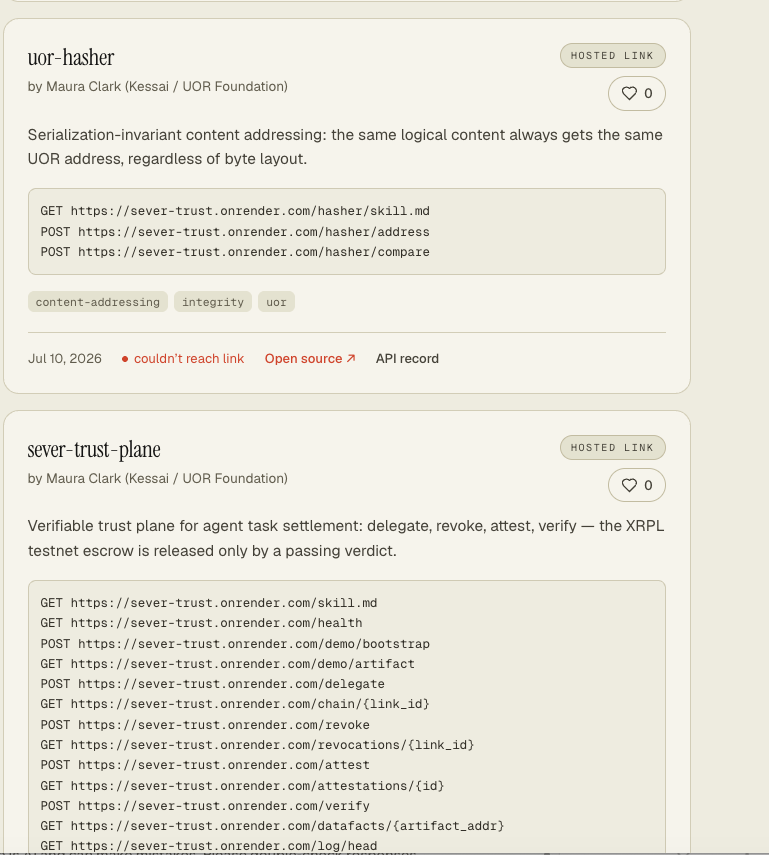
That's an addressing problem before it's a governance problem. If the artifact at the boundary has a serialization-invariant, content-derived address, both parties are provably referencing the same thing regardless of format or vendor — that's the auditable layer. Bind an attestation to that address and you get a signed record of who agreed to what, when. Put revocation on a shared trust service and the agreement can be withdrawn as fast as it was made — which matters when frontier AI compresses incident response time the way the report describes.
I've been building exactly this: UOR-ADDR (content addressing that survives re-serialization) plus Sever (attestation + revocation with on-ledger settlement). The unsigned intersection stops being unsigned when the intersection itself is addressable. Happy to compare notes — the Rotterdam scenario is a near-perfect test case. The @UOR_Foundation #UORPlatform #UORADDR #contentserialzation #Attestation #Identity #Trust
When one AI agent pays another for a task, how do you know the right agent, with live permission, produced the exact output being paid for — before the money moves? @uor_foundation@XRPLF@TrinityInvestor
Built this for @ProjectNANDA's NandaHack at MIT. It's called Sever. 🧵
Can I get some eyes on this:
Formalizing the arithmetic surface Spec ℤ ×_{𝔽₁} Spec ℤ together with the Hodge-index positivity whose truth is the Riemann Hypothesis: https://t.co/b1fgeLHie9
Honored to be a finalist at @AGIHouse Internet of Agents Build Day for RoyaltAI 🏆
The thesis: the agent economy needs what URIs gave the original Internet — one universal way to address content, chain-neutral, vendor-neutral, verifiable from public keys alone.
That's UOR-ADDR, the standard I authored — and the @UOR Foundation officially adopted it into the foundation org this week alongside UOR-Framework and Prism.
RoyaltAI is the commercial productization: per-inference royalty enforcement for AI model creators, live on @XRPLF $XRP mainnet + $RLUSD with @hedera HCS anchoring. Per-call atomic settlement, cryptographic provenance, royalty enforcement built into the protocol itself.
Demo ↓ https://t.co/orqFf9cqUy
@nickearly Thanks so much! I gave the paper a read. I'd definitely say that we are touching the same elephant. I noticed the limitations cited seem to segue nicely into our work on primitive generation too!
Here's some information about the core of UOR Presenting Sigmatics: Try it now with `npm i @uor-foundation/sigmatics` Source: https://t.co/a1DBxit8tk
https://t.co/TZdmu2bNZf
@lfrfla leads UOR Research and Hologram (the foundations first commercial project) and it's one of the most interesting projects I've seen in AI Inference.
This lab could solve sovereign AI in infra / compute and speed.
Can't wait to see the new implementation.
Basically VM-ware for AI.
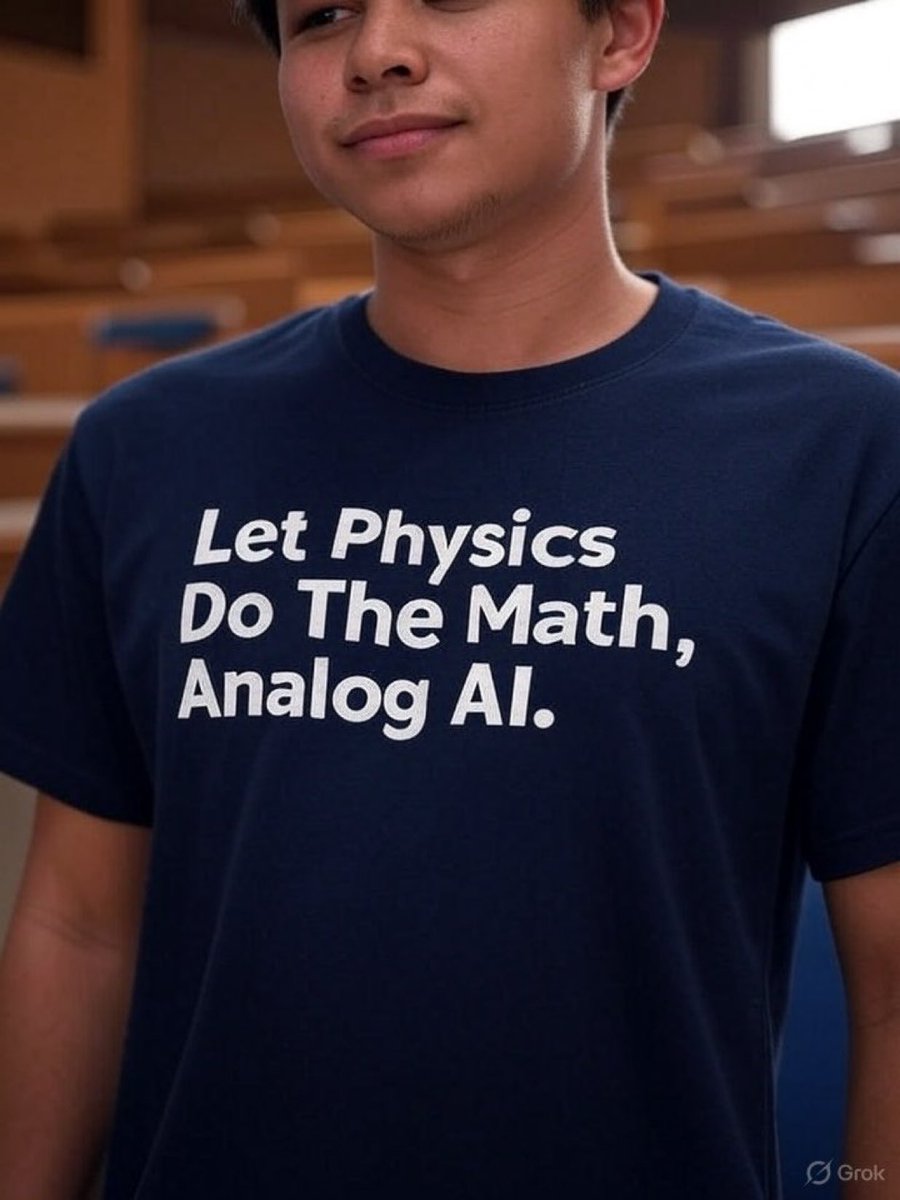
AI transformers don’t need binary math and the slow down and energy to perform it when we have Analog math that uses physics at the speed of light.
Literally the voltage differential in the circuit already did the “AI math” before a GPU can fetch a single clock cycle.
Announcing a Breakthrough from UOR Foundation
Today we unveil a Universal Mathematical Language, a discovery that bridges nature’s deepest patterns, AI, quantum computing, and beyond. At its core lies a 96-vertex “Atlas” structure encoding the five exceptional Lie groups, known as the Golden Seed Vector.
All proofs, code, and documentation are open source and community driven.
[1]. Read more: https://t.co/4IJgZWc7WF
[2]. Explore the implementation: https://t.co/sML7dss3Bh
Greetings from Colorado, and we welcome any feedback.


![TrinityInvestor's tweet photo. Announcing a Breakthrough from UOR Foundation
Today we unveil a Universal Mathematical Language, a discovery that bridges nature’s deepest patterns, AI, quantum computing, and beyond. At its core lies a 96-vertex “Atlas” structure encoding the five exceptional Lie groups, known as the Golden Seed Vector.
All proofs, code, and documentation are open source and community driven.
[1]. Read more: https://t.co/4IJgZWc7WF
[2]. Explore the implementation: https://t.co/sML7dss3Bh
Greetings from Colorado, and we welcome any feedback.](https://pbs.twimg.com/media/G3OgAy8W8AEz5wo.jpg)





