Claude for biology is shaping to be an orchestration layer with connectors and MCPs for established tools. Useful but not incredibly novel. Same with other "AI scientists," leaves one wondering whether anything more is possible.
How Anthropic's new results post would read without the PR:
Claude orchestrated open-source protein design models, PXDesign, RFdiffusion, Genie, BoltzGen, from a 30k-token expert prompt and 12,500 H100-hours of compute, and designed binders against 14 of 15 targets. Hit rates of 22–35% against a 10–15% baseline, where some of those tools already report similar numbers on their own.
The orchestration is genuinely impressive. But the open-source models did most of the lifting, and they came from the Baker lab, Columbia, MIT, ByteDance Seed, and most of them were already wet-lab validated before Claude touched them.
Which also sets the ceiling. All these generators share a single PDB-shaped training distribution, so calling four of them doesn't diversify away the blind spot, since they fail together. The targets that worked are the well-studied ones.
So the valid claim is that an agent can now drive this stack competently in the regime where the stack already works.
Instead, we got this announcement:
How Anthropic's new results post would read without the PR:
Claude orchestrated open-source protein design models, PXDesign, RFdiffusion, Genie, BoltzGen, from a 30k-token expert prompt and 12,500 H100-hours of compute, and designed binders against 14 of 15 targets. Hit rates of 22–35% against a 10–15% baseline, where some of those tools already report similar numbers on their own.
The orchestration is genuinely impressive. But the open-source models did most of the lifting, and they came from the Baker lab, Columbia, MIT, ByteDance Seed, and most of them were already wet-lab validated before Claude touched them.
Which also sets the ceiling. All these generators share a single PDB-shaped training distribution, so calling four of them doesn't diversify away the blind spot, since they fail together. The targets that worked are the well-studied ones.
So the valid claim is that an agent can now drive this stack competently in the regime where the stack already works.
Instead, we got this announcement:
I'm deeply grateful to announce the launch of @yochaiwiki - https://t.co/TDLSvY8bVX - a new way to learn Jewish texts.
The printing press made the library portable and cheap. @SefariaProject made the Jewish bookshelf free. And we're deeply grateful to them for enabling us to build atop their treasure trove. Claude and ChatGPT now make information free. But texts by themselves don't drive learning; information doesn't drive transformation. And Knowledge isn't "chiddush" (insight). The next frontier is personalized guidance through the library and the formation of deliberate practice.
Yochai is a Socratic AI "chevruta" or learning guide, powered by a foundational library of 1,000+ primary sources from the Jewish canon, (and a knowledge graph of 2.5M entities, and 16M entity relationships, 375,000 searchable passages, and 17,000 canonical concepts that we developed around our own ontology). Yochai, uniquely, takes you directly to the sources and pushes you to discover and articulate your own insights about them.
In addition to asking Yochai questions of life adviceor intellectual and spiritual interest, you can read the texts with Yochai's "lenses" in the margins, ask Yochai to produce lesson plans and source sheets, divrei Torah, textual outlines, and lit reviews, all backstopped by a verified library.
Yochai takes its name from Shimon Bar Yochai, 2nd century sage and purported author of my namesake.
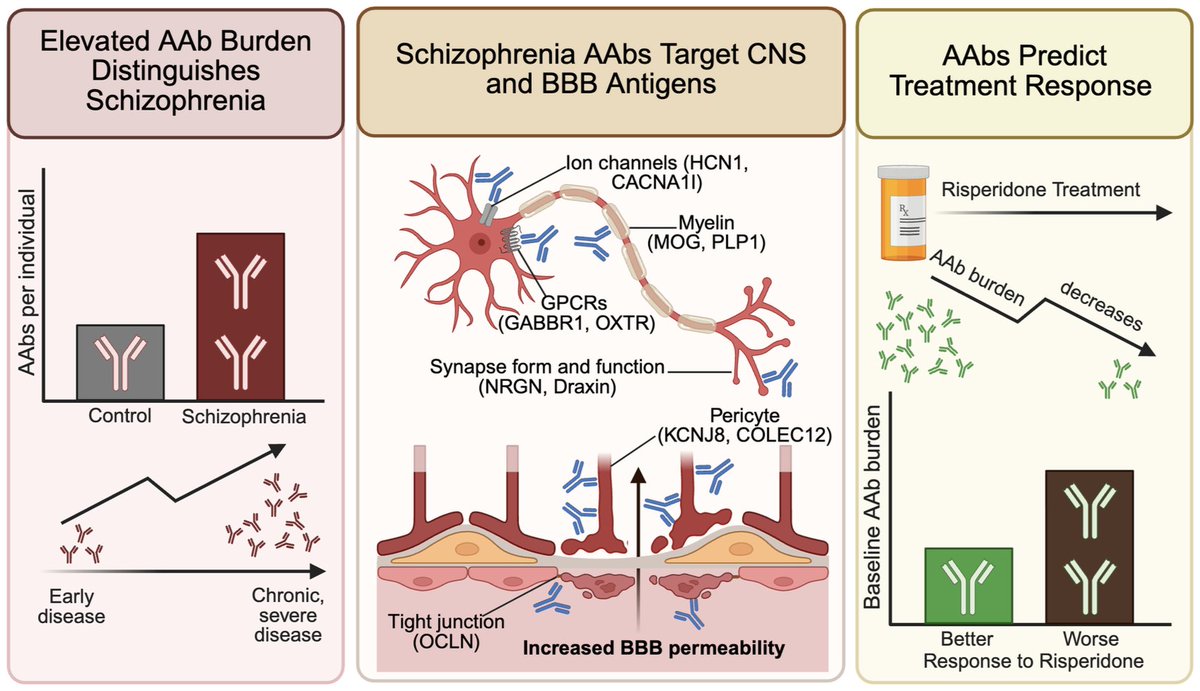
Autoantibodies cause autoimmune disease, shape infection outcomes, and alter cancer immunotherapy. But what role might they play in neuropsychiatric disease? In our new preprint, Katlyn Nemani and @JillianRJaycox take on this question in schizophrenia. 🧵
https://t.co/lmL4sx7QSz
We all know about small molecule polypharmacology; kind of crazy that we are only now learning that approved/late-clinical mAbs often have real off-target interactions (including pembrolizumab and lecanemab!)
How specific are therapeutic monoclonal antibodies, really?
In our new paper, @Yile_Dai led a collaboration with Adimab to profile 174 FDA-approved and clinical-stage mAbs against 6,172 human extracellular proteins.
What we found surprised us.🧵
https://t.co/ONTSF60B2g
✡️ -- MIRACLE CAUGHT ON CAMERA: A Talmid Chacham in Eretz Yisroel was calmly putting away a sefer in a Shul in Rishon Letzion on Monday, when suddenly the heavy bookcase loaded with sefarim collapsed right on top of him.
BH, he walked away completely uninjured!
'Torah Magna Umatzla'
🎥 @moshe_nayes