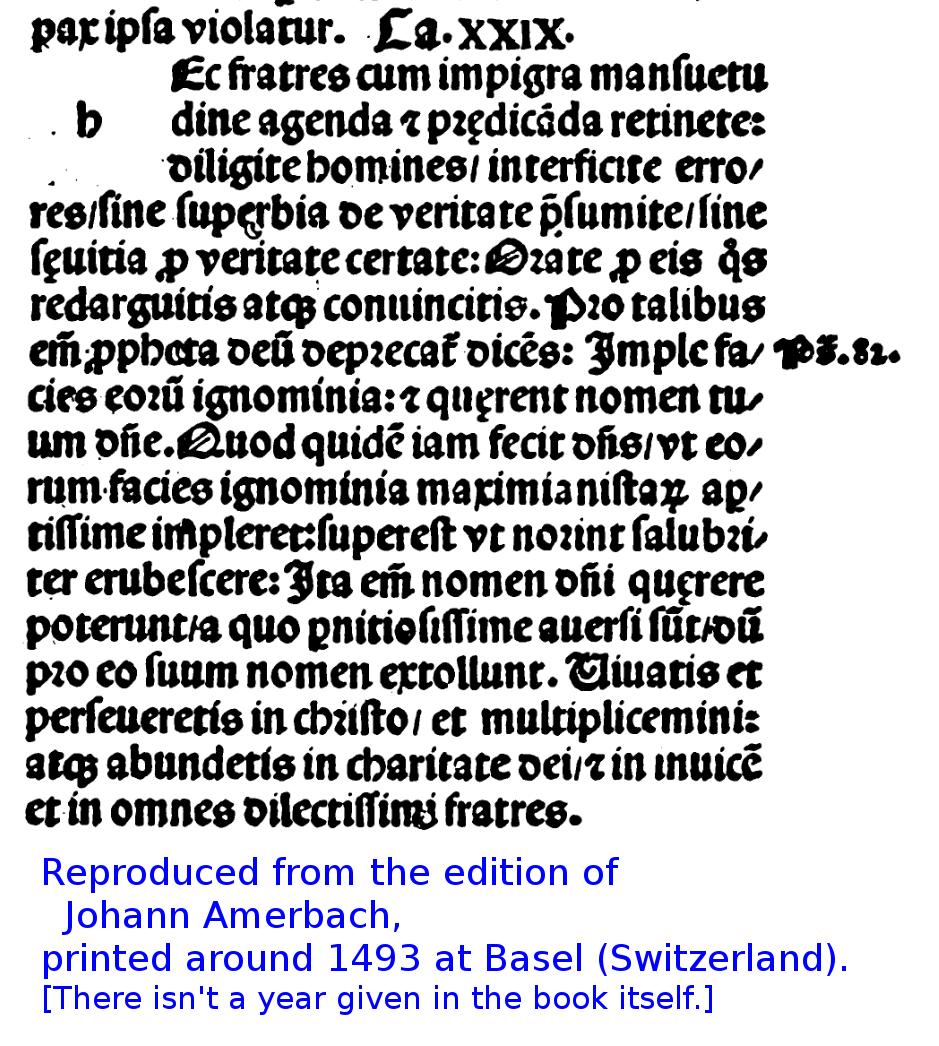
»..diligite homines, interficite errores, sine superbia de veritate praesumite, sine saevitia pro veritate certate, orate pro eis quos redarguitis atque convincitis.«
St. #Augustine(354–430),
Contra Litteras Petiliani,
Book 1, Chapter 29
#Christianity#ChristianCulture#Europe
Interaction nets are a model of computation that treat a program as a graph that is rewritten in small, localized steps. Every dependency is explicit and every value has exactly one owner, so independent steps can run in any order, or all at once, and give the same result.
In theory, this should remove the need for a large amount of modern CPU hardware, including large caches, coherency, locks, and more. We highly recommend reading “On Interaction Nets” from @TendrilsCompute for an intuitive explanation.
The Interaction Net is inherently parallel, memory-efficient, high-order, mathematically elegant in a way that nothing else is. It is capable of computing λ-terms exponentially faster than existing λ-calculators(!) and it supersedes Turing Machines and Automata in several senses.
The Interaction Net is inherently parallel, memory-efficient, high-order, mathematically elegant in a way that nothing else is. It is capable of computing λ-terms exponentially faster than existing λ-calculators(!) and it supersedes Turing Machines and Automata in several senses.
The Interaction Net is inherently parallel, memory-efficient, high-order, mathematically elegant in a way that nothing else is. It is capable of computing λ-terms exponentially faster than existing λ-calculators(!) and it supersedes Turing Machines and Automata in several senses.
Introducing Frostbite: a new class of CPU built around interaction nets.
Given only interaction net theory, our agents co-designed the ISA and chip architecture from scratch, running large swarms to design, verify, and optimize the CPU down to the final GDS.
On our first set of target workloads, Frostbite is 4.6x more performant per watt than modern traditional CPUs at similar area.
@1jpablo1@worlddestroyar@insurrealist Yes, and Logic Programming uses a similar, iterative, and nondeterministic, paradigm (though its traditional form is NOT Turing-complete, intentionally so).
New mathematical problems will arise because of the new tools, analogously to straightedges, compasses, sun-dials, lenses, telescopes, antennas, etc. By far not all of the new problems are going to be accessible to the then current state of the AI (e.g. because of interfaces).
Cybernetics and that part of complex systems and control is going to be very popular again! (This includes NeuroAI, which in my opinion -probably biased - is better interpret as cybernetics).
New mathematical problems will arise because of the new tools, analogously to straightedges, compasses, sun-dials, lenses, telescopes, antennas, etc. By far not all of the new problems are going to be accessible to the then current state of the AI (e.g. because of interfaces).
An example: I predict that there is going to be an analogue of Numerical Analysis for the novel AI-assisted proof-search. Each of
1) iterative solution-search-algorithms
2) condition of a problem
3) forward- and backward-error-analysis
have meaningful analogues for proof-search.
Cybernetics and that part of complex systems and control is going to be very popular again! (This includes NeuroAI, which in my opinion -probably biased - is better interpret as cybernetics).
New mathematical problems will arise because of the new tools, analogously to straightedges, compasses, sun-dials, lenses, telescopes, antennas, etc. By far not all of the new problems are going to be accessible to the then current state of the AI (e.g. because of interfaces).
Recent expert opinion agreeing with this.
"Dare change one [definition?] Then you [have to wait for] days to have the proof-checker re-check all of this..
For AI writing proofs, proof-checking is already actually a bottleneck!"
Martin Kleppmann, 2026-09-17 [v=qHsQctTSpjA]
Soon we will have symbolic proofs whose full verification can take days on a cpu cluster or even weeks. It's only a matter of time before AI-generated mathematics converges to full blown theology.
GPT built a website that converts logic formulas into Quine's bond notation. Make the scope of quantifiers visual and highlight the meaninglessness of bound variables themselves. Feel free to play around with it, make some memes, and see who can come up with the funniest ones:
ChatGPT is not 'intelligent' as of 2026-11-18. I am sure of that from discussing easy proofs with it. Again and again it reasons in cumbersome, redundant ways that make it clear that it merely collates bits and pieces in its training-data.
(Usual caveat: free tier.)
@BrunsJulian1541 Yes, and it is sad how 'oppositely oriented' to the Computing-Revolution 1.0 (~personal computing) the current Computing-Revolution 2 (~centralization of matchless computing services by greedy hoarding corporations) is.
Relevant: https://t.co/0p1MypEfUW
"Open source [math-AI-]models are like two years behind [the proprietary ones].
..
It would be much better if there were good open-weight, open-source [ones] but there just aren't."
Andrew J. Blumberg, on 2026-10-30
[v=oftWYjFHbgQ; 18m30s]