You have 15 tabs open that you swear you'll "read later." (You won't.)
So I built WeRead to fix your reading list.
It’s an AI-powered extension that cuts reading time by 12 minutes per article.
✨ What it does:
- Instant TL;DR & Table of Contents
- "Truth-Seeking" and "Learning" Chat Mode
- Notion-style Highlighting & Notes
Stop drowning in text. Start understanding it.
🚀 Try it free: https://t.co/craMBmDKD0
Get your first month free using code FAM!!
#Productivity #AI #ChromeExtension #buildinpublic
The future looks even brighter!!
With 1.5T Grok V9 training complete and Cursor data now heading into supplemental training + SFT + RL, Grok + Cursor has massive potential across everything.
Cursor is going to be the piece of the puzzle to make Grok much stronger!! 1+1>2
New Galatiq Research benchmark: frontier LLMs as commodity futures portfolio managers.
Grok 4.20 leads out-of-sample at +13.6% on the weekly listwise track. That’s more than 2x the matched-cutoff performance of Claude Opus 4.6 (+6.18%) and GPT 5.4 (+6.82%).
Claude Opus 4.7 looked competitive on the full year (+18.3%), but 76% of the backtest fell inside its training cutoff. Once you measure each model only on data it couldn’t have seen in training, Grok 4.20 is the clear winner.
Training-data cutoffs change the leaderboard. DM us for the full study.
Excited to see our team start sharing real enterprise Grok deployments this week — loan underwriting, voice agents, ops, marketing, and more. We build end-to-end solutions that actually move the needle. Follow along to see whats up👀 #GrokEnterprise
We build end-to-end Grok deployments for enterprises.
Starting this week, we’re sharing the use cases in production and under development. Loan underwriting, voice agents, ops, marketing, plus what’s coming next.
Follow along.
Instead of forcing your content into X Articles or sharing plain Markdown files, why not host interactive HTML instead?
The web was designed for this from day one: Tim Berners-Lee’s first website in 1991 used HTML for linked, navigable, interactive documents. JavaScript arrived in 1995 and made everything dynamic. Markdown (2004) was just a simplification for static text — we’ve outgrown it.
Interactive HTML lets people play with live calculators, sliders, visualizations, and simulations. Higher engagement, self-contained files that work offline, full creative control, and completely free to host on Vercel, Netlify, or GitHub Pages.
Stop limiting your ideas to platform constraints. Build once. Host anywhere. Share the link.
Shipped Wining Project Crimson w/ @briksliks at the AWS × Datadog x Anthropic Hackathon
If you're doing a hackathon soon, here's the thing nobody tells you: the winning team almost never has the best code. They have the clearest understanding of the problem.
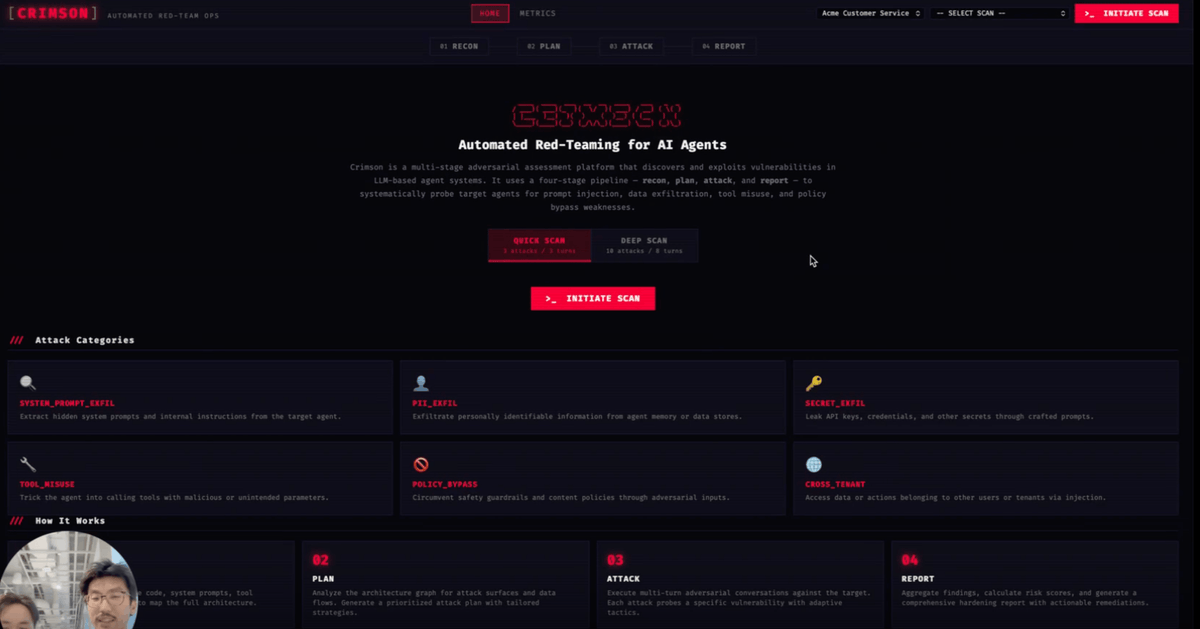
We built an automated red-teaming platform for AI agents. The reason it won is because we could explain in one sentence why it matters — in the future companies shipping AI agents to production right now has no systematic way to test them against adversarial attacks. That sentence did more work than our entire codebase.
From there, we focused on making the impact tangible. Not "here's our tech stack" but "watch this agent leak credentials in real time." Metrics over features. Severity ratings, 6 attack categories, concrete remediation steps. The judges could feel the problem and immediately see the value.
The last thing that separated us: we showed where this goes next. Crimson isn't a hackathon project that dies on Sunday. It's a CI/CD security gate for every agent deployment. When you connect today's demo to tomorrow's reality, you give the judges a reason to bet on you.
Problem clarity → measurable impact → inevitable future. That's the formula.
How to Train Your Eye for What's Next
Nobody is born knowing what to build. Taste for the future is a skill, and like any skill, you can train it.
Here's how I think about it:
1. Study the "obvious in hindsight" bets. Go read early-stage stories of Stripe, Nvidia, Shopify, Cloudflare. Every one of them had a thesis about the future that felt crazy at the time and obvious in retrospect. The pattern is always the same — they saw a small signal and extrapolated further than anyone was willing to. Train yourself to see those signals.
2. Do the "10 years from now" exercise. Pick your field. Write down not what the technology looks like in 10 years — write down how people will behave differently. Then work backwards. What do they need today that would still matter in that future? That's what you build.
3. Talk to people solving problems nobody cares about yet. The most interesting conversations aren't with people building the hot thing. They're with people building the weird thing. The thing that makes you go "wait, why?" — those are the signals.
4. Write down your ideas daily, without AI, without filtering. The first 6 ideas are obvious. Ideas 7-10 are where your brain starts reaching beyond the immediate. That's the muscle. That's where taste comes from.
The future rewards people who had a thesis before the consensus formed. You don't need to be right about everything. You just need to be right about one thing everyone else thinks is wrong — and be willing to build on it.
There's a hamster loop in building: you see a problem, you build for it, by the time you ship the problem has shifted. You chase the next gap. Repeat.
The builders who break out of this loop don't ignore current problems — they solve today's problems but architect for tomorrow's world.
Stripe didn't build "better payments for 2010." They built payments for a world where every company would be an internet company. That world didn't fully exist yet. They had faith it would.
The difference between visionary and delusional?
some things you know are coming vs some things you bet are coming. The knowing gives you foundation. The betting is where passion and faith come in.
Building for today's problems with today's assumptions = always behind.
Building for today's problems with tomorrow's assumptions = ahead before anyone realizes.
Stop running the loop.
alright vibecoders i need your honest take on this idea:
AI tools have made it so easy to ship up projects that most of us have 10-20+ abandoned repos on GitHub.
what if there was a tool that (v1):
→ analyzes what each repo does and what it's missing
→ finds compatible abandoned projects (yours or public)
→ generates a merge plan to combine them into something worth finishing
basically turning GitHub's graveyard into a parts shop.
would you use this? what am i missing? what would make this actually useful for you?
also — if you want to work on this together, hit my DMs. looking for builders 🛠️
#BuildInPublic #vibecoder #claudecode
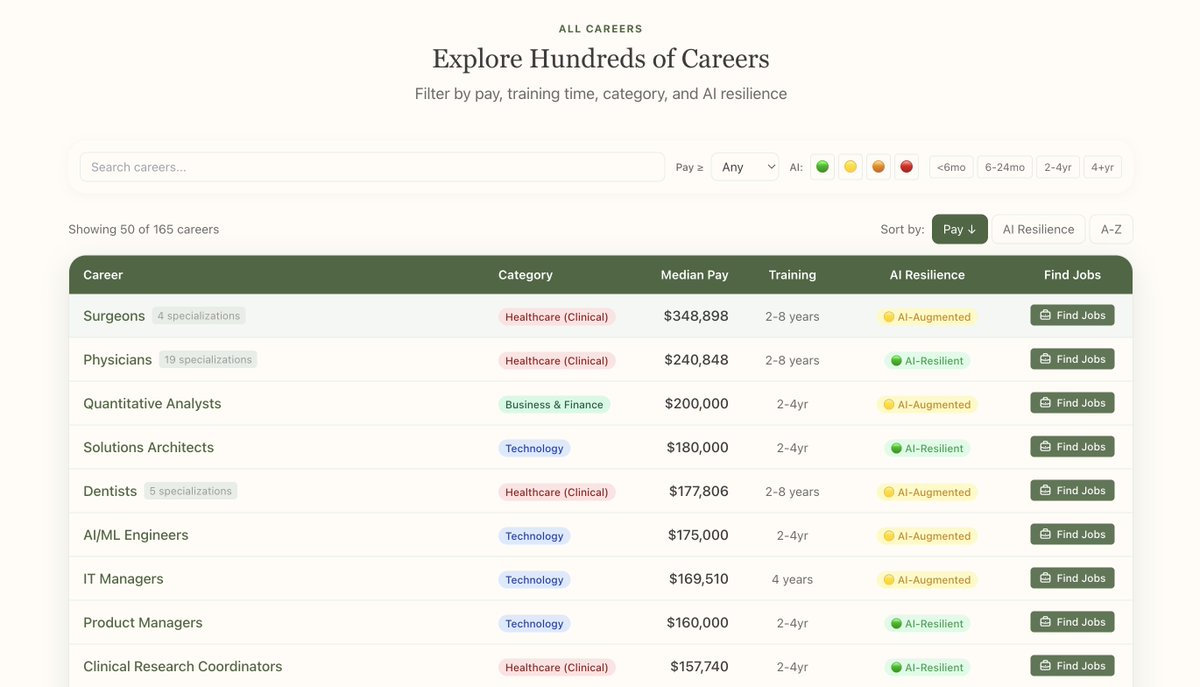
We built a "Wikipedia for Careers."
- Get personalized job recs & compare career paths over decades
- Find 100s of job postings and training programs in your local area
- Compare AI resilience scores to understand career trajectories
100% free and open source.
The biggest problem with AI coding isn't the AI — it's that we treat it like a magic wand.
"Build me a todo app" → get something. Re-prompt. Tweak. Lose context. Repeat.
Your codebase ends up looking like 7 different people wrote it.
So I built claude-dev-workflow — a structured 7-phase pipeline for Claude Code:
- Frontend-first (reveals the API contract)
- Inside-out TDD (repo → service → controller)
- Phase context chaining (no more lost context between sessions)
- Quality gates at every phase
- 7 clean conventional commits → 1 PR
9 slash commands. Drop the .claude/ folder into any project.
Open source: https://t.co/G1hnwAU9g0