Submitted the very first swap transaction immediately after the MAPO exploit.
Below is a case-by-case breakdown of the maximum potential profit I could have captured from MAPO using @Web3MapInk pro (only $49/month)
Using alerts + auto-buy, I bought MAPO first right after the exploit and acquired 453M MAPO for $300.
The key question was how to exit the position. There were three main options:
1. Simple sell on the same chain (~75x)
Based on the OKX quote, I could have received at least $25K, which is roughly a 75x return.
However, since the OKX quote was not auto-refreshing, this may not have been the exact local top.
2. Bridge to BSC and sell (~420x)
There was a swap transaction of around $3,300 for 1.1M MAPO:https://t.co/6GpYlR523M
A simple calculation would value 450M MAPO at around $1.35M, but considering pool liquidity and price impact, that would likely have been impossible.
Still, I believe capturing at least $150K+ (~420x) could have been realistic.
3. Bridge to MAPO and send to Bithumb (~840x–1,680x)
This was likely the most profitable route.
This wallet appears to have sent around 100M–200M MAPO to Bithumb and is currently estimated to have made over $300K in profit: https://t.co/NqfYRGqD8V
If I had sent my full position and the order book could absorb it — or if I had sold gradually — I believe $300K–$600K could have been possible, roughly 840x–1,680x.
In most exploit events, bridges tend to close very quickly.
Many wallets that bridged too late appear to have ended up with forced burns.
For events like this, I believe the two most important factors are:
1. Buying faster than anyone else
2. Finding and using the bridge route immediately
With personalized Telegram alerts delayed by at most 30 seconds, Web3 Map Pro can help users access this kind of information as quickly as possible.
Web3 Map detected the @MapProtocol exploit faster than anyone else. (~20 sec)
Alerts were sent just 20 seconds after the exploit.
Web3 Map creator @LHW0803 bought MAPO only 30 seconds after the first dump
— the first buy transaction over $30 after the crash.
(tx: https://t.co/ZRqR0rVJ65)
He swapped $300 for 460M MAPO, which reached around 70x at the local DEX high.
One of our users, @parnakr (Tg handle),
used Web3 Map to find the bridge route and captured 5 figures+ in profit.
Many other subscribers also captured the opportunity.
Congrats to everyone.
Web3 Map detected the @MapProtocol exploit faster than anyone else. (~20 sec)
Alerts were sent just 20 seconds after the exploit.
Web3 Map creator @LHW0803 bought MAPO only 30 seconds after the first dump
— the first buy transaction over $30 after the crash.
(tx: https://t.co/ZRqR0rVJ65)
He swapped $300 for 460M MAPO, which reached around 70x at the local DEX high.
One of our users, @parnakr (Tg handle),
used Web3 Map to find the bridge route and captured 5 figures+ in profit.
Many other subscribers also captured the opportunity.
Congrats to everyone.
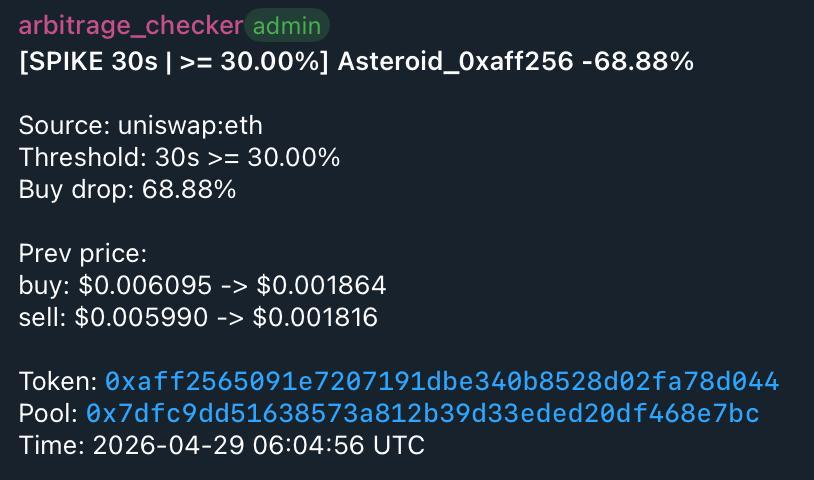
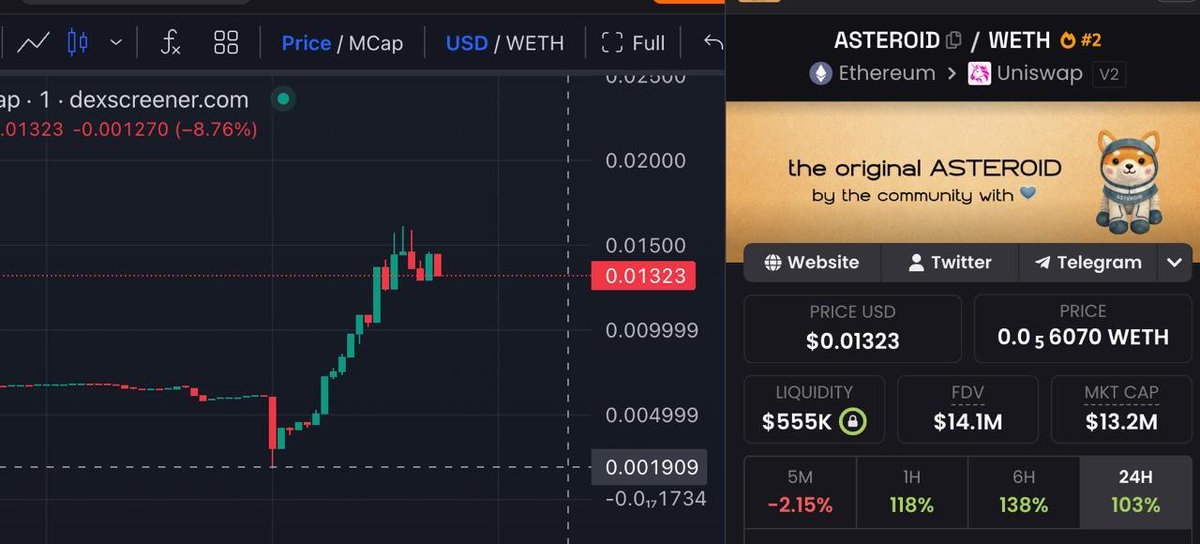
We catch the price drop of @AsteroidCoinOG today
Alerts went within 15 seconds.
Chance of x6.
Only 2 days left for the free pro event.
Try https://t.co/gJeuEyFFjf
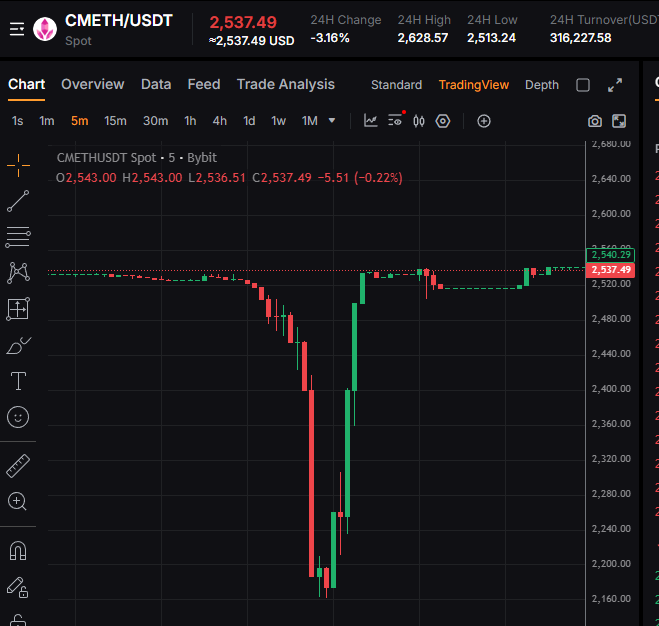
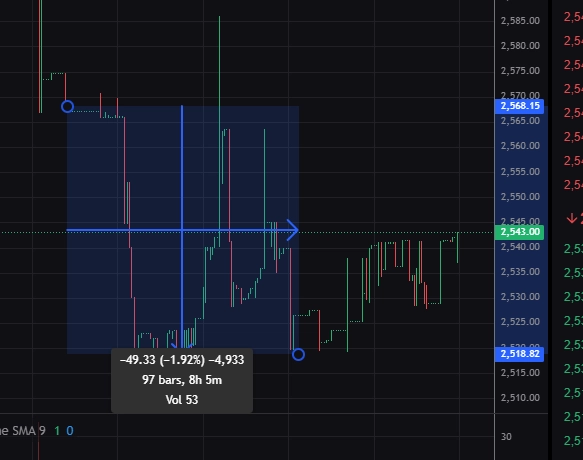
April 23, 2026 / Arbitrage Recap — cmETH (Mantle <-> Bybit)
- Event Time: 23 Apr 01:15 ~ 09:20
- Detection Time: 23 Apr 01:15
- Cause: Possible market maker error
- Route / Execution: Buy bybit - Sell Mantle Moe (or other dapp)
pool: 0x38e2a053e67697e411344b184b3abae4fab42cc2
token: 0xe6829d9a7ee3040e1276fa75293bde931859e8fa
- Expected Profit: ~1% x n times
Apart from Web3 Map, few platforms track prices all the way to Mantle, and it appears that Bybit’s price remained artificially low due to a market maker error.
The market maker on that exchange made a similar mistake on April 17, 2026 as well, so this pair warrants close monitoring.
source: https://t.co/vD3McqdMou
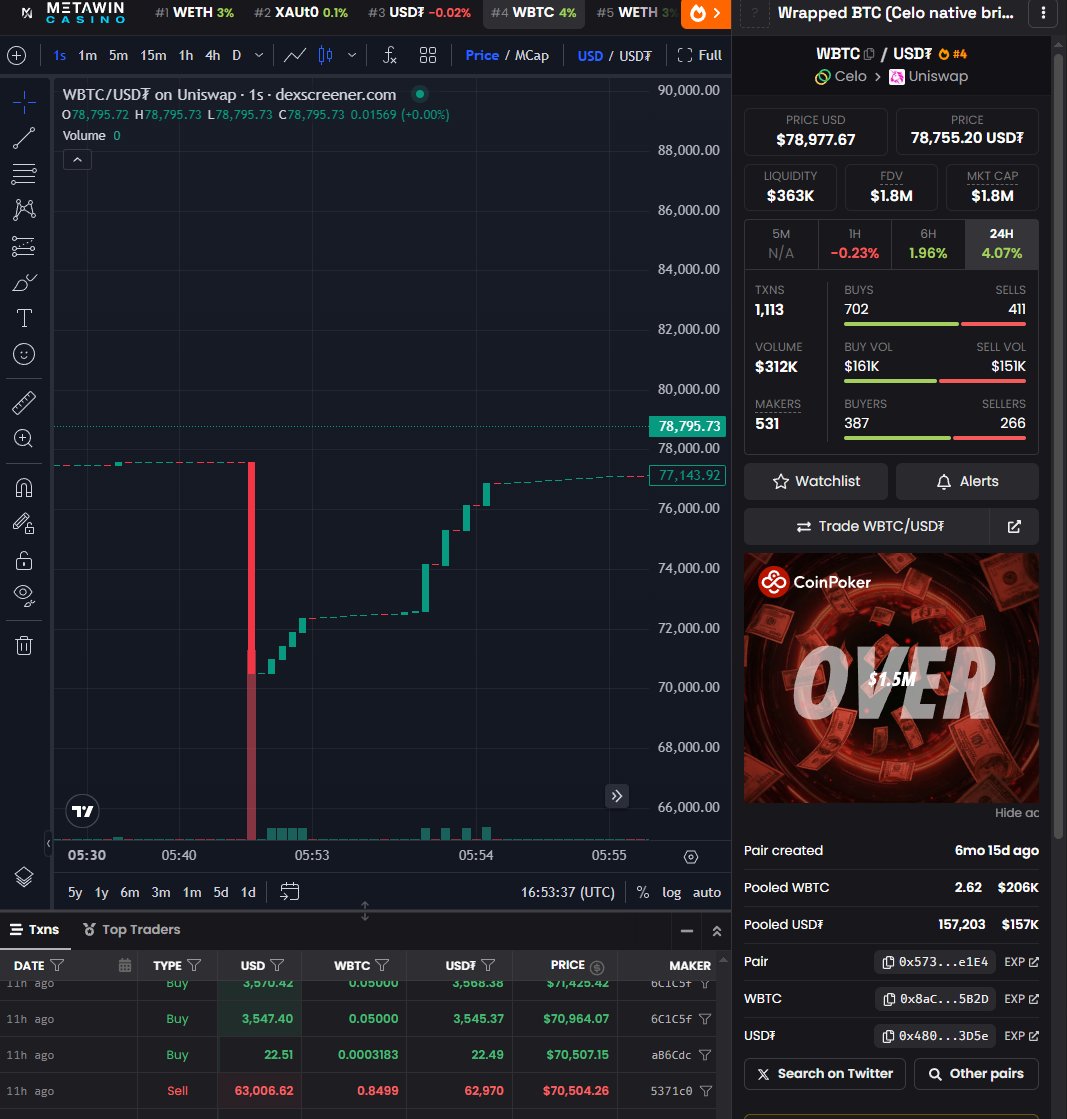
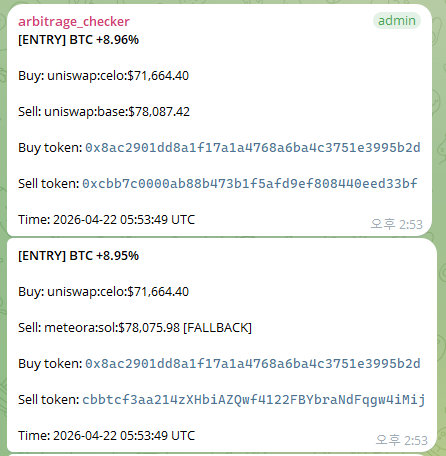
April 22, 2026 / Arbitrage Recap — wBTC (celo)
- Event Time: 22 Apr 05:52:39
- Detection Time: 22 Apr 05:52:54 (+15 sec)
- Cause: Fat finger dump 60k in the small tvl pool
- Route / Execution: buy Uniswap in Celo
pool: https://t.co/6f5DLWfkSR
token: https://t.co/kSrN9BRaRV
Because the gap was caused by a simple large sell-off mistake, no bridge to another chain was required.
- Expected Profit: +8.96%
There was sufficient liquidity, it was possible to swap well over $1,000 during this event.
At peak profitability, buying the 0.85 BTC sold in the fat-finger trade required an investment of around $63,000, with an expected profit of roughly $2,000.
(The timestamp shown in the image is based on an unsynchronized server clock and may differ from the actual on-chain time.)
source: https://t.co/T5NP0E6cu8
Introducing @Web3MapInk — a platform for detecting cross-chain arbitrage opportunities and potential exploits.
We detect opportunities across 10,000+ price sources.
(Detected the USR and DOT exploits within 30 seconds.)
Page: https://t.co/wscxbnwhwo
Learn more 👇
Introducing Privacy Boost: onchain privacy SDK for enterprise.
The first privacy offering for @Optimism. Now live on OP Mainnet.
Enterprises need regulatory-friendly privacy.
LLM Knowledge Bases
Something I'm finding very useful recently: using LLMs to build personal knowledge bases for various topics of research interest. In this way, a large fraction of my recent token throughput is going less into manipulating code, and more into manipulating knowledge (stored as markdown and images). The latest LLMs are quite good at it. So:
Data ingest:
I index source documents (articles, papers, repos, datasets, images, etc.) into a raw/ directory, then I use an LLM to incrementally "compile" a wiki, which is just a collection of .md files in a directory structure. The wiki includes summaries of all the data in raw/, backlinks, and then it categorizes data into concepts, writes articles for them, and links them all. To convert web articles into .md files I like to use the Obsidian Web Clipper extension, and then I also use a hotkey to download all the related images to local so that my LLM can easily reference them.
IDE:
I use Obsidian as the IDE "frontend" where I can view the raw data, the the compiled wiki, and the derived visualizations. Important to note that the LLM writes and maintains all of the data of the wiki, I rarely touch it directly. I've played with a few Obsidian plugins to render and view data in other ways (e.g. Marp for slides).
Q&A:
Where things get interesting is that once your wiki is big enough (e.g. mine on some recent research is ~100 articles and ~400K words), you can ask your LLM agent all kinds of complex questions against the wiki, and it will go off, research the answers, etc. I thought I had to reach for fancy RAG, but the LLM has been pretty good about auto-maintaining index files and brief summaries of all the documents and it reads all the important related data fairly easily at this ~small scale.
Output:
Instead of getting answers in text/terminal, I like to have it render markdown files for me, or slide shows (Marp format), or matplotlib images, all of which I then view again in Obsidian. You can imagine many other visual output formats depending on the query. Often, I end up "filing" the outputs back into the wiki to enhance it for further queries. So my own explorations and queries always "add up" in the knowledge base.
Linting:
I've run some LLM "health checks" over the wiki to e.g. find inconsistent data, impute missing data (with web searchers), find interesting connections for new article candidates, etc., to incrementally clean up the wiki and enhance its overall data integrity. The LLMs are quite good at suggesting further questions to ask and look into.
Extra tools:
I find myself developing additional tools to process the data, e.g. I vibe coded a small and naive search engine over the wiki, which I both use directly (in a web ui), but more often I want to hand it off to an LLM via CLI as a tool for larger queries.
Further explorations:
As the repo grows, the natural desire is to also think about synthetic data generation + finetuning to have your LLM "know" the data in its weights instead of just context windows.
TLDR: raw data from a given number of sources is collected, then compiled by an LLM into a .md wiki, then operated on by various CLIs by the LLM to do Q&A and to incrementally enhance the wiki, and all of it viewable in Obsidian. You rarely ever write or edit the wiki manually, it's the domain of the LLM. I think there is room here for an incredible new product instead of a hacky collection of scripts.
[TLDR: dr-manhattan solves liquidity problem in prediction markets]
1/ Prediction markets are exploding. Polymarket, Kalshi, Limitless, Opinion... new venues and markets launching every day.
But here's the problem: orderbook is too thin. Traders struggle to enter positions at fair prices—and exiting is even harder.
Too many markets. Not enough depth.










![drmanhattan_oss's tweet photo. [TLDR: dr-manhattan solves liquidity problem in prediction markets]
1/ Prediction markets are exploding. Polymarket, Kalshi, Limitless, Opinion... new venues and markets launching every day.
But here's the problem: orderbook is too thin. Traders struggle to enter positions at fair prices—and exiting is even harder.
Too many markets. Not enough depth.](https://pbs.twimg.com/media/G88PADxbYAAf12p.jpg)





