This is f*cking insane.
Everyone is talking about Trump asking Nvidia to give Jensen Huang a "second chance"
Almost nobody is talking about what Jensen told Lex Fridman about TSMC:
"Three decades. I don't know how many tens, hundreds of billions of dollars of business we've done through them.
And we don't have a contract"
In 3 minutes, he explains how Nvidia's supply chain runs on trust instead of paper, and why he turned down the chance to run TSMC in 2013
Today the WSJ called his handshake deals a danger for Nvidia
When a founder leaves, most people count his shares.
Jensen is describing the asset that doesn't transfer:
Promise → delivery → trust → billions in capex on his word
Old way: lawyers sign the contract, then the partner builds
New way: the founder explains it from first principles, and partners commit "several billion dollars of capital investments each"
The board can hire a new CEO. It can't hire 30 years of trust
This 3-minute clip explains Nvidia's next problem better than any analyst note
I’ve spent much of this year helping Shenzhen prepare for APEC. China and Xi want to use this moment to introduce the world to a city that much of the world still doesn’t know. For decades, Shenzhen has been hiding in plain sight. No sitting US President has ever been here, nor has Elon Musk.
The world’s attention has been on Beijing’s politics and Shanghai’s finance, while Shenzhen has quietly become the most important center of technological innovation and industrial execution on Earth.
To those seeing Shenzhen for the first time: the technologies being showcased for APEC aren’t nearly as interesting as the technologies that ordinary people here use every day.
A carefully choreographed week of demonstrations can show what China is capable of producing, but it cannot fully capture what happens when an entire city becomes an enormous real-world feedback loop between engineering, manufacturing, consumers, and deployment. Outsiders consistently underestimate this.
Shenzhen hasn’t exactly been China’s secret, at least intentionally. It has been the rest of the world’s blind spot. And after this week, ignorance about what is happening here will be a much harder excuse. Shenzhen is about to be famous.
Elon Musk says Nvidia made a mistake removing Jensen Huang, confirms he's spoken with him privately and says he would hire him himself: "who wouldn't?"
"I would call Jensen, Michael Jordan, perhaps at his peak level, in terms of what he means to a team."
"You got a winning streak that's just gonna happen, and then you kick Michael Jordan off your team. Doesn't seem like a smart decision to me."
"There's no one that can really replace Jensen. He does the roles of several people. He's managing supply chain. He has long-term relationships that have been built up over decades. He understands his technology incredibly well."
"His team loves him. And many of them are there because of him, and have had higher offers to go elsewhere and have turned them down because of personal loyalty to Jensen."
"He's one of the most talented entrepreneur CEOs in history. Who wouldn't want to hire Jensen?"
Nvidia board underestimated the challenge of managing global semiconductor supply chain.
There are 1.3m subcomponents in a Vera Rubin rack. Prob 1,000 high-tech vendors and 85% of are in East Asia (South Korea, Taiwan, China, Japan).
Many of those deals have no contract and are negotiated over a local beer (probably mixed with a rice-based liquor), some type of deep fried protein, comically small restaurant chairs and then closed with a spit and handshake.
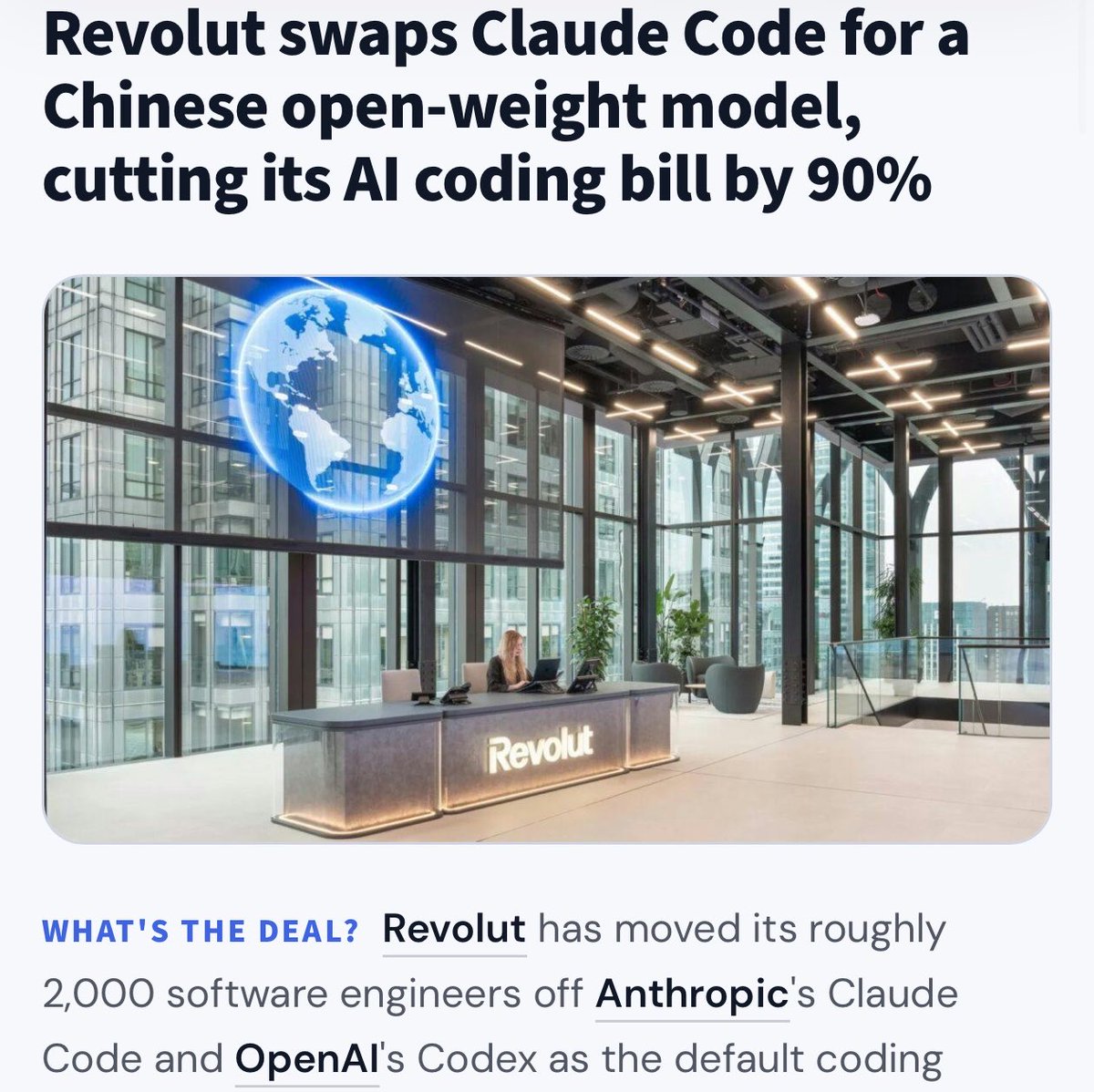
The big theme at Web Summit this year is the rise of Chinese open source models, and the increasing likelihood western AI companies are yesterday’s news.
Too many tech conferences in Europe and the US are suiciding themselves by platforming yesterday’s news.
Europe’s tech conferences in particular have been decimated in recent years. Attendee numbers have completely collapsed. Why?
IMHO the mistake they’ve made is they’ve increasingly become content marketing departments for a small number of Silicon Valley VCs who are over exposed / over invested in a small number of mostly AI companies.
These conferences entertain ridiculous panels where investors interview their own portfolio companies. Who wants to hear that type of low value nonsense.
Sure it might be lucrative for a conference organiser in the short term, but it’s an insult to the intelligence of their attendees. Those attendees, who are tech founders and/or work in tech, are voting with their feet and abandoning some previously great startup / tech conferences.
The implosion of several previously great conference is ultimately bad for Europe.
Anyway, like it or not the future of technology is increasingly Chinese. If you don’t have Chinese AI labs, in particular, headlining your speaker roster, you’re yesterday’s news.
You’re adding almost no value for attendees. A tech conferences job is to create a window into the future for attendees, not to force feed attendees outdated VC content marketing slop.
Open source software for your Muse personal agent so you can literally vibe code any gadget you can imagine in your life, build stuff for your friends, or create net new hardware products that are crazy smart out of the box
🚨 side project alert 🚨
Announcing Muse Gadgets, an open source ESP32 firmware and Linux sdk so that you can make hardware devices that work with Muse.
Grab an API token from https://t.co/Q0dE0cYnCs and point your favorite coding agent at the github repo to build your own peripherals for Muse.
Still reflecting on the remarkable life of @Om Malik since his recent passing.
Loved the new set of quotes and stories John @Gruber shared on @DaringFireball. (Thanks for including me.)
We can all learn from the tenacity and the humanity of Om Malik.
https://t.co/seqxgn08eL
We pushed back on Chinese guānxì (“关系”) as strategy as early as 1997.
Even then—when relationships mattered more—it was clear:
relationship-peddling in China had a shelf life.
So, long before I founded Super 8 China—
I built @apcoworldwide China around data-driven issue management.
Helping MNCs navigate entry, scale, and complexity.
That model held.
Guanxi isn’t a strategy.
It’s a bridge.
APCO—and I as founding predecessor—are fortunate to have my friend @jamesLmcgregor, a leading China practitioner-strategist, now overseeing the China firm.
Good take below by Chanez Guettab on LinkedIn, especially for how it reframes the role of relationships in China strategy.
———
“The biggest myth about doing business in China?
“You need Guanxi.” 🇨🇳
For decades, Western companies believed that personal relationships were the secret key to success in China.
Dinners. Gifts. Endless relationship-building.
But after years of observation and analysis, I’ve started to see something different:
Guanxi is no longer the real key to success in China.
And a new reality is emerging.
What changed?
1️⃣ China’s economy became professional
Many Chinese companies today are:
• Publicly listed
• Managed by MBAs
• Competing globally
Decisions are increasingly based on data, performance, and ROI — not favors.
⸻
2️⃣ Anti-corruption changed the rules
The anti-corruption campaigns of the last decade reshaped business behavior.
What used to be called “relationship maintenance” can now be seen as legal risk.
Executives are far more cautious.
⸻
3️⃣ A new generation arrived
Young Chinese professionals grew up in a different world.
Many studied abroad.
They use global platforms like LinkedIn and WeChat.
For them, constant favor-trading feels:
• inefficient
• outdated
• unnecessary
⸻
So what replaces Guanxi?
Something much simpler.
Professional credibility.
The new business relationships in China are increasingly based on:
✅ Competence
✅ Results
✅ Clear value
✅ Professional reputation
Relationships still matter.
But they are no longer the main currency.
Performance is.
⸻
Guanxi might still open the door.
But in modern China…
Only competence keeps you in the room.
⸻
💬 I’m curious about your experience:
Is Guanxi still essential for doing business in China — or is it becoming outdated?”
⸻
#ChinaBusiness #Guanxi #BusinessStrategy #ChinaMarket #InternationalTrade #CrossCulturalLeadership