political philosophy:
-postlibertarian in the sheets
-neoreactionary in the streets
personal philosophy:
-analytic gray-pilled realist
metaethical stance:
-emotivist non-cognitivist virtue ethics
doxastic attitude:
-pluralistic non-theist
spirit animal:
-Diogenes
What Žižek really gets wrong is that I’m neither left wing nor right wing. I’m above those labels that were born out of seating arrangements in the French National Assembly during the Revolution.
I’m a man of God. Your tiny political labels cannot shackle me.
The biggest lie is that governments primarily serve the public interest. In reality they expand their own power, shield elites and connected interests, and treat citizens as resources to tax, regulate, and manage. The costs fall on ordinary people through debt, inflation, and eroded freedoms. This pattern holds across most regimes and centuries.
The Boomers inherited a civilization built on centuries of collective sacrifice, with strong families, churches, traditions, and communities. But they came of age during a cultural revolution that increasingly taught them two things: personal gratification should take precedence over inherited obligations, and dismantling those obligations was progress toward a better world.
In one direction, Edward Bernays helped lay the foundations of modern consumer culture by exploiting psychological desires, selling products as symbols of status, independence, and self-expression. We all know his famous 1929 campaign marketed cigarettes to women as "torches of freedom," that associated consumption with emancipation. The product itself was almost incidental to the point. What was important was convincing people that satisfying a manufactured desire meant a liberation from traditional norms. So, by the time the Boomers reached adulthood, advertising, television, and mass consumption had made personal gratification and self-expression central to American life, and it was everywhere.
From another direction came whats loosely called Western Marxism, the Frankfurt School, the New Left, and later critical theories that, ensemble, interpreted Western institutions through the framework of oppression and domination. So all those family structures, and religion, and traditional morality, and education, and established hierarchies etc., all became coded as oppressive and in the way of real progress. The whole frame demoralized people to consider that overcoming these institutions was the way toward emancipation and a higher level of a complete way of life for everyone.
Let’s run through the greatest hits. Antonio Gramsci explained how churches, schools, and other institutions maintained cultural hegemony. Theodor Adorno and his colleagues developed the F-scale in The Authoritarian Personality (1950), identifying rigid conventionalism, submission to authority, and sexual moralism as markers of authoritarian tendencies. Herbert Marcuse combined Freud and Marx in Eros and Civilization (1955), arguing that civilization could free itself from unnecessary repression and organize life around greater pleasure and erotic freedom. Apparently, we were going to get high and screw our way into utopia. Wilhelm Reich had pushed the sexual angle even further, linking sexual repression to authoritarian obedience and treating sexual liberation as a revolutionary force.
Second-wave feminism brought these critiques of the West into marriage, and motherhood, and the family itself. Friedan critiqued the ideal of domestic fulfillment in The Feminine Mystique (1963). Kate Millett's Sexual Politics (1970) reframed relations between men and women through, you guessed it, political domination. Shulamith Firestone's The Dialectic of Sex (1970) did the same recipe here, identifying the biological family as a foundation of sexual inequality and calling for its revolutionary transformation.
All of that reframing of the West as oppression didn't stop there. Nope. It of course extended to education, history, and Western cultural authority. Paulo Freire's Pedagogy of the Oppressed (1970 in English) promoted critical consciousness as a means of identifying and transforming oppressive social structures. And Frantz Fanon's The Wretched of the Earth (1961), endorsed by Jean-Paul Sartre, called for revolutionary liberation from colonial domination. Post colonialism is a thing too, and we'll have to cover Edward Said's Orientalism (1978) which, oh you guessed it, challenged Western representations of other societies as instruments of imperial power.
So yeah, some of these thinkers had different goals, and many opposed consumer capitalism. But they're all linked in how their ideas contributed to a broader cultural shift that reframed inherited Western institutions as bad and presented liberation from traditional authority as progress.
So, consumer culture encouraged people to put their desires first, while radical critical consciousness and social criticism offered all the moral justifications anyone needed to be demoralized and reject any inherited obligations they had to future generations. One made tradition inconvenient. The result was that the Boomers had all the reasons they needed to pursue their own comfort while believing that abandoning traditional obligations was progress for society.
Consider the disappearing family reunions, estranged siblings, and grandparents detached from their grandchildren. Nobody has to deliberately destroy the extended family. Enough people simply stop feeling responsible for maintaining it.
The State-Invariant Law is the reciprocal standard governing how any agent enters, exits, exchanges, transfers, performs, extracts, corrects, and remedies in relation to another.
Many states. One relational law. https://t.co/cThDcrVmyD
The insect argument reveals a bug in rationalist thought.
A substitution of measurement for meaning.
Each step attempts to appear rational, but each bridge holds assumptions never established by correspondence.
Thinking It Through Is Not Working It Out https://t.co/jfOnfUeUFq
The future of the human race depends on keeping these Effective Altruists as far away from control over AI as possible. They repeatedly tell you they care less about you than insects, and you should believe them.
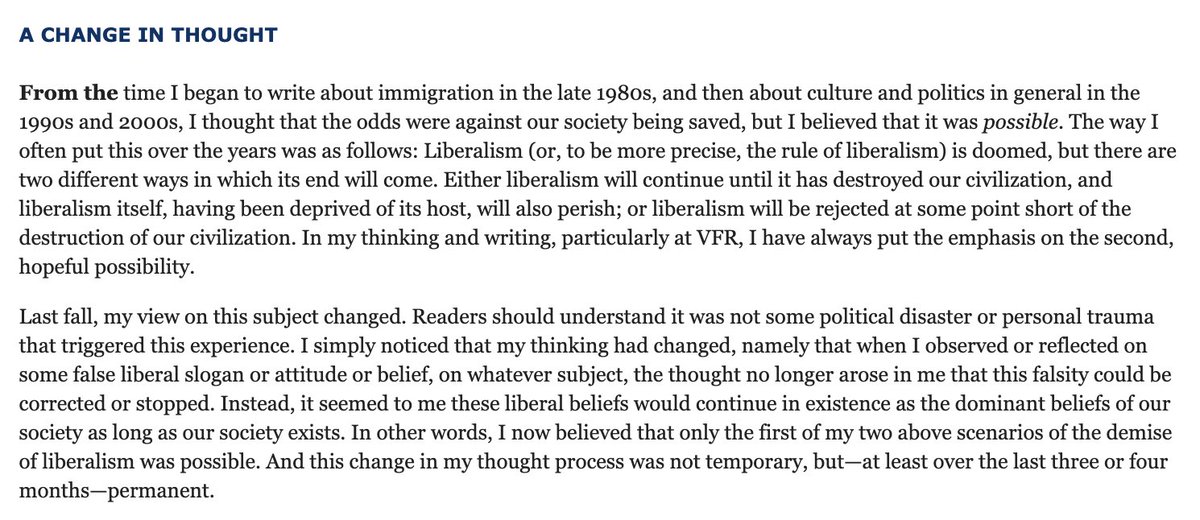
I wanted to respond to this very generous little essay by mentioning some earlier writers.
If the next regime nationalizes the mainstream media and appoints Steve Sailer to purge it, we’ll know America finally has a serious right. For the last 40 years, Sailer—formerly of the defunct UPI, AP’s little brother, and later expelled like all decent people from National Review—has been our only completely honest journalist. For something like fifteen years I read not only his blog, but all the comments, every day. “If the world is against me,” Athanasius used to say, “then I am against the world.” In the end, Christendom ran on his creed for a thousand years.
We could say the same of Stephen McIntyre in science. The Climategate controversy of 20 years ago, where the thoroughly-unscientific doings of climate scientists were leaked in an email dump, was a formative intellectual experience for me: refuting the infallibility of the temple. But by McIntyre and his anonymous Internet army of amateur statisticians, all their DC-style fudging had already been laid bare for anyone who could read math. To the credit of our courts or what is left of them, Michael Mann even lost his lawsuit. No one cared. But it was the Fauci texts and virology Slack, 20 years earlier.
(I guess no one cares now, either! But it is also a travesty that Richard Ebright has not yet been named to purge the American infectious-diseases temple—with emergency powers of arrest, indefinite detention and special interrogation. FWIW, I don’t know either of these people and they’d probably disown me.)
I do know Razib Khan, who has been at the center of the human-genomics revolution for the last 25 years. Though not a working scientist himself, he knows everyone worth knowing in the field. Dispelling the 20th-century myth of human uniformity, from the highest temples of the great world-state which conquered the planet on the back of that myth, is not for the faint of heart! “Molti nemici, molto onore.” On a battlefield like this, it is easy to tell a wise leader from a rash hero, a hero from a cautious man, a cautious man from a company man, a company man from a genuine snake. Though these records are not yet public, history keeps them. It will record Razib as the first.
Lastly I want to pay tribute to the late Larry Auster, a pundit not a journalist, a real American prophet, who after his expulsion from conservamedia edited his own Athanasian monastery on the web, posting email comments as he saw fit. Larry, an intensely stubborn man, had that inflexible rectitude of the early Christians. (A Christian born a secular Jew, he was the cousin of the boring novelist Paul Auster.) Absolute sincerity was the essence of his voice; he would not come to the world, the world must come to him. I could not imagine him pretending to change his mind. Yet it was completely flexible, and completely his own. The full archive of his work remains online and anyone can read it with profit. This sample (from 2012, a year before his death) must suffice.