Back in March I posted a bearish chart on $HYPE when we had a weekly SFP. As strong a signal as it gets on a high timeframe.
Once that SFP was invalidated, it was clear — this thing had serious strength underneath and was heading to ATHs. Been bullish since early May and that conviction hasn't changed.
Don't see this move stopping before price discovery. The $90–100 region looks likely.
Doesn't look like a bear market if you look at this chart. Maybe signalling what's to come for the wider market?🙂
I love that I’m only seeing tweets about “ $HYPE can go so much higher, look at what $SOL did last cycle” *after* it already made new ATHs
people were calling me a countertrade indicator months ago when I said hype would make new ATHs in the first place; now everyone’s in agreement that HYPE is severely mispriced
funny how that works…
traders love to get too high in the clouds when times are great, and forget how to dream as soon as the market turns sour for even just a few months
this will always be true.
mastering momentum is the easiest way to consistently build wealth in trading
remember how to dream in the infancy of new trending regimes, then cash in on the extension of that rally as your peers pile in with fomo to drive price further away from your entry
allow yourself to target infinity whilst(!) remaining rational. understand that you must scale OUT in order to benefit from the move
it sounds incredibly simple; yet most can’t execute it
and execution is what matters.
After you've figured out your system/edge, it is only about half of the job done. Rest, your success in the markets depends on your day to day habits that may seem negligible but compound pretty well overtime.
Market Structure Cheat Sheet — how to count properly.
This educational thread is sponsored by @_WOO_X — where I trade crypto with zero fees on spot.
Most traders mark every swing as structural. They're not.
A swing becomes structural only when the next leg confirms it.
Everything else is internal — noise inside the bigger structure.
The 4 reads on the cheat sheet:
1. Normal structure — HH and HL in an uptrend. Simple to count.
2. Price is fractal — inside every structure, there's a smaller one. The internal swings are just noise. Not where you trade.
3. Unconfirmed HL — a low isn't a structural HL until a new HH prints. Until then, it's a candidate, not a structural point.
4. The line in the sand for a MSB is the last confirmed LL (in a downtrend, the last confirmed LH). That's where the bias flips, not the latest swing your eye finds.
Count what's confirmed. Trade what's structural.
@_WOO_X X Pro — zero fees on spot: https://t.co/iWxTrgYsA3
MSB: Real Break vs Fakeout - Cheat Sheet
This post is sponsored by WOO X Pro — trade with zero fees on spot: https://t.co/iWxTrgYsA3
In an uptrend, you need a higher high to confirm a higher low.
In a downtrend, you need a lower low to confirm a lower high.
That's the rule I count by.
Most traders see a break and chase. Most breaks aren't even structurally valid.
Here's how I read it.
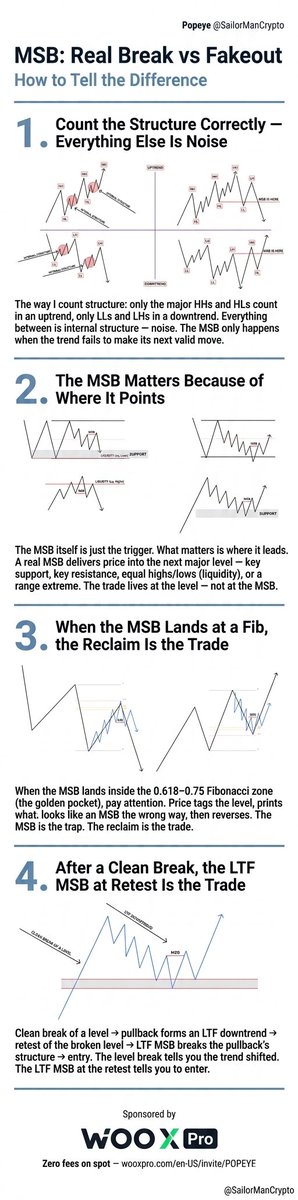
𝟭. 𝗖𝗼𝘂𝗻𝘁 𝘁𝗵𝗲 𝘀𝘁𝗿𝘂𝗰𝘁𝘂𝗿𝗲 𝗰𝗼𝗿𝗿𝗲𝗰𝘁𝗹𝘆 — 𝗲𝘃𝗲𝗿𝘆𝘁𝗵𝗶𝗻𝗴 𝗲𝗹𝘀𝗲 𝗶𝘀 𝗻𝗼𝗶𝘀𝗲
The way I count structure: only the major HHs and HLs count in an uptrend.
Only the major LLs and LHs in a downtrend.
Everything between is internal structure — small wiggles that don't change the trend.
The MSB only happens when the trend fails to make its next valid move.
In an uptrend, that's an HL breaking before a new HH prints.
In a downtrend, an LH breaking before a new LL.
Internal wiggles are not MSBs.
The break of the LAST valid swing point is.
𝟮. 𝗧𝗵𝗲 𝗠𝗦𝗕 𝗺𝗮𝘁𝘁𝗲𝗿𝘀 𝗯𝗲𝗰𝗮𝘂𝘀𝗲 𝗼𝗳 𝘄𝗵𝗲𝗿𝗲 𝗶𝘁 𝗽𝗼𝗶𝗻𝘁𝘀
The MSB itself is just the trigger.
What matters is where it leads.
A real MSB delivers price into the next major level — a key support, a key resistance, an equal highs/lows zone (liquidity), or a range extreme.
If the MSB is in the middle of nowhere with no level in sight, it's noise.
If you can't name where the MSB is heading, you don't have a setup.
You have a guess.
The trade lives at the level — not at the MSB.
𝟯. 𝗪𝗵𝗲𝗻 𝘁𝗵𝗲 𝗠𝗦𝗕 𝗹𝗮𝗻𝗱𝘀 𝗮𝘁 𝗮 𝗙𝗶𝗯, 𝘁𝗵𝗲 𝗿𝗲𝗰𝗹𝗮𝗶𝗺 𝗶𝘀 𝘁𝗵𝗲 𝘁𝗿𝗮𝗱𝗲
When the MSB lands inside the 0.618–0.75 Fibonacci zone (the golden pocket), pay attention.
That's where SFP plays out.
Price tags the level.
Prints what looks like an MSB the wrong way.
Then reclaims and reverses hard back with the original trend.
The MSB is the trap.
The reclaim is the trade.
Wait for the reclaim and the LTF structure shifting back with the original direction.
That's the entry — not the MSB itself.
The Fib tells you WHERE.
The reclaim tells you WHEN.
𝟰. 𝗔𝗳𝘁𝗲𝗿 𝗮 𝗰𝗹𝗲𝗮𝗻 𝗯𝗿𝗲𝗮𝗸, 𝘁𝗵𝗲 𝗟𝗧𝗙 𝗠𝗦𝗕 𝗮𝘁 𝗿𝗲𝘁𝗲𝘀𝘁 𝗶𝘀 𝘁𝗵𝗲 𝘁𝗿𝗮𝗱𝗲
When price makes a clean break of a key level, don't chase it.
The trade is the pullback.
That pullback usually forms an LTF downtrend (in a bullish breakout) or an LTF uptrend (in a bearish breakout).
It pulls price back to retest the broken level.
What you're waiting for is the LTF MSB at that retest — the moment the pullback's structure breaks.
When the last LH of the pullback gets taken out (in a bullish setup), the pullback is done and the original direction resumes.
That's the entry.
The level break tells you the trend shifted.
The LTF MSB at the retest tells you it's safe to take the trade.
Don't chase the break. Wait for the LTF MSB on the pullback.
𝗛𝗼𝘄 𝘁𝗼 𝘂𝘀𝗲 𝘁𝗵𝗶𝘀
Count structure correctly first.
The internal wiggles don't matter — only the last valid swing.
When the MSB happens, ask where it's pointing.
If it's into a level that matters, you're early to a real setup. If it's nowhere, ignore it.
After a clean break of a level, wait for the pullback.
The LTF MSB at the retest is your entry — not the break itself.
The reclaim is the trade.
Most breaks are noise.
The real ones reward patience — either at the retest, or in the reclaim.
WOO X Pro — zero fees on spot: https://t.co/iWxTrgYsA3
The 4 Market Phases — and How to Trade Each One
Every market moves in cycles. If you don't know which phase you're in, you're guessing. And guessing costs money.
This educational post is sponsored by @_WOO_X, where I trade crypto with zero fees on spot.
Here's the framework.
Phase 1 — Accumulation
This is where a downtrend dies. Price stops making new lows and starts moving sideways in a tight range. Volume dries up. Volatility compresses.
Most retail traders are still bearish here because the downtrend is fresh in their memory.
Smart money is quietly buying. You will often see a deviation below the range low — a liquidity grab that traps late shorts before price reverses hard. That wick below the range is not a breakdown. It is a trap.
What not to do: don't short the range low. That is exactly where smart money wants your stop loss.
Phase 2 — Markup
Breakout from the accumulation range. Higher highs, higher lows. Volume increases on the up moves. This is where trends are born.
The only job here is to ride it. Don't fight it, don't try to call the top, don't fade every push higher because "it went too far." Trend is your friend until structure breaks.
What not to do: don't short into strength hoping for a reversal. Respect the structure until it gives you a reason not to.
Phase 3 — Distribution
This is where an uptrend dies. Price stops making new highs and starts chopping sideways at the top. Smart money is selling into retail buying. Volume spikes on the drops and weakens on the rallies — that tells you who is in control.
You will often see a deviation above the range high — a liquidity grab that traps late longs before price rolls over. That wick above the range is not a breakout. It is distribution.
What not to do: don't buy the breakout at the top. That is FOMO, and smart money is selling directly into it.
Phase 4 — Markdown
Breakdown from the distribution range. Lower highs, lower lows. Volume expands on the sell-offs. This is where most retail gets trapped buying every dip hoping for a bounce.
The only job here is to stay out or trade with the trend. Don't catch the knife. Don't convince yourself every support level will hold. Wait for accumulation structure to form before thinking about longs.
What not to do: don't buy every dip in a downtrend. Wait for the cycle to reset. Wait for accumulation.
These four phases repeat on every timeframe and every asset. Learn to identify them and you will always know what the market is doing — and more importantly, what it is about to do.
Know which phase you're in before you trade.
All this free educational content is sponsored by @_WOO_X — trade with zero fees on spot.
https://t.co/iWxTrgYsA3
"Buy the dip" is the most expensive advice in crypto.
Here's why most traders lose money following it — and how to know when a dip is actually a dip.
Everyone says buy the dip. Nobody tells you that most dips in a downtrend are not dips at all — they are lower lows.
And buying a lower low is not being smart. It's being someone else's exit liquidity.
The difference between a real dip and a trap is not complicated, but most traders never bother to learn it.
So they keep buying, keep averaging down, and keep wondering why the chart keeps going against them.
1. A dip only exists in an uptrend
This is the most basic rule and the one most people ignore.
In an uptrend, price pulls back to a level of demand, holds structure, and continues higher. That's a dip. It's a healthy retracement within a trend that is still intact. Higher highs, higher lows — the structure confirms it.
If the structure is not there, it is not a dip. Full stop.
Pro tip: Before you buy any pullback, zoom out.
If the higher timeframe is not making higher highs and higher lows, you are not buying a dip. You are catching a falling knife.
2. In a downtrend, it's not a dip — it's just a lower low
Price bounces in a downtrend. Every time it does, people scream "buy the dip." But what they're actually buying is a lower high before the next lower low.
The trend is making lower highs and lower lows — that bounce is not a buying opportunity, it's a distribution event. Smart money is selling into your optimism.
Pro tip: Count the structure. If price just made a lower low and bounces, that bounce needs to break the previous lower high before it means anything.
Until then, it's just noise inside a downtrend.
3. Re-distribution vs accumulation — learn the difference
A range after a drop can look like a bottom. But not all ranges are accumulation. If the range resolves to the downside, it was re-distribution — a pause before more selling.
Accumulation shows declining volume, absorption at the lows, and eventually a spring or MSB to the upside. If you can't tell the difference, you're guessing with your capital.
Pro tip: Watch volume inside the range.
In accumulation, volume dries up on the drops and expands on the bounces.
In re-distribution, it's the opposite.
The volume tells the story before price confirms it.
4. Volume tells you what price won't
A real dip in an uptrend pulls back on declining volume — sellers are drying up.
Then the bounce comes on expanding volume — buyers stepping in with conviction.
A lower low in a downtrend bounces on low volume and drops on expanding volume.
The volume profile doesn't lie. If the bounce has no volume behind it, it's not a dip. It's a dead cat.
Pro tip: If you're not checking the volume profile before entering any trade, you're trading blind.
Price shows you what happened.
Volume shows you why.
5. How I tell the difference
I look at three things: trend structure, volume profile, and the reaction at key levels.
Is the macro trend making higher highs and higher lows?
Is the pullback happening on declining volume?
Is price holding at VaL or a known demand zone?
If all three align, that's a dip I'm interested in. If even one is missing, I wait. Patience has saved me more money than any setup ever has.
Pro tip: Don't buy the dip because Twitter told you to. Buy the dip because the structure, the volume, and the level all confirm it.
Multiple reasons for a trade — that's the edge.
Closing:
The next time someone tells you to buy the dip, ask yourself one question — is this actually a dip, or am I just buying someone else's exit?
The structure, the volume, and the context will always give you the answer. Your job is to listen.
"the market doesn't care about your bias. respect the structure, or become the liquidity."
If this was useful, like and repost — it helps more people find it.
Which dip did you buy that turned out to be a lower low?
Drop it below. No shame, we've all been there.
Phrases course sellers who don't trade keep repeating.
1. It's all about the mindset.
2. Trading is easy. Controlling the emotion is hard.
3. It's all about mental clarity.
4. Meditation is the exercise of trading.
While all this is true, you need a real system, data and edge.
Influencers use above psychological Tweets to get your attention.
5 Golden Steps you can't avoid when becoming a new Trader.
This is what I tell all my trading interns without fail.
1. Make the exchange your obedient Pet. Get a solid understanding of all the Trading tools. Understand every order type, understand the exchange. Understand how every button on the exchange works. You should make the Trading UI and system your obedient pet. Good doggy exchange.
2. Get Clear indepth understanding of most indicators and how they work. You should be able to use them as statistics. You should understand what and how everything om the indicator is roughly made and what it shows.
Yes EMA is one line but what does it actually show?
3. Once you've enough understanding, find out the style of trading that'll work for you, Scalping, swing, macro. This depends on your lifestyle, health and Job. You can't have ADHD at extreme levels and expect to be a Passive investor. Make your lifestyle important, then choose the Trading style.
4. Make a trading system. Backtest it. Then test it live for 1000 trades on 10 different assets with a small Capital. Use 100 dollars or whatever you can afford as tuition fee to rest your understanding in the real world.
5. Once you've done this well enough, immediately get a trading friend or a trading partner. This is most important. Do it Immediately. They will prevent you from making emotional decisions.
Money Flow
Clusters over clusters of bands, no clear demand for any single coin. This reflects the uncertainty in the market as everyone waits for a decisive move.
The flow into #BTC isn’t bullish in this context. It’s not about BTC doing a 10x here, it’s simply where people park capital when they’re unsure about the rest of the market.
#Crypto #MoneyFlow #BTC #Trading
This is my will and my final message. If these words reach you, know that Israel has succeeded in killing me and silencing my voice. First, peace be upon you and Allah’s mercy and blessings.
Allah knows I gave every effort and all my strength to be a support and a voice for my people, ever since I opened my eyes to life in the alleys and streets of the Jabalia refugee camp. My hope was that Allah would extend my life so I could return with my family and loved ones to our original town of occupied Asqalan (Al-Majdal). But Allah’s will came first, and His decree is final. I have lived through pain in all its details, tasted suffering and loss many times, yet I never once hesitated to convey the truth as it is, without distortion or falsification—so that Allah may bear witness against those who stayed silent, those who accepted our killing, those who choked our breath, and whose hearts were unmoved by the scattered remains of our children and women, doing nothing to stop the massacre that our people have faced for more than a year and a half.
I entrust you with Palestine—the jewel in the crown of the Muslim world, the heartbeat of every free person in this world. I entrust you with its people, with its wronged and innocent children who never had the time to dream or live in safety and peace. Their pure bodies were crushed under thousands of tons of Israeli bombs and missiles, torn apart and scattered across the walls.
I urge you not to let chains silence you, nor borders restrain you. Be bridges toward the liberation of the land and its people, until the sun of dignity and freedom rises over our stolen homeland. I entrust you to take care of my family. I entrust you with my beloved daughter Sham, the light of my eyes, whom I never got the chance to watch grow up as I had dreamed.
I entrust you with my dear son Salah, whom I had wished to support and accompany through life until he grew strong enough to carry my burden and continue the mission.
I entrust you with my beloved mother, whose blessed prayers brought me to where I am, whose supplications were my fortress and whose light guided my path. I pray that Allah grants her strength and rewards her on my behalf with the best of rewards.
I also entrust you with my lifelong companion, my beloved wife, Umm Salah (Bayan), from whom the war separated me for many long days and months. Yet she remained faithful to our bond, steadfast as the trunk of an olive tree that does not bend—patient, trusting in Allah, and carrying the responsibility in my absence with all her strength and faith.
I urge you to stand by them, to be their support after Allah Almighty. If I die, I die steadfast upon my principles. I testify before Allah that I am content with His decree, certain of meeting Him, and assured that what is with Allah is better and everlasting.
O Allah, accept me among the martyrs, forgive my past and future sins, and make my blood a light that illuminates the path of freedom for my people and my family. Forgive me if I have fallen short, and pray for me with mercy, for I kept my promise and never changed or betrayed it.
Do not forget Gaza… And do not forget me in your sincere prayers for forgiveness and acceptance.
Anas Jamal Al-Sharif
06.04.2025
This is what our beloved Anas requested to be published upon his martyrdom.
PLEASE READ 🚨
I see people are putting their life savings into some coins because some guy with a Suit said Ethereum will Pump to 16K by year end.
If the predictions come true, I'll be the happiest as a heavy Ethereum holder.
But let me also remind you that the same guy made predictions about BTC, ETH Classic, Neo, Bitcoin Cash and many other Shitcoins which Dumped 90% in 2018.
Even if you'd have held these Shitcoins for 9 years , you'd have made a loss of 90-99%.
Many people listen to these hyperbole predictions and use leverage.
Use your little common sense. Please. Eventually, managing risk wins you the game.