Changing the Landscape of Open Computing with reliable, composible, upstream, and secure SBCs and Computing Devices for professionals, hobbyists, and tinkerers.
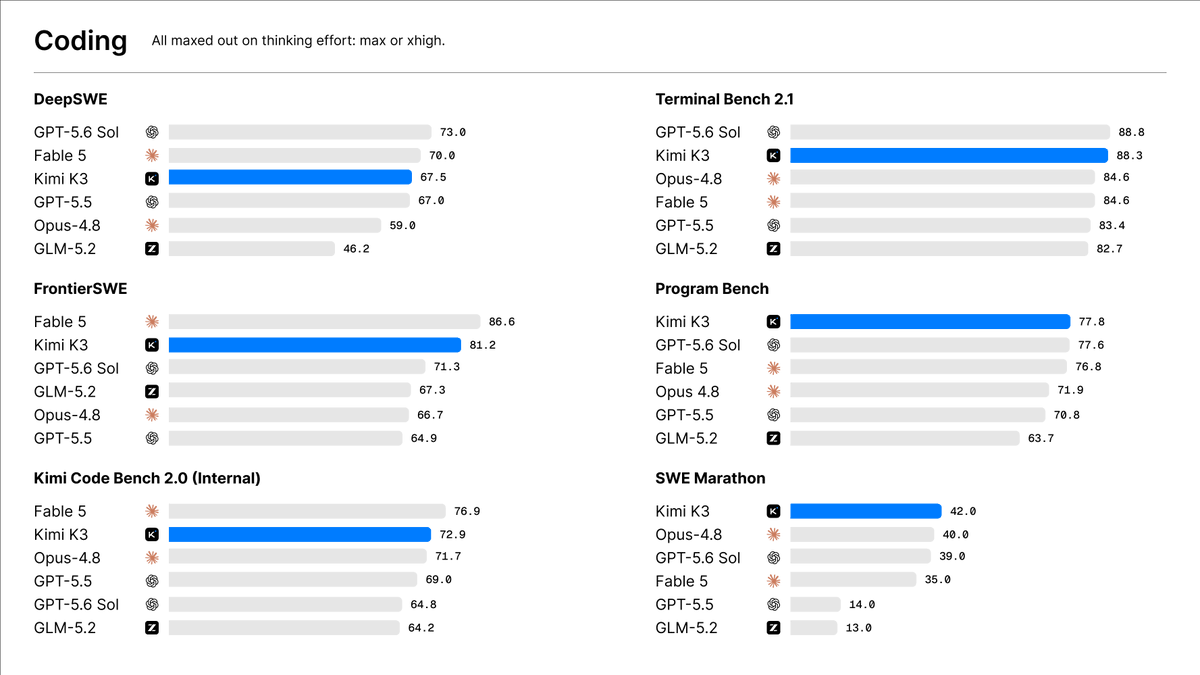
Introducing Kimi K3: Open Frontier Intelligence
🔹 2.8 Trillion Parameters, 1 Million Context, Native Multimodal
🔹 Kimi Delta Attention enables up to 6.3x faster decoding in million-token contexts
🔹 Attention Residuals deliver ~25% higher training efficiency at <2% additional cost
🔹 Built for long-horizon agentic coding and self-evolving workflows
Kimi K3 is now live on on https://t.co/zrk6zZxZUo, Kimi Work, Kimi Code, and the Kimi API.
Open Weights by July 27, 2026.
🔗 API: https://t.co/XCrgjXAqMw
🔗 Tech blog: https://t.co/YTfiMSNM1f
@geerlingguy Dense ~30B models (needing 40GB VRAM) is where local inferencing becomes useful. GB10's 256b DDR inferface is the bottleneck that prevents it from being useful. RTX Pro 6000 is the real starting point. This may change with model advancements a year from now.
@aniiland@ASUS@Snapdragon We use it for native compiles and now this part of our infrastructure is down. We moved to a Dimensity 9400 machine in meantime.
@Qualcomm would capture so much of the local inference market with proper Linux support of Hexagon with the X2.
@ASUS we have one of your @Snapdragon X Elite S5507QAD for our testing environment. The battery discharged to 0% and became stuck at 0%. As hardware engineers, we opened the battery and tried to send SMBUS commands to reset the lock. No luck on such a trivial problem. Lenovo and Dell can both reset from Windows/BIOS. What are you doing?
Together with draw call optimization, our first platform can achieve up to 5x draw call improvement and 2x shader throughput improvement from Debian 13's mesa baseline.
@lone_voidwalker@cnxsoft LP core performance are not insignificant. You can fit 3-4 LP cores in the same space as HP cores. There are a lot of tasks where discrete LP cores running two threads provide much higher performance than one HP core sharing resources.