Libya’s Intelligence Agency has long been one of the country’s fiercest battlegrounds for political influence.
The agency falls under the authority of the Presidential Council, but the three members, Mohamed al-Menfi, Moussa al-Koni and Abdullah al-Lafi, have spent years at odds, with major appointments often exposing deep internal divisions.
With a new unified authority increasingly likely, and a new Presidential Council expected to follow, the race to control the Intelligence Agency has intensified. The post carries a substantial budget, limited oversight and influence over a network of affiliated companies, making it one of Libya’s most coveted positions.
The conflicting statements and rumours emerging over the latest vote reflect the chaos behind the scenes. Persistent allegations that votes are being bought suggest the deadlock is less about principle than competing demands over the size of the political payoff.
Do I have any Qatar experts in my network?
I’m looking for candidates for a research project. If you’re interested or have any recommendations, I’d really appreciate it.
🔷 The “Middle East” is over.
Mohammed Soliman, author of West Asia, explains why.
In our interview with @ThisIsSoliman, he lays out how the Iran war has exposed a deeper shift already underway and what it means for Europe, India, Gulf strategy and the future of AI infrastructure.
A must read conversation.
https://t.co/FlryO6nvsD
𝗟𝗶𝗯𝘆𝗮 𝗗𝗲𝘀𝗸 𝗠𝗮𝗿𝗸𝘀 𝗦𝗲𝘃𝗲𝗻 𝗬𝗲𝗮𝗿𝘀
In political risk, longevity is proof of capability. It reflects the ability to navigate complexity, adapt to constant change, and deliver through uncertainty.
Over the past seven years, we have supported clients across due diligence, market entry, project delivery, and political risk advisory, operating at the centre of Libya’s most challenging environments.
Alongside this, we have maintained consistent output, with seven years of political reporting and five years of energy reporting through our flagship subscription products, widely read by stakeholders and those operating in Libya.
A track record built on consistency, access, and delivery.
Thank you to our clients and partners for your continued trust.
🔴𝐅𝐫𝐨𝐦 𝐑𝐢𝐬𝐤 𝐄𝐯𝐞𝐧𝐭 𝐭𝐨 𝐌𝐚𝐫𝐤𝐞𝐭 𝐁𝐚𝐬𝐞𝐥𝐢𝐧𝐞: 𝐎𝐮𝐫 𝐋𝐚𝐭𝐞𝐬𝐭 𝐈𝐫𝐚𝐧 𝐀𝐬𝐬𝐞𝐬𝐬𝐦𝐞𝐧𝐭
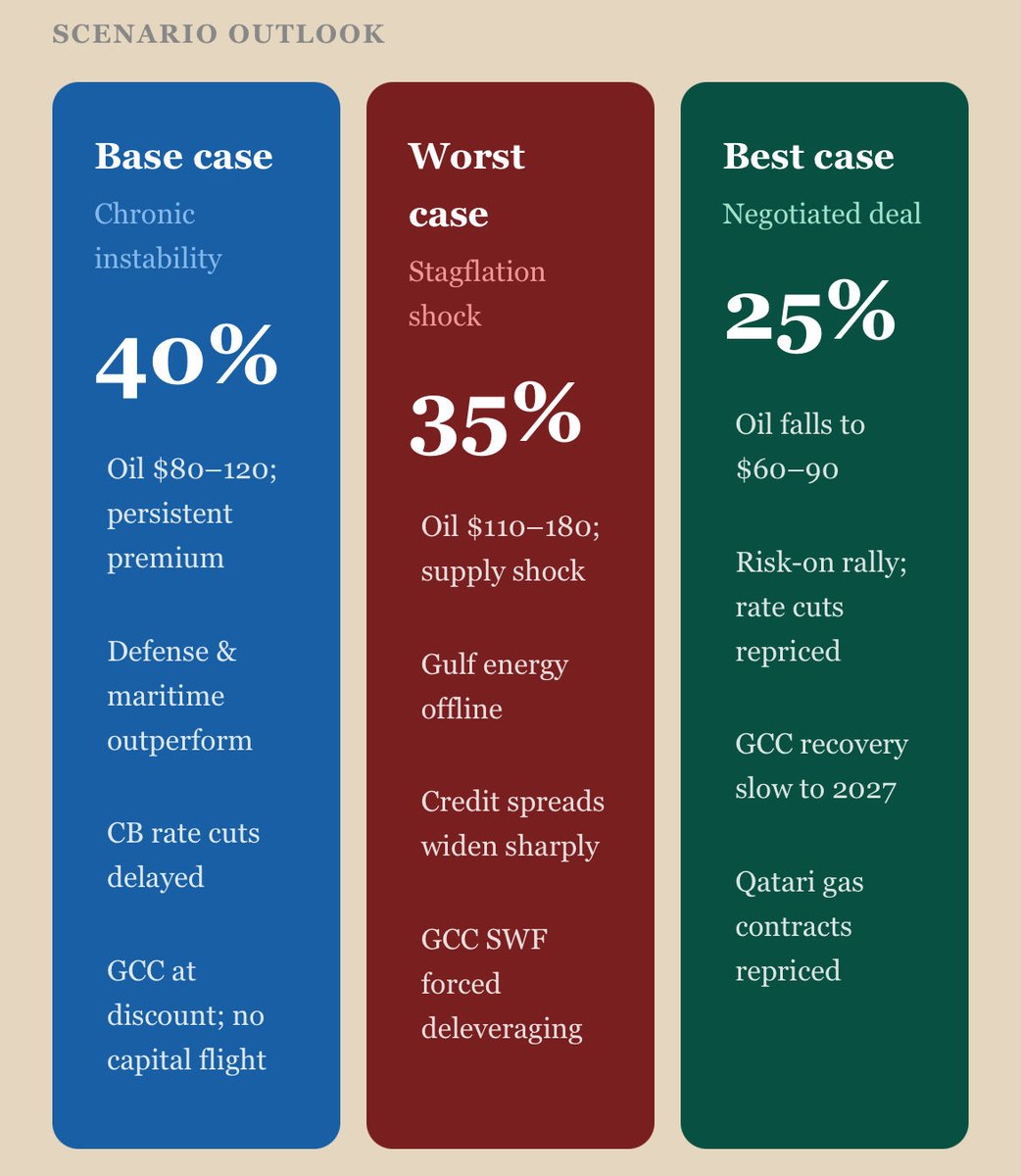
Our Iran Desk has published its 𝐰𝐞𝐞𝐤𝐥𝐲 𝐮𝐩𝐝𝐚𝐭𝐞 𝐭𝐨 𝐨𝐮𝐫 𝐬𝐜𝐞𝐧𝐚𝐫𝐢𝐨 𝐦𝐚𝐩𝐩𝐢𝐧𝐠 — a conflict guide for clients and subscribers.
We argue that markets must now price instability 𝐜𝐨𝐧𝐭𝐢𝐧𝐮𝐨𝐮𝐬𝐥𝐲, 𝐧𝐨𝐭 𝐩𝐞𝐫𝐢𝐨𝐝𝐢𝐜𝐚𝐥𝐥𝐲. What was once episodic risk is now a 𝐬𝐭𝐫𝐮𝐜𝐭𝐮𝐫𝐚𝐥 𝐛𝐚𝐬𝐞𝐥𝐢𝐧𝐞.
We assess three pathways:
• 𝐁𝐚𝐬𝐞 (𝟒𝟎%): chronic instability without systemic breakdown
• 𝐖𝐨𝐫𝐬𝐭 (𝟑𝟓%): uncontrolled escalation and a stagflationary global shock
• 𝐁𝐞𝐬𝐭 (𝟐𝟓%): partial political reset and negotiated de-escalation
𝐄𝐧𝐞𝐫𝐠𝐲 𝐢𝐬 𝐭𝐡𝐞 𝐩𝐫𝐢𝐦𝐚𝐫𝐲 𝐭𝐫𝐚𝐧𝐬𝐦𝐢𝐬𝐬𝐢𝐨𝐧 𝐜𝐡𝐚𝐧𝐧𝐞𝐥. Oil volatility will determine inflation and growth across all scenarios. Our probability-weighted expectation sits at $101/bbl, with a pronounced asymmetric risk toward $145+.
𝐓𝐡𝐞 𝐒𝐭𝐫𝐚𝐢𝐭 𝐨𝐟 𝐇𝐨𝐫𝐦𝐮𝐳 𝐢𝐬 𝐭𝐡𝐞 𝐜𝐫𝐢𝐭𝐢𝐜𝐚𝐥 𝐜𝐡𝐨𝐤𝐞𝐩𝐨𝐢𝐧𝐭. Iran retains structural leverage over global energy flows regardless of the conflict’s military trajectory.
𝐍𝐨 𝐚𝐜𝐭𝐨𝐫 𝐜𝐨𝐧𝐭𝐫𝐨𝐥𝐬 𝐞𝐬𝐜𝐚𝐥𝐚𝐭𝐢𝐨𝐧.
The US seeks withdrawal, Israel seeks to sustain pressure, and Iran prioritises deterrence and regime survival. This misalignment is the core escalation driver.
𝐖𝐡𝐚𝐭’𝐬 𝐬𝐡𝐢𝐟𝐭𝐢𝐧𝐠 𝐬𝐭𝐫𝐮𝐜𝐭𝐮𝐫𝐚𝐥𝐥𝐲:
• GCC safe-haven status weakening, with assets trading at a geopolitical discount
• Capital reallocating toward Turkey, India, and Southeast Asia
• Supply chains and capital repricing toward resilience over efficiency
𝐄𝐧𝐝 𝐬𝐭𝐚𝐭𝐞: a faster transition toward a 𝐦𝐮𝐥𝐭𝐢𝐩𝐨𝐥𝐚𝐫 𝐞𝐧𝐞𝐫𝐠𝐲 𝐨𝐫𝐝𝐞𝐫
Winners: Americas, North Africa, Russia
China strengthens in renewables
Asian importers face the sharpest exposure
👉 𝐖𝐡𝐚𝐭 𝐰𝐞 𝐜𝐨𝐯𝐞𝐫: scenario pathways, market implications, escalation dynamics, and forward indicators
📩 Subscribe online to read the full report: 🔗 https://t.co/yvzWKg6op2
Or get in touch via email for a sample
[email protected]
🇸🇦 Saudi Arabia is pouring billions into U.S. entertainment, and the ambition is clear.
From a $55bn bet on Electronic Arts to Hollywood dealmaking, and figures like @Turki_alalshikh driving the cultural push, Riyadh is positioning itself as a serious patron of global creative industries.
The opportunity is huge, but execution will define it.
Read more:
https://t.co/W8E0RfJbjC
🚨 While the world focuses on Iran, a new front has taken shape.
Sources warn Israel sees Trump’s backing as an opportunity to annex parts of southern Lebanon.
Full exclusive 👇
https://t.co/Aicpc3YGVr
🇺🇸 Trump’s Africa policy has been seriously underreported.
With the Middle East, tariffs, the Ukraine war and Trump’s usual statements dominating headlines, it’s easy to see why.
But we’ve been tracking it.
At GPD, we followed @US_SrAdvisorAF Massad Boulos — Trump’s Africa adviser and key political intermediary — from the DRC to Libya and across North Africa. And something started to shift.
From Rabat to Algiers, the tone changed.
Officials spoke about Boulos with less excitement, less weight.
So what happened?
Enter @SEPeaceMissions Witkoff.
A quiet power struggle is now unfolding inside Trump’s team, and North Africa is right at the centre of it.
Here’s what regional actors are telling us 👇🏽
https://t.co/rUycVbkM1C
🔴Breaking: The GNS makes the first move and calls for a comprehensive dialogue to form a unified government.
PM Hamad called on the PC, HoR and HCS to “make this moment a true turning point”.
The statement does not include the GNU but does include the “ballot box” as end goal.
🔴 Trump reveals:
• He doesn’t know who is leading Iran after the strike that killed Khamenei and dozens of senior officials.
• He was surprised that Iran’s retaliation included strikes against Gulf states — suggesting regional allies may have been led to believe the operation would be contained and low-risk for them.
🔴 Energy escalation is now front and centre.
IRGC commander Ebrahim Jabbari, advisor to the IRGC chief, has threatened all Gulf tankers and pipelines — warning oil could hit $200 per barrel.
This is not layered escalation. This is shock strategy.
Attrition has taken a backseat. Tehran appears to be using immediate economic pressure to force Washington to stand down.
At the same time, Iran’s decentralised military structure and internal policy frictions are becoming more visible. Messaging has shifted rapidly — from denying any intent to close the Strait, to limiting threats to U.S.-linked vessels, to issuing sweeping warnings.
Whether this translates into action via small boats, mines, or coastal missile launches remains uncertain.
We previously identified energy as the Gulf’s red line. That test may now be approaching.
The natural follow-up would be Houthi pressure in the Bab al-Mandeb. Tehran says it can fight alone — but a simultaneous trade-route squeeze by its most capable proxy would be a gamechanger.
The coming hours will show whether this coercive gamble compels restraint — or accelerates the formation of a broader coalition against Iran.
🔴 A Warning to Arab Leaders: The Time to Act Is Now
With every press conference, Washington signals something deeply concerning: no coherent long-term plan, misread assumptions, and escalation layered upon escalation. This was not a war of necessity. It was a war of choice.
The region now sits between an Israeli leadership pushing forward militarily, a U.S. administration following without strategic clarity, and an Iran prepared to widen the battlefield rather than concede. Arab states are not observers. Their cities, energy infrastructure and populations sit directly in the blast radius.
The conflict has already exceeded initial assessments.
Lebanon is pulled in.
Energy markets are exposed.
Civilian infrastructure is increasingly vulnerable.
We do not assess full Iranian state collapse as imminent. But if this extends, the risks become systemic:
• Renewed Kurdish insurgency dynamics
• Deadly pro and anti-government clashes
• Severe humanitarian breakdown
• A migration wave neither the region nor Europe can manage
One miscalculation could push this beyond repair.
The binary presented to the world, “bomb Iran or surrender to it,” is false and dangerously simplistic.
History is clear: wars drift when politicians mistake momentum for strategy.
We saw this in Ukraine. Early negotiations in Turkey showed potential off-ramps. Those talks were later derailed after Western intervention, with Boris Johnson urging Kyiv not to accept a deal. Years later, casualties mount and no decisive political solution exists.
Amid this drift, Arab states have largely been the only rational actors. While others escalate rhetorically or militarily, Arab capitals have shown restraint, caution and strategic patience. They understand that regional collapse would first and foremost devastate their own societies.
Europe, meanwhile, appears confused at best. Reflexive alignment without leverage has left it reactive rather than strategic, amplifying escalation rather than shaping outcomes.
Arab states should not feel condemned to operate in the shadow of U.S. foreign policy, especially when Washington’s current trajectory risks strategic implosion rather than resolution.
Instead of aligning with one side of a failing binary, Arab capitals should move decisively to build a diplomatic front, bringing in Turkey, Europe and other middle powers to form a third bloc. A bloc for sensible states to rally behind, and crucially, for concerned populations across the world who do not want another global conflict to rally around.
Not escalation. Not passivity.
A coordinated diplomatic bloc beyond the binary.
Without it, this may be the moment we look back on years from now as the point at which so much unnecessary suffering and cost could have been averted.
🔴 CENTCOM confirming three Americans killed in action changes the political equation.
U.S. casualties are the line that shifts a conflict from foreign policy to domestic crisis. They don’t stay overseas — they come home.
This is where the cycle becomes dangerous for Trump.
Regime change without boots on the ground is unrealistic.
Boots on the ground would be politically toxic — another open-ended war Americans have little appetite for.
But casualties create pressure. Pressure demands response.
Response risks escalation.
Tehran understands this dynamic. The objective now is to raise the cost before any U.S. declaration of “mission accomplished.”
Oil volatility.
Strikes on U.S. assets.
Sustained attrition.
The strategy is simple for Iran: ensure Trump cannot declare victory without paying a visible domestic price. Otherwise, he won’t come back to the negotiating table seriously, he’ll just come back for a round 3 when Israel requests it.
Bottom line: American casualties never land quietly back home. This just got tougher for Trump
🔴 It is safe to say Iran has succeeded in dissolving inter-GCC tensions.
We have long argued that the Gulf is stronger united than divided. In this piece, we proposed the creation of a joint foreign policy engine for the GCC.
The unprecedented events of the past 12 hours may lay the first foundation stone for such coordination.
As Europe risks sleepwalking into past mistakes, the GCC, alongside Turkey, may prove to be among the few actors positioned to think and act pragmatically.
Serious de-escalation is urgently needed before the region is pulled into something far harder to reverse.
Full article 👇🏽
https://t.co/mIjuHRXXHf
🔴 The region may be edging toward a worst-case escalation.
Strikes reaching as far as Kuwait Airport and the Palm in Dubai, allegedly via drones, mark an unprecedented widening of the theatre. This could reflect a mismanaged Iranian response or a deliberate decision to extend pressure beyond US military assets into the wider Gulf arena.
Some suggest hotels are being targeted because military personnel were temporarily rebased there. Even if true, striking such sites is extraordinarily risky and likely to backfire, inviting broader retaliation and international backlash.
At the same time, warnings tied to potential disruption in the Strait of Hormuz are already affecting maritime traffic. Commercial vessels are receiving alerts and expected to comply. In this environment, perception alone can move markets and military calculations.
This moment demands sobriety, not brinkmanship. A unified regional and international push for de-escalation is urgently needed. The risk of sliding into a far more destabilising phase is no longer theoretical.
للتذكير بمادئ وأخلاقيات النشر والتفاعل (تلك التي لا تخفي على أحد، إلا انها كثيرا ما تُنسي وتتجاوز لمصالح ضيقة وأنية)؛ يأتي هذا الميثاق👇🏽
رابط المشاركة ادناه
#الميثاق_الليبي_لأخلاقيات_الفضاء_الرقمي