GM CT Have a nice day
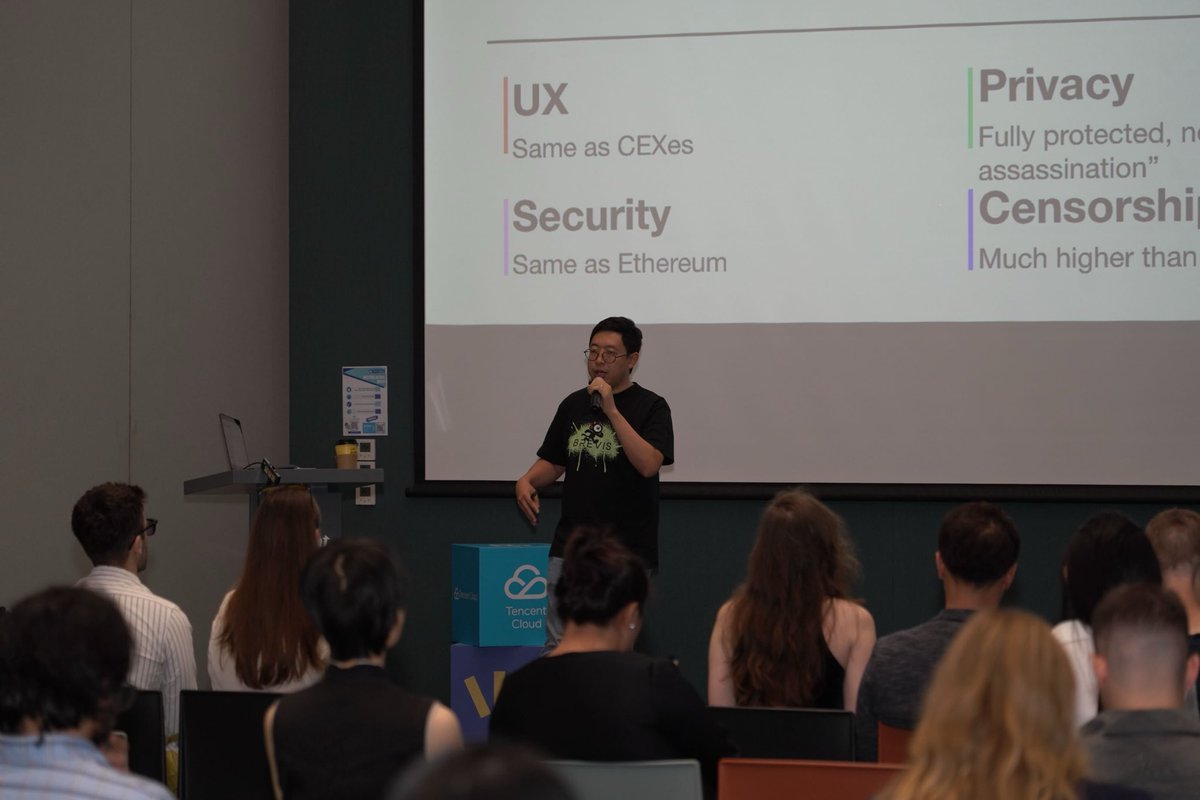
Lets talk a little about Brevis
Have you ever wondered why smart contracts feel so limited? They struggle to access and process large scale on chain historical data without sky high gas fees.
This is the problem solved by @brevis_zk, a revolutionary project that acts as an extra brain or coprocessor for blockchains
Let’s break it down
What is Brevis?
Simply put, Brevis is a smart ZK (Zero-Knowledge) coprocessor that allows smart contracts to access and perform complex computations on the entire on-chain history of any blockchain.
Imagine your dApps being able to "read" all historical transactions of a wallet and make smart, trustless decisions (no need to rely on a third party).
How Does It Work?
Request: A smart contract requests historical data computation from Brevis.
Read & Compute: Brevis reads massive historical data off-chain (e.g., from Ethereum’s genesis block) and performs heavy computations as requested.
Prove: The key step: Brevis generates a cryptographic proof (ZK Proof) that confirms the computation was performed correctly.
Verify: The compact ZK proof is sent back to the smart contract. The smart contract verifies it quickly and cheaply.
Result: Smart contracts receive 100% verified computation results without processing raw data themselves.
(placeholder for visual diagram)
Problems Solved: On Chain Limitations
High Gas Fees: Running complex calculations directly on mainnet is expensive.
Limited Data Access: Smart contracts struggle to access very old block data.
Computation Limits: There’s a limit to how complex an operation can be per block (block gas limit).
Brevis moves all heavy computation off-chain, leaving only lightweight proof verification on-chain. Efficient and cost-effective.
Utility & Real Use Cases
Here’s the real power of Brevis:
- Advanced DeFi:
On-chain Credit Scoring: Analyze a wallet’s full transaction history to build advanced credit models for undercollateralized lending.
Synthetic Assets: Create derivatives based on complex historical metrics (e.g., an asset’s historical volatility).
Active Liquidity Management: Smart market-making strategies based on historical volume and price movements
- Digital Identity & Reputation:
Build rich reputation systems based on on-chain user activity (e.g., DAO participation frequency, liquidity provision history).
- Gaming & NFTs:
Games with more dynamic logic that react to players’ historical achievements.
NFTs that "level up" or evolve based on an owner’s historical interactions within the ecosystem
- Governance:
Analyze historical voting patterns to prevent manipulation or Sybil attacks.
Make governance proposals based on deep analysis of a DAO’s treasury.
- Bridges & Interoperability:
Validate cross-chain status and transactions more securely and decentralized
- Why It Matters
Brevis opens the door to a new generation of data-driven dApps. Apps are no longer "blind" to the past they can learn and react to the entire on-chain history.
Its ZK technology ensures all processes are trustless you don’t need to trust Brevis, only the mathematical proof.
- conclusion
Brevis is a computation layer that gives superpowers to smart contracts. Its a key infrastructure component for the future of smarter, more sophisticated Web3 applications
gBrevis 🫡