DON'T FALL FOR THIS SCAM!
They tell you it's crypto arbitrage. You buy crypto from an exchange like Binance or Coinbase and sell on NeuroLanche for an inflated price
The scam is so ridiculous, I'd surprised anyone falls for it
@durov Telegram is becoming a hub for crypto crime
Are you still grinding your @jup_predict World Cup challenge or are you rekt already?
Thanks to Messi for victory over Austria, my selections are still grinding
#ARGAUT
What I've learnt so far from farming airdrops:
1. Never farm Layer 2 projects: The most disappointments and dust airdrop come from L2 projects
L2 projects require users to grind both testnet and mainnet afterwards they can come up with a criteria to cut everyone out without instant consequences. Also, note that grinding mainnet requires real funds, and you can lose a portion of your capital in fees
2. Never farm any Bitcoin project: No matter what the project says they're doing for Bitcoin, they're 99% gonna do a shitty or no airdrop at all
The real truth is that Bitcoin doesn't need these projects. It’s the most popular crypto asset. 90% of holders just want to hold it and not unlock any liquidity of any sort as these projects claim to want to solve. Examples include: yala, citrea, mezo, etc
3. Gated testent doesn't mean cook: I think this is perfectly understandable, and citrea is a major example amongst others
4. Hard testnet tasks = DUST or Zero airdrop
5. Not all referral testnets are gonna be dust
6. Any project that preaches "community is everything" is a major red flag 🚩🚩
7. Ignore founders' promises. They can turn at any time. Farm with little to zero expectations
8. Don't fade dac-chain testnet. I'm bullish on this.
Start here: https://t.co/BLNddggMPY
I like that DataHaven focuses on auditing and provenance. If AI is going to touch finance and governance, this kind of trust layer feels mandatory, not optional
AI is only as good as the data it learns from. And today, most AI runs on opaque, unverifiable data pipelines
That’s the gap @DataHaven_xyz is solving at the Web3 + AI layer
By giving AI systems verifiable memory, provable data lineage, and tamper-evident storage, DataHaven makes it possible to:
→ Audit AI outputs
→ Prove where training data came from
→ Detect manipulation at the data layer
As AI starts making financial, identity, and governance decisions, “trust me” data won’t cut it
Web3 + AI isn’t about hype.
It’s about building AI that can prove its truth, and DataHaven is laying that foundation.
This hits hard—Web3 storage solves availability but not integrity. DataHaven actually gives us cryptographic certainty about how data is used and updated
I believe @DataHaven_xyz is solving the data problem decentralized storage couldn't solve
As we all know, web2 storage is fast but opaque. You can’t prove who wrote the data, when it changed, or what an AI model actually saw. Trust is assumed
We also know, most Web3 storage fixes availability, not integrity. Files can exist onchain or offchain, but there’s still no cryptographic proof of how that data was used, updated, or referenced
That gap is where DataHaven sits
DataHaven introduces verifiable data lifecycle:
• Every document has cryptographic provenance
• Every update leaves a proof trail
• AI memory becomes auditable, not assumed
• Data access is enforceable, not implicit
Under the hood, DataHaven anchors proofs to Ethereum and leverages EigenCloud / EigenLayer security for tamper resistance at scale. This means trust isn’t social, it’s cryptographic
As AI systems start making financial, legal, and governance decisions, unverifiable data becomes a systemic risk
Infrastructure that makes data provable isn’t optional anymore. It’s the base layer
Most people will notice this after AI and institutions standardize on it
By then, the trust layer will already be locked in.
@0xSteel @DataHaven_xyz For me, the most exciting part is auditable AI memory. Knowing outputs can be traced back to provable inputs is exactly what’s missing for serious adoption
I can tell you for free why @DataHaven_xyz is the trust layer for Web3 + AI
AI is moving fast, but there’s a problem most people are ignoring: "Trust"
We're building systems that influence finance, research, identity, and governance, yet the data behind AI decisions is still unverifiable. If an AI can’t prove where its memory came from, how do you trust its output?
Keep reading.......
DataHaven isn’t trying to build a better model. It’s building the trust layer for Web3 + AI
• Verifiable AI memory – AI can cryptographically prove the origin and history of its data
• Decentralized data sovereignty – users and institutions control access, not platforms
• Provable document storage – files can’t be altered without leaving onchain evidence
• EigenCloud-backed security – strong guarantees against tampering and silent edits
As AI systems become autonomous, unverifiable data becomes a systemic risk. Infrastructure that makes data provable, auditable, and tamper-evident isn’t optional anymore
That’s why I see DataHaven as foundational, not hype
AI needs trust. DataHaven is building it.
@0xSteel @DataHaven_xyz AI is moving fast, but trust is always lagging. DataHaven finally addresses that, and it feels essential for the next wave of Web3 applications
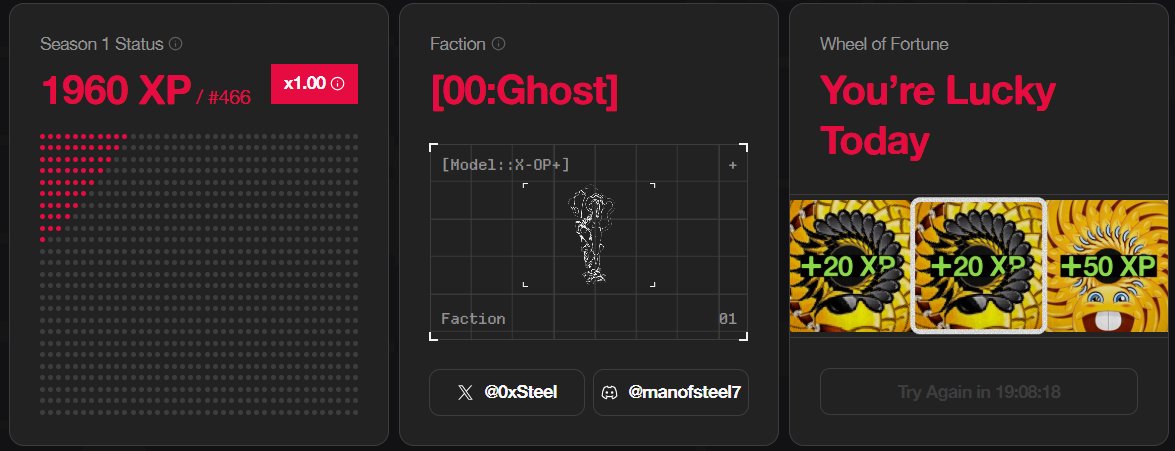
I finally got +20XP on the @Xyberinc watchtower wheel of fortune after 2 days of getting unlucky with –50XP and –100XP
I think the algorithm maps out a few days to reduce the XPs of users on the leaderboard
I'll be sure to avoid those "XP reducing" days next time
. @NeoxInfra treats security and compliance very seriously. Its built-in rules ensure:
• Policy-controlled allocations — capital only moves within predefined risk limits
• Autonomous risk agents — monitor markets and exposure in real time
• On-chain transparency — allocations and performance are verifiable
• No black-box vaults — partners always know where funds are deployed
This is the kind of infrastructure neobanks and fintechs actually need to offer yield without taking protocol risk
Security isn’t an add-on here. It’s the foundation.