Welp, that happened faster than I predicted. Thought it would be end of 2027, then early 2027, but agentic traffic growing so fast that bots have now passed human traffic online for the first time in the Internet's history. https://t.co/2zX5bHdhsa
Introducing Ideogram 4.0: the best open image model in the world.
Think it. Make it. Own it.
Download the weights, fine-tune on your own data, and run it on your hardware. Live on every Ideogram plan and the API today.
MAI-Transcribe-1.5: SOTA speech-to-text across 43 languages, transcribing 1 hour of audio in under 15 seconds.
🥇 #1 on FLEURS averaged across 43 languages
🥇 #1 on @ArtificialAnlys Accuracy x Speed Pareto Frontier
🥉 #3 on AA WER at 2.4%
Use it now: https://t.co/B7Wlj0gqZJ
We're finally shedding the .so (thank you Somalia!), and using the .com for @NotionHQ. And for this beautiful moment, I want to share a fun story:
Back in 2018, I had just joined Notion, and one of the first things @ivan asked me to do was figure out how we could own https://t.co/BxoFvc83VG. I had never done a big domain purchase before, so I reached out to a few domain brokers to understand the landscape. We tried different brokers, kept things anonymous, and attempted to surface a price the seller might consider.
A year went by… nothing. Meanwhile, it was pretty clear this was only going to get more expensive as we grew. We needed a different approach. A fellow founder connected me to a broker who took a very different tack. Less transactional, more long-term relationship builder. He spent months getting to know the domain owner. Turns out owner was a fellow entrepreneur in the west coast… and a huge Grateful Dead fan.
So we figured, why not get creative? Something beyond just price. So I called up our investor Ronny Conway and asked if there was any way he could help set up a private meeting between the domain owner and the Grateful Dead. Ronny is one of those people who somehow makes impossible things possible. A week later he calls me back: “New York City. Halloween. 15 minutes after the concert. Done.”
The broker went back to the owner with an offer: some cash, some equity, and a private meeting with the Grateful Dead. That got his attention. He didn’t take the band meeting in the end, but he did lean into the equity (great call, in hindsight). We shook hands, and a few weeks later, the deal was done.
I’ve been waiting years for the day we move our product to https://t.co/BxoFvc83VG. Looks like 2026 is finally the year. Safe to say I’m unreasonably excited about this update!
Codex can now deploy and host websites for you using Sites! 🎉
This includes storage for data and files using D1 and R2 💥
We started rolling out to Business and Enterprise customers before rolling out more broadly.
More details 👇
The next evolution of Hermes Agent is here!
Introducing Hermes Desktop: everything you love about Hermes, now native on your machine.
First demoed in Jensen's GTC keynote, it's now in public preview.
In the last 6 months at @Ahrefs, we analyzed over 1 billion data points across 14 studies. Here's what we learned about AI search optimization:
1) "Best X" blog listicles are the single most prominent content format cited by AI chatbots. They make up 43.8% of all page types cited by ChatGPT specifically.
2) 67% of ChatGPT's top 1,000 citations come from sources marketers can't influence: Wikipedia (29.7%), homepages (23.8%), app stores (6.6%). Only 32.3% are influenceable content like educational pages, reviews, news, and blog posts.
3) 28.3% of ChatGPT's most-cited pages have zero Google organic visibility. These pages get cited repeatedly by ChatGPT despite not ranking in Google at all. A completely separate discovery layer.
4) ChatGPT only cites about 50% of the URLs it retrieves. It fetches dozens of pages per query but uses half as background context without attribution. This means that being retrieved and being cited are very different things.
5) Adding schema markup had zero meaningful impact on AI citations. AI Overviews actually dipped −4.6%, while AI Mode (+2.4%) and ChatGPT (+2.2%) showed changes indistinguishable from zero.
6) YouTube mentions have the highest correlation (0.737) with AI brand visibility out of all the factors we studied (including all the conventional SEO metrics like backlinks, page count, DR, etc). This held true for both Google-owned and OpenAI products.
7) AI Overviews reduce clicks to the #1 result by 58%. That’s up from 34.5% just 10 months earlier. The trend is accelerating.
8) 99.9% of AI Overviews appear on informational intent queries. Transactional, navigational, and local searches are almost entirely AIO-free. Shopping triggers AIOs just 3.2% of the time.
9) For a given search query, Google’s AI Mode and AI Overviews reach the same conclusions 86% of the time — but cite almost entirely different sources (only 13.7% citation overlap).
10) AI Overviews change every 2.15 days on average, with 70% of content differing between consecutive observations. But semantic similarity stays at 0.95. The words, sources, and entities constantly shuffle, but the actual meaning barely moves.
Simple tips to get more out of your AI agent:
1. Ask it to do the work.
2. Have it remember and apply past lessons.
3. Give examples of the desired outcome.
4. Ask what context, access, or information it needs.
Told Hermes to monitor Dell Outlet for a good deal on a 32" 4K Dell P-Series monitor. After weeks of watching, one finally showed up today. Now hoping the order goes through before someone else grabs it. Wish me luck! 🤞
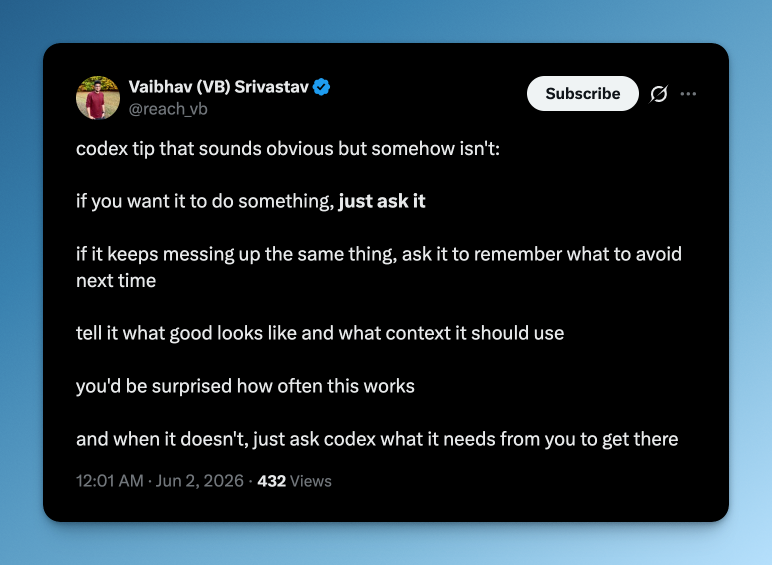
codex tip that sounds obvious but somehow isn't:
if you want it to do something, just ask it
if it keeps messing up the same thing, ask it to remember what to avoid next time
tell it what good looks like and what context it should use
you'd be surprised how often this works
and when it doesn't, just ask codex what it needs from you to get there