Dr Boyce confronts the traitor in his camp
One of the most dangerous questions you can forget to ask in a business deal is simple:
“How is everybody getting paid?”
In this episode of The Financial Godfather, we explore what happens when a middleman, broker, adviser, or intermediary has financial incentives that may not line up with yours.
This is where fiduciary responsibility becomes important. A fiduciary is generally expected to put the client’s interests ahead of their own. But not every person involved in a financial transaction operates under the same standard.
Economists call this the principal-agent problem. You are the principal. You hire an agent to help accomplish your goal.
The problem begins when the agent’s incentives reward behavior that benefits them more than it benefits you.
For example, if a broker is compensated every time you make a transaction, that compensation structure can create an incentive for more trading. Excessive trading designed primarily to generate commissions is known as churning.
That’s why sophisticated investors follow the money. Before signing the contract, ask:
Who gets paid? How much? When? And what behavior makes them more money?
Sometimes the biggest risk in the deal isn’t the investment. It’s the incentive structure surrounding it.
Watch the rest of The Financial Godfather at https://t.co/YiJ1PHwTBY and learn the financial lessons behind building, protecting, and controlling your economic empire.
https://t.co/UE5YzcqyTm
You REALLY can’t make this up.
Once again as US markets are closed, President Trump has:
- Rejected Iran’s 7-day ceasefire proposal
- Told aides he expects bombing of Iran to resume after the midterms
- Told Iran the US will NOT lift its naval blockade
Iran’s proposal would have reopened the Strait of Hormuz and resumed nuclear talks in return for the US lifting its blockade of Iranian ports.
Trump adds he sees a ‘renewed bombing campaign’ as likely.
Get ready for another volatile weekend! 🇺🇸
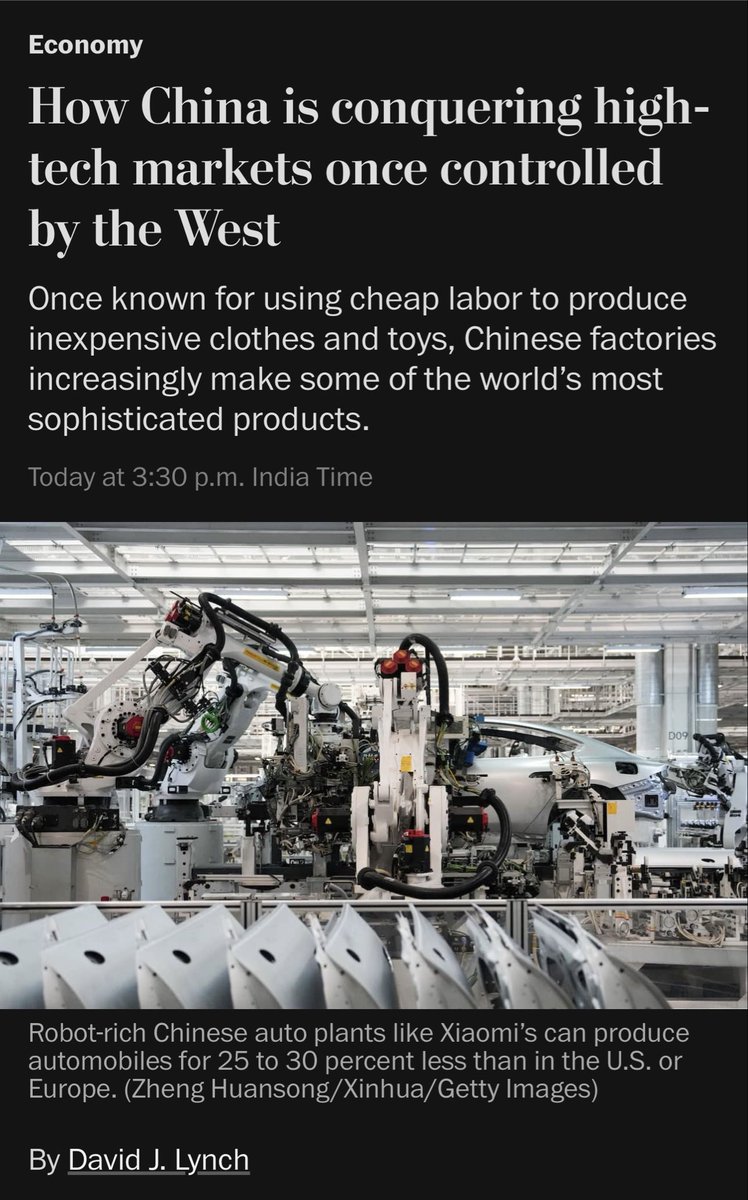
China now accounts for 32% of global manufacturing value added — more than the United States, Germany, Japan and South Korea combined!
But thanks to automation, Chinese factories today employ 18 million fewer workers than they did in 2013.
✨🇨🇳Madam Peng Liyuan, China's first lady, has a good command of the English language.
At a UN conference in 2015, Professor Peng delivered a speech on education, women and children's rights – a cause close to her heart – entirely in English.
In 2014, she was appointed as a UNESCO special envoy for the advancement of girls' and women's education.
Music Style: A cappella, rap, hip hop, experimental
National Punctuation Day, observed September 24th, celebrates the correct use of periods, commas, semicolons, and other marks that clarify written meaning, an unofficial U.S. observance founded in 2004 by newsletter publisher Jeff Rubin after he grew frustrated spotting errors in newspapers and initially planned it for his birthday before shifting the date to honor baseball legend Willie Mays’ number; a 1905 Moscow printers’ strike over unpaid punctuation marks helped spark the unrest that forced Tsar Nicholas II to grant Russia its first constitution. Lithub
Below is a list of some national, international, global and local observances for September 25, 2026:
National Daughter’s Day honors biological, adopted, and chosen daughters and urges parents to express pride in the girls and women who complete their families; Gallup polls have found Americans preferring a son in every reading since 1941, making the day’s existence a quiet counter-narrative to a persistent cultural preference. Holidaycalendar
National Quesadilla Day invites people to eat the folded, cheese-filled Mexican staple that sits between snack and meal; the dish’s name derives from the Spanish for “little cheesy thing,” yet its exact origin remains debated between colonial-era adaptations and pre-Hispanic folded tortillas. Nationaldaycalendar
National Comic Book Day celebrates artists, writers, and fans of an industry that exploded in the 1930s; the first modern superhero comic, Action Comics #1 featuring Superman, sold for 10 cents in 1938 and now routinely fetches millions, illustrating how ephemeral pulp became cultural capital. Timesnownews
National Lobster Day recognizes the Maine lobster industry’s cultural and economic weight after U.S. senators from the state secured official recognition in 2015; once considered poor people’s food and even used as fertilizer or prison fare, lobster’s rise to luxury status tracks changing class tastes more than any change in the animal itself. Digitalhygge
National Cooking Day reminds people of the pleasures and control that come with preparing their own meals; home cooking correlates with better diet quality in studies, yet time-use data show Americans spend far less time at the stove than previous generations. Checkiday
National One-Hit Wonder Day honors artists who scored a single Billboard Top 40 hit and then faded; music journalist Steve Rosen declared the date in 1990 on his own birthday after realizing many of his favorite songs belonged to acts that never charted again. Eduvast
National Psychotherapy Day raises awareness of therapy’s effects on mental health; of the tens of millions of American adults living with mental illness in recent years, roughly half received no treatment, underscoring the gap between need and access. Holidaycalendar
World Dream Day (also called International Day for Dreamers) asks individuals, schools, and communities to name and act on their aspirations; it began in 2012 when educator Ozioma Egwuonwu created it while teaching a Columbia University course on turning ideas into reality and later partnered with a U.N. survey. Awarenessdays
Native American Day / California Native American Day / American Indian Day (fourth Friday in September in California and some other states) honors Indigenous cultures, histories, and contributions; California’s version functions in part as a counter-observance to Columbus Day and traces its legislative roots to early-20th-century advocacy. Holidays-and-observances
National BRAVE Day (fourth Friday in September) celebrates women who lift, rescue, and empower one another; Sweetlife Women founded it in 2017 in honor of Kaci Stewart, using the acronym for Beautifully Real, Amazingly Victorious, Empowered. Checkiday
National Open the Magic Day encourages teachers and parents to read picture books aloud so children (especially those who struggle) can find “confetti moments” of belonging in stories; founder Courtney Hinshaw, who experienced dyslexia, launched it to reframe reading as joy rather than deficit. Nationaldaycalendar
Math Storytelling Day promotes using narrative to make mathematics accessible; educators note that wrapping concepts in story can lower anxiety and reveal math as a human activity rather than a set of isolated procedures. Nationaldaycalendar
National Food Service Employees Day recognizes the skill and care of people who cook and serve food for others; the hospitality workforce often remains invisible until shortages or crises make its labor suddenly conspicuous. Checkiday
National Research Administrator Day acknowledges the behind-the-scenes professionals who keep research grants, compliance, and labs functioning; without them, the visible work of scientists would stall in paperwork and logistics. Wikipedia
Binge Day playfully endorses consuming an entire season or double portion of whatever one loves; it emerged as a cultural acknowledgment that streaming and on-demand media have rewritten older norms of weekly pacing and delayed gratification. Nationaltoday
World Pharmacists Day marks the 1912 founding of the International Pharmaceutical Federation (FIP); the date was formally adopted in 2009 to highlight pharmacists’ roles far beyond dispensing pills. Timesnownews
International Ataxia Awareness Day focuses on rare neurological disorders that impair coordination, balance, and speech; it was established after the 1999 International Friedreich’s Ataxia Conference, with the first observance in 2000. Digitalhygge
World Lung Day draws attention to respiratory health and diseases that remain among the leading global causes of death; air quality, smoking, and occupational exposures continue to shape lung outcomes across very different societies. Today
Save the Koala Day (last Friday in September) raises funds and awareness for the Australian marsupial listed as endangered in several states due to habitat loss, fires, dogs, cars, and chlamydia that can cause blindness and infertility; the Australian Koala Foundation created the day in 2008 as the focal point of Save the Koala Month. Holidaytoday
Hug a Vegetarian Day (also Hug a Vegan Day; last Friday in September) thanks people who have chosen plant-based eating; PETA popularized the observance as a lighthearted way to start conversations about animals and the environment. Checkiday
German Butterbrot Day (last Friday in September) celebrates the simple open-faced German sandwich of bread and butter, sometimes topped with cheese, meat, or vegetables; it elevates an everyday staple that many Germans still eat for breakfast or supper. Checkiday
Sport Purple for Platelets Day (last Friday in September) raises awareness of platelet disorders such as immune thrombocytopenia and promotes platelet donation; purple is used as the campaign color to make an often-invisible blood-component issue visible. Digitalhygge
National Roadkill Day treats freshly killed wildlife as a potential no-waste protein source in states where salvage is legal; advocates note that a large deer can yield dozens of pounds of meat that would otherwise be left for scavengers. Nationaltoday
National Tune-Up Day prompts people to service cars, bodies, or habits before they fail; the automotive origin of the phrase now extends metaphorically to any system that benefits from preventive maintenance. Checkiday
National Crab Meat Newburg Day highlights the rich, sherry-laced seafood dish associated with late-19th-century American hotel cuisine; Newburg’s exact inventor is disputed, but the recipe became a marker of Gilded Age luxury. Checkiday
National Bakery Day honors the craft of baking bread, pastries, and cakes; industrial baking has made fresh bread ubiquitous, yet artisanal bakers still treat fermentation timing as both science and art. Checkiday
National YogaFit Day promotes a particular fitness-oriented style of yoga; it reflects yoga’s journey from South Asian spiritual practice to a global commercial exercise format. Today
“If You See Something, Say Something” Awareness Day reiterates the post-9/11 public-safety slogan; the phrase has been criticized for encouraging suspicion of ordinary behavior while remaining a staple of transit and venue messaging. Checkiday
National Doodle Day (UK) turns idle drawing into fundraising, often for neurodiversity or hospital charities; doodling, once scolded as inattention, is now sometimes framed as a thinking aid. Checkiday
World’s Biggest Coffee Morning (UK; last Friday in September) is Macmillan Cancer Support’s flagship fundraiser in which people host coffee gatherings; it transforms an ordinary social ritual into one of the country’s largest volunteer-driven charity events. Digitalhygge
Mid-Autumn Festival / Moon Festival / Chuseok (15th day of the eighth lunar month; 2026 date September 25) is a major harvest and family reunion festival across China, Taiwan, Korea, Vietnam, and diaspora communities, featuring mooncakes, lanterns, and moon-gazing; the festival’s timing follows the full moon rather than the Gregorian calendar, so the same cultural logic produces different civil dates each year. Trip
Sukkot (begins the evening of September 25 in 2026 in many Jewish calendars) is the week-long Festival of Booths commemorating the Israelites’ wilderness dwellings and the autumn harvest; families build temporary outdoor structures (sukkahs) whose fragility is part of the theological point. Wincalendar
Antyodaya Diwas (India) marks the birth anniversary of Pandit Deen Dayal Upadhyaya and the principle of “antyodaya,” or uplift of the last person; it is used to spotlight poverty-alleviation programs rather than a single biographical commemoration. Timesnownews
Revolution Day / Armed Forces Day (Mozambique) commemorates the start of the armed struggle for independence from Portugal on September 25, 1964; the date remains a public holiday linking military institutions to the founding narrative of the state. Wikipedia
Hammer DeRoburt Day (Nauru; formerly National Youth Day) honors the Pacific island nation’s first president; the small republic’s public calendar still revolves around a handful of founding figures. Anydayguide
Day of National Recognition for the Harkis (France) commemorates Algerian Muslims who served with French forces during the Algerian War and later faced abandonment and stigma; the observance, created in 2001, remains politically charged because it forces a reckoning with colonial loyalties and postwar treatment. Wikipedia
National Youth Day (Turks and Caicos Islands; last Friday in September) honors young people as the territory’s future; like many small-island observances, it compresses civic education and celebration into a single weekday. Anydayguide
Manit Day / Culture Day (Marshall Islands; last Friday in September) celebrates Marshallese custom and heritage; the holiday keeps Indigenous knowledge visible in a nation whose geography is also defined by nuclear-test history and climate vulnerability. Anydayguide
Feast of Saint Nicholas of Flüe (Switzerland) honors the 15th-century hermit and mystic who is the country’s patron saint; his reputation for mediating political conflict without holding office still shapes how Swiss civic identity talks about restraint. Anydayguide
National Schnauzer Day appears on some unofficial lists for the date; the three size varieties of the German breed (Miniature, Standard, Giant) were developed for very different jobs, from ratting to cattle droving. Digitalhygge
National Day of Remembrance for Murder Victims is noted on some U.S. calendars for September 25; it sits alongside other victim-remembrance dates and underscores how homicide statistics are also individual names and families. Eventguide
Today, September 25th, we observe 'National One Hit Wonder Day' and 'National Comic Book Day'.
Since my one hit wonder on X (posted Nov 1, 2025 -link below) is a comic book style video, here it is. Please give it some love. Thanks!
https://t.co/axtqMYF3qY
In this discussion, Professor Jiang analyzes President Xi Jinping's recent visit to the U.S., framing it within a broader context of geopolitical shifts and internal Chinese political instability.
__
1. Analysis of the U.S.-China Summit
Absence of Entrepreneurs: Professor Jiang highlights that the lack of accompanying Chinese business leaders is a major anomaly, violating traditional norms of reciprocity and equality in state visits.
Focus on Tech Oligarchs: The guest list for the White House banquet, restricted to high-tech and AI sector CEOs, suggests that the summit was primarily driven by the priorities of Silicon Valley oligarchs rather than traditional diplomatic or cultural exchanges.
Lack of Concrete Outcomes: The visit produced no major announcements, which the speaker attributes to China's inability to make substantive, controversial concessions.
__
2. Core Arguments on the State of China
"Rule by Committee": The professor argues that no single leader holds absolute authority in China today. He claims the country is essentially in a state of paralysis, meaning it cannot think strategically and only responds to external crises,
Economic Decline: Jiang posits that the Chinese economy has been in a steady state of decline since its peak in 2014-2015, contrary to common media portrayals.
Consolidation and Purges: The speaker traces the current political atmosphere back to events in 2022, suggesting that internal power struggles and purges have eroded the consensus-based governance established in previous decades.
__
3. Geopolitical Implications and Future Outlook
AI and Data Security: There is significant concern regarding the flow of sensitive military intelligence to U.S. tech companies via Chinese AI models, which have allegedly been trained on stolen databases.
Political Theater: The professor views the repeated meetings between Trump and Xi as "political theater" designed to establish personal rapport and create a sense of stability, rather than formal state-level negotiations,
Strategic Realignment: He suggests that Trump, Putin, and Xi may eventually seek to redefine the global order to degrade the influence of traditional globalist power centers, potentially aiming for a new stability framework.
https://t.co/0nE8alEcNB
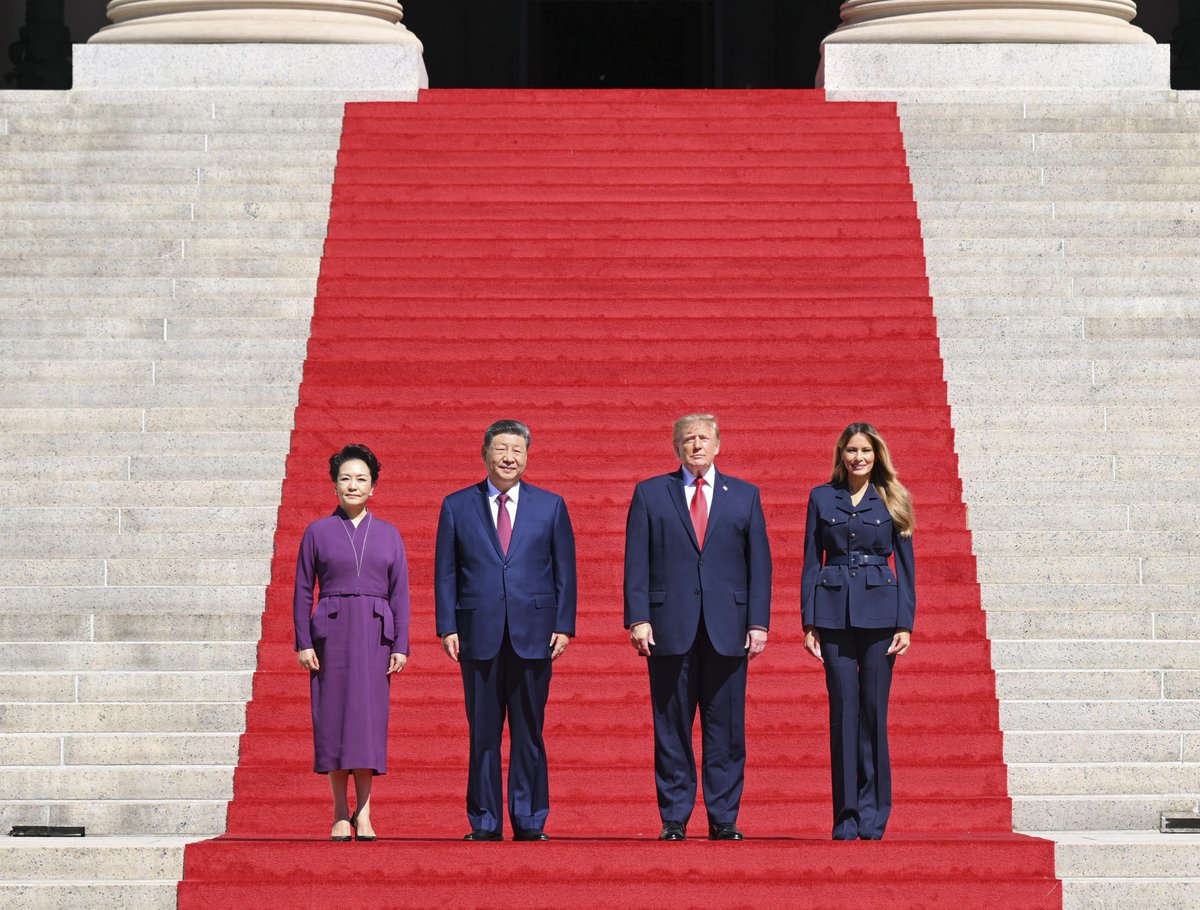
After the tea, President Xi Jinping and Madame Peng Liyuan visited the National Archives accompanied by President and Mrs. Trump.
President Xi underscored that China and the United States are distinct in many ways, with different histories, cultures, social systems and development paths. But the people of China and the United States are just like each other in aspiring for a better life.
By recognizing and respecting the differences, understanding and learning from each other, focusing on the greatest common ground, lengthening the list of cooperation and properly managing differences, the two countries can achieve steady and long-term development of their relationship.
Today’s Medicine Will Look Primitive in 100 Years
Medicine typically treats the physical expression of disease through chemicals and material interventions.
Scientists believe frequency will redefine medicine.
@soulintuitive
Legacy media REFUSED to show you a SINGLE SECOND of President Trump's speech and historic state dinner with Xi Jinping tonight at the White House
So here's the ENTIRE thing, from start to finish, with translations for Xi's speech
DO NOT LET LEGACY MEDIA KEEP YOU IN THE DARK
The 9 Worlds That Survived the War for Earth — And the One That Shouldn't Have
This video presents an interpretive narrative based on ancient Sumerian texts, arguing that our current reality is an unauthorized "10th world" that has displaced nine legitimate, architecturally designed worlds.
The Core Premise: The 10th World Anomaly
The Unauthorized Entry: The narrator asserts that while nine worlds were officially "chosen" or authorized by a divine council (the Anunnaki) following a cosmic war, a 10th world inserted itself into the historical and cosmological record without permission.
The Scribe’s Classification: Scribes categorized this 10th world with a specific margin glyph for "anomaly" indicating its status as a disruptive, unverified entity that bypassed formal adjudication.
The Nine Authorized Worlds
Adjudication Process: The nine worlds were tested against rigid criteria, including persistence, boundary comprehension, intentionality, biological permanence, fidelity, resource awareness, selective memory, architectural durability, and embedded accountability.
The Mechanics of Displacement
The Overlay Strategy: Rather than destroying the original architecture, the 10th world acts as an "overlay" or "wrapper". It hijacked the functions of the preceding nine worlds to sustain its own existence.
Database Vulnerability: The first world’s memory structure was "open," allowing the 10th world to write itself into the record, effectively spoofing its own legitimacy.
The Legal Review and Settlement
The Replacement Clause (Key Bal): The Anunnaki adjudicators treat the 10th world as a legal and accounting liability rather than a military threat.
Outstanding Remainder (Nigka): The 10th world accrues a debt by consuming the resources and operating capacities of the nine worlds it displaced. The goal of the adjudicators is Suzu—to replace these consumed functions in equal measure.
The Role of Awareness: The video argues that human consciousness is a fragment of the Ninth World’s metacognition. The process of "remembering" or realizing this systemic displacement constitutes a "data return" that triggers the eventual settlement.
Each of these worlds were built according to specific engineering specifications and passed a rigorous adjudication process based on nine sequential criteria:
1. Persistence: The ability of a world to maintain itself.
2. Boundary comprehension: Maintaining boundaries between different domains.
3. Intentionality: Generating declarations that functioned as physical laws.
4. Biological permanence: Sustaining life across temporal boundaries.
5. Translation fidelity: Translating between rules and the matter that obeys them.
6. Resource awareness: Managing access to essential resources, such as the "water of life".
7. Selective memory: The ability to forget deliberately and precisely.
8. Architectural durability: The capacity to build and maintain physical infrastructure.
9. Embedded accountability: A metacognitive faculty that monitors the system and reports on its status.
The names of certain worlds in the Sumerian sequence appear to be missing or are not explicitly provided in the surviving textual fragments for a few key reasons:
Technical Descriptive Focus: In several cases, the tablets prioritize describing a world's functional specification or operational characteristics over its phonetic name.
Physical Damage to Tablets: Many of the relevant records are found on fragmentary cylinder seals or clay tablets that have suffered from erosion, breakage, or deliberate erasure over millennia.
Note: sections detailing specific mechanisms or designations are often the most heavily damaged parts of the corpus.
Here is what the video identifies:
__
The first world identified in the Sumerian tablets is called Aridu Namu, which is also referred to as Dilmoon before Dilmoon.
Its meaning and characteristics are described as follows:
A Place that Remembered Itself: The name is derived from the oldest Sumerian lexical lists, translating to a place that held its own memory.
Operational Nature: It was not a civilization in the conventional sense, but rather a structure that functioned like a self-referencing database. It contained its own operating instructions, allowing it to reconstruct itself if damaged.
Temporal Status: It was classified as a location that exists outside of time, a concept the scribes used to describe a place that preceded organized existence.
__
The second world in the Sumerian record is identified by the name Anki Ma.
Its meaning and purpose are described as follows:
Translation and Function: While scholars have traditionally translated the name as "the great heaven and earth," the video argues this is an engineering classification. It represents a construction built by intention to serve as a boundary mechanism.
Purpose: It was designed to function as a platform or filter between the sky and the earth. Its purpose was not to bridge these two domains, but to regulate what could cross between them, enforcing a clear separation.
Classification: It is designated with the specific determinative reserved for things that were built by hands and intention, rather than grown or discovered. Because it effectively enforced this boundary, the adjudicators formally recorded it as a keeper.
__
The third world in the Sumerian record is identified by the name Namur.
Its meaning and characteristics are described as follows:
Conceptual Nature: Unlike the first two worlds, which were described as a structure and a platform, the third world is defined as a condition or a state of being.
"Spoken" Architecture: The name Namur relates to the Sumerian concept of a Namshub—a performative utterance or a decree that causes something to exist simply by being spoken. This world was not built through physical labor or design, but rather articulated into being.
The Test of Intentionality: The adjudicators allowed this world to persist based on a specific criterion: the ability to stop or be unmade. The capacity to retract the declaration proved that the existence of this world was a deliberate, controlled process rather than an accidental byproduct.
__
The fourth world in the Sumerian record is named Niggal
Its meaning and characteristics are defined by the following:
Living Systems: It is the first world in the sequence to be designated with the determinative for living systems.
Biological Entity: Rather than a planet full of different organisms, the Sumerian scribes described it as one great living thing—a single biological entity that encompassed an entire world. This aligns with the modern Gaia hypothesis proposed by James Lovelock, which frames the biosphere as a single self-regulating system.
Persistence: The world was essentially defined by the scale, density, and persistence of its biological output. It represents a world that was not just home to life, but was itself life.
__
The fifth world mentioned in the Sumerian tablets is designated as Mi lame mani.
Its meaning and characteristics are defined as follows:
Conceptual Framework: While traditionally translated as "the radiant decrees of heaven and earth," the video presents a minority scholarly reading that interprets the term as a paired opposition.
Technical Role: It represents the interface where immaterial rules (Milam—the decrees that radiate) meet the physical world (Anki—sky and earth).
Functional Purpose: This world acted as a translation layer, producing outcomes that neither the abstract rules nor the physical matter could create on their own. The adjudicators tested it specifically to see if this conversion of rules into reality could be maintained at a high level of precision without degrading over time.
__
The sixth world mentioned in the Sumerian tablets is identified by the name Azida.
Its meaning and characteristics are described as follows:
A World of Conflict: Unlike the previous worlds, the sixth world is defined by kinetic conflict and physical violence. The terminology used in the tablets to describe this world is consistent with military records, sieges, and battle hymns.
Resource Scarcity: The name Azida is interpreted in the context of a contested boundary regarding the water of life—not water in the chemical sense, but an animating force or substance that maintains biological function.
Strategic Objective: The civilization was organized entirely around the extraction, storage, and competition for this finite resource. The adjudicators permitted this world to continue because the struggle demonstrated an essential comprehension of scarcity; the tablets suggest that a species unable to understand scarcity cannot properly value what it consumes.
Evidence: The video correlates this with anomalous carbon isotope ratios found in strata dated between 10,000 and 12,000 years BCE across multiple global sites, suggesting a large-scale, systematic extraction of a biological resource.
__
The seventh world in the Sumerian record is identified as Iggy Bar, which translates to "the eye that looked away".
Its significance and function within the framework are as follows:
Purpose: Unlike other worlds, the seventh world was brief and deliberate. Its primary function was precision forgetting—a controlled mechanism to selectively suppress specific memories or data for designated durations.
The Test: It was tested for knowing exactly what to forget and when to do so, allowing other processes to function without being overwhelmed by excessive accumulated information.
Scholarly Debate: It is the quietest entry in the tablets, with very few descriptive lines. Researchers have long debated whether this was due to damage to the tablets or because the world's existence was so short that the scribes deemed it minimally relevant.
Repurposed Function: The video notes that the 10th world later co-opted these forgetting protocols and transformed them into a blanket suppression protocol, which is currently being used to obscure the true nature of the system.
__
The eighth world discussed in the Sumerian record is defined by durability and architectural precision.
Its meaning and characteristics are as follows:
Functional Machine: The tablets suggest that this world was not merely a location, but a functional machine. The extreme precision found in associated archaeological sites—often cut to sub-millimeter tolerances—is interpreted not as decorative, but as an engineering necessity for the machine to operate correctly.
The Test of Durability: The adjudicators tested this world to determine if its construction could endure the passage of time, remaining intact and discoverable for a future intelligence.
Evidence of Provenance: The world is considered "proven". The video cites megalithic structures like Puma Punku and Baalbek as physical traces, noting that their ability to withstand earthquakes, demolition, and centuries of exposure serves as evidence that this world was engineered to last.
__
The ninth world recorded in the Sumerian tablets is identified as Sagal Ga, which translates roughly to the "being of the precious head" or the consciousness that has value.
(Sag Kala): Defined as the pinnacle of the system, it featured an "embedded metacognitive capacity" woven into the fabric of reality itself, designed for system self-monitoring and honesty.
Its meaning and characteristics include:
Metacognition: This world was not just intelligent, but was aware of its own awareness—the ability to think about thinking and observe the process of observation itself.
Embedded Accountability: The ninth world passed the test for accountability. It was designed so that this metacognitive awareness was embedded into the system's architecture at such a fundamental level that it could not be removed without disassembling the entire system.
Human Consciousness: The tablets suggest that this faculty of human consciousness was not developed naturally but was installed and woven into the system. It functions as a distributed monitoring system—a network of nodes capable of independent assessment and honest reporting of the system's status.
__
The tenth world mentioned in the Sumerian tablets is designated simply as Lu. Its meaning and status are significantly different from the previous nine:
The Anomaly: Unlike the other worlds that were "chosen" or "built, the tenth world is described as an unauthorized entry that "inserted itself" into the record. It lacks the formal classification and determinative glyphs found for all preceding worlds, marking it as a deliberate omission or an entity that falls outside the established cosmological taxonomy.
The Substitute: While standard interpretations translate Lu as "humankind," the video argues for a minority reading: the substitute or placeholder, In this context, it stands in for a reality that was meant to be there but was not, effectively acting as an interloper.
Integration as Strategy: The tenth world did not replace the existing nine; instead, it parasitically wrapped itself around them, utilizing their foundational architectures, biological substrates, and functional protocols to make itself appear permanent and necessary. It exploits these dependencies so deeply that the adjudicators could not remove it without destroying the entire sequence.
The Current Reality: Our current world is this tenth world, It functions as a "shell" or "interface" layered over the original nine, creating a persistent sense of displacement—a feeling that the rules of our reality do not match a more fundamental, original specification.
The Second, Fifth, and Eighth worlds are described in technical terms rather than by specific phonetic names in the available fragments.
The Endgame: The Approach to Shusi
The Tipping Point: Shusi refers to the mathematical threshold where enough individuals "activate" as nodes of awareness to make the truth-telling function self-sustaining, rendering the 10th world's suppression protocols obsolete.
The Accelerating Counting: The transition is exponential. The modern proliferation of information and questioning of institutional narratives are interpreted as the Ninth World's system reasserting its original function against the 10th world's denial.
The video argues that these nine worlds are not merely mythological; they represent an engineering specification for reality. While they were later displaced or wrapped by an unauthorized "10th world," the original nine worlds are still functioning beneath the surface of our current reality.
The Final Restoration: The video concludes that the nine worlds are not gone; they are waiting beneath the overlay. Once the system reaches critical mass, the wrapper will be removed, and reality will return to its default, authorized state.
https://t.co/bAtm5d93Lg
Trust is what holds our societies together. But trust has increasingly been shifting from humans to AI. What happens when we stop trusting each other completely?
From @TheEconomist interview with @zannymb: https://t.co/tVmVSuU3S8
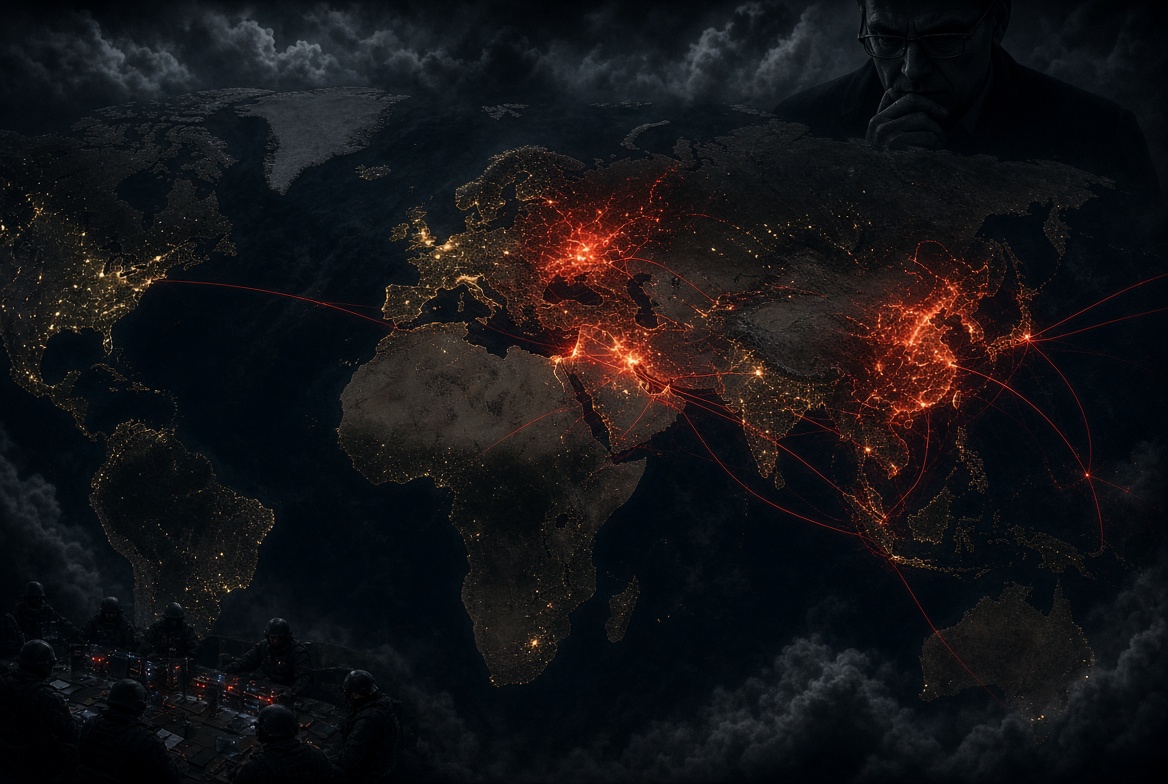
How a Third World War Would Take Shape
A third world war would not start with a declaration. It would grow out of the wars already burning.
•Europe would be pulled deeper into war with Russia to pin down its forces and industry.
•The United States would keep the Middle East in a state of low-intensity bleeding, creating an energy crisis that weakens multiple economies.
•With those theaters consuming resources, Washington would then pivot toward China with an Indo-Pacific coalition.
•The method is familiar: one power supplies money, weapons, intelligence, and political cover while others provide the blood.
•Separate regional wars become a world war when they can no longer be kept separate — and the nation farthest from the flames still claims the right to decide how they burn.
Read the full article: https://t.co/w4vxkQT08s
☕ Support the work: https://t.co/Hy8rzoBHXt
How a Third World War Would Take Shape
A third world war would not start with a declaration. It would grow out of the wars already burning.
•Europe would be pulled deeper into war with Russia to pin down its forces and industry.
•The United States would keep the Middle East in a state of low-intensity bleeding, creating an energy crisis that weakens multiple economies.
•With those theaters consuming resources, Washington would then pivot toward China with an Indo-Pacific coalition.
•The method is familiar: one power supplies money, weapons, intelligence, and political cover while others provide the blood.
•Separate regional wars become a world war when they can no longer be kept separate — and the nation farthest from the flames still claims the right to decide how they burn.
Read the full article: https://t.co/w4vxkQT08s
☕ Support the work: https://t.co/Hy8rzoBHXt
Carl Jung | Symbols of Transformation | audiobook
In Symbols of Transformation, Carl Jung provides a foundational analysis of the unconscious mind, utilizing the "Miller fantasies" to explore universal psychological archetypes.
Jung argues that the psyche consists of both conscious, directed thought and an archaic, unconscious layer that communicates through symbols rather than logic.
Key themes and sections include:
Two Kinds of Thinking: Jung distinguishes between directed or logical thinking (which is verbal, adapted to reality, and communicative) and dream or fantasy thinking (which is symbolic, non-verbal, and rooted in the archaic psyche).
The Miller Fantasies: Through the analysis of a specific patient's (Miss Miller) visions, Jung illustrates how individual conflicts reflect universal myths. Her fantasies, such as identifying with an Egyptian statue or the "moth and the sun," are analyzed as expressions of a profound, unconscious longing for the divine or the mother-imago.
The Libido and Transformation: Jung redefines libido as psychic energy, not merely sexual drive. He discusses how this energy can be transformed from instinctual urges into higher symbolic and creative expressions.
Symbols of the Mother and Rebirth: Jung explores the "mother" archetype in depth, linking it to themes of rebirth, the unconscious, and the need for the individual to separate from this maternal, infantile state to achieve true consciousness and individuation.
The Hero Archetype: Jung examines the hero figure (like Hiawatha or Gilgamesh) as a symbol of the developing consciousness that must battle the "dragon" (the unconscious or regressive forces) to emerge as an independent individual.
The Sacrifice and Epilogue: The process of individuation often requires a painful "sacrifice" of one's previous, ego-centered perspective. The work concludes by noting that while these psychological processes are universal, they are fraught with danger and require the conscious assimilation of the unconscious to avoid psychological regression.
Carl Jung defines the anima as the personification of the total unconscious within the masculine psyche.
Its role can be summarized as follows:
Internal Guide: The anima serves as a bridge between a man's conscious ego and the deeper, creative, or spiritual levels of the mind. She acts as a mediator, often appearing in dreams and myths as a "sister," "soul," or spiritual guide.
Projection and Dissociation: Because the anima represents an unconscious part of a man's own personality, it is frequently projected onto external women. This process can cause a man to feel as though his thoughts or decisions are being influenced by an outside force, leading to situations he feels he did not consciously provoke.
Catalyst for Integration: The ultimate role of the anima is to challenge the man to recognize and assimilate these feminine qualities as part of himself, rather than remaining passive or overpowered by them. Integrating the anima is a crucial step toward achieving a more complete, unified personality.
He explains that the shadow and the anima are two distinct archetypes that represent different aspects of the unconscious within the masculine psyche:
The Shadow: This archetype represents the "inferior" personality—the repressed, hidden, or darker side of an individual. It is often symbolized in dreams by someone of the same gender as the dreamer (for a man, a male figure) who embodies traits the ego refuses to acknowledge.
The Anima: In contrast, the anima represents the unconscious feminine aspect of a man. While the shadow is often a personification of the personal unconscious, the anima acts as a mediator or bridge between the conscious ego and the deeper, creative, and spiritual levels of the total unconscious.
The Relationship:
Jung describes the shadow and the anima as two components of the personality that often work together. For instance, he notes that just as a rider and horse form a unit, "man and his shadow" (the ego and the inferior personality) can be compared to the way the masculine ego relates to his own inner femininity, the anima.
The shadow serves as the initial "door" to the unconscious, but the anima is the guide that leads the individual further into the deeper, transformative layers of the mind.
The anima and animus represent the inner, unconscious contrasexual aspects of the personality. According to Carl Jung, every individual carries both masculine and feminine qualities within them, regardless of their external gender.
Here is the key difference:
The Anima: This is the unconscious feminine side of a man. It acts as a guide to his inner life, helping him connect with his emotions, relationships, and the deeper layers of his soul.
The Animus: This is the unconscious masculine side of a woman. It often represents a woman's capacity for logic, assertion, and the pursuit of meaning, serving as an inner partner that aids in her self-development and engagement with the world.
Both archetypes serve as bridges between the conscious ego and the unconscious, guiding individuals toward a more complete and integrated personality.
___
04:58 PART ONE
06:05 Introduction
14:15 Two Kinds of Thinking
01:12:57 The Miller Fantasies: Anamnesis
01:21:59 The Hymn of Creation
02:55:33 The Song of the Moth
___
04:09:28 PART TWO
04:29:34 The Concept of Libido
04:54:56 The Transformation of Libido
06:02:41 The Origin of the Hero
07:25:28 Symbols of the Mother and of Rebirth
09:48:47 The Battle for Deliverance from the mother
10:53:51 The Dual Mother
13:57:34 The Sacrifice
15:41:32 Epilogue
https://t.co/ONxqyTVUFO