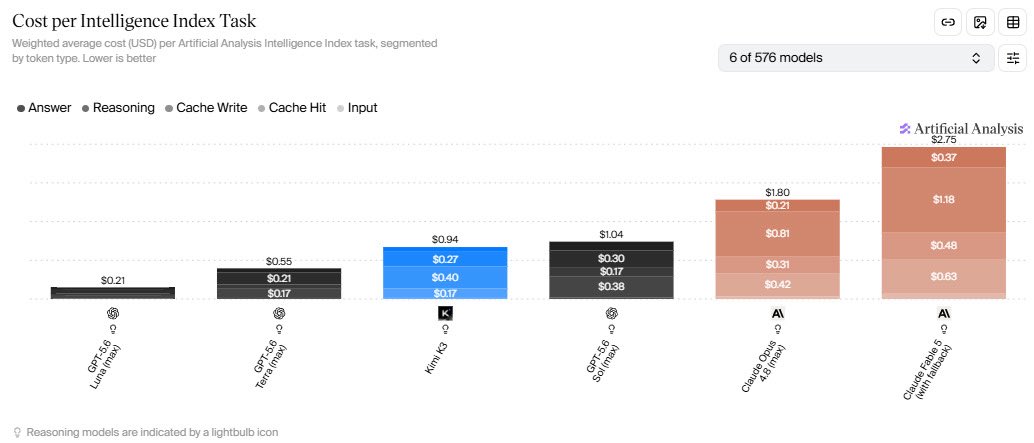
Kimi K3 may be an important inflection point for AI. Potentially negative for Anthropic and OpenAI while being net positive for essentially every other company in the world. I mean that very literally. Although the real “Sputnik moment” would be an open-source frontier model that was also token efficient unlike Kimi K3 which is 50-70% more expensive to run than GPT 5.6 per Artificial Analysis.
Rationale:
A world where there are only 2-3 dominant frontier labs with 90% inference margins is net negative for every other layer while being awesome for those 2-3 labs. Those labs would become monopsonies for power, data centers, semiconductors and hyperscalers and would obviously vertically integrate over time into all those layers while also completely subsuming the application/software layers.
Anything that lowers margins and increases competition at the model layer is good for every other AI layer: power, semiconductors, hyperscalers, neoclouds and yes even software.
This is why Jensen is so supportive of open-source. An open-source model requires the *exact* same amount of compute to run as a closed frontier model of similar size and architecture. Kimi K3 is roughly the same price as GPT 5.6 Terra on a per token basis, which actually suggests that it is less computationally efficient as I am sure that GPT 5.6 is priced to a higher margin than K3. And given that K3 is a token wastrel, i.e. token inefficient, it is significantly more expensive per task than GPT 5.6 and Grok 4.5, which are much more token efficient. Cost per token and token efficiency (i.e. intelligence density per token) are the drivers of intelligence per unit of cost. The winning AI companies will be those that offer the most intelligence per $ over time.
Lower margin % at the model layer = more margin $ at every part of the infrastructure layer and is a godsend for software. This can happen either through open-source models like K3 at the frontier *or* having a vertically integrated model company like Meta, SpaceX or Google at the frontier. Both outcomes result in a lower margin % at the model layer as vertically integrated model companies don’t really care where the margin $ come from. This is why it was so painful for OpenAI and Anthropic when Google was right there with them from a model competitiveness perspective and why Grok 4.5 and Muse 1.1 were just as important as Kimi K3.
The reason Kimi K3 is only *potentially* negative for Anthropic and OpenAI is 1) the @ericvishria point that the Claude and ChatGPT products and harnesses may be more important than their models today and 2) the hypothesis that they have much more advanced model checkpoints internally that are already being used for RSI. In the latter scenario, reaching RSI even a few months ahead of other labs might be enough to cement a permanent lead.
Time will tell on both points. And likely fairly quickly.
Caveat would be that since Kimi K3 is not token efficient and thereby actually more expensive than ChatGPT 5.6, we may need to see a more token efficient open-source model at the frontier or see Grok 5/Composer 4/Muse 2 at multiple points on the Pareto frontier for this potential risk to Anthropic and OpenAI to play out. And I am sure they will both vertically integrate as quickly as possible while continuing the product/harness strength they have shown over the last 8 months.
Now that the budget bill has passed Congress, we can see what the projections look like for deficits, government debt, and debt service expenses. In brief, the bill is expected to lead to spending of about $7 trillion a year with inflows of about $5 trillion a year, so the debt, which is now about 6x of the money taken in, 100 percent of GDP, and about $230,000 per American family, will rise over ten years to about 7.5x the money taken in, 130 percent of GDP, and $425,000 per family. That will increase interest and principal payments on the debt from about $10 trillion ($1 trillion in interest, $9 trillion in principal) to about $18 trillion (of which $2 trillion is interest payments), which will lead to either a big squeezing out (and cutting off) of spending and/or unimaginable tax increases, or a lot of printing and devaluing of money and pushing interest rates to unattractively low levels. This printing and devaluing is not good for those holding bonds as a storehold of wealth, and what’s bad for bonds and US credit markets is bad for everyone because the US Treasury market is the backbone of all capital markets, which are the backbones of our economic and social conditions. Unless this path is soon rectified to bring the budget deficit from roughly 7% of GDP to about 3% by making adjustments to spending, taxes, and interest rates, big, painful disruptions will likely occur.
we reached $5M ARR with a team of 5
what's https://t.co/K8Kjeq5dCi secret?
>AI agents everywhere
here are the top agents we use every day to scale with such a lean team
In 2011, Patagonia made the boldest move in retail history:
They spend $100,000 to tell the world NOT to buy from them.
It didn't make any sense.
But this anti-sales campaign made $123 million and changed marketing forever.
Here's the full story:🧵
Life is not hard. We make it hard.
Whenever the word ‘should’ pops up in your mind, that is social programming.
Get rid of “should” as much as possible.
Naval
Your inner world shapes your outer reality.
A turbulent mind sees conflict and chaos; a peaceful soul radiates love and warmth.
Cultivate inner harmony to transform your experience of the world. 🧘♀️
@SchopenhauerNow Opinions are fueled by emotion; thinking is ignited by rationality and curiosity.
Emotions come cheap, but thinking is heavy-duty work.
@SchopenhauerNow Opinions are fueled by emotion; thinking is ignited by rationality and curiosity.
Emotions come cheap, but thinking is heavy-duty work.
Beneath the surface of conflicts lies a truth: we're more aligned than we realize.
Seek to understand others' intentions and perspectives. Step back, listen, and empathize.
In doing so, you'll cultivate inner peace, harmonious relationships, and genuine happiness. 🕊️🤝💖