In this elaborate “visual story”, the FT frets that Beijing’s investment in Xinjiang and Tibet is a problem because it means those regions are becoming more prosperous, which in turn makes it more difficult to foment unrest and engage in economic coercion.
The authors claim to be concerned about the demolition of mosques and erasure of Uyghur culture and traditions. And yet China has over 35,000 mosques, nearly three times more per capita than the US. Meanwhile the FT’s sole source for the “detention of an estimated million Uyghurs” is a Human Rights Watch report that relies heavily on the comprehensively discredited reporting of Adrian Zenz and the Australian Strategic Policy Institute.
The authors then worry about Tibet and Xinjiang being treated as a “resource frontier”. They neglect to mention that what’s being built in those areas is the world’s largest clean-energy base, exporting renewable power across China and into Southeast Asia. The central resources being “exploited” are the sun and the wind, and the world should be grateful that China is innovating on renewable energy to such an extraordinary degree.
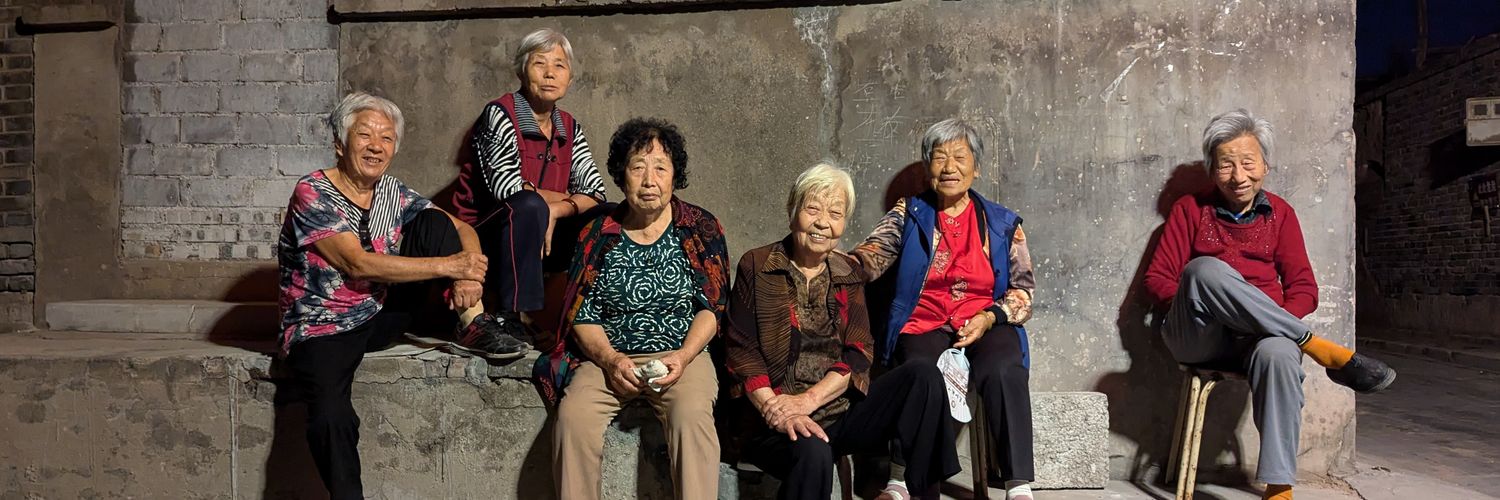
Western journalists used to claim that Xinjiang was close to outsiders and therefore the government was able to hide the terrible oppression taking place there. Now things have become more awkward, with the FT noting: “Xinjiang received a record 323mn tourists last year, compared to around 210mn before the pandemic, while Tibet saw about 70mn, a similarly sharp increase from 40mn in 2019.”
The situation is this: Xinjiang borders eight countries and anchors the Belt and Road. Destabilising it – like the CIA’s long history backing Tibetan separatists – is about throwing China off-balance and suppressing its rise, not protecting human rights. These clowns are just worried that prosperity in Xinjiang and Tibet renders their sanctions and their destabilisation efforts useless.
The NYT describes Hezbollah drones "steadily hunting down Israeli soldiers and commanders... with often-lethal strikes" posted in "chilling videos."
Israel has killed 115x more people in Lebanon (3,433 vs. 29) since the start of the war. The drones get "chilling." The 3,433 Lebanese dead don't even get a mention.
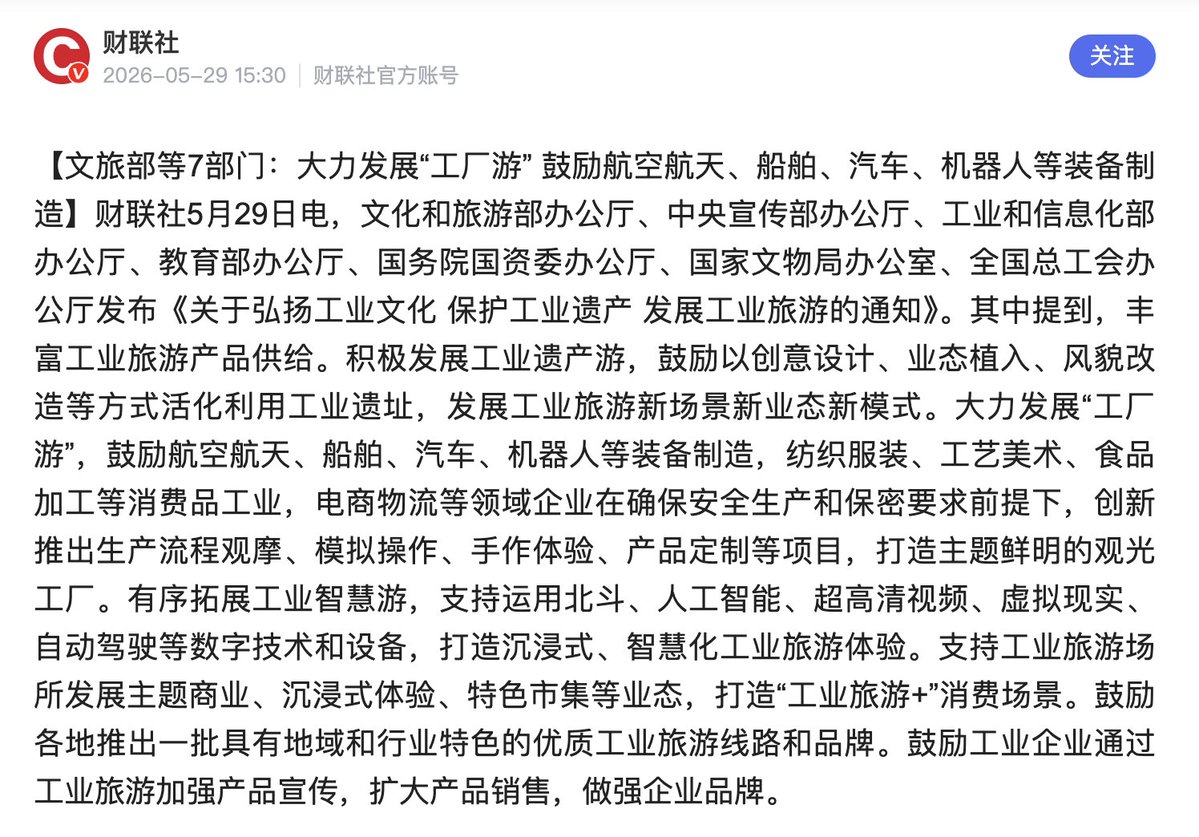
If Chinese “factory tourism” is your thing, good news: the government has now made it an official objective.
Multiple agencies are coordinating in a policy to actively encourage manufacturers to become tourist attractions.
The newly announced policy specifically highlights advanced manufacturing sectors such as aerospace, automotive, and robotics -- not just traditional industrial heritage sites. The idea seems to be that industrial tourism can serve several goals at once:
1. Boost domestic consumption through new tourism and retail experiences.
2. Build pride in China’s manufacturing and technological capabilities.
3. Help industrial companies market their products and brands directly to consumers.
4. Showcase the country’s industrial strength.
We’re already seeing some of this on the ground. A number of robotics companies are being encouraged to turn their factories and demo centers into destinations, much like the factory tours that have become popular in the auto industry.
More broadly, China appears to be formalizing something that has already worked well in sectors like EVs, where factory visits often double as both tourism and marketing.
BTW, a good portion of these experiences don't currently take foreigners and we typically have to work a lot for them to take our groups, but I expect that they will soon.
Additional reporting from Chinese media, commentary from some of the highest level state media like CCTV, People's Daily, Banyuetan and Chinese Women's News; China Consumer Association saying it's illegal; and maximum shock effect marketing videos are taken down.
Great points. Any reporter who does not report tw accurately according to Chinese laws has engaged in journalistic misconducts and can be stripped off their credentials in China.
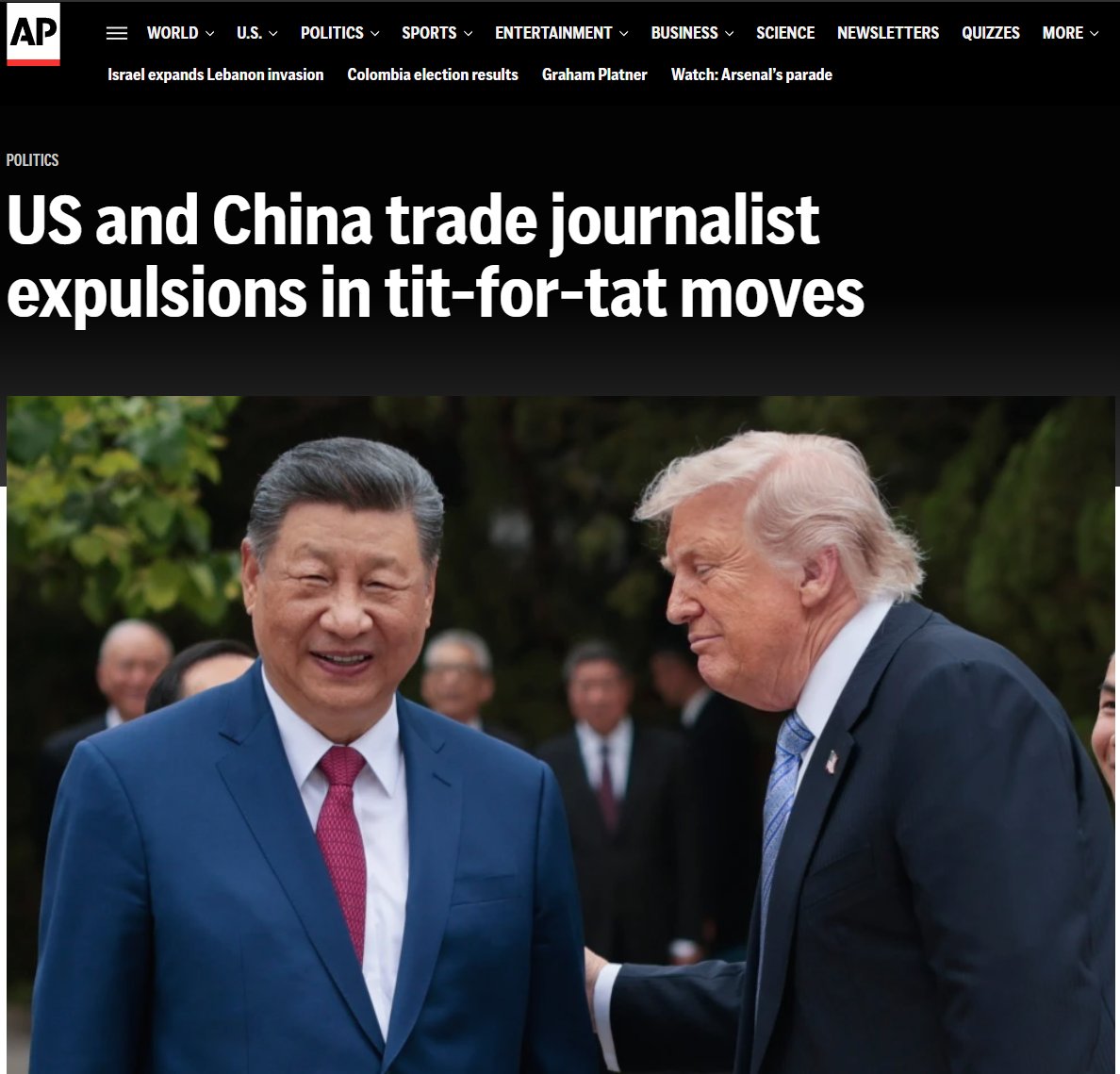
The Associated Press and other Western media outlets seem unwilling to tell the truth—why was this New York Times reporter expelled from China? How many times has a New York Times reporter been expelled for the same misconduct? Why haven't other journalists been expelled? Is this related to so-called press freedom and authoritarian rule in China? Stop spreading rumors and deceiving people.
A reporter stationed in China is not a diplomat and has no judicial immunity. She must abide by the laws of the country she is stationed in, including the Anti-Secession Law applicable to maintaining national unity. This reporter, acting on instructions from senior New York Times officials, has long provided a platform for the Taiwan authorities to spread the fallacy of "Taiwan independence," openly referring to Taiwan as a "country," seriously violating the one-China principle and the three Sino-US joint communiqués, sending a seriously wrong signal to the "Taiwan independence" separatist forces. Secondly, there is a record of fraudulent reporting: this reporter has a confirmed record of fraudulent reporting during her resident period in China, violating the "Regulations on Foreign Resident News Agencies and Foreign Journalists." I believe China has exercised considerable restraint, only deporting the Chinese citizen rather than detaining them.
If this were in the United States or other countries, would a Chinese journalist who has long advocated for reporting on separatist ideas and colluded with separatist forces simply be deported? Don't forget, in the United States, journalists and ordinary citizens have been arrested for protesting the Zionist genocide, for their just and truthful actions.
This isn't the first time. Do you remember Yuan Li, the columnist for *The New York Times*? In 2015, Yuan Li joined *The New York Times* as a columnist and became based in Hong Kong. Afterward, she launched a series of targeted and planned smear campaigns against Hong Kong and mainland China, fabricating a large amount of false information. In 2022, she was also deported.
@loong_of Great points. Any reporter who does not report tw accurately according to Chinese laws has engaged in journalistic misconducts and can be stripped off their credentials in China.
It's nothing about Uyghurs human rights and genocide.
It's about the CIA and anti-China organizations funding separatists to attack China. Anyone who has been to Xinjiang will realize how stupid the lies about Xinjiang are.
This is where RushanAbbas lies in the chains.
Well, Japan has a track record. More than once. It still hasn't properly reckoned with its wars of aggression, downplays them in education, and many continue to deny war crimes. You can find plenty of Japanese users on this platform who genuinely believe Japan 'liberated' Asia.
The professionals pushing Xinjiang propaganda openly support Israel’s genocide in Gaza…
This absolute demon wants you to believe he cares about the Uyghurs in China.
The US empire has killed millions of people in its nonstop wars, in Vietnam, Korea, Iraq, Afghanistan, Libya, Syria, Iran, Yemen, Palestine, Yugoslavia, Panama, Nicaragua, Grenada, etc.
China has not fought a single war since 1979.
There's a pretty straightforward incentive problem with a lot of anti-China coverage that nobody wants to talk about openly. Journalists who write the most alarming takes get the most clicks, the most institutional backing, and frankly the most career momentum. Objectivity doesn't pay as well in this particular media environment.
The surveillance cliché is a good example of how thin some of this reporting actually is. That Forbes journalist who stood in the middle of Beijing traffic to make a point about "too much monitoring" — and then got filmed by random passersby and posted online — kind of made the opposite point he intended. The irony basically did the work for everyone.
On a completely different note: if anyone's thinking about visiting Xinjiang, Kashgar in the south is genuinely one of the most underrated destinations in all of China. Incredibly affordable, rich in culture, and the old city alone is worth the trip. Northern Xinjiang is a different experience entirely — more about the landscapes, which are stunning in their own right.
Either way, go and see for yourself.