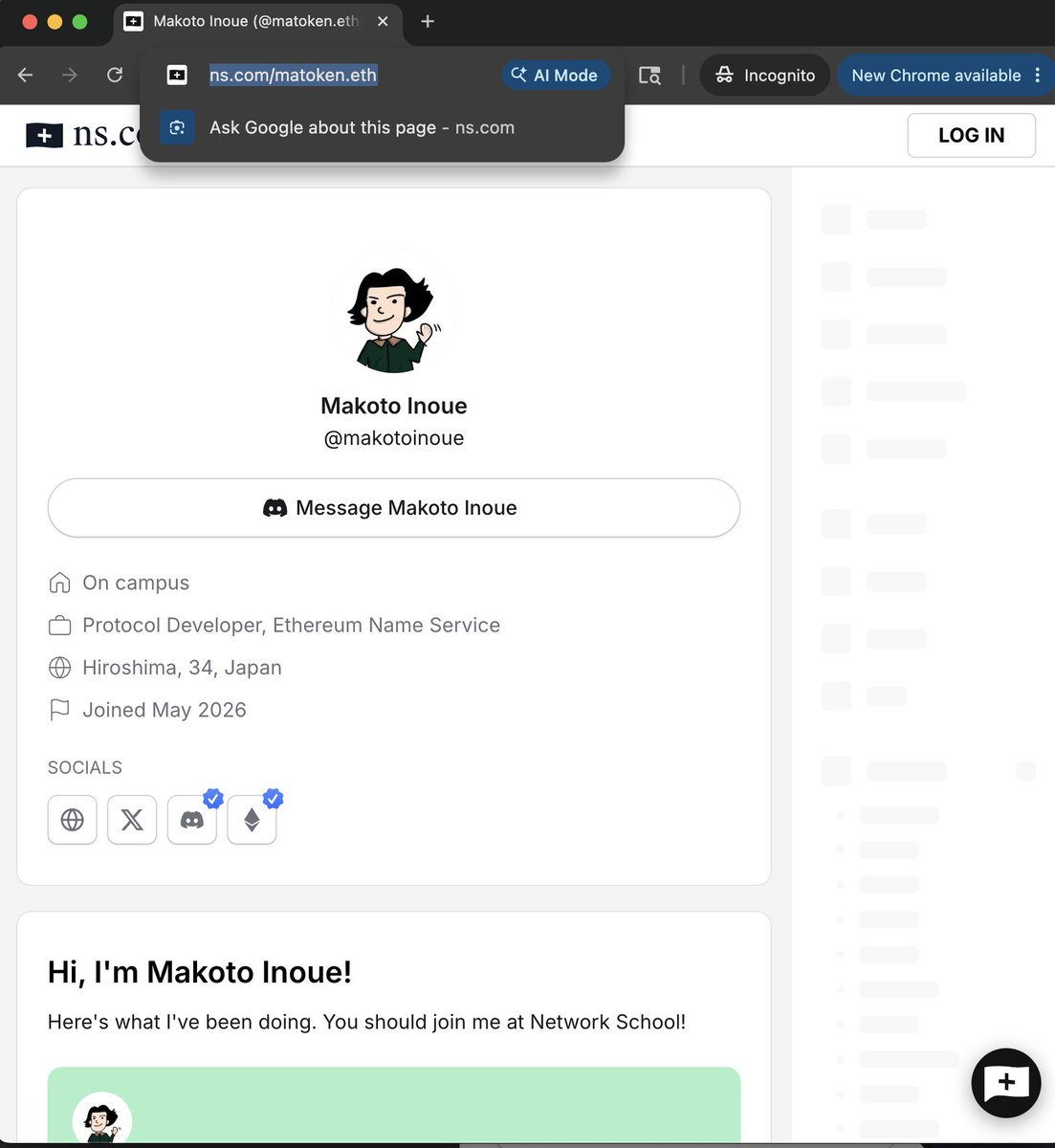
@LefterisJP Yes! Would love to see Rotki earning rev shares for the great ENS renewal reminder feature or other ENS features you may add in the future 😀
A rotki user just renewed their ENS before expiration.
Not in their calendar. Didnt remember the date. rotki did.
The app analyzes your history, finds your ENS names and reminds you to act. Same for bridges, vesting etc
Your identity shouldnt expire because you forgot a date!
With the second batch of awards going out earlier this week for @ens_dao's Contract Naming Season, it has finally come to a close.
6 months and 7,095 of ENS awards later, it's time to wrap it up. 🧵
💰 SOLD: kevin.eth
For: $42,911.19 (21.25 ETH)
Buyer: 0x7a63...f682
Seller: vault.kevin.eth
Last Sale: 40.00 ETH, 18 Aug 2022
Categories: First Names Global, Short Name Auction 1k #940, Gamertags, Handles, First Names USA
https://t.co/UTvaAMYIkF
ENS names are no longer just single objects with one owner and one resolver.
ENSv2 introduces hierarchical registries that let different parts of a namespace branch into their own permissions, logic, and resolution systems.
Dive deeper: https://t.co/5FOOiJqq8n
.@Kleros_io, the leading decentralised arbitration protocol on Ethereum, has adopted Enscribe-powered ENS naming for its smart contracts as part of @ens_dao Contract Naming Season.
For a protocol built on trust and verification, contract identity matters.
Until now, ENSvolution showed you what changed on a name. It didn't show you who owned it or when it was renewed.
That changes today 👉 Ownership + renewals are now on the timeline.
https://t.co/Fa6WF988cz 🫡
Ethereum is about to fundamentally change how blocks are executed. With the upcoming Glamsterdam hardfork, it's shipping EIP-7928: Block-level Access Lists, a proposal that brings parallelization to the EVM.
Here's a short explainer of what it is, how it works, and why it's a big deal for scaling.
Let's start from the top. Alongside EIP-7732 (ePBS), EIP-7928 is the execution-layer (EL) headliner for Glamsterdam. Like ePBS, the main focus has been scaling Ethereum, though both proposals come with a bunch of other, equally important properties on the side e.g. removing trust requirements from the PBS pipeline or improving sync.
EIP-7928 adds a Block Access List (BAL) to every Ethereum block. A BAL is a list of accounts and storage slots that the block touches, but that's not all: it also contains post-transaction state diffs (this part is critical!).
Post-transaction state diffs tell you what the state looks like after each transaction. Quick example: user A swaps 1 ETH for DAI on DEX B. The BAL tells you that user A's ETH balance decreased by 1 ETH + tx fees and their nonce went up by 1; that DEX B's ETH balance went up by 1 ETH; and that inside the DAI contract, user A's DAI balance increased while DEX B's decreased.
In other words, all of that info becomes statically available, something that previously required tracing the transaction.
Client software (Geth, Nethermind, Besu, Erigon, Reth, Ethrex, Nimbus) can use this to do a few very powerful things:
1. Parallelize transaction execution. Knowing the post-state of each tx resolves the dependencies between them. No transaction has to wait on the previous one anymore, so execution can be perfectly parallelized. Instead of large parts of block validation sitting idle waiting on sequential execution, clients can finally make much better use of modern hardware.
2. Batch prefetch. One of the most cumbersome jobs for a node has been fetching the state needed for execution from disk. Because state locations (e.g. the exact storage slot in the DAI contract where user A's balance lives) are only discovered along the way, while executing, state-fetching has been a real drag on scaling: it blocks execution, takes time, and eventually slows everything down. With BALs, everything a node needs for execution is known upfront and can be loaded into cache in one go, in parallel. This speeds things up even further.
3. Parallelize post-state root calculation. Another expensive task is walking the updated state tree to compute the post-state root, which is needed so that everyone agrees on what's on disk after executing the block. With the post-tx state already in the BAL, nodes can do this in parallel while executing. A heavy task that used to wait until all transactions had finished can now run alongside prefetching and execution.
4. Snap sync (v2). An often overlooked, less sexy aspect of blockchains is syncing. Nodes need to catch up with the chain, and they need to catch up faster than the chain progresses. Today, most nodes do snap sync: downloading blocks, headers, and state in parallel while chasing the tip, and then "healing" the database once they're close to the head. Healing means asking peers for trie nodes, receiving them, validating them, and updating the local DB. It's iterative, networking-heavy, can take a while, and especially higher throughput pushes that phase to its limits. BALs help here too: with snap v2, nodes can catch up to the tip and skip the healing phase entirely. Syncing at higher throughput becomes more robust and reliable.
So, to summarize, a BAL contains two things:
-> The state locations the block accesses
-> The state changes after each tx (incl. the new values)
We're already seeing big performance gains today: on 6-core machines, EL clients validate blocks up to 5x faster, making block gas limits of 300M a very realistic outcome. ePBS will add to that by decoupling the block from the payload, giving validators 2-4x more time for execution.
To not overshoot (security stays priority #1), the fork will likely ship with a 200M gas limit, but we shouldn't be stuck there for long before pushing to 300M and beyond. That's a 10x in scaling since we started taking the topic seriously, without touching hardware requirements.
None of this would have happened without people going all-in, heads down, shipping: so many hours spent in calls debating the right design, so many iterations refining the specs, and tons of test cases written (and still being worked on). The road from whiteboard to production-ready code has been a journey, and we're not at the finish line yet, but from what I can tell, things look super bullish for Ethereum.
Glamsterdam will be a fork that shows what's possible when a distributed, decentralized community works on a shared goal, laser-focused on providing enough block space to onboard the next wave of users.
What’s changing under the hood in ENSv2?
Quite a bit.
Registries, resolvers, and permissions have all been redesigned for greater modularity, flexibility, and a better developer experience 🧵