We’ve been quietly building the world’s most data-driven home health assessment, and now we’re excited to share it publicly.
Environmental toxin exposure is one of the most important and overlooked health issues of our time, and for many people, it starts right at home.
Lightwork helps you understand and improve your home’s functional health.
We conduct comprehensive assessments of air quality, water quality, lighting, EMFs, mold, and more, then help remediate the hidden toxins and health hazards we uncover.
We believe creating a healthy home is one of the most important things you can do to improve your health.
Our assessments are now available in NYC, Austin, LA, SF, and London, and our team travels nationwide.
Learn more 👇
Jaspr is a beautiful, reliable, and well-engineered product, but doesn’t score as well as other similarly-priced models on air throughput or “quiet CADR” (throughput at a quiet volume), which are the primary metrics our tool uses to rank the units. As a result our algorithm rarely recommends it, because other models (including other well-designed ones) can provide much more throughput for lower cost.
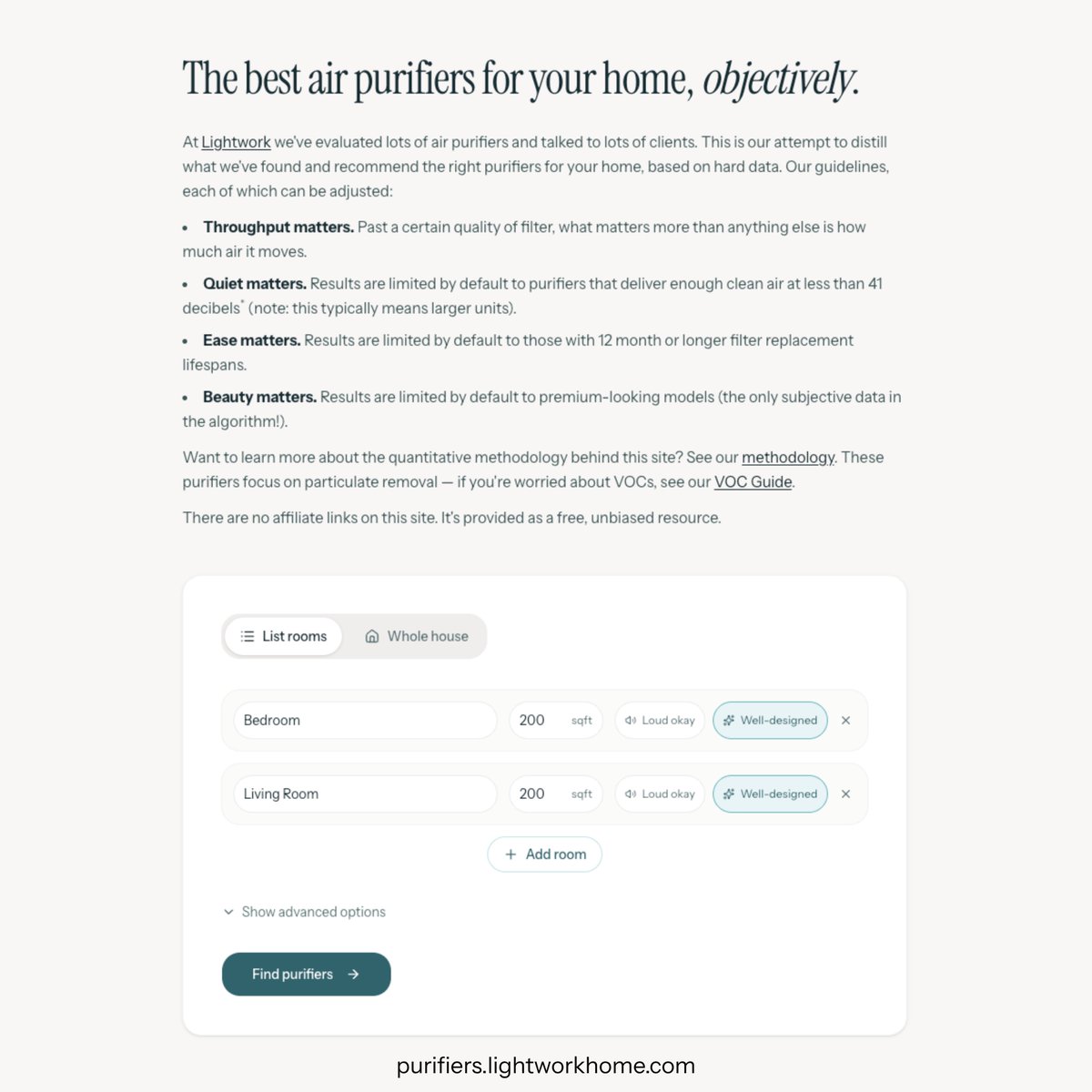
We built a free, data-driven tool to objectively help you choose the right air purifier for your home.
There is so much marketing noise in the air purifier space. Companies use and come up with all sorts of buzzwords to suggest that their purifier does something special. It's shockingly difficult to get straight answers and objectively evaluate performance.
So we created a free tool to help you pick the right air purifiers for your home. 100% free, no signup required, no affiliate links, no partnerships or bias. Just data.
Here’s something that might surprise you: most modern air purifiers filter about the same percentage of particles. Any HEPA filter removes at least 99.97% of particles at around the size it performs worst at (which is pretty dang good!). So what matters more is throughput (measured as CADR, or Clean Air Delivery Rate), how much air the unit can push through that filter. A purifier that's too small for your room will never get the air clean, no matter how good the filter is.
But after consulting on air filtration with a lot of clients, we've realized that there are some other real-world, practical considerations that most recommendations ignore:
> Quiet matters. If an air purifier is too loud, people simply won't use it. And an unused air purifier is no good at all.
> Ease matters. If you have to replace the filters too often, most people will simply not do it. And dirty filters tank the efficacy of a unit.
> Beauty matters. For many customers, having an ugly air purifier is a non-starter. So finding aesthetically-appealing ones, at least for certain rooms, is a factor.
> Price matters. On top of all that, people want value. If it's too expensive, it won't get purchased in the first place.
So we've created a tool that factors in all of the above to recommend the right air purifiers for your home. You put in your room sizes and preferences around noise and design, and it recommends a best-value pick and an upgrade pick for each room. The site walks through the methodology behind it all, including a metric we developed called "Quiet CADR," the clean air delivery rate at a volume you can actually live with.
One of our main goals at Lightwork is to bring science-backed, data-driven rigor to the home health industry, which has historically been plagued with imprecision, poorly-supported claims, and (at worst) scams.
(link below)
Key thing when picking an air filter is the CADR. This tells you how much clean air the unit actually delivers, which matters far more than any other marketing claims about filtration.
Multiply the CADR by 1.5 to roughly get the coverage area in square feet. For example, a unit with a CADR of 200 is good for a ~300 sq ft room.
I did a whole-house toxin health assessment, where a guy spent half a day testing our house's air quality, water, EMFs, lighting, mold, and household products.
So many surprises:
- Our Waterdrop reverse-osmosis water filter seems to be introducing a chemical (Dichloromethane) into our drinking water that wasn't in the (whole-house filtered) tap water. Will recheck this to make sure it's not a fluke.
- Even though we have air purifiers in many parts of the home, they weren't on the proper setting so our air quality was not great. Turned them all up higher.
- Most of our light bulbs have blue light and super high flicker rates which disrupt circadian rhythms. Replacing a bunch of them.
- The wifi router in my office is EMF'ing the sh*t out of me. Going to move it to a different part of the room.
- The powerstrip under our bed is EMF'ing the sh*t out of us. Getting a grounded power strip that avoids this.
- Some of our shampoos and soaps had harmful ingredients.
On the plus side, no gas leaks or carbon monoxide 👌
I'm predicting this is going to become the next microplastics-type trend, to test your home for toxins and harmful products.
Try this at your home!
Your Lights might be Flickering And You Don’t Even Know It. This could be massively disrupting your nervous system.
Alexa at @lightworkhome brought this to my attention when she gave my home a full diagnostic test for mold, dirty energy and a bunch of other toxins.
Try putting your phone on slow motion and poining it at your lights.
You may not see it with your eyes, but your brain is still processing it.
Over time, low quality LED and fluorescent lights can contribute to:
• Eye strain
• Headaches
• Fatigue
• Brain fog
• stress on your nervous system
The biggest offenders is Cheap LEDs and Fluorescent bulbs.
Some Better options are:
• flicker-free LEDs (CRI 90+)
• Warm light (2700K) in the evening
• Incandescent or halogen if possible
Your environment affects your performance.
This small adjustment in your home and workplace might make a huge difference in you life. 💡
@sharkgevity
🚨NEW: Experts in environmental exposures from @lightworkhome actually went on-site this month to take measurements of the EMF levels around the 49ers practice facility and Levi's Stadium. Some of the findings they discovered and sent me are alarming.
Their findings:
> Near the transmission lines around the perimeter of the facility, we measured 4.7 to 22 mG, roughly 5 to 20x higher than typical residential environments.
> Further from the lines, we measured 0.3 to 1 mG, which is typical for most towns and cities.
> We were unable to access the facility itself, so indoor levels remain unknown.
> Strong evidence across multiple meta-analyses links continuous exposure above ~3 mG with increased childhood leukemia risk, and that threshold is exceeded in many areas surrounding the facility.
> Firm conclusions cannot be drawn without readings from inside the facility, but unusually elevated exposure alongside an atypical injury pattern warrants further investigation.
#49ers
We visited the area to take readings of the Extremely Low Frequency Magnetic Field strength.
Our findings: the fields are 5-20 times higher in certain areas around the facility than in typical residential areas, primarily driven by the transmission lines connecting to the electrical substation; however, we were unable to access the facility itself, and the levels could be much lower inside, or the same or higher.
More info here: https://t.co/iilcXvoRmq
We recommend an advanced on-site assessment that maps field strength, calculates time-weighted exposure based on usage patterns, and measures temporal variation as power demands cycle. If needed, remediation can range from simple usage changes to engineered options such as active shielding.
Lightwork Home Health would be happy to offer a preliminary evaluation of the facility pro bono to ensure our 49ers' training environment is setting them up for success.
The internet has lit up with discussion about whether elevated electromagnetic fields near the 49ers’ practice facility could be contributing to the team’s spate of injuries. Lightwork Home Health visited the area to measure the Extremely Low Frequency Magnetic Field strength, or ELF-MF.
Our findings:
> Near the transmission lines around the perimeter of the facility, we measured 4.7 to 22 mG, roughly 5 to 20x higher than typical residential environments.
> Further from the lines, we measured 0.3 to 1 mG, which is typical for most towns and cities.
> We were unable to access the facility itself, so indoor levels remain unknown.
Strong evidence across multiple meta-analyses links continuous exposure above ~3 mG with increased childhood leukemia risk, and that threshold is exceeded in many areas surrounding the facility.
Firm conclusions cannot be drawn without readings from inside the facility, but unusually elevated exposure alongside an atypical injury pattern warrants further investigation.
We tested @awilkinson's house. He's as health-conscious as they come (and his house was top tier). But we still found room for improvement.
In his recap, he said:
"I've talked to a bunch of friends about this. The ones who've gotten their homes tested all have the same thought: 'It's insane that nobody checks this stuff.'"
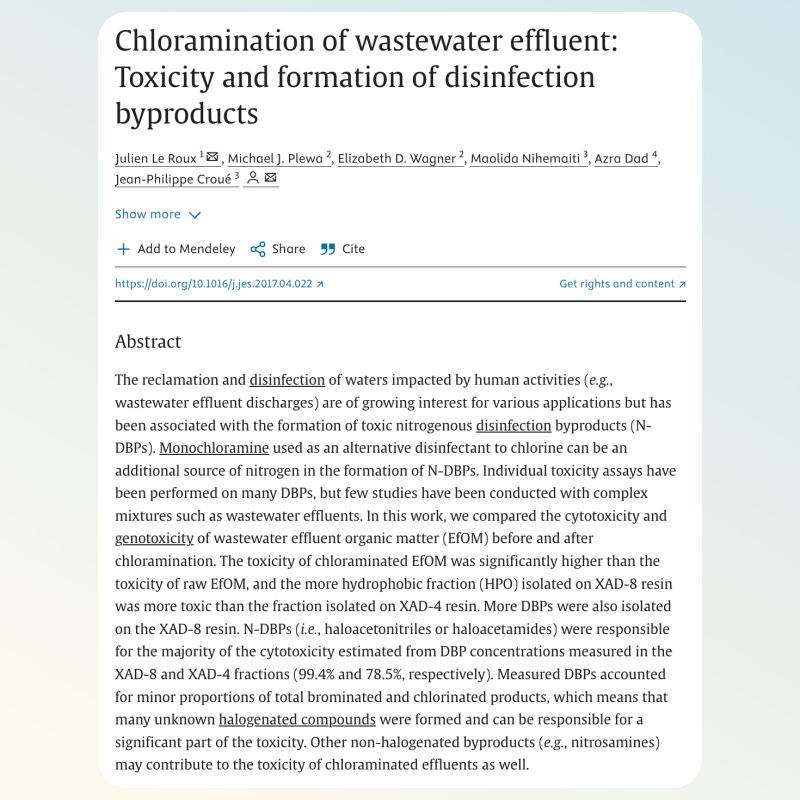
Unregulated disinfection byproducts are a major source of drinking water toxicity that nobody is testing for (apart from us!).
Researchers conducted a comprehensive investigation into U.S. drinking water toxicity and found that unregulated disinfection byproducts (DBPs) are key contributors to overall toxicity.
DBPs form when disinfectants like chlorine or chloramine react with organic matter during water treatment.
In the US, only 11 DBPs are currently regulated, specifically some trihalomethanes (THMs) and haloacetic acids (HAAs). However, thousands of DBPs can be created through this process, and most are not routinely monitored or tested for. This research found that many of these unregulated DBPs are significantly more cytotoxic and genotoxic than the regulated ones, and they occur just as frequently, if not more so.
Why This Matters
Many highly toxic yet unregulated disinfection byproducts are effectively overlooked by standard water testing, despite contributing meaningfully to overall drinking water toxicity.
While there has been a strong focus on PFAS contamination in recent years, DBPs are typically found at concentrations more than 1,000 times higher in drinking water, making them a much larger concern for most homes.
That’s why we now offer an advanced water test that measures the total amount of these sorts of disinfectation byproducts in your water, capturing the combined impact of all the regulated and unregulated disinfection byproducts so we can assess overall risk and guide targeted contaminant reduction and any further testing.
We recently ran our full environmental health assessment on the @superpower HQ and @maxmarchione's personal home. Are they as healthy as they claim?"
Most people track their sleep, dial in nutrition, and fine-tune supplements. But they overlook the spaces they spend most of their time in: their home and office. And more often than not, those spaces are working against them.
Air quality, lighting, water purity, EMF exposure, and mold are all critical factors that can influence sleep quality, focus, hormone health, recovery, and more.
Tomorrow we're sharing everything live: the full results, plus actionable steps to optimize your own space.
What you'll learn:
> The real findings from Superpower HQ and Max's home, fully unfiltered
> The hidden environmental factors that hurt performance and longevity
> The highest-impact fixes for air, water, light, and EMF exposure you can implement immediately
Everyone who registers is entered to win a one-year Superpower membership plus a full water lab test for 100+ contaminants with a consultation.
Link to sign up below
We tested @derekflanz 's home in Austin a couple of weeks ago, and he wrote about the experience in his 5 Healthy-ish Things newsletter.
One of the main findings was elevated AC electrical fields in both of his daughters’ rooms and his wife’s office, which we’re now helping him resolve.
It’s a great behind-the-scenes look at a Lightwork assessment.