Acabo de enviarles sus respectivas cartas notariales a los activistas políticos o streamers (o lo que sean) Carlos León Moya, alias @contracultural, y Marco Sifuentes Quintana, alias @ocram. A ambos sujetos les estoy dando 24 horas para que muestren las pruebas de la temeraria y difamatoria aseveración que hicieron sobre la autoría de mis 4 libros el domingo pasado. Si no prueban su dicho (difamación agravada), deberán rectificarse públicamente. Sí, como calculo, no van a tener las pelotas para responder, lo harán en el Poder Judicial. Después no estén llorando “persecución de Keiko Fujimori”.
PD pueden contratar al Riverita @IDL_Rivera para que los defiende. Será un gusto ganarle otra vez.
#LavaChato
I kept making my .NET projects more complicated than they needed to be.
When I started out, an API was a controller that talked to a DbContext, and it worked fine.
Then I learned about the repository pattern, so every entity got a repository.
After that came AutoMapper, MediatR with CQRS, and a Clean Architecture solution with a separate project for every layer.
Each of these felt like the next step towards writing proper enterprise code, so I added them to every new project by default.
The problem is that I was adding them before I had the problem they solve.
A generic repository on top of EF Core mostly repeats what the DbContext already gives you.
A mapping library saves some typing, but a missed property shows up at runtime instead of at compile time.
And when a small app is split into many layers, adding one new field means changing files in several projects.
I went through exactly this with fullstackhero.
Over time, I moved it from layers to vertical slices inside a modular monolith, removed MediatR and AutoMapper, and dropped the generic repository so that the handlers use the DbContext directly.
A feature now lives in one folder, so it is much easier to see everything a request touches.
I would still reach for microservices or a message bus when several teams need to deploy on their own schedule, or when one part of the system has a very different load from the rest.
Those are real reasons, but most projects I see don't have them yet.
Which pattern did you add early and remove later?
Follow me if you want more practical .NET content like this.
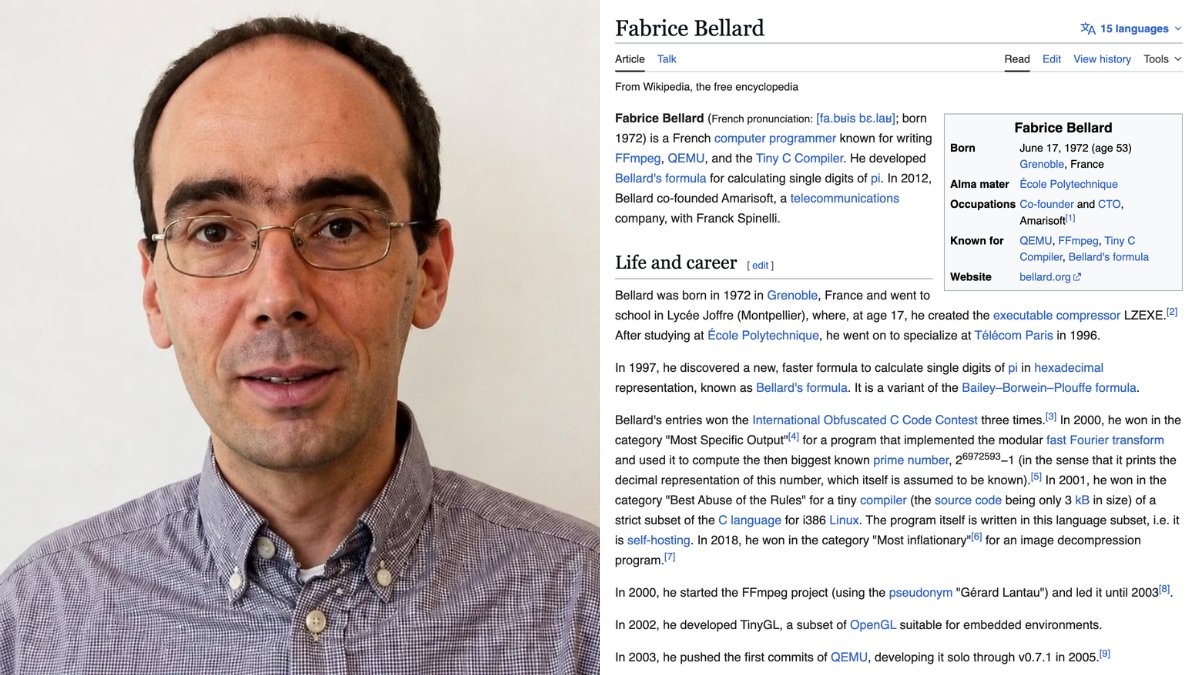
A French engineer who lives quietly in Paris has spent 30 years writing software that the entire internet now runs on without knowing his name.
He wrote the code that streams every YouTube video, every Netflix show, every TikTok clip. He wrote the code that runs the virtual servers underneath AWS, Google Cloud, and Microsoft Azure. He calculated more digits of pi than anyone in history. He has no Twitter. He has no marketing. He just keeps shipping.
His name is Fabrice Bellard.
Here is the story, because almost nobody outside the systems programming world knows what one man has built.
Fabrice was born in 1972 in Grenoble, France. He studied at École Polytechnique, the top French engineering school. He never went to Silicon Valley. He never built a startup empire. He just wrote code.
In 2000 he started a project called FFmpeg, an open-source multimedia framework for encoding, decoding, and streaming video. He was 28. The project did one thing nobody else had done well. It handled every video and audio format that existed, in one library, on every operating system. He led it himself for years.
Today FFmpeg is the invisible engine of the internet. YouTube uses it. Netflix uses it. VLC uses it. Chrome and Firefox use parts of it. Every Android phone, every iPhone, every smart TV, every video editing tool you have ever touched runs FFmpeg somewhere underneath. If you have watched a video on a screen in the last 20 years, Fabrice's code processed it.
He was not done.
In 2003 he started QEMU, a machine emulator and virtualizer. He wrote it solo until version 0.7.1 in 2005. QEMU lets you run any operating system on any other operating system. It became the foundation of modern virtualization. KVM, the Linux kernel hypervisor, runs on top of QEMU. Every major cloud provider, AWS, Google Cloud, Microsoft Azure, IBM Cloud, runs virtual machines on infrastructure built around it. The Quick Emulator is the most cited piece of cloud infrastructure code on Earth.
He kept going.
In 2001 he won the International Obfuscated C Code Contest with a small C compiler that grew into TCC, the Tiny C Compiler. TCC can compile and boot a Linux kernel from source in under 15 seconds. In 2004 he calculated the most digits of pi ever computed at the time, using a personal desktop computer and an algorithm he derived himself called Bellard's formula. In 2011 he wrote a complete PC emulator in pure JavaScript that runs Linux in your browser, a project called JSLinux that engineers still cannot believe is real.
In 2019 he released QuickJS, a small but complete JavaScript engine that fits where V8 cannot. In 2021 he released NNCP, a neural network based lossless data compressor that immediately took the lead on the Large Text Compression Benchmark.
Then he turned his attention to large language models. He built TextSynth Server, a web server with a REST API for running LLMs locally. He released ts_zip and ts_sms, compression utilities that use language models to compress text and short messages at ratios traditional algorithms cannot reach. He released TSAC, a very low bitrate audio compression system. In December 2025 he released Micro QuickJS, a new JavaScript engine for microcontrollers, separate from QuickJS, designed for environments with almost no memory.
Fabrice co-founded a telecom company called Amarisoft in 2012, where he serves as CTO. Amarisoft builds 4G and 5G base station software used by carriers and labs around the world. He has been running it for over a decade while continuing to ship personal projects from his own home page at bellard dot org
He has no Twitter. He has no Instagram. He gives almost no interviews. His personal website is a flat list of projects with no styling, no fonts, no marketing copy. Just titles and links.
A quiet French engineer who never moved to Silicon Valley wrote the code that quietly runs the internet.
He is still shipping.
Los israelíes son increíbles. Un grupo de ellos en un avión. Oyen un alboroto en la cabina, derriban la puerta, salvan al capitán que ha sido apuñalado por el copiloto, lo someten y neutralizan, luego toman el control del avión y lo aterrizan. Todos sobreviven. Nombra cualquier otra nación en el mundo que produzca el tipo de personas capaces de lograr esto.
Via @Joel7Richardson
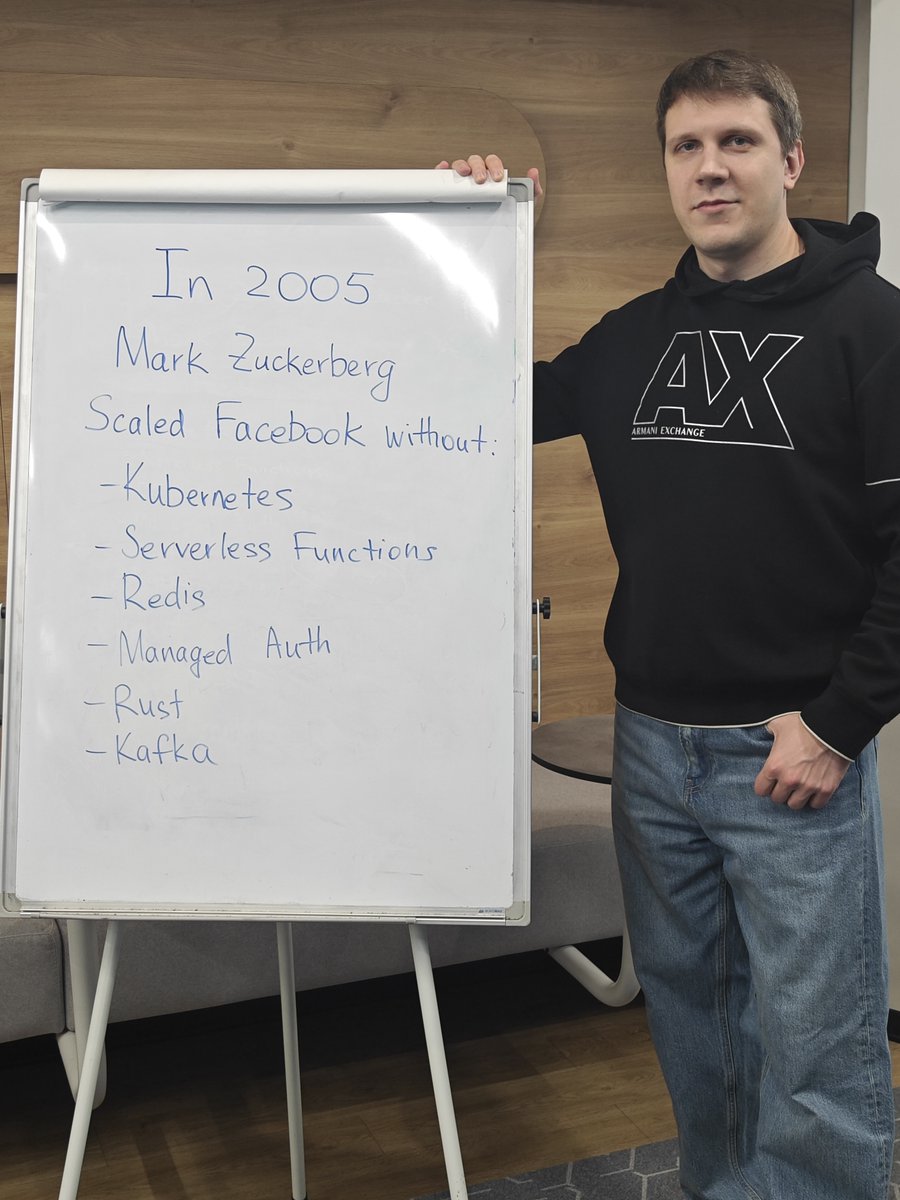
In 2005, Mark Zuckerberg was running Facebook on PHP and MySQL.
Without Kubernetes, Kafka, Redis, Serverless Functions and Rust.
By the end of that year, it had 5.5 million users.
Modern teams do the opposite.
We wire up 10 moving parts before the first real user signs up.
We design for 1 million users for tomorrow.
Most products die somewhere around 1000.
We try to guess every future scenario, so we add:
→ extra abstraction layers
→ message queues
→ caches "just in case"
→ microservices for a team of three
All to solve problems you don't have yet.
And every layer you add is one more thing to debug during the outage.
One more thing a new hire has to learn.
One more reason for deploy to go wrong.
And now imagine how this problem scales with AI agents.
Your AI agent doesn't care about your architecture.
But you should!
Always architect your apps based on current needs (not possible future guesses), leaving room for extension and evolution.
Simplicity scales much more easily and it is easier to change.
Complexity often kills projects far before they reach that guessed scale.
Build your projects like Facebook in 2005: small, fast and boring, solving only problems you have today.
♻️ Repost to help others build better software
➕ Follow me to improve your .NET and Architecture Skills
Gen X defined:
Ages 45-61
Looks 35-40
Will 100% throw hands
Doesn't care about your feelings
Cusses a lot
Will make you cry with words
Great work ethic
Pragmatic
Zero tolerance for stupidity
Skeptical of authority
Doesn't trust anyone at 1st
Extremely loyal friend
Figures shit out
Most likely your boss
Works hard, plays hard
No fear
Sarcastic as fuck
Still listens to the same music
Knows lyrics to Rock, Rap & Country
Proficient in analog & digital tech
Self reliant
Adaptable to any environment
Just wants to be left alone
Seamos claros, DGP estaba jugando al FIFA en modo carrera.
Hizo estupideces gracias a su desconocimiento real de cómo gestionar un club de la dimensión de Alianza Lima.
Sin embargo, ni naciendo 1000 veces y volviendo a cagarla la misma cantidad de veces, sería peor que los actuales acreedores que toda su vida han hecho mierda a nuestra institución.
Ni los actuales, ni él. Pero, si tuviera que elegir en una hipotética situación de emergencia, me quedo con este huevonazo. Que definitivamente no es tan malo como los otros.
Algo como lo que pasó en las últimas elecciones presidenciales en las que tuvimos que votar por Keiko para no darle el poder a los terrucos. La misma huevada sería.
C@NCER FIGHTING FOODS MOST PEOPLE DON'T KNOW
1. The best vegetable to fight c@ncer is Broccoli
2. The best fruit to fight c@ncer is Blueberries
3. The best mushroom to fight c@ncer is Turkey Tail Mushroom
4. The best herb to fight c@ncer is Turmeric
5. The best seed to fight c@ncer is Flaxseeds
6. The best nut to fight c@ncer is Walnuts
7. The best spice to fight c@ncer is Cinnamon
8. The best legume to fight c@ncer is Lentils
9. The best leafy green to fight c@ncer is Spinach
10. The best cruciferous vegetable after broccoli is Cauliflower
11. The best antioxidant-rich drink is Green Tea
12. The best allium vegetable to fight c@ncer is Garlic
Solo para el arbitraje peruano, esto no es tarjeta roja.
Qué curioso, justo contra el equipo del presidente sancionado por reventa de entradas.
El fútbol peruano es un meme tragicómico a la imagen y semejanza de sus directivos.
@TuFPF@SafapPeru
Know this:
Cancer loves an acidic environment; so know which foods are acidic.
Cancer loves a low oxygenated state; so exercise/walk.
Cancer loves high glucose/sugar; so intermittent fast, reduce processed high carb foods.
Cancer hates vitamin D levels above 80 to 100ng/ml
Do NOT give cancer what it loves.
#cancer #Health #Cancertips
RT for Awareness
Una vergüenza lo de hoy. El principal responsable es Guede, se le elogió bastante con justa razón pero se ha desubicado. Parece templado de Paolo y sus 11s se condicionan a el. Mucho gonca como Advincula. Mucha soberbia del dt y Navarro en no reforzar arriba. Neira es un insulto
An MIT Media Lab study used EEG to track what happens in the brain when people write with ChatGPT rather than on their own. Fifty four students completed essay tasks while wearing electrode caps. One group used ChatGPT, one used a search engine, and one used no tools. Across sessions, the ChatGPT group showed the weakest neural connectivity in networks linked to memory, attention, and analytical work. They also had more trouble recalling what they had just written and produced more generic prose. The authors describe this as a kind of cognitive debt: the tool does the synthesizing, and the brain stays quieter [1].
The same experiment points to a better order of use. Students who first wrote unaided and only later switched to ChatGPT showed stronger recall and more widespread brain activity than students who started with the model and then had to work alone. In other words, the model helped more when it scaffolded thinking that was already underway than when it replaced that thinking from the start. The practical lesson is not that large language models should be banned. It is that they work best as a second pass, after the writer has already done the hard part of forming and remembering an argument [1].
[Kosmyna, N., Hauptmann, E., Yuan, Y. T., Situ, J., Liao, X. H., Beresnitzky, A. V., Braunstein, I., & Maes, P. (2025). Your Brain on ChatGPT: Accumulation of Cognitive Debt when Using an AI Assistant for Essay Writing Task. arXiv. DOI: 10.48550/arXiv.2506.08872]
@EduSV_1901 Guede no tiene autocrítica Edu, eso debería hacérselo notar su comando técnico. Es cierto también que no le trajeron jugadores. Ojalá cómo dices ponga solo a los mejores y se deje de experimentar con formas de jugar que incomoden al equipo.
URGENT: Go to your medicine cabinet and find your B12 supplement, your multivitamin or your b12 complex that you are currently taking. Now take a look at the ingredients. If it says cyanocobalamin, anywhere on the container, kindly throw it in the trash; where it belongs.
When cyanocobalamin is metabolized, the cyanide group is released as “cyanide”
They’ll tell you it’s “safe and effective” or that it’s only a small amount. But that small amount is found in so many things you’ve been consuming since you were born, including everything from baby formula to energy drinks.
Use methylcobalamin, hydroxocobalamin, or adenosylcobalamin, which do NOT contain a CYANIDE .
Cobalamin= B12
Cyano=cyanide
#Health #b12 #methylcobalamin, #hydroxocobalamin #adenosylcobalamin








![Rainmaker1973's tweet photo. An MIT Media Lab study used EEG to track what happens in the brain when people write with ChatGPT rather than on their own. Fifty four students completed essay tasks while wearing electrode caps. One group used ChatGPT, one used a search engine, and one used no tools. Across sessions, the ChatGPT group showed the weakest neural connectivity in networks linked to memory, attention, and analytical work. They also had more trouble recalling what they had just written and produced more generic prose. The authors describe this as a kind of cognitive debt: the tool does the synthesizing, and the brain stays quieter [1].
The same experiment points to a better order of use. Students who first wrote unaided and only later switched to ChatGPT showed stronger recall and more widespread brain activity than students who started with the model and then had to work alone. In other words, the model helped more when it scaffolded thinking that was already underway than when it replaced that thinking from the start. The practical lesson is not that large language models should be banned. It is that they work best as a second pass, after the writer has already done the hard part of forming and remembering an argument [1].
[Kosmyna, N., Hauptmann, E., Yuan, Y. T., Situ, J., Liao, X. H., Beresnitzky, A. V., Braunstein, I., & Maes, P. (2025). Your Brain on ChatGPT: Accumulation of Cognitive Debt when Using an AI Assistant for Essay Writing Task. arXiv. DOI: 10.48550/arXiv.2506.08872]](https://pbs.twimg.com/media/HQ-nF7XWAAAaIJc.jpg)


