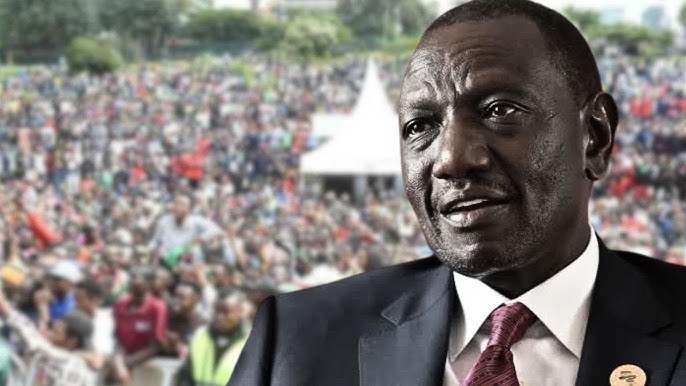
That Ruto is cornered is no longer something to dismiss, because the political mood, the anger on the ground and the fractures around him are becoming harder to ignore.
“Ruto Must Go” can win an election, but it cannot run a country, and the opposition must now start telling Kenyans what happens after the celebrations are over.
Start with the national debt. Which loans will they honour, which ones will they audit, what happens to odious or questionable debt, and how exactly will they stop Kenya from borrowing simply to repay previous borrowing?
Then tell us what happens to this bloated government structure where almost every problem has somehow produced an authority, agency, board, council, commission, fund, secretariat, director general, board chairman, CEO, offices, vehicles and allowances.
Why, for example, does Kenya need a whole Kenya Water Towers Agency with its own board and administration to coordinate conservation of water towers instead of placing that work directly inside the responsible ministry alongside the existing forestry, water and environmental departments?
The government itself has admitted that some State corporations have overlapping or duplicated mandates and has been trying to merge or restructure them, which tells you the problem is not imaginary.
How many water agencies does one country need before water actually reaches people's taps, when we already have the Ministry of Water, Water Works Development Agencies, the National Water Harvesting and Storage Authority, Water Resources Authority and other institutions funded from the same taxpayer?
How many agricultural boards, authorities and corporations do we need before farmers receive affordable fertiliser, functioning markets and reasonable prices for what they produce?
How many youth funds, women funds, enterprise funds and empowerment programmes must exist separately, each carrying administrators and operational costs, instead of creating one properly managed financing institution with measurable results?
Why do functions that could comfortably sit as departments inside ministries repeatedly become standalone State corporations requiring CEOs, boards, procurement departments, HR departments, finance departments, legal departments and expensive headquarters?
The opposition must tell us which State corporations it will abolish, which ones it will merge, which boards disappear on day one and how much money those changes will actually save taxpayers.
Tell us what happens to SHA and whether healthcare will continue being built around deductions, unexplained private technology companies and layers of agencies before money finally reaches the hospital treating the patient.
Tell us what happens to the housing levy, and whether government should really be collecting money from every worker, building houses, identifying beneficiaries, financing mortgages and competing with private developers at the same time.
Tell us what happens to university funding, HELB, school capitation and the endless experiments that leave parents discovering new education policies after schools have already opened.
Tell us what happens to county financing and whether governors will continue travelling to Nairobi every few months begging Treasury to release money that Parliament already allocated to counties.
Tell us what happens to corruption cases, because Kenyans do not need another government that arrives with its own thieves, protects them for five years and suddenly discovers corruption when somebody falls out politically.
Tell us what happens to procurement. Will every tender, beneficial owner, contract variation and final payment become publicly searchable, or will we continue pretending transparency exists when more than half of government contractors can remain hidden behind companies?
Tell us what happens to the police. Will the next president still call commanders when he wants opponents arrested, or will Kenya finally build a police service where an officer fears the law more than he fears State House?
Tell us what happens to the DCI, ODPP, EACC, intelligence services and other institutions that become extremely energetic when powerful people have private problems but suddenly develop weak knees when politically connected goons, killers and thieves are involved.
Tell us what happens to State House spending, advisers, presidential delivery units, special envoys, taskforces and endless committees created whenever somebody in government wants another office.
Tell us what happens to Cabinet size, principal secretaries, CAS style positions if they return under another name, government advisers and political appointees scattered through State corporations.
Tell us whether government vehicles will still consume billions transporting officials to meetings where they discuss why government has no money.
Tell us whether every new president will continue creating offices for election losers and coalition partners instead of forcing political parties to carry the cost of their own political settlements.
Tell us what happens to taxes, because promising to reduce taxation is easy until the same politicians enter Treasury and discover they inherited a government whose recurrent expenditure they are unwilling to cut.
Tell us what happens to pending bills, because thousands of businesses have supplied government, paid VAT, borrowed money to perform contracts and then waited years for the State to pay them.
Tell us what happens to electricity costs, fuel taxes, manufacturing, agriculture and small businesses, because Kenya cannot tax itself into prosperity and then wonder why investors move production elsewhere.
And most importantly, tell us what happens to the structure of political power itself.
If all the opposition is offering is another president controlling Parliament, influencing prosecutors, intimidating independent institutions, appointing friends everywhere and borrowing billions with no consequences, then we are simply preparing the next “Must Go” movement.
Ruto going is now a reality.
But Kenya cannot spend the next year discussing who takes the cake without asking why the cake is this expensive, why so many people are eating from it and why ordinary Kenyans are always the ones paying for it.
STATE HOUSE APPOINTMENT SCAM— THE NANOK NAME SWAP THAT STINKS OF CORRUPTION, IMPUNITY
What the Documents Show
Treasury CS John Mbadi Ng’ongo wrote an official letter nominating 4 persons for appointment as Members of the National Government Constituencies Development Fund (NG-CDF) Board, to be forwarded for parliamentary vetting per Circular Ref. OP/CAB.9/1A dated 25th November 2025.
The 4 names in Mbadi’s letter were: Ms. Komora Yvonne Nsunsu; Ms. Manyaga Yvonne Boyani; Mr. Mutua Fidelis Kieti; and Mr. Ahmed Diriye Mohammed.
The “concurrence letter” from Deputy Chief of Staff Josphat K. Nanok, responding on behalf of the Office of the President, however, lists a different fourth name: Morris Putita Kaaka — in place of Ahmed Diriye Mohammed.
The first 3 names are identical in both letters. Only the fourth was switched — a targeted, deliberate substitution.
🔴 The Institutional Chain — Who Has Authority Here?
@koske_felix serves as Chief of Staff and Head of the Public Service, with @GovernorNanok as his Deputy Chief of Staff at @StateHouseKenya.
Nanok is therefore the second most powerful official in the Executive Office of the President — and the man who signed the “concurrence” letter that swapped the nominee.
The “concurrence” process — routed through OP/CAB.9/1A — is supposed to be a formal approval check, not a substitution mechanism. It is not a power to override a Ministry’s substantive recruitment decisions.
🔴 Why This Is Serious Corruption
The NG-CDF Board appointment process involves: open public recruitment → competitive vetting → a shortlist submitted by the Cabinet Secretary for Treasury → parliamentary vetting → gazette notice. This is a long, merit-based process with multiple safeguards.
By the time a name reaches the CS’s nomination letter to Parliament, it has already survived competitive recruitment. Substituting a name at the “concurrence” stage means someone jumped the entire queue without competing.
The swap was surgical — three names kept, one swapped — suggesting Morris Putita Kaaka was specifically inserted by State House influence, bypassing the @PSCKenya process and the competitive shortlisting.
This is not a clerical error. Two separate official letters, two different names — one from Treasury, one from State House. The discrepancy is deliberate.
🔴 The Circular OP/CAB.9/1A — What It Actually Means
Circular OP/CAB.9/1A of 25th November 2025 governs the appointment of Chairpersons, Board Members, and CEOs of State Corporations. It is a procedural instrument setting out the roles of the appointing authority and the concurring authority.
The “concurrence” role of the Chief of Staff / Deputy Chief of Staff is to verify compliance with the process — not to substitute candidates. Using it to insert a preferred name is an abuse of the concurrence function.
🔴 The Broader Accountability Picture
If Nanok signed the concurrence letter inserting Kaaka, the question is: on whose instructions? The Deputy Chief of Staff does not act unilaterally — instructions flow from the Chief of Staff and ultimately from the President.
Ahmed Diriye Mohammed — the dropped nominee — was the product of a fair, open, competitive process. His removal without cause, at the final pre-parliamentary stage, is a violation of his constitutional rights under Articles 10, 27, and 232 (national values, equality, and public service values
@NAssemblyKE is being sent a falsified shortlist — one that does not reflect the outcome of the competitive process. Vetting a name that wasn’t competitively recruited corrupts the parliamentary oversight function entirely.
Mr Nanok didn’t respond to COFEK inquiries
🔴 Public Interest Action Points
The @ODPP_KE and @EACCKenya should investigate whether the substitution constitutes abuse of office under the Anti-Corruption and Economic Crimes Act
Parliament must vet these nominees must demand the original recruitment records and verify that all four names
US Destroyer Forced to Turn Back After Iranian Warning - Exposing Trump’s Hollow Propaganda
An American Arleigh Burke-class destroyer, the USS Michael Murphy (DDG-112), departed from Fujairah port in the UAE and attempted to pass through the Strait of Hormuz, only to be forced to return after receiving a direct warning from Iranian armed forces that it would be targeted if it proceeded.
The vessel turned around and headed back to Fujairah, confirming once again that Iran maintains full control over the strategic waterway.
Contrary to the loud propaganda blasted by Donald Trump and his fraudulent machinery of lies, no US aircraft carrier has crossed the Strait of Hormuz. The empire’s endless press releases and victory declarations remain exactly what they have always been: the main component of their failing war machine.
Those who still believe American official statements and Centcom briefings are simply falling for the same recycled lies that have already been exposed multiple times in this conflict.
The US Navy can issue all the bold statements it wants from safe distances, but when its ships actually approach Iranian-controlled waters, reality quickly forces a humiliating retreat.
@wambuijoan2024 Pascal aandike script kuhusu hii break up, aiuze alafu yeye ndio akuwe starring kwa hiyo film.
Your set-back can be the foundation for your come-back. #SundayMotivation.
@Dylar004@KenyaPower_Care@NyabichaAlex@C_NyaKundiH Unakumbuka ile electrification ya uhuruto ya 15k, they didn't reduce the the cost of wewe kuwekewa stima ni ati walisema uweka down payment ya 15k then the rest will be deducted ukilipa monthly bill.thats how this system works
In 2026, try this in the exact order
MS Excel > SQL > Python > Power BI/Tableau > Basic Statistics and Math.
Apply for as many jobs as you can and bid for all data related gigs on job listing or freelancing platform of your choice.
Visit @LuxDevHQ, for learning & internships
@ignyharaz2 Pole sana to Sammy Kioko. It’s painful to see talent and effort go to waste because of delayed payments. Government should protect small contractors, not crush them.
I think Kioko need to sue the County Government of Machakos!!
@ignyharaz2 If you need a fast solution, if you have proof you rendered the services and they are not answering your call or not giving you any response avail youself to CBK with proper documentation follow up from there