@dollzmoka start using real vids with live band, not edited Mr removed and the weakest part in encores ... How pathetic ...
https://t.co/V0HjdBLMhP
https://t.co/5RtI6LvhXd
https://t.co/KsA5sNBaXr
@somsaltang This is also how YG destroyed Park Bom's vocal chords. I think this company is truly rapping-oriented and they don't really care about training their artists' singing properly. They are infamous for singing in cursive way and belting unsupported high notes ...
@hanniduck1006 Sự chính xác, cô lập, sức mạnh lõi, uyển chuyển, Hanni có thể lên tier 4 hay 3 nếu tiếp tục luyện tập. Điệu nhảy của những bạn còn lại nghiêng về hướng girlgroup dance nhiều hơn nên chỉ sử dụng phần hông và mông. Yeji có vẻ dần mất đi hiphop dance ...
Min Heejin: It says in the article that they contacted ADOR. So, I don’t understand why the kids have to be treated like that, why they’re being divided like this. Let’s just say the two people revealed first that they wanted to return to the company.
Even so, I think someone like me would have waited. They could have contacted the other members, because it’s better to announce everything at once. That way, the fandom doesn’t get confused, and people don’t get unnecessarily stressed.
But why make it worse like this, why create confusion? And if the three people clearly expressed their intention to return, that should be accepted. Why suspect them, why try to question their true intentions? If the court ruled that way, and if they want to follow the court’s decision properly, they shouldn’t question intentions—they should just do it. That’s the way not to harass them.
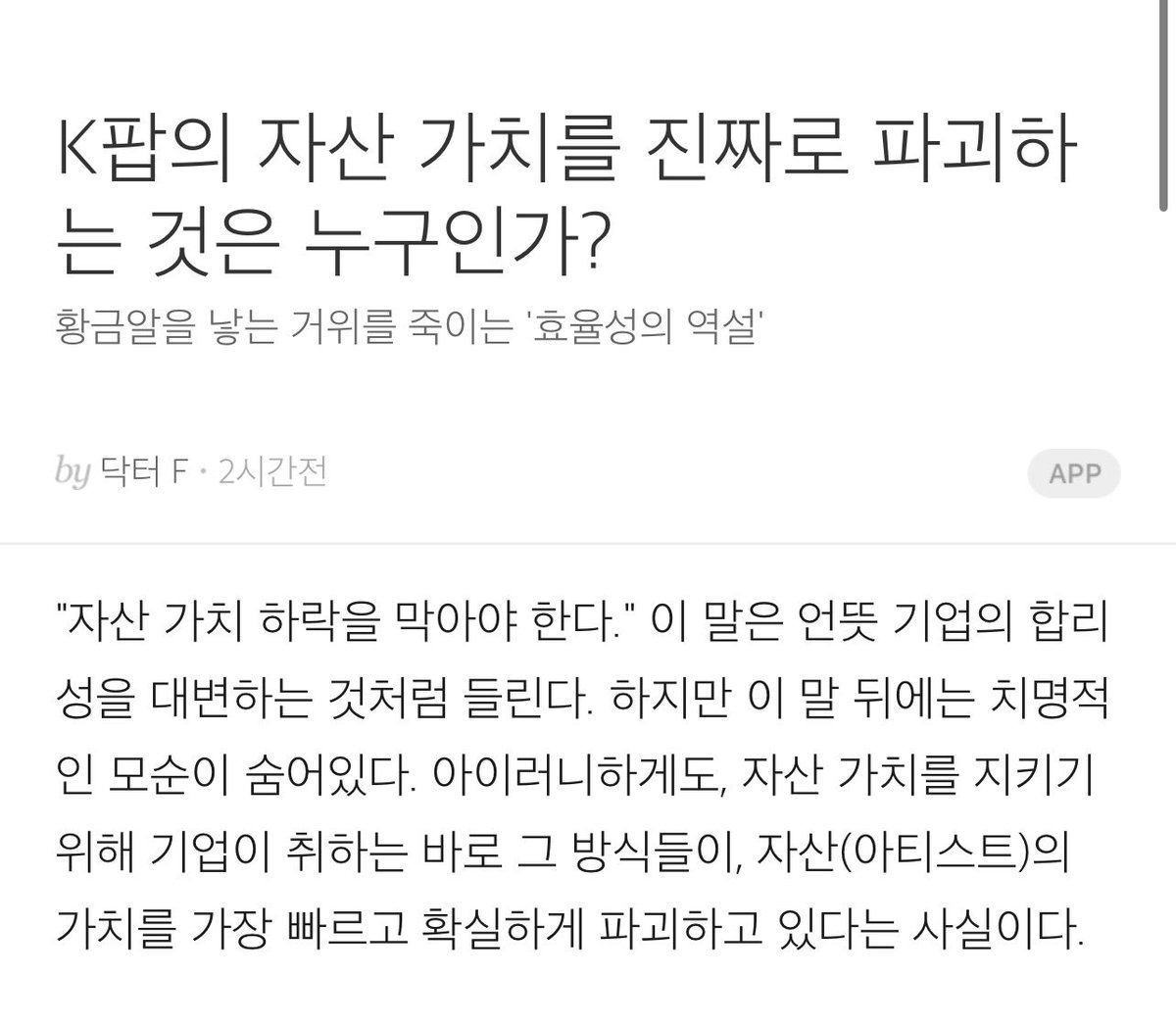
Who is really destroying the asset value of K-pop?
https://t.co/bZl3QHvWQn
Dr. F
“Asset value must be protected.”
At first glance, it sounds like a perfectly reasonable, business-minded statement.
But behind that line is a fatal contradiction: the very methods companies use to “protect” asset value are, ironically, the fastest, most certain ways to destroy the value of the asset (the artist) itself.
We call this the Efficiency Paradox.
1. Factory vs. Garden: Running a garden with factory logic
Companies instinctively crave control and predictability.
In a semiconductor factory, this is ideal: reduce defects, standardize processes, run machines 24/7, and you maximize asset value.
The problem is that K-pop isn’t a factory. It’s more like a garden.
Artists aren’t standardized parts. They’re living beings with unpredictable emotions, unique narratives, and creative souls. If a gardener tries to force flowers to bloom faster by blasting them with 24-hour light and dumping fertilizer nonstop (control + efficiency), the flowers may bloom quickly, but their roots rot, and they die (burnout + creative collapse).
When a company micromanages every move of an artist in the name of “risk management” and pushes them nonstop for “sales maximization,” the artist loses life, energy, and spark. They become a well-trained doll, and the public eventually stops caring.
In trying to “efficiently manage” the asset, the company ends up destroying the asset’s core value: its appeal.
2. Redefining risk: the real danger isn’t noise, it’s homogenization
Companies label internal conflicts, like the NewJeans case, as “risks that damage asset value,” because public noise can affect stock prices.
But from a colder, more rational standpoint, the biggest long-term risk in K-pop isn’t scandals. It’s homogenization.
To minimize failure, capital repeats proven success formulas. Every group starts to look the same, sound the same, and market the same. It feels “safe” in the short term, but in the long run it drains the industry’s uniqueness, causing consumer fatigue… a slow, mutual downfall.
NewJeans had value because they were different. Their originality didn’t come from control or efficiency. It came from autonomy, from creative “inefficiency,” from stubborn craftsmanship.
But now capital wants to eliminate that very source of originality, labeling their creative freedom as a “risk.”
It’s like cutting open the goose that lays golden eggs to get all the gold at once… pure greed, pure self-destruction.
3. Conclusion: Protecting the person is protecting the asset
So the idea that “for the sake of the industry, we should just bury the NewJeans issue” is completely wrong.
For the sake of the industry, this issue needs to be discussed more loudly and more thoroughly.
Treating artists like actual people, and guaranteeing creators the autonomy they need, isn’t just a moral duty… it’s the smartest business strategy. It’s the only way to extend an artist’s life cycle, preserve their unique brand value, and maintain the trust of their customers (the fans).
If companies truly want to protect asset value, they need to close the old ledger of “control and efficiency” and start writing a new investment manual based on autonomy and respect.
Because a goose only keeps laying golden eggs if you keep it healthy, a truth so simple and so cold that companies can no longer afford to ignore it.
@TiffosaLatam@sheepymcsheepy oh please, I'm pretty sure you would not say the same if their situations are in reverse. I bet you would mock her pitiful appearance (that won't ever happen tho) and put her through hell with your malicious comments. How hypocritical you are ...
The teacher chose the shyest student in the class to draw a piece of paper, and if it was blank, the whole class would get a free lesson to play.
But all the papers were blank, and she did this to help him socialize and alleviate his shyness.