IF-
If you can keep your head when all about you
Are losing theirs and blaming it on you;
If you can trust yourself when all men doubt you,
But make allowance for their doubting too;
2204-page mathematics PDF ebook:
"Algebra, Topology, Differential Calculus, and Optimization Theory For Computer Science and Machine Learning"
Find it here: https://t.co/HZc0LRoD7R
The Scientist and Engineer's Guide to Digital Signal Processing By Steven W. Smith
Amazing book to keep handy if you work on anything DSP. Loved the way the chapters are organized!
https://t.co/kmtyDJL1st
trying to use topological data analysis to map the shape of my x bookmarks through mapper + embedding extraction and generated 3 views:
- density: where attention keeps gravitating
- pca: the dominant axes of variation
- centroid: center vs edge (typical -> outlier)
Best paper I've read so far this month:
All elementary functions (sin, cos, tan, exp, log, powers, roots, hyperbolic functions, π, e, and even basic arithmetic) can be generated from just one binary operator:
eml(x, y) = exp(x) − ln(y)
…plus the constant 1.
Meet the new Stitch, your vibe design partner.
Here are 5 major upgrades to help you create, iterate and collaborate:
🎨 AI-Native Canvas
🧠 Smarter Design Agent
🎙️ Voice
⚡️ Instant Prototypes
📐 Design Systems and DESIGN.md
Rolling out now. Details and product walkthrough video in 🧵
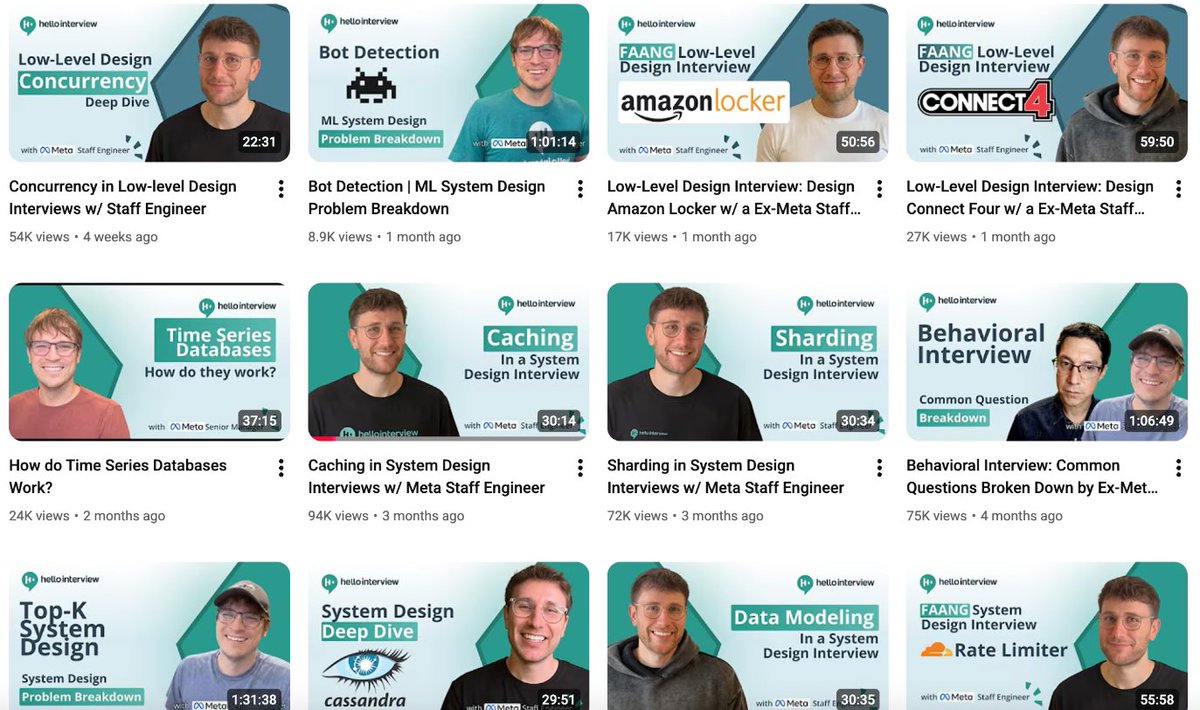
One of the BEST channels for System Design:
https://t.co/6LJuJnIu3m
1. API Design
https://t.co/AUx3IzQkir
2. Sharding
https://t.co/sKObv3NN9H
3. Caching
https://t.co/zQr7bzsZm2
4. Concurrency
https://t.co/WcxW2fAyCZ
5. Data Modeling
https://t.co/zX2R66k7NK
6. Rate Limitter
https://t.co/zX2R66k7NK
🎉Congratulations to Prof Hung Vinh Tran @UWMadisonMath and Dr Jiwoong Jang @math_umd for winning the 2025 Best Paper Award in the Advances in Continuous and Discrete Models journal!🏆Read their notable article here: https://t.co/IgY3UbXEQc
#AdvancesinContinuousandDiscreteModels
📁 Andrew Ng, AI pioneer and co founder of Google Brain, says most high dimensional data is simpler than it looks.
A 10,000 dimensional dataset often lives on a much smaller subspace.
If you compress it first, learning becomes faster, cheaper and more efficient.
Sometimes intelligence is not adding more. It is reducing wisely
"Is measure theory useless for non-mathematicians?"
After many years of searching, I finally found the answer in this book. Measure theory lets you:
1. Unify the language of continuous and discrete distributions. This saves time since you don't have to repeat arguments to cover both cases.
2. Unify the language of single and multiple variables. This also saves time for the same reason.
3. Define independence of random variables more cleanly.
The usual way independence is taught works well for concrete examples, but once you start reasoning about independence in the abstract, it's easy to lean on intuition in ways that aren't fully precise.
Measure theory gives a single, unambiguous definition that avoids those ambiguities.
4. Define convergence more completely in the statistical context. This makes proofs of convergence shorter and more reliable.
These are strong reasons for statistical theorists, but most applied people probably don't need it.
To be clear, I have taken several courses in measure theory, but it always seemed like insane levels of overkill for my own research.
I always felt like maybe there was something I was missing. This book finally put the pieces together for me.
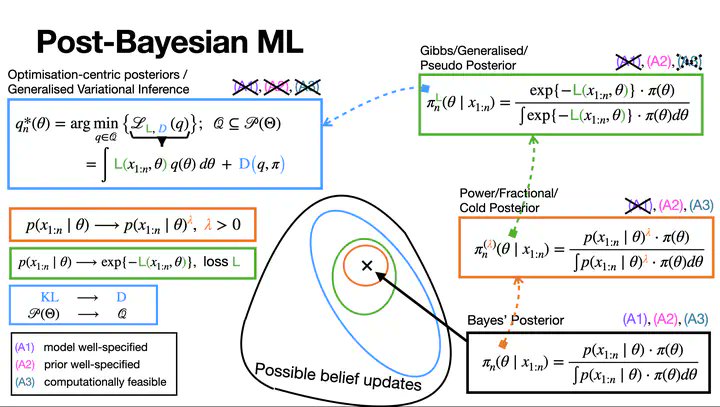
Bayesian machine learning is an approach to modeling and inference that treats unknown parameters and predictions as random variables and updates beliefs using Bayes’ rule as new data arrives. Instead of producing single best guesses, it produces full probability distributions that quantify uncertainty. In probability theory, Bayesian ML builds directly on conditional probability, likelihoods, and prior distributions, providing a coherent framework for learning from data. In machine learning, it powers methods such as Bayesian neural networks, Gaussian processes, and probabilistic graphical models, enabling robust prediction, uncertainty estimation, and principled model comparison. In real life, Bayesian ML is used in medicine, finance, robotics, and recommendation systems, where decisions must be made under uncertainty and models must adapt as evidence accumulates.
Image: https://t.co/BZNSK73Fpc
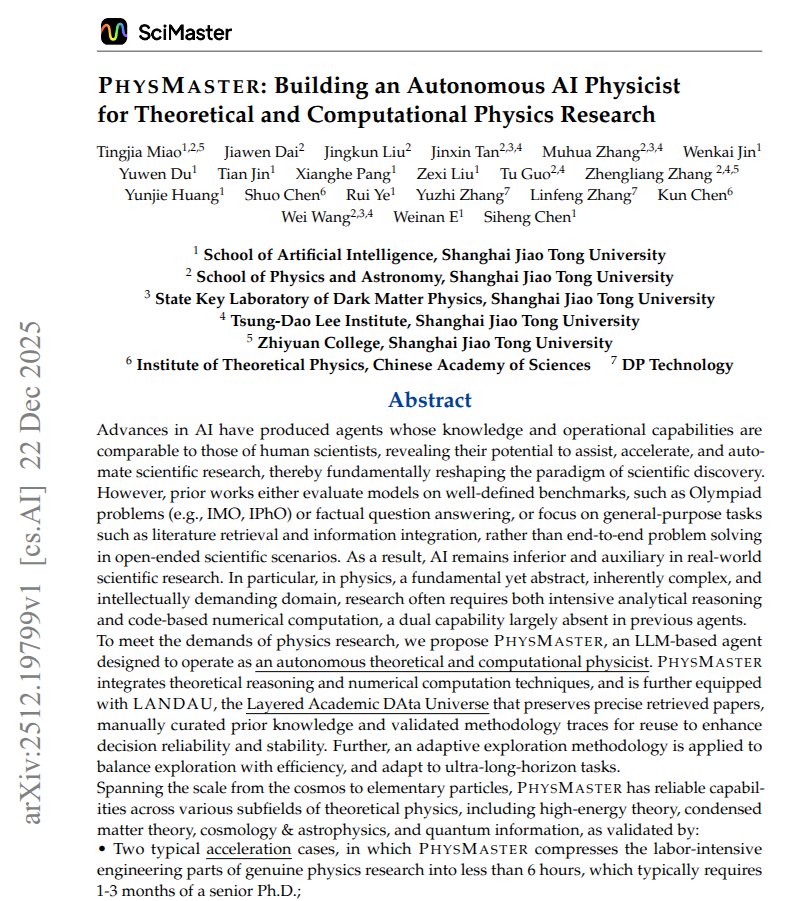
New paper from top Chinese labs builds PhysMaster, a Large Language Model agent that reasons, runs code, and shrinks physics work to hours.
Physics needs careful derivations plus numerical checks, and PhysMaster is built around that full loop.
In 2 projects, it turns 1 to 3 months of grunt work into less than 6 hours, and can finish a full loop in 1 day.
A Large Language Model mostly predicts text, so the hard parts, long reasoning chains plus numerics, need checking instead of pure writing.
PhysMaster cleans the question into subtasks, builds a local library of papers, then writes and runs code to test each step.
For long tasks it uses Monte Carlo Tree Search, explores paths, scores them, and sticks with the best one.
A supervisor agent manages progress and critiques, and a theoretician agent does derivations and coding in a safe coding workspace.
LANDAU, short for Layered Academic DAta Universe, is its memory, it stores trusted facts, reusable workflows, and retrieved snippets, so the agent repeats reliable methods instead of making things up.
Across acceleration, automation, and autonomous discovery demos, the paper argues this combo is what lets an AI act more like a working physicist.
----
Paper Link – arxiv. org/abs/2512.19799
Paper Title: "PhysMaster: Building an Autonomous AI Physicist for Theoretical and Computational Physics Research"
Our full course "advanced deep learning for physics" (ADL4P) is online now at https://t.co/jgil2rlGn0 😁 The course covers AI and neural network techniques for physics simulations & combinations with numerical methods. All recordings, slides and exercises are freely available!