@mlysimonsen@macastel3 We have 4% of global population and 25% of the global GDP. Yes, the world order we created post WWII has been remarkably good for the American middle class.
@doublewhammyguy @macastel3 I agree with you that Trump is an idiot and that China isn’t great.
It is my view that the way we’re going about it isn’t going to get us what we want.
@JeffBoeker@macastel3 Agree with you that foreign policy is substantially more complex than business generally speaking.
Also have the view that Trump is less capable of complex and deliberate thinking than even the average moderately successful business person.
@JeffBoeker@macastel3 I’m pointing out that the difference in psychology and values of counterparties matter to your approach. Whether you’re negotiating for your the interest of your shareholders or your citizens - there’s a way to act that gets you what you want, or doesn’t.
@SirGingaa@SpencerHakimian Not to mention the guy that hired them all and is single-handedly crushing the global economy and eroding the structural stability of our 250 year old system of government.
@_FlipMan Be more responsive to a text.
“You usually don’t want to cook on Fridays. The last two times you got a large cheese and large pepperoni. What time should we deliver it?”
White House admits they sent their list of demands to Harvard by mistake, but are standing by it
White House admits that they deported Abrego Garcia by mistake, but are standing by it
White House got mathematical formula wrong for calculating reciprocal tariffs, but stood by it
@ShinghiD This survey may represent the remaining 45%. Almost certainly the case that while people may indicate multiple countries, the volume coming out of China is higher than the number of responses represent.
Let’s say 70% of rest is another 32%.
I’d estimate >80% total.
@ShinghiD Note that this is a survey by Jungle Scout, whose customers are predominantly US based sellers.
45% of sellers are in China. ~100% of that is made in China.
Estimated another ~10% are actually from China but have a US entity.
55% already all from China.
The White House may not realize that manufacturing is not like a computer.
When you turn it off, you can’t simply turn it on again.
Factories all over the world, especially those focussed on the U.S. market, are laying off their workers, because they don’t have orders or because they cannot afford imported raw materials and components made more expensive by the tariffs.
These laid off skilled workers will find other jobs or retire, meaning that many will not return to work when the trade deal promised, materializes. Therefore new workers will need to be trained and it will take a long time for factories to regain their pre-tariff supply outputs, never mind delays to restocking such as production time (varies) and the transit time of sea shipping from China to the United States (30-60 days all in depending on location).
In other words, by the time you have tariff induced shortages of important products, a trade deal will not solve that for months.
And few suppliers are adding capacity to compensate right now because that capacity can become a big economic loss depending on the timing and terms of the trade deal.
Would you buy real estate or start construction if your lender refused to tell you when they’d give you a loan and at what terms?
No, you wouldn’t. Perhaps someone needs to explain to the White House how the same is true for manufacturing, tariffs, and trade deals.
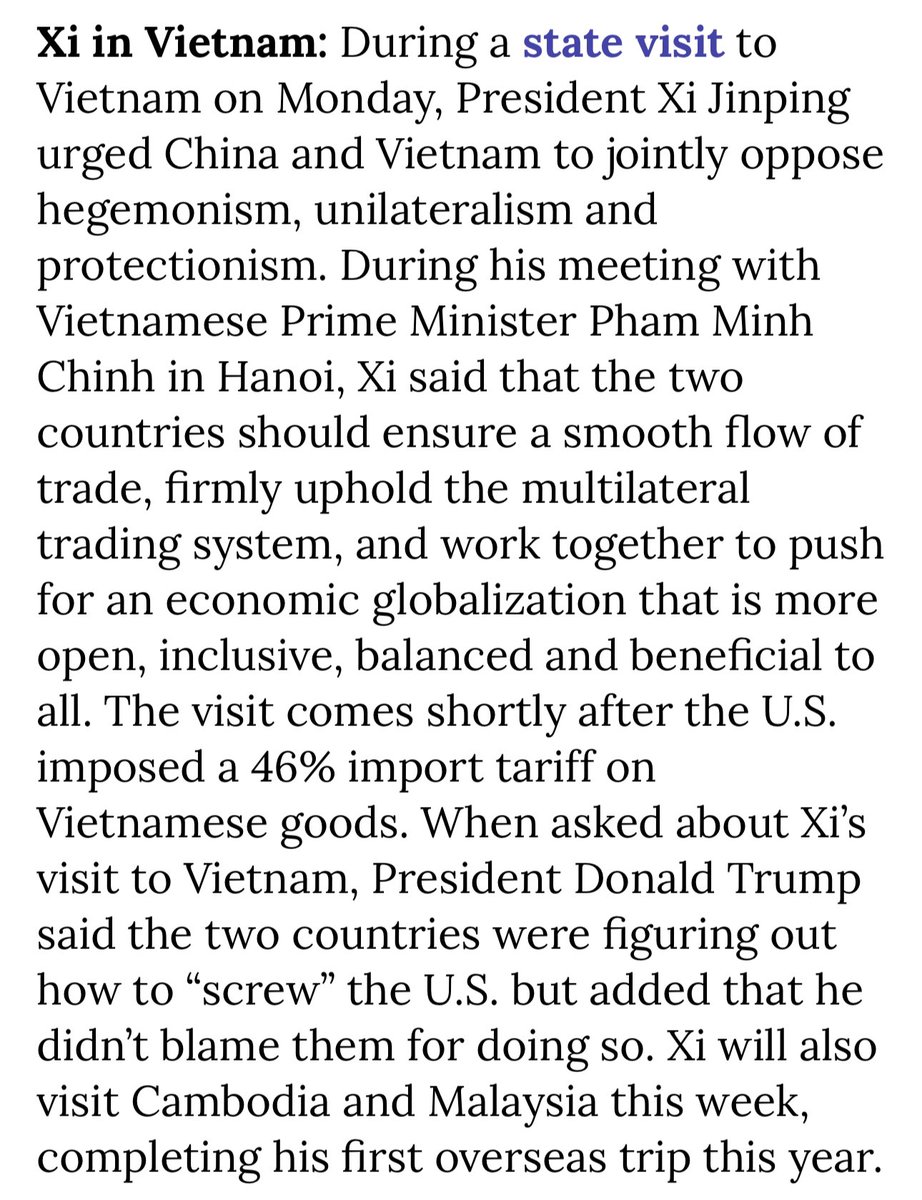
Speaking of which, China has made 3 since “liberation day” when the White House announced reciprocal tariffs. The president of China rushed to Vietnam, Malaysia, and then Cambodia, signing agreements to enhance cooperation, possibly bogging down U.S. attempts to achieve trade deals with those key countries which provide alternative manufacturing options for the U.S. in a post-China tariff environment.
We have a very interesting situation here because it will be another 1-2 months before we feel the effects of the tariffs but once we do, it could take months to fix these issues.
Given that no trade deals with the U.S. have yet been announced, it’s not clear to me whether or not, we understand that.
@ShinghiD This was my reaction when I first got involved in E-commerce. Thinking about the micro economics of how customers are making purchasing decisions, and the macro of currencies, global trade patterns, monetary policy, etc.