Under a month later, my suspicions are proven correct.
While other ideologies preserve the state as a shelter for the bourgeoisie, Anarchism doesn't, and the omission of direct mention of Communists/Socialists, indicates that at present, Anarchists are what truly threatens them.
my theory is we'll see anti-anarchist rhetoric from the state and it's mouth pieces for just this reason, and it started kicking into gear with the Prairieland verdict. they've made all the other -isms cultural boogeymen, and also anarchism is the ultimate solvent of power.
In fact, not only is version control seemingly feasible, you might even get the concept of configuration for free along the way, both of which would have saved me some hassle as a musician, either in preventing problems or making diagnosing them much more straight forward.
The RDF/OWL Audio Effects, Music, and Studio ontologies, and Bitwig's DAWproject file format pretty much demonstrate the "discretizability" of these concepts, the former came out of semantic web research, and seems like a spiritual predecessor to the latter.
Call it reverse, or inverse engineering, but version control is used to develop the very software people make music with, meaning the music concepts that are manipulated in the process of creation must lend themselves to discretization to some degree.
They both describe the concepts that exist in music and music production software, and seem rather extensible, with the former even touching the audio hardware domain, meaning not only could audio be versioned/replicable but the software/hardware set up of entire studio sessions.
Maybe some arcane linux-fu could restrict certain variables to being accessed by specific applications, but it seems that'd require restraining the semi-randomness with which processes running them are assigned PIDs, so as to check which is which, but that's above my pay grade.
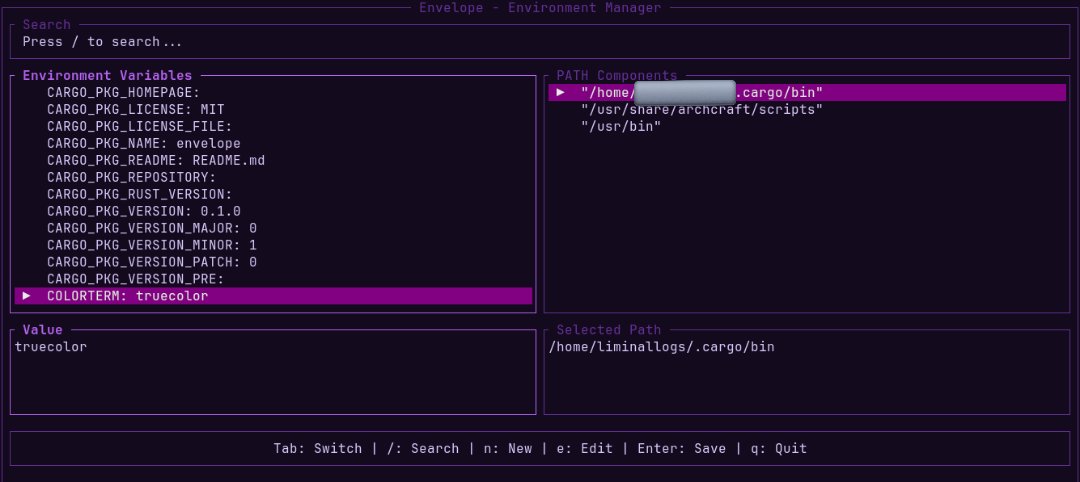
Built a TUI in Rust for editing PATH components and viewing environment variables, I'd make editing the variables a feature too, but due to child process isolation, changes to them only affect local copies of them, and won't persist after the process running the application ends.
Also, iirc, it's almost impossible to reliably track what processes in user/kernel space are using, or will use a given environment variable, so even if you could apply the change system wide, the changes could crash living or woken up processes expecting it have a certain value.
I've spent my whole life bucking against arbitrary systems of authority and their agents/standards, and being made to feel crazy it about challenging them or their necessity, so finding a community that values this reminds me that I've not been insane this whole time.
Despite the occasional tense discourse, I truly enjoy "anarcho-twitter", and am glad to have stumbled onto it, knowing there are people out there with whom I have commonality about how to build a better world, and what that better world looks like really does help keep me going.
I don't care about Fort Knox in the slightest but it is hilarious how it was supposed to be audited by Trump and Elon and got swept under the rug, it definitely gave "Oh fuck, there's no gold."
@Snailswithsails@hannahspierMD There's a throughline here about these things challenging the individual responsibility narrative and clarifying that some things are systemic or that the system works as a dual inhibitor of function alongside problems.
@g_abe2 This last little round of discourse has made this painfully clear to me, there's plenty of examples of how horizontality can be built and maintained, but what really grinds my gears is the idea of the most anti-statist political theory somehow inevitably recapitulating a state.
It is actually really tragic that people cannot conceive of any meaningful mid to large scale organizational structure outside of the concept of a state, I know it isn't exactly their fault but it doesn't make it any less irksome.