Students of chemical physics, soft matter, biophysics, or anyone interested in understanding the visible world through a lens of its molecular constituents should check out Statistical Mechanics and Stochastic Thermodynamics, available for preorder https://t.co/Y761hftU3K
🚨 Job Alert! 🚨 Join the UC Berkeley Physics Department! We’re hiring an Assistant Professor in soft condensed matter (broadly defined). Both experimentalists and theorists are encouraged to apply!
https://t.co/xN1G6EYoPf
Introducing CECAM-US-WEST, a new CECAM node located at UC Berkeley. Programing starting next calendar year! @UCB_Chemistry@cecamEvents https://t.co/KzfbnMsRjK
Excited to join @WashUPhysics as an assistant professor in Fall 2025! My group will develop non-equilibrium statistical physics to study criticality in biology—biomolecular condensates, gene regulation & adaptive immune systems. DM for postdoc/grad openings! #myphysicsjourney
Statistical mechanics and stochastic thermodynamics is finally out in the US. Use the code below to get a discount through @OUPAcademic https://t.co/6BEykHJGJD
Students of chemical physics, soft matter, biophysics, or anyone interested in understanding the visible world through a lens of its molecular constituents should check out Statistical Mechanics and Stochastic Thermodynamics, available for preorder https://t.co/Y761hftU3K
🚨 Job Alert! 🚨 Join the UC Berkeley Physics Department! We’re hiring an Assistant Professor in soft condensed matter (broadly defined). Both experimentalists and theorists are encouraged to apply!
https://t.co/gSZGJWWNK1
Excited to give the condensed matter talk today across Oppenheimer way @BerkeleyPhysics. Join if you want to hear about emergence in soft, warm materials driven away from equilibrium my group has been working on @UCB_Chemistry@KavliENSI
Don't miss the Condensed Matter Seminar on Monday, September 30 with David Limmer: Hydrodynamics of active fluids. Join us at 2:30 p.m. in 251 Physics North.
https://t.co/eNgL9leYWV
Please RT!
@GiEmmePi1 and I are organizing a symposium at the March @AmerChemSociety meeting in San Diego, sponsored by @ACSPHYSDivision.
~25 phenomenal invited speakers and open slots for contributed talks. Apply now! Submission will close on Sept. 30.
https://t.co/gili0FNJfh
Congratulations to Aditya @gafnys on winning a poster award at #cecam55 on his work developing variational path sampling and using it to gain insights into reactivity away from equilibrium! @UCB_Chemistry@KavliENSI https://t.co/2Ttspr3Xm8
check out Amr's @AmrDodin most recent collaboration with the Saykally group in which he explore how cations--like guanidinium-- can be selectively adsorbed to the air-water interface @UCB_Chemistry https://t.co/8zYucsbOn9
Kritanjan's latest takes a fresh look at an old problem: the molecular origin of the super-Maxwellian velocity distribution of evaporating helium from water, finding that it is due to an anomalously small friction at the air-water interface https://t.co/hWH5586BJz @UCB_Chemistry
@AsheshGhosh1@UCB_Chemistry done in close collaboration with Kranthi Mandadapu, en route to further studies on large scale mechanical behavior of driven processes in the cell
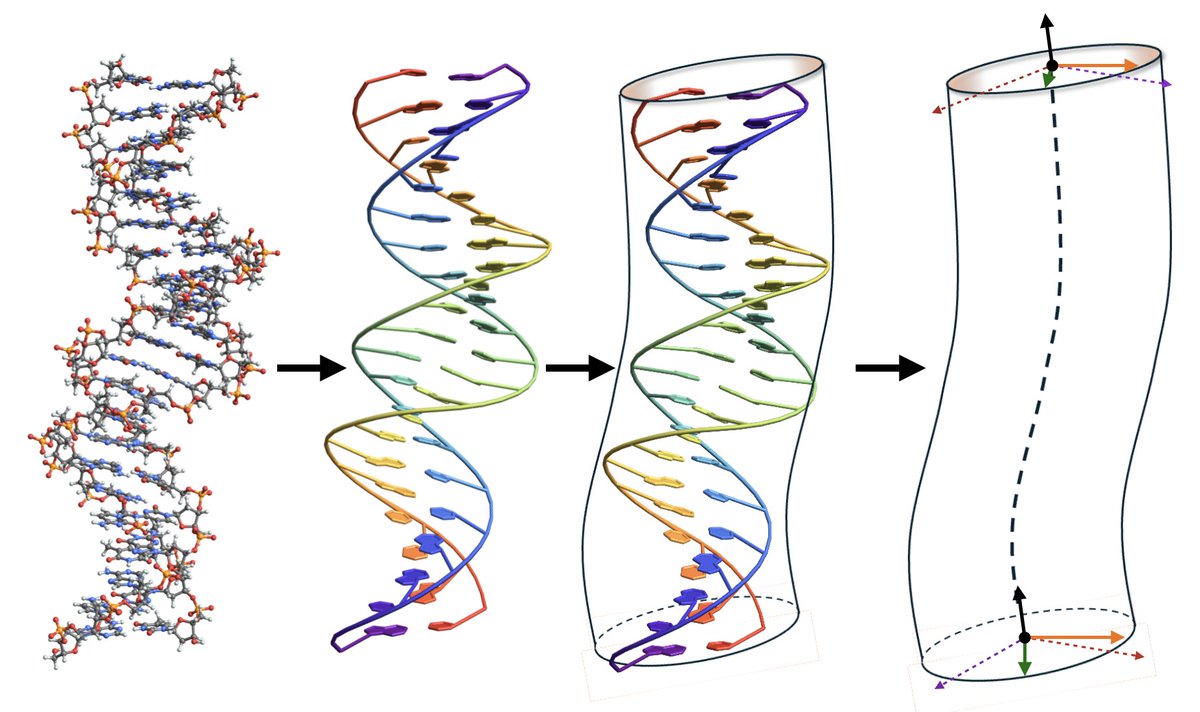
When is DNA like an asymmetric top? Check out @AsheshGhosh1's study on the twisted worm-like chain, a good model for DNA mechanics, whose Green's function is solved in a basis of Wigner D-functions, the eigenfunctions of the asymmetric top https://t.co/wo0maQi2pw @UCB_Chemistry
I'm excited to share that my article, 'Mystery Droplets Inside Cells May Play Vital Roles in Life,' has been published in Scientific American. In this piece, I discuss the physics of biomolecular condensates and reflect on my personal journey in the field. https://t.co/GqFNlNz8wX
Check out Jorge's latest, first in the group, in which he develops what we call variational time reversal, a formalism and algorithm to compute distributions of collective variables in nonequilibrium steady-states and active matter https://t.co/HeUmruhhiL @UCB_Chemistry@NSF
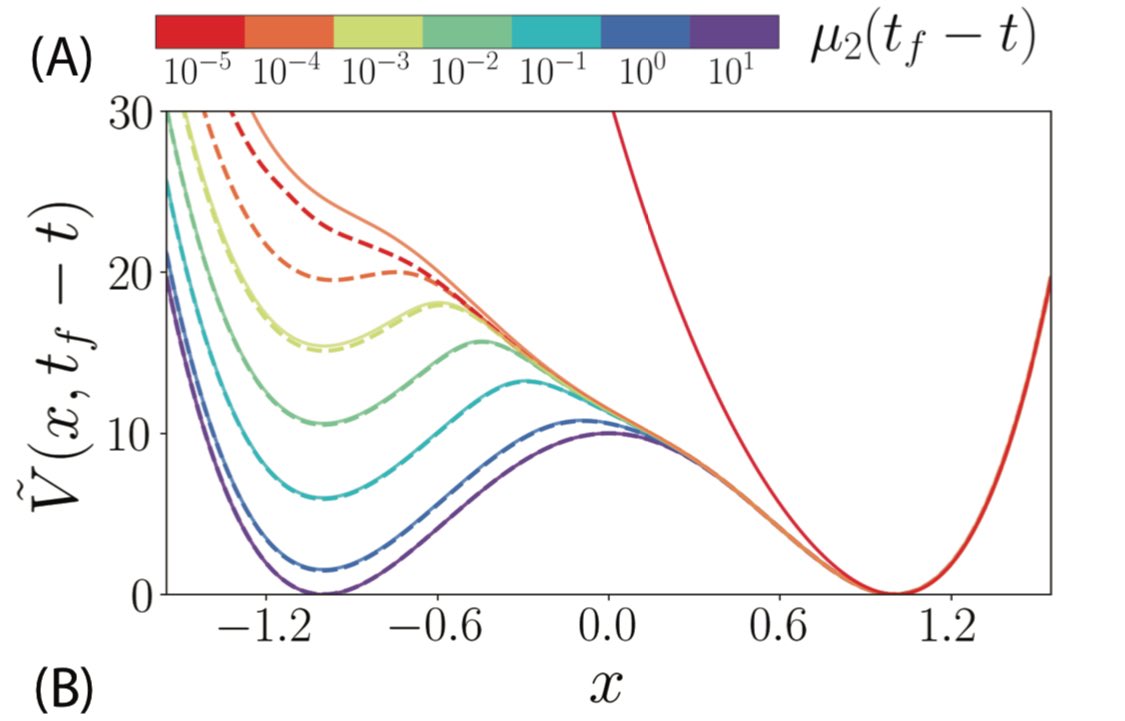
In molecular simulations, one often tries to add a force to a system to speed up a rare event. Nearly always their addition obscures the dynamics by which the event would occur naturally. In Aditya’s @gafnys arXiv post he solves this problem https://t.co/BnNrFlbAwb
In particular he shows that adding a specific time dependent force related to the committor allows one to study a reactive path ensemble by generating it from a collection of driven trajectories. This is possible in practice even in interacting systems @UCB_Chemistry