Turut prihatin. 🥀
Terdampak karhutla, begini kondisi pemakaman Katolik di Dusun Lintang Batang, Desa Teluk Bakung, Kecamatan Sungai Ambawang, Kabupaten Kubu Raya, Kalimantan Barat.
Semoga api segera padam dan kondisi di wilayah terdampak segera membaik. 🙏🏻
GRIB nyetok senpi buat persiapan pembunuhan massal ojol & buruh & mahasiswa, dana perangnya dari:
1. Bisnis narkoba
2. Literal merampok
3. Mencuri tanah orang & menghajar pemiliknya rame2
4. Merampok pabrik, truk, kapal sampai pabriknya pada kabur ke Vietnam, terus PHK massal
PALESTINE BENEATH THE WINGS
The Birds of Palestine, illustrated by artist John Rooney, is one of those works that becomes more poignant the longer you look at it.
Hundreds of wings crowd the page: falcons and owls, herons and swallows, kingfishers, plovers, wagtails, storks and sunbirds, painstakingly drawn and accompanied by their Arabic names.
It is beautiful as natural history.
But after the devastation of Gaza, it can also be read as an ecological archive.
Because the destruction of a landscape does not end with its people or its buildings. When you destroy orchards, wetlands, agricultural fields, coastal habitats and vegetation, you dismantle the intricate living world that depended upon them.
And Palestine occupies an extraordinary place in that world.
Sitting at the meeting point of Africa, Asia and Europe, Palestine forms part of one of the great migration corridors between Eurasia and Africa. Gaza's narrow coastal strip is crossed seasonally by enormous numbers of migrating birds — ducks, herons, storks, cranes, flamingos, waders, raptors, quail and countless smaller species.
For some, Palestine is home.
For others, it is a resting place on a journey of thousands of miles.
And one of the most important places along that journey is Wadi Gaza.
A WETLAND FULL OF WINGS
Wadi Gaza is far more than an empty strip of land cutting across Gaza.
It is a coastal wetland stretching towards the Mediterranean and an important habitat for Palestinian wildlife.
A two-year Palestinian scientific survey of Wadi Gaza recorded an astonishing 118 bird species belonging to 38 families.
Of those, 85 species — 72 percent — were migratory.
Nearly half were associated with aquatic environments. Among the birds recorded were cattle egrets, moorhens, coots, spur-winged plovers, barn swallows, white wagtails and the beautiful Palestine sunbird.
Even before the present war, Palestinian researchers warned that destruction and fragmentation of vegetation threatened Gaza's birds. Their research identified the uprooting and demolition of vegetated areas under Israeli occupation as damaging bird ecology.
What has happened since October 2023 exists on another scale entirely.
THE ERASURE OF A LANDSCAPE
In September 2025, the UN Environment Programme published its second major assessment of Gaza.
The figures are staggering.
By August 2025, approximately 97.1 percent of Gaza's tree crops had been damaged.
So had 82.4 percent of annual crops, 95.1 percent of shrub and natural forest, and 89 percent of grassland and fallow land.
Overall, more than 91 percent of Gaza's cropland had been damaged.
Those statistics describe a catastrophe for human beings who depend upon that land for food and livelihood.
But they describe something else too.
The destruction of habitat.
An orchard is not simply a collection of trees.
It is blossom and fruit, insects and seeds. It is nesting material, shade and shelter. It is somewhere for a migrating bird to descend exhausted from the sky and replenish the energy needed to continue its journey.
An olive grove is an ecosystem.
A field is an ecosystem.
A reed bed is an ecosystem.
Destroy them and an entire web of life begins disappearing with them.
UN environmental experts have concluded that the damage to Gaza's soils, freshwater supplies, vegetation and coastline has reached unprecedented levels, warning that recovery from some of the destruction could take decades.
WHEN THE WATER IS WOUNDED
For Gaza's birds, the destruction of water systems may prove particularly consequential.
Wetlands are effectively service stations along migratory highways. Birds descend to drink, feed and recover before continuing journeys that can span continents.
But Gaza's freshwater and sanitation infrastructure has been devastated.
There is now widespread pollution, sewage-system collapse and contamination of terrestrial, freshwater, marine and coastal environments. Soil has been contaminated by untreated sewage, solid waste and residues associated with munitions, while the loss of vegetation and compaction caused by military activity have damaged the soil's ability to absorb water.
For birds dependent upon wetlands, agricultural pools and coastal habitats, changes like these ripple through the food chain.
Remove healthy water and vegetation and insects decline.
Remove insects and insect-eating birds lose food.
Damage aquatic ecosystems and waterbirds lose feeding grounds.
Destroy mature trees and nesting and roosting sites disappear with them.
Ecological destruction rarely kills only one thing.
It travels.
THE DAMAGE WE CANNOT YET COUNT
There is another important truth.
Nobody yet knows the full scale of Gaza's wildlife losses.
Conducting comprehensive ecological surveys amid such destruction has been extraordinarily difficult. Access and security restrictions mean the full extent of the environmental damage cannot yet be assessed.
So it would be wrong to invent a number for how many birds have disappeared.
What scientists can measure is what has happened to the places those birds require to survive.
And those measurements are devastating.
The trees are gone.
The orchards have been razed.
Fields have been destroyed.
Soils have been damaged and contaminated.
Freshwater systems have been shattered.
Wetlands and coastal ecosystems face pollution.
And millions upon millions of tonnes of rubble now sit across Gaza.
For a migratory bird arriving from Africa or Eurasia, none of the politics responsible for that destruction means anything.
It simply follows an ancient route.
A swallow does not know that the orchard beneath it has been destroyed.
A heron does not understand why the water is contaminated.
A migrating raptor cannot know why the familiar vegetation below has vanished.
It arrives because countless generations before it arrived.
And either the habitat is still there, or it isn't.
THE PALESTINE ABOVE PALESTINE
That is why John Rooney's The Birds of Palestine feels so different to me now.
Look again at that crowded page.
Every tiny painted bird belongs to a much larger story — of migration, season, water, agriculture and place.
For generations Palestinians have watched these birds arrive and depart. They gave them names in Arabic. Farmers encountered them among their crops. Children heard them in gardens. Birds nested among olive, citrus and fig trees and gathered beside wetlands and along the Mediterranean shore.
They became part of the memory of the landscape.
And there is something almost unbearably beautiful about migration in Palestine.
Human beings constructed borders.
Birds never recognised them.
Long before today's walls, checkpoints and boundaries existed, birds were crossing this land between continents.
They still are.
Some remain in Palestine throughout the year.
Others leave.
And then, following something older than maps, they return.
Perhaps that is why this poster deserves to be seen as more than a beautiful catalogue of Palestinian birdlife.
Today it is also a reminder that the destruction of Gaza cannot be measured solely in flattened buildings.
There is another ledger beneath the rubble:
the orchard that will not blossom,
the wetland that can no longer sustain life,
the nest buried beneath the ruins,
the field where insects no longer rise,
the tree that once offered shelter,
the migration stop that has disappeared.
One day Palestinian ecologists and ornithologists will again be able to walk Gaza properly, notebooks and binoculars in hand.
They will return to Wadi Gaza.
They will stand beneath what remains of the trees.
They will watch the Mediterranean sky.
And they will begin counting.
Not simply what was destroyed.
But what survived.
What came home.
And what never returned.
Until then, The Birds of Palestine feels almost like an archive of the living landscape itself —
a portrait of the Palestine beneath the wings, and a reminder that when a land is devastated, more than human history is being erased.
Selamat pagi, Sahabat Kompas!
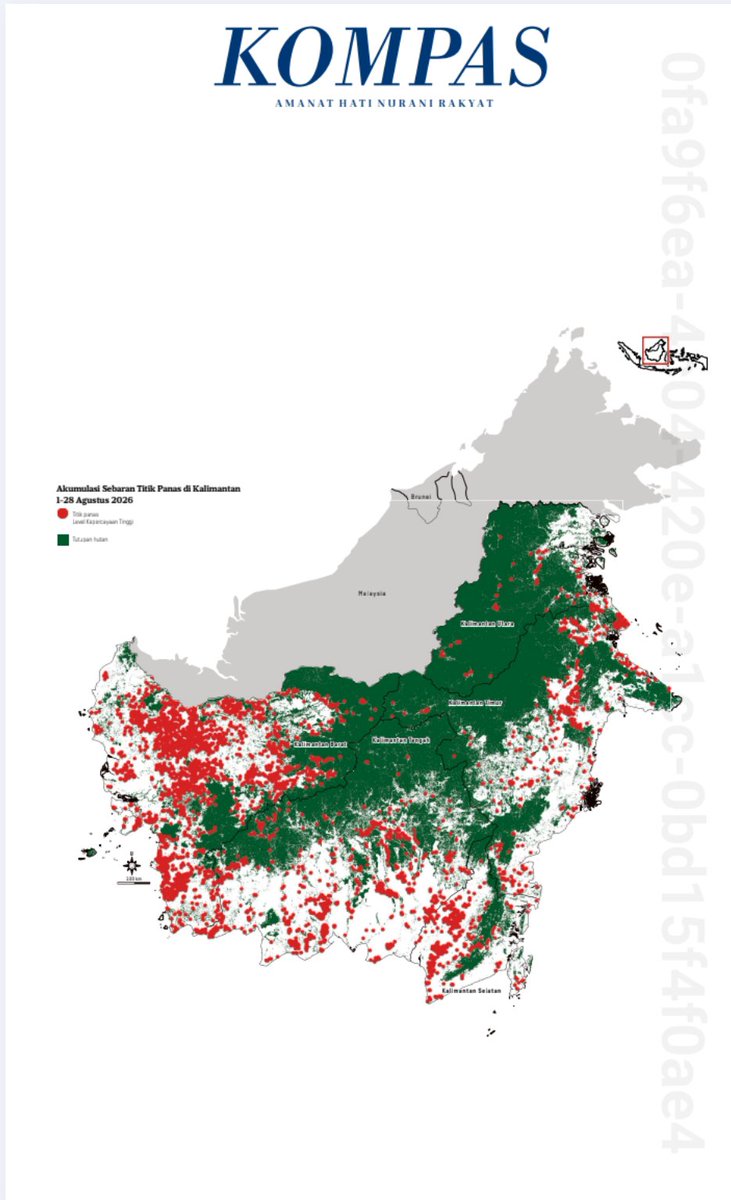
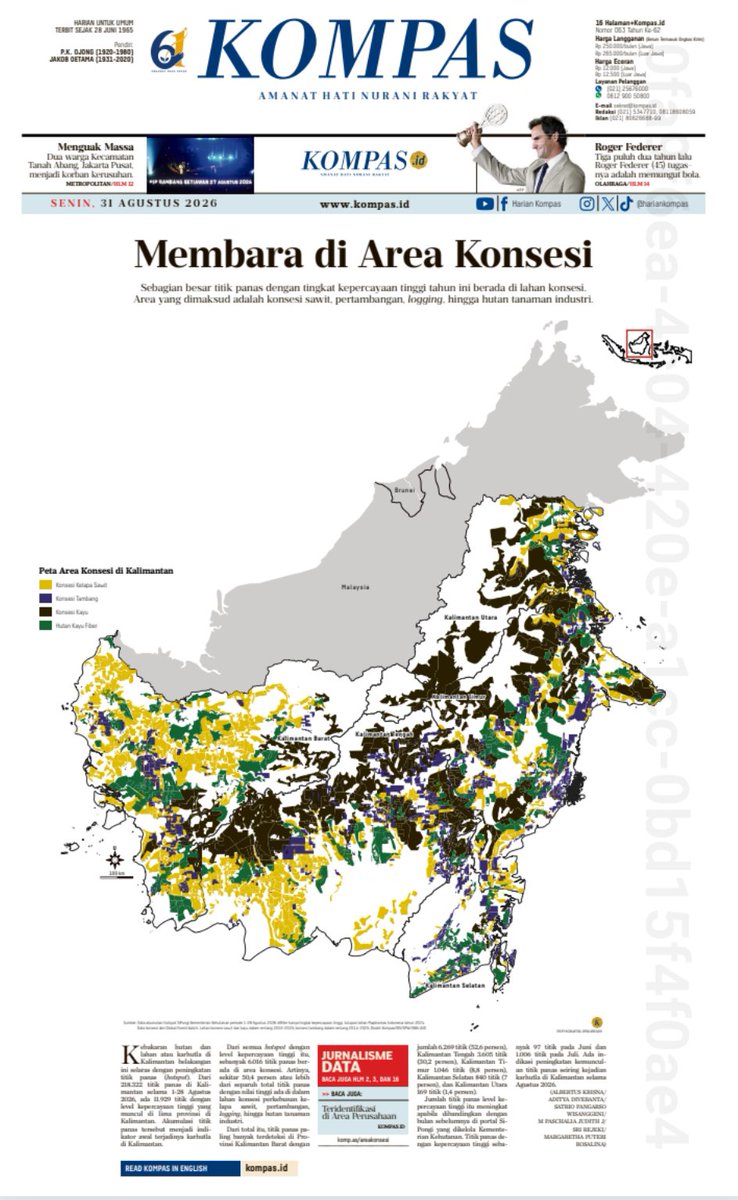
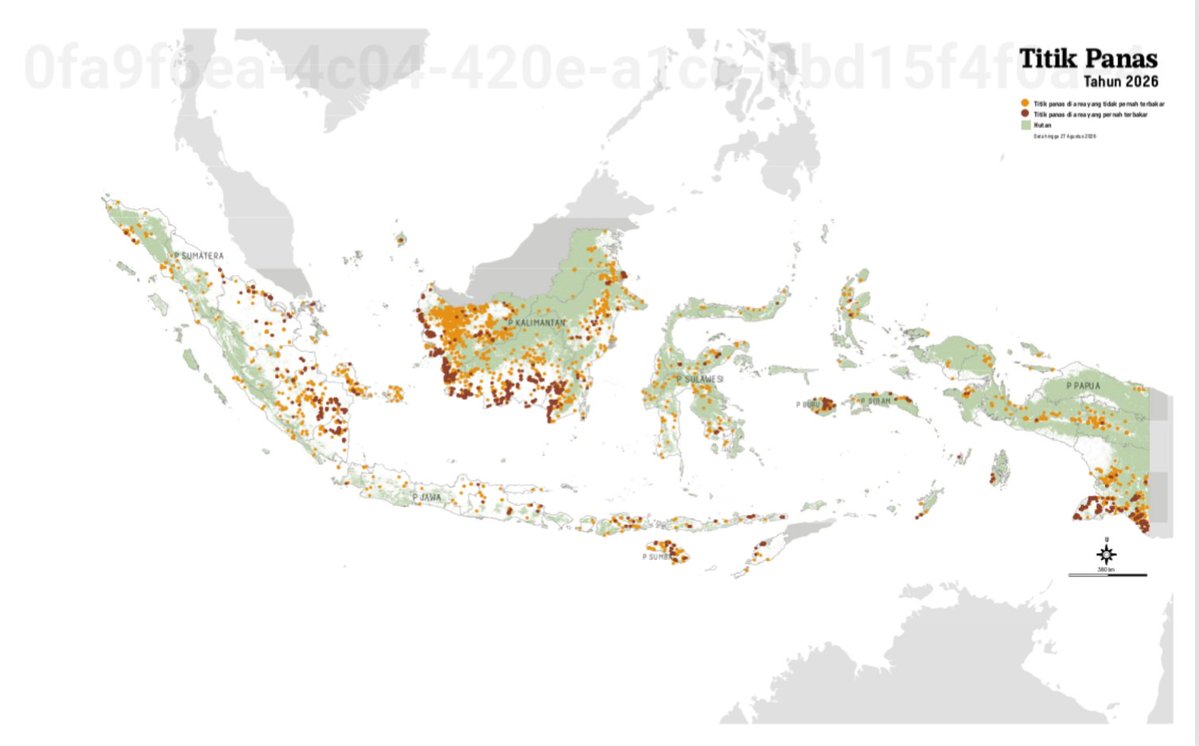
Hari ini kami terbit dengan wajah yang berbeda. Kami kembali menampilkan infografik interkatif di atas lembar kalkir. Perwajahan ini merupakan bagian dari rangkaian liputan #JurnalismeData "Membara di Area Konsesi". Pastikan Anda mendapatkan koran kami.
#AdadiKompas
I'm sure you've heard about the illegal forest fires happening in Borneo/Kalimantan, Indonesia. I live here
Borneo is the largest rainforest in Asia and home to orangutans. and our government isn't doing shit to deal with this situation right now (donation links below)
“Rumah saya terbakar! Masih banyak orang di dalam rumah!” kata Endang Susilawati pada tim penyelamat yang sedang mengevakuasi warga di Jekan Raya, Palangkaraya, Kalimantan Tengah.
Endang panik karena api dan asap kebakaran hutan mengepung adik dan kakeknya.
More than a year after the Al-Rahim family home was bombed in the Zeitoun neighborhood east of Gaza City, Civil Defense teams continue searching for the bodies of several family members, despite their limited resources.
Kompas hari ini membuat ilustrasi utk menunjukkan bahwa area kebakaran kebanyakan di konsesi sawit. Ini jelas berarti Kalimantan dibakar oleh sistem kapitalisme perkebunan monokultur sawit.