Two years ago, we released Genesis, a universal physics engine for robotics.
Today, I’m excited to announce 🍎 Eden — a robot learning framework built from the ground up for agents, unleashing full potential of Genesis.
One task definition. From simulation to real robots. Sim-to-sim and sim-to-real just got easier.
Coding agents build tasks 1.6–4× faster than in Isaac Lab.
🧵 1/11
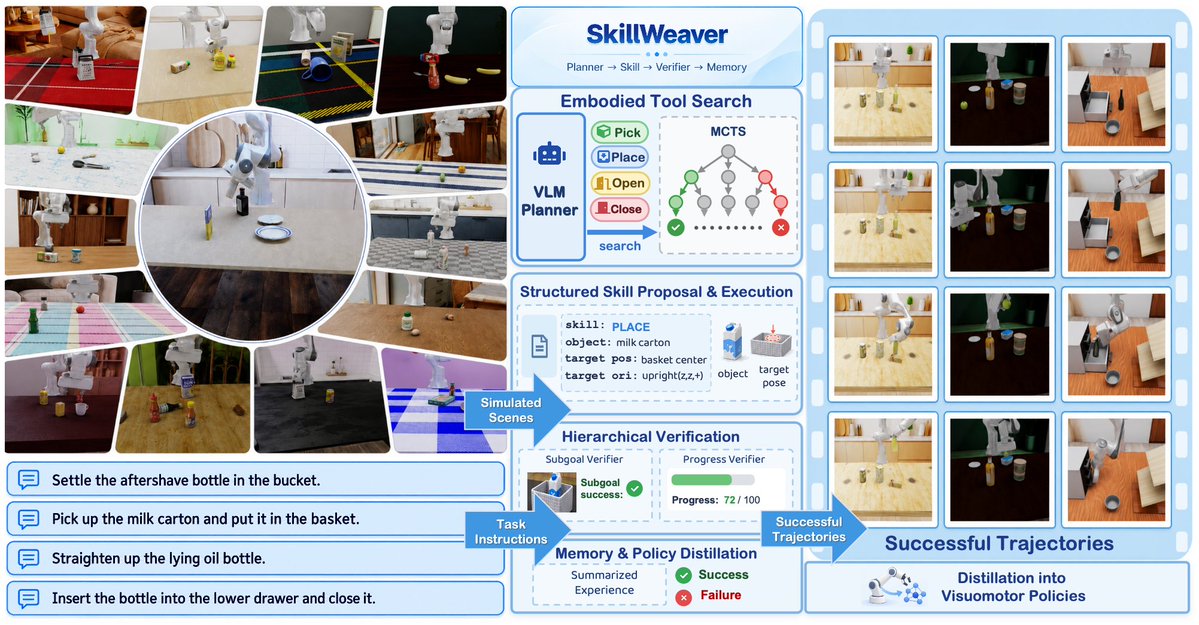
Can robots generate their own training data at scale? 🤖
Come check out SkillWeaver at #CoRL2026 tomorrow! We leverage agentic exploration over learned neural interaction skills to generate large-scale robot data in simulation, enabling stronger generalization and sim-to-real transfer.
📍 Poster #90 | Nov 11, 10:30 AM–12 PM
https://t.co/8i5NsmT4K4
https://t.co/6EoyJ2syoc
1/9 Introducing our #CoRL2026 work 🤖 GeomVLA: Unifying Scene, Motion, and Action in 3D
A shared metric 3D reasoning space connects perception, future scene motion, and action.
🌐 https://t.co/FOVoUsM1p7
1/ We introduce TrackEverything: a 3D point tracker that tracks all points across all frames of long videos (1000+ frames).
Our key idea is to tie computation to unique 3D scene content rather than redundant 2D pixels in a video.
https://t.co/NYHPTTg0Gr
🚀Excited to share Qwen-3D (ECCV 2026) — a generalist 3D vision–language model that does grounding, segmentation, VQA, and spatial reasoning in one place. VLMs are great at images and short clips, but long videos bury them in tokens. Our idea: put multi-view frames into a shared 3D world, so attention scales with what’s in the scene, not how many frames you feed it.
📄https://t.co/W5lhqHe10F
🌐https://t.co/4fZkoEIGJJ
@niksteel123@ayushjain1144 We haven’t considered using game engines for capturing scene + temporal data - we are mostly using open source 3D benchmarks and simulators. We do have a follow up project on the 4D scenes, @ayushjain1144 is leading this
🚀Excited to share Qwen-3D (ECCV 2026) — a generalist 3D vision–language model that does grounding, segmentation, VQA, and spatial reasoning in one place. VLMs are great at images and short clips, but long videos bury them in tokens. Our idea: put multi-view frames into a shared 3D world, so attention scales with what’s in the scene, not how many frames you feed it.
📄https://t.co/W5lhqHe10F
🌐https://t.co/4fZkoEIGJJ
So why doesn’t everyone just do this? The data just isn't there. We’ve got ~1B images… and maybe ~10k posed 3D scenes. Pure 3D-first models don’t scale today. So Qwen-3D is a unified 2D–3D model: shared parameters, shared token space, trained with both. Keep the scale of 2D data; add geometry where we have it.
We may receive 2D frames from sensors, but the world is inherently 3D - many of the frames we receive are redundant due to overlapping views.
Once you lift RGB-D into world space, those redundant views collapse into persistent scene tokens. Same room, 400 frames or 75 — similar token budget.
Having a model that runs on these kinds of inputs wins you 📦Compactness · 🗺️Spatial reasoning · ⏱️Temporal consistency