Great honor for being selected as the 2026 Class of PMSE Early Investigators!Hearty congratulations to other honorees!Look forward to ACS Fall 2026 in Chicago.
🎉 Congratulations to the 2026 Class of #PMSE Early Investigators!
We’re proud to recognize these emerging leaders for their innovative contributions to polymer science & engineering.
🧪 Honorees will be celebrated during #ACSFall2026
📍 Chicago, IL | 🗓 Aug. 24–27, 2026
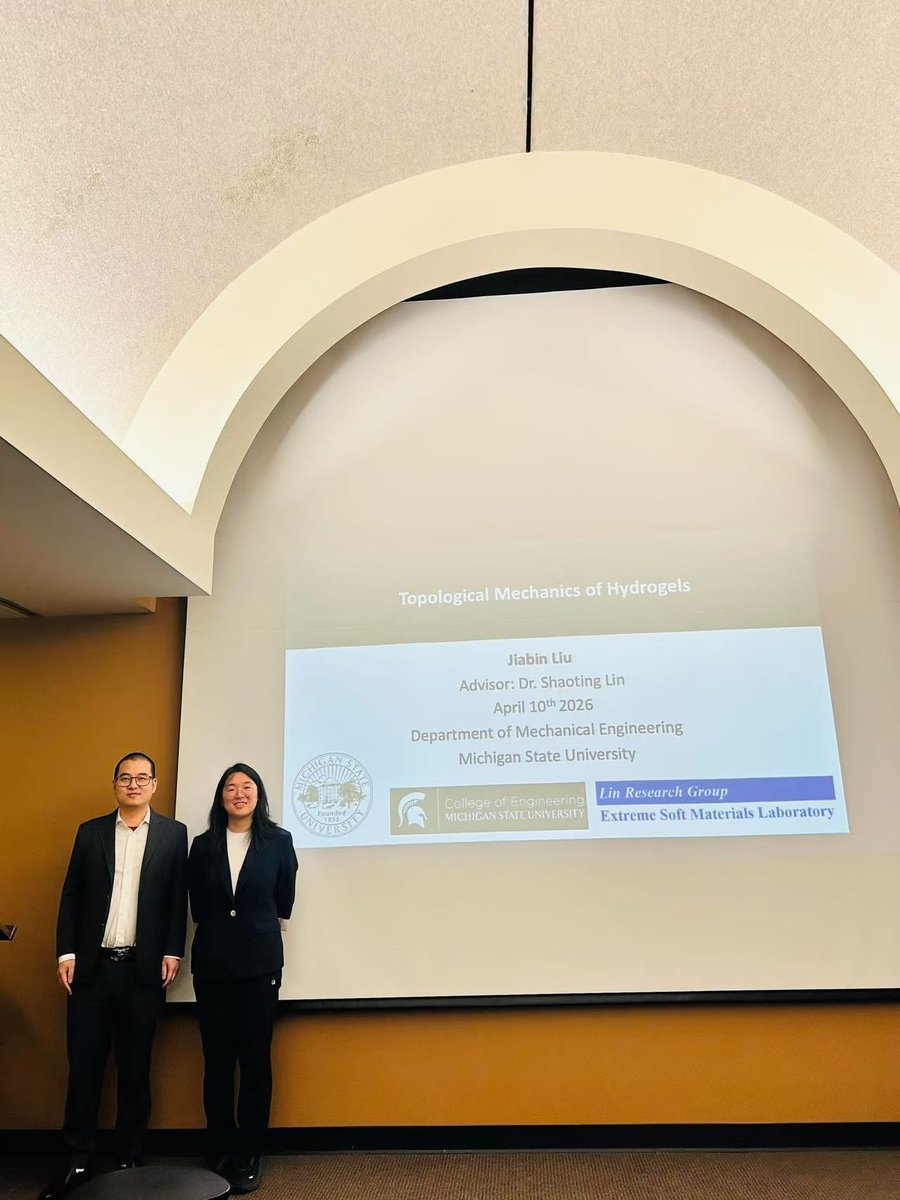
Today is a milestone of my group. We graduate our first PhD student Jiabin Liu with her thesis, titled "Topological Mechanics of Hydrogels". The core of her thesis is to explore network topology as a fundamental determinant for enabling extreme mechanical and transport properties
Thrilled to share our joint work on "Tissue-Adhesive Hydrogel-MXene Biosensor for In-situ Intraoral TNF-α Detection", just published in Science Advances (https://t.co/YWntcH3Owi). Congrats to my student Tsz Hung Wong, Jie Ma, Ruihao Lu!
The core idea is introduce selective-permeable hydrogel as an interfacing material between sensing probe and body fluid, only allowing the passage of target biomarkers while rejecting the transport of non-target biomolecules, thereby enhancing sensing performance.
Thrilled to share our joint work on "Tissue-Adhesive Hydrogel-MXene Biosensor for In-situ Intraoral TNF-α Detection", just published in Science Advances (https://t.co/YWntcH3Owi). Congrats to my student Tsz Hung Wong, Jie Ma, Ruihao Lu!
USNC-TAM 2026 will be held on June 21–25, 2026 in Pasadena, California. Shaoting @lin_shaoting , Ruobing @RuobingB, Berkin and I are organizing a mini-symposium, Mechanics and Physics of Soft Materials. Please submit an abstract by Jan 15, 2026.
https://t.co/73ORg7TjQy
Feel proud to share our recent work on defect-engineered elastocaloric polymers published in Advanced Science (https://t.co/qMN5XRnVFK), in collaboration with @RuobingB at NEU and Prof. Svetlana Boriskina @ MIT.
The defect-engineered polymer achieves an adiabatic temperature change of up to 8.14 °C at an elevated temperature above 65 °C. This working mechanism is due to competing effects of dangling-chain defects on strain-induced crystallization and temperature-induced crystallization.
Feel proud to share our recent work on defect-engineered elastocaloric polymers published in Advanced Science (https://t.co/qMN5XRnVFK), in collaboration with @RuobingB at NEU and Prof. Svetlana Boriskina @ MIT.
Reading again the essay by Walter Noll, The Role of the Professor.
He "lives" his subject and cannot easily switch it off, even while lying in bed awake or on vacation. He recreates the subject in his mind each time he lectures on it.
https://t.co/T09LkIsHD6
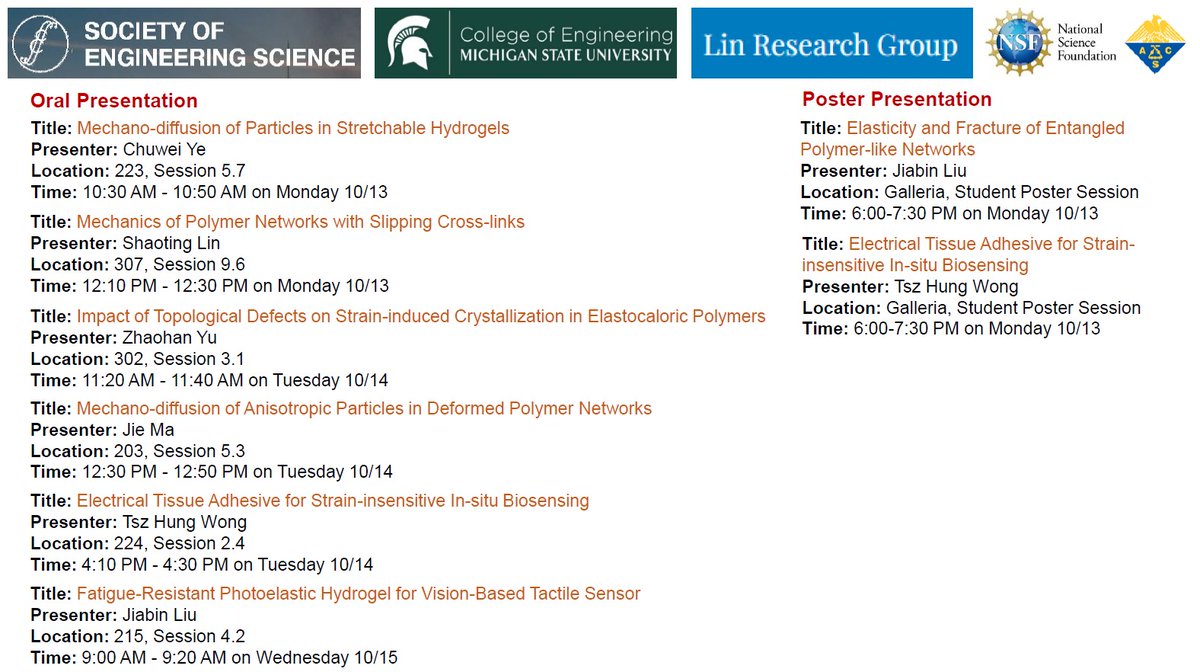
We are excited about the 2025 SES meeting @SocEngScience next week. We will present our recent research progress covering topics: 1) Mechano-diffusion, 2) Tactile Robots, 3) Hydrogel Bioelectronics, 4) Topological Mechanics, 5) Elastocaloric Polymers. Feel free to stop by.
Highly excited to co-organize the 2026 MRS Spring Symposium SB08 with @Junsoo_twit , @cemilyd, and Wei Zhai on "High-Performance Soft Materials by Polymer-Network Design" at 2026 MRS Spring Meeting in Honolulu. Abstract submissions are now open! Look forward to your submission!
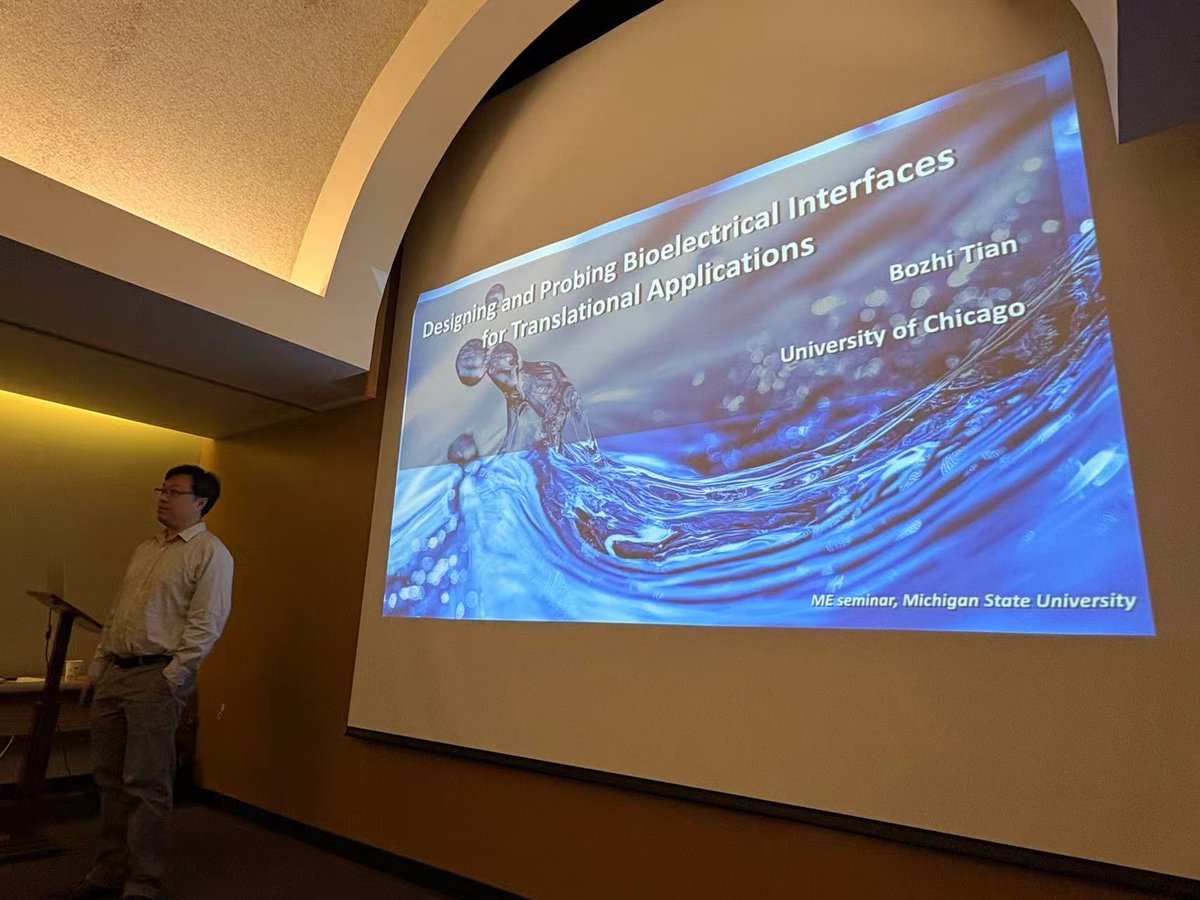
It's my great honor to host Prof. Bozhi Tian from U Chicago to give a seminar talk on Bioelectrical Interfaces for Translational Applications. We all enjoyed the talk and learned from the talk. Glad to see our students to have opportunities to interact with their role models.
In 1994, I went for my first sabbatical, at Max Planck Institute for Metals Research, in Stuttgart, Germany. My host, Manfred Rühle, let me alone. In the Institute Library, I discovered Gibbs’s paper on phases in a pure substance.
What a revelation!
https://t.co/qnf62DT7No
Many thanks for highlighting this. We feel grateful a recent award from the ACS Petroleum Research Fund, seeking a new direction for harnessing mechanical deformation to engineer nanoparticle transport, potentially beneficial for enhanced oil recovery and drilling fluid design.
ME’s Shaoting Lin will use a new two-year grant from the ACS Petroleum Research Fund to explore fundamentals associated with particle transport that govern petroleum applications in oil refining, such as the release of catalyst agents and removal of petroleum contaminants.