More retailers for PlayStation 5 DualSense Controller - Grand Theft Auto VI LE
GameStop: https://t.co/piye45QZeO
PS Store: https://t.co/QwZHbKsJhw (scroll down) #ad
A man says he was voluntarily paying his child’s mother $300 a week, but after asking for just two months to get back on his feet financially, she filed for child support and the court ultimately ordered him to pay only $13 a month
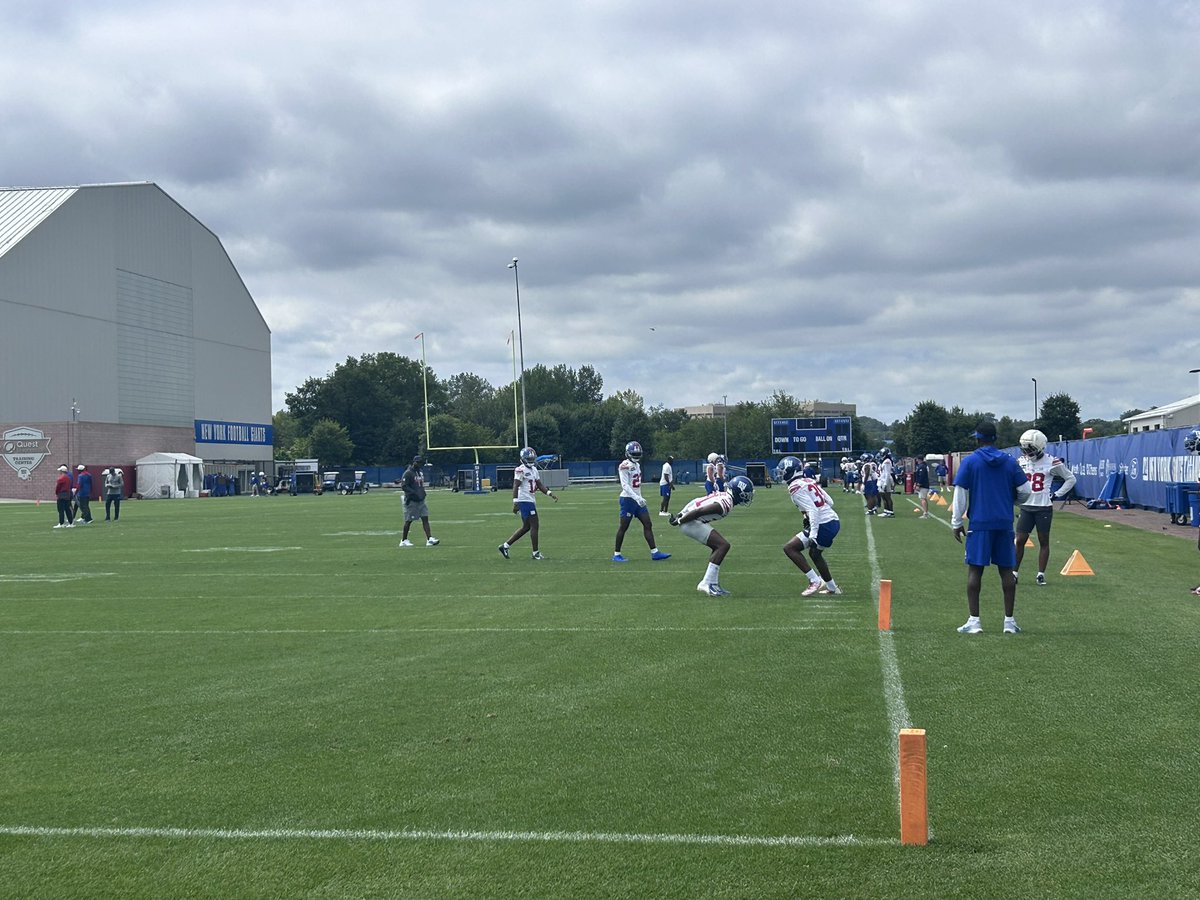
Giants practice in shells (close to full speed but no hitting) just ended:
Malik Nabers did one release rep in 1-on-1 routes (no QB or ball), and his right leg didn’t seem to support his plant/cut well. He regained his balance after the stumble but immediately stepped out of the drill
Nabers later took his first ‘live’ rep of camp in 11 on 11. Jogged his route with a limp. Took a second rep later and ran it relatively normally
Took two more on the goal line, didn’t see a target. Then caught three passes from Jaxson Dart in 7 on 7. Release looked better there but still limping
After his third catch, where he jumped a bit and landed uncomfortably, Nabers walked off slapping himself in the helmet. And he didn’t do anything more in team
Nabers then left that field and did some individual releases with trainers on another field
Practice ended with Abdul Carter pick 6 of Dart after a Kayvon tip, then Ar’Darius Washington INTd Jameis Winston
Center John Michael Schmitz is back from his concussion. Suited up and practiced, although his snaps were limited
Colton Hood and Bobby Jamison-Travis both received some attention from trainers during the practice
OBJ drew a DPI in the end zone on Hood (on a target from Dart). Later, OBJ caught a pass from Jameis and spun the ball down on the ground for the first down. He wore sweats on a hot day and seemed gassed late, also did push ups after turning the wrong way on a deep target
DNPs: WR Jalin Hyatt, RB Turbo Miller, DL Josh Tupou
A new LB Chandler Martin was on the practice field in a 55 jersey with no number #talkinball @NYDailyNews
World News Report — Friday, August 7, 2026
As of this morning in California, several developments stand out because of their potential effects on human life, regional stability, global food and energy supplies, public health, and the world economy. Some are changing rapidly, especially the U.S.–Iran conflict and Gaza diplomacy, so statements about negotiations should be treated as provisional rather than settled outcomes.
1. U.S.–Iran war: Hormuz remains the most consequential immediate global risk
Diplomatic activity involving Iran, Oman, Qatar and the United States has raised hopes that the five-month conflict could move toward de-escalation, yet there is no confirmed comprehensive peace agreement. Earlier optimism pushed oil prices sharply lower, while renewed doubts and Iranian consideration of restrictions on U.S. and Israeli vessels sent prices upward again. Reuters reported this morning that Brent crude was around $83 a barrel.
The clearest evidence that the crisis remains serious is shipping traffic. Only 33 vessels crossed the Strait of Hormuz from Monday through Thursday, compared with 50 during the equivalent period a week earlier. Before Iran closed the waterway following the February 28 outbreak of the U.S.-Israeli war with Iran, roughly 130–140 vessels normally transited each week. Shipowners remain reluctant to enter despite steep discounts on Iraqi crude because of security, insurance and sanctions concerns.
Iran and Oman have discussed an arrangement concerning movement through Hormuz, although important details remain unresolved. Industry sources have questioned whether a plan giving Tehran greater control over Gulf-bound traffic could function under existing U.S. sanctions and insurance rules. Iran is also considering legislation that could prohibit U.S. and Israeli vessels from using the strait. These are proposals and political moves, not yet proof that a workable maritime settlement exists.
Why it matters: Hormuz is one of the world's most important energy corridors. Prolonged disruption can raise fuel, transportation, fertilizer and food costs far beyond the Middle East. Iraq and other Gulf exporters are particularly exposed, while Asian importers such as China and India face supply uncertainty.
What to watch: whether Iran and Oman produce a detailed transit arrangement; whether Washington accepts any part of it; whether vessel traffic begins returning toward normal levels; and whether military activity decreases rather than merely pauses.
2. Gaza: diplomatic claims of progress coexist with continuing strikes and civilian suffering
The Gaza ceasefire framework agreed last October has not produced a durable end to violence. Israel has continued strikes in Gaza, and Reuters reports that approximately 1,200 Palestinians have been killed during the nine months since the ceasefire began, according to Palestinian health officials. Hamas generally does not publish comprehensive figures separating its combatant losses from civilian deaths, so the precise composition of casualties remains uncertain.
On August 6, the foreign ministers of Saudi Arabia, Egypt, the UAE, Turkey, Qatar, Jordan, Pakistan and Indonesia jointly condemned Israeli military actions affecting civilians, health facilities and other infrastructure. Israel rejected that characterization and said Hamas continues to rearm, recruit fighters and rebuild tunnels in violation of the peace plan's requirement for a demilitarized Gaza. Those accusations represent the Israeli government's position rather than independently established findings in every individual case.
President Trump recently said there had been a breakthrough and that Hamas had agreed to lay down its weapons. The unresolved issue is implementation: Israel maintains that withdrawal cannot be completed while Hamas retains military capacity, while Hamas and Palestinian representatives have demanded cessation of Israeli operations and progress toward withdrawal. Consequently, headlines suggesting that the Gaza conflict is essentially resolved overstate the situation on the ground.
The humanitarian picture also remains severe. Much of Gaza's population is displaced, infrastructure has suffered extensive destruction, and disputes over aid access and security continue. A UN official recently also accused Hamas personnel of obstructing aid operations in some incidents; Hamas disputed that account. That illustrates why responsibility for particular events must sometimes be reported as contested rather than settled.
Why it matters: civilians remain caught between unresolved military and political demands. A genuine settlement would affect regional diplomacy, reconstruction, humanitarian access, Israeli security and Palestinian governance for years.
What to watch: independently verifiable Hamas disarmament steps, changes in Israeli deployments, sustained reductions in strikes, humanitarian-access improvements and concrete agreements among mediators rather than announcements alone.
3. Ukraine and Russia: expanding missile pressure and attacks on Black Sea trade
Ukraine is confronting a significant shortage of air-defense ammunition. President Volodymyr Zelensky said allied deliveries of missile interceptors during 2026 have fallen to approximately one-third of the 2025 level, while Russia has intensified ballistic and missile attacks. Ukraine is particularly short of Patriot interceptors capable of countering ballistic missiles.
The United Nations condemned large-scale missile and drone attacks this week affecting both Ukraine and Russia and again called for de-escalation. UN officials have separately warned that attacks around Black Sea ports and shipping corridors are harming civilians while creating renewed risks to international food security.
The agricultural dimension is increasingly important. A recent Russian attack damaged a foreign-flagged ship carrying wheat in Ukraine's Black Sea region, killing a crew member, according to Ukrainian authorities. Kyiv says it will provide subsidized credit and other assistance to farmers and exporters affected by attacks on ports and the maritime corridor. Russia and Ukraine have both targeted agricultural or export-related facilities during recent fighting.
Why it matters: Ukraine and Russia are both major agricultural exporters. Serious disruption around Black Sea ports can translate into higher wheat and food prices, particularly for import-dependent countries in Africa and the Middle East. Militarily, insufficient Ukrainian interception capacity also increases risks to civilian areas and energy infrastructure as winter approaches.
What to watch: Western interceptor deliveries, Russia's missile-production rate, attacks on Black Sea shipping and whether diplomatic channels produce meaningful negotiations rather than simply deadlines or declarations.
4. Democratic Republic of Congo: Ebola outbreak passes 4,000 confirmed cases
This is one of today's most serious public-health developments.
The Democratic Republic of Congo's public-health institute now reports 4,053 confirmed Ebola infections and 1,850 deaths in the current outbreak. Cases have been recorded in Ituri, North Kivu, South Kivu, Haut-Uele and Tshopo provinces. It is now the world's second-largest recorded Ebola epidemic, exceeded only by the 2014–2016 West African outbreak.
Researchers believe transmission may have begun in January or earlier, months before authorities formally declared the outbreak on May 15. Delayed identification, inadequate surveillance, population movement, armed conflict and shortages of treatments and vaccines suitable for the particular Ebola species have contributed to the rapid spread. Because detection is incomplete, experts believe the true number of infections could be higher.
There was some reassuring news today. Authorities intercepted a riverboat approaching the Kinshasa area after learning that a passenger later suspected of Ebola had traveled aboard it. All roughly 300 passengers were screened; seven passengers with illness symptoms were tested, and all seven tested negative for Ebola. Authorities have nevertheless expanded screening of boats arriving near Kinshasa.
This distinction is important: the boat incident has not established transmission in Kinshasa, a metropolitan area of more than 17 million people. The negative tests lessen that immediate concern, although surveillance continues.
Why it matters: Ebola containment becomes much more difficult when cases occur across conflict-affected provinces with large displaced populations and weak health infrastructure. Protecting healthcare workers is particularly important because infections among medical personnel can further weaken the response.
What to watch: the rate of new cases, vaccine availability, transmission into additional provinces, healthcare-worker infections and whether authorities can strengthen surveillance and treatment capacity.
5. China: Beijing faces heavy rain as Typhoon Dolphin approaches
Heavy rain struck Beijing on August 7, with several districts issuing warnings for flooding, mudslides and landslides. Authorities are simultaneously preparing for Typhoon Dolphin, adding another layer of weather risk.
Urban flooding is a major concern in densely developed areas, while mountainous and agricultural districts face greater landslide and mudslide risks. Because this situation is still developing, early warnings should not be interpreted as evidence that catastrophic damage has already occurred.
Why it matters: China has experienced repeated extreme-rainfall emergencies in recent years. Major flooding can affect transportation, food production, industrial activity and millions of residents, while typhoon damage can extend across several provinces.
What to watch: Dolphin's final track and intensity, evacuation orders, rainfall totals and reports of flooding or infrastructure disruption during the next several days.
6. China’s exports surge as AI demand reshapes global trade
China reported an unusually strong July trade performance. Exports increased 23.9% from a year earlier, while imports increased 27.5%, according to customs data reported by Reuters. Semiconductor exports nearly doubled and high-technology exports rose strongly, reflecting worldwide investment in artificial-intelligence infrastructure.
The figures do not necessarily mean China's entire economy is booming. Domestic consumption and investment remain comparatively weak, and traditional export categories such as toys and ceramics have performed less strongly. The IMF currently projects Chinese real GDP growth of about 4.6% in 2026 and has argued that China would benefit from shifting toward stronger domestic consumption.
Trade tensions also remain a structural risk. Recent IMF research concludes that U.S. tariff increases are substantially passed through into import costs, while companies respond partly by switching toward lower-priced suppliers and products. Another IMF study finds that subsidies and tariffs in strategic industries can redirect trade while reducing global economic welfare through distortions and cross-border effects.
Why it matters: China's manufacturing performance influences global electronics, AI infrastructure, commodity demand, shipping and inflation. Strong exports may support global supply, while simultaneously intensifying trade tensions with countries concerned about industrial competition.
What to watch: additional U.S. or European restrictions, semiconductor trade, China's domestic demand and whether today's exceptional export growth persists.
7. Sudan: one of the world's worst humanitarian crises remains dangerously undernoticed
Sudan continues to merit sustained international attention even though it is not today's dominant headline.
Earlier this week, the independent Emergency Lawyers group said a Sudanese military drone strike hit a civil court in North Darfur, killing at least 35 people. The Sudanese military had not responded to AP's request for comment at the time of publication, meaning responsibility for the specific incident comes from the rights group's account rather than an acknowledged military statement.
The broader humanitarian situation is indisputable. The United Nations describes Sudan as the world's largest displacement crisis and one of its worst hunger emergencies. Nearly 34 million people require humanitarian assistance, around 21 million need health assistance, and more than 4 million are estimated to be acutely malnourished during 2026. Diseases including malaria, measles, dengue, hepatitis E and meningitis are circulating amid badly weakened healthcare services.
Drone warfare by both sides has become increasingly prominent. AP reports that UN data attributed roughly 80% of Sudanese civilian deaths during the first four months of 2026 to drone attacks. Precise nationwide casualty totals remain uncertain because large parts of the country are difficult to access.
Why it matters: Sudan combines war, famine risk, displacement, disease and weakened state institutions on an enormous scale, with millions of refugees and displaced people placing pressure on neighboring countries.
What to watch: Darfur and Kordofan fighting, humanitarian-access routes, famine indicators, outside military involvement and credible ceasefire negotiations.
The most important developments to watch
The U.S.–Iran conflict and Strait of Hormuz remain the greatest immediate danger to global energy and shipping. Diplomacy is active, although declining vessel traffic shows that confidence has not returned.
The Congo Ebola epidemic is the most urgent emerging global-health story. Crossing 4,000 confirmed infections represents a substantial deterioration, even though the suspected riverboat transmission near Kinshasa was not confirmed.
In Gaza, political statements about progress should be judged against measurable realities: continuing strikes, civilian casualties, unresolved disarmament questions and humanitarian conditions.
In Ukraine, shortages of missile interceptors and renewed attacks around Black Sea ports create both humanitarian and global food-security risks.
Meanwhile, Sudan's enormous humanitarian emergency, China's severe-weather threat and the increasingly AI-driven restructuring of global trade deserve sustained attention even when other conflicts dominate the headlines.