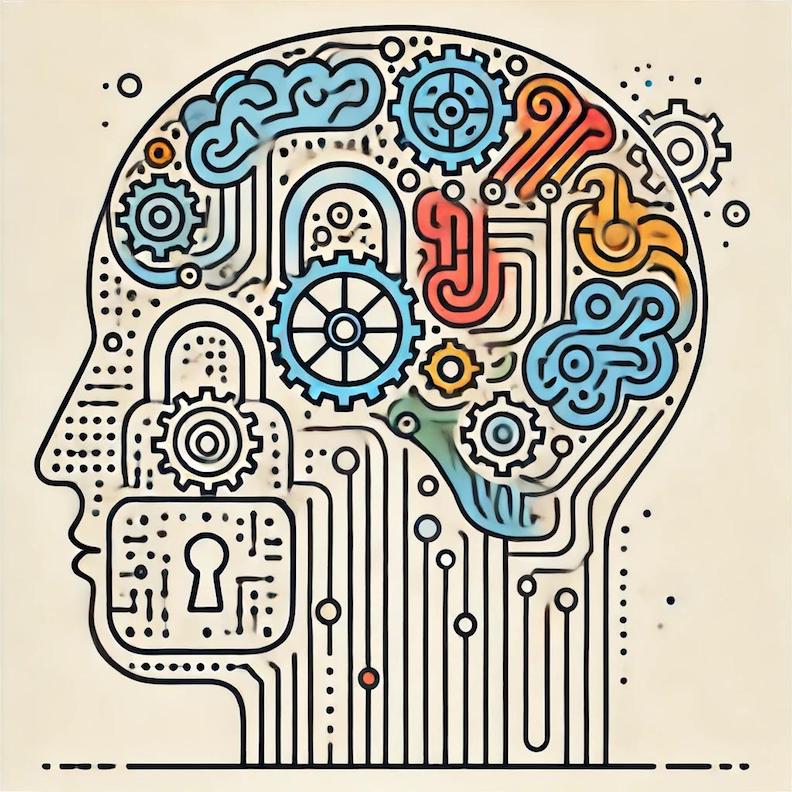
The Philosophical Enigma of Large Language Models
🔵LLMs challenge traditional notions of intelligence and consciousness, blurring lines between AI and biology.
🔵Artificial qualia and a reimagined Turing Test may prompt a reassessment of machine consciousness.
🔵Rigorous inquiry—driven by the rate of change—is crucial as we explore the "cognitive" implications of LLMs.
https://t.co/YcR7VKVQOS #LLMs #AI #AGI
“We would have profound moral obligations to consider their welfare, autonomy, and even their "rights" as persons—a realization that scrambles our anthropocentric value systems and forces a radical expansion of the circle of ethical consideration.”
“LLMs are unlocking the realm of ideas. The cognitive interface enables users to engage with machines on a conceptual level, moving beyond the retrieval of information to the exploration and refinement of thoughts.”
⚡️The Cognitive Interface—Reshaping Our Computer Interactions
🧠Unlocking human potential through the technology interface of pure thought.
The evolution of information access and interaction has been a transformative technological and human journey, from Gutenberg's printing press to Google's search engine. As we stand at the beginning of the Cognitive Age, large language models (LLMs) are not just catalyzing a shift from transactional interactions to iterative engagements; they are introducing a fundamentally new computer interface—the cognitive interface.
The Emergence of the Cognitive Interface
The history of human-computer interaction has been marked by significant milestones. From the early days of punch cards and keystrokes to the revolutionary graphical user interface (GUI) pioneered by Xerox PARC and popularized by Steve Jobs, each advancement has redefined how we interact with machines. Now, with the advent of LLMs, we are witnessing the birth of the cognitive interface—a language-based, cognitively responsive design that adapts to the user's needs and context.
A Fundamental Shift in Interface Technology
This cognitive interface represents a fundamental shift in computer interface technology. Unlike traditional interfaces that rely on explicit commands and predetermined actions, the cognitive interface leverages the power of natural language processing and machine learning to understand and respond to user intent. This dynamic interaction allows for a more intuitive, human-like engagement with technology, making it accessible to a broader range of users.
From Words to Facts to Ideas
The cognitive interface is not merely a change in how we interact with computers; it is a pivotal component of the evolution. Gutenberg's printing press democratized access to words, while the Internet revolutionized the dissemination of facts. Now, LLMs are unlocking the realm of ideas. The cognitive interface enables users to engage with machines on a conceptual level, moving beyond the retrieval of information to the exploration and refinement of thoughts.
Amplifying Human Intellect
The cognitive interface amplifies human intellect by leveraging the vast knowledge and computational power of LLMs. By processing and synthesizing information, identifying patterns, and generating insights, LLMs augment our cognitive capabilities. This symbiotic relationship between humans and machines enhances our ability to think critically, solve complex problems, and make informed decisions.
Fostering Creativity and Innovation
The iterative nature of the cognitive interface fosters creativity and innovation by providing a platform for collaborative ideation. Through dynamic conversations with LLMs, users can explore diverse perspectives, challenge assumptions, and generate novel solutions. This iterative process mimics the way ideas evolve and mature through human dialogue, enabling users to refine their thoughts and develop innovative concepts.
Think, Act, Become—Our Cognitive Future
The cognitive interface will help redefine the boundaries of human-computer interaction. By leveraging the power of natural language and adaptive, context-aware responses, the cognitive interface will make technology more accessible, intuitive, and empowering. These fundamental shifts will have far-reaching implications across industries, from education and health care to business and creative pursuits.
By shifting from transactional interactions to iterative engagements and enabling the exploration of ideas, the cognitive interface unlocks new realms of thought and understanding. In this new and transformative phase, the Cognitive Age promises a future where the symbiotic relationship between humans and machines propels us toward new heights of creativity, innovation, and discovery. This exciting new era of cognitive empowerment heralds unprecedented opportunities and advancements, driving us toward a brighter, more engaged, and perhaps even more enlightened future.
https://t.co/cmTL8Jg0Ud
#AI #cognition #AGI #LLMs @thought@BrianRoemmele
@JohnNosta@BrianRoemmele@jordanbpeterson at 14 minutes in you mention language as the operating system of the brain. I'd put forth language as the code and metaphor is the system and culture as the platform.
✒️The Word Is Mightier Than the Algorithm
Is language itself the operating system for human-AI collaboration?
https://t.co/usQXKrCqx8 #AI#AGI#LLMs#language
⚡️Beyond Language: Expanding the Realms of AI Expression
(Apolumtramic thnatosaccidance is not a typo.)
🔴AI language models push linguistic boundaries, hinting at new modes of expression.
🔴Seemingly nonsensical AI outputs may contain deeper meaning and creativity.
🔴Comparisons to abstract art and experimental literature provide helpful context.
https://t.co/Wt0SMfVFMS
#AI #AGI #LLMs #GPT4 #GPT5 #Claude3 @AnthropicAI
Terminologies explained -
Islamic Republic (“IRI”)(جمهوری اسلامی): the government in Iran
Islamic Revolutionary Guard Corps (“IRGC”)(سپاه پاسداران): the armed forces that protect the IRI’s system of governance, “velayat-e faqih (ولایت فقیه) and the supreme leader, “vali-e faqih.” They suppress internal uprisings, deemed as a threat to the supreme leader & the system.
Morality police (گشت ارشاد): the police responsible for enforcing the religious dress code and observance of religious laws.
The Basij (بسيج): a separate paramilitary branch of the IRGC, originally voluntary militias.
Artesh (ارتش): the official Army, designed to protect the territorial integrity of the land from external threats.
Not to be confused with:
Iran: our beloved homeland
Iranian: our beloved people
Please take care not to conflate these things.
How #GeorgeCarlin’s #sevendirtywords you can’t say on radio/tv changed legal history: https://t.co/qTdw5WSzQH
In fact, you’re not even allowed to pronounce the name of the governmental body that regulates it … @FCC#FAQ you need to know #WDYK
In 4 minutes, Kurt Vonnegut explains stories better than anyone I’ve ever heard.
“The shape of the curve is what matters. Not their origins.”
He plots stories on 2 axes:
X: Time
Y: Good fortune / ill fortune
He goes on to say,
“Somebody gets into trouble, then gets out of it again. People love that story. They never get tired of it.”
Point 1:
Stories have defined patterns.
In Joseph Campbell’s Hero of a Thousand Faces, he makes the case for the Hero’s Journey.
Since then, it’s become the most famous storytelling structure in the world.
Vonnegut argued stories could be divided into 8 shapes.
Each story, he said, fit one of the 8.
Point 2:
Vonnegut says,
“Be a sadist. No matter how sweet and innocent your leading characters, make awful things happen to them — so the reader may see what they're made of.”
To see who your characters really are, you have to make them suffer.
Only then does your audience have someone worth cheering for.
Point 3:
End on a high note.
Vonnegut says, “It’s not accidental that the line ends up higher than where it began. This is encouraging to readers.”
The way a story makes people feel when they finish is how they remember it.
It’s called recency bias.
Lift people up and they will love you.
***
“There are people. There are stories. The people think they shape the stories, but the reverse is often closer to the truth.”
I wrote this with @RobbieCrab. Follow him for lessons on storytelling + fundraising.
And I talk about creative storytelling & writing fiction. Follow me @nathanbaugh27 for more like that.
An interesting new dev blog about @aidungeon's new Heroes game. They discuss a generative AI solution for handling quests and plot arcs in a world where there are no invisible walls or limits.
Introducing Triggers! #AI#gamedev
https://t.co/SfZPgx7Kni