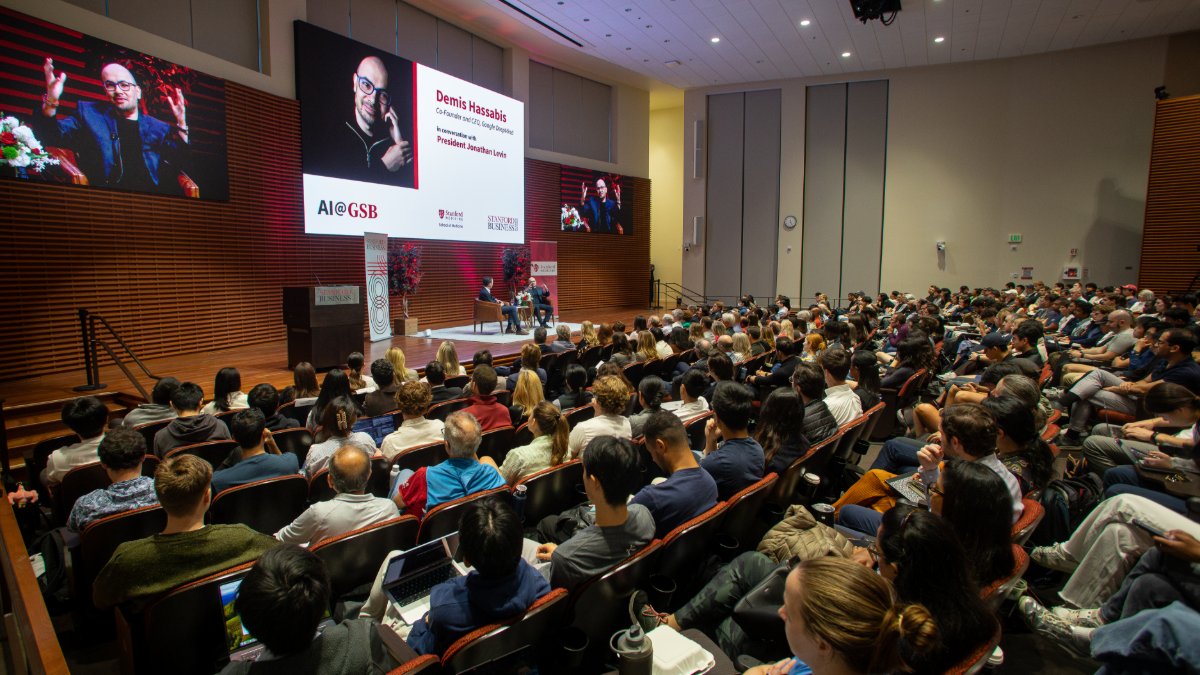
Co-founder and CEO of @GoogleDeepMind, @demishassabis, spoke with Stanford President Jonathan Levin about the frontier of artificial intelligence and what it means for how we live, work, and flourish.
Watch the interview here: https://t.co/g62kgDf4R0
Welp, that happened faster than I predicted. Thought it would be end of 2027, then early 2027, but agentic traffic growing so fast that bots have now passed human traffic online for the first time in the Internet's history. https://t.co/2zX5bHdhsa
How a Noble Virtue Becomes a Civilizational Threat
Empathy is widely regarded as a laudable human virtue, yet even Buddhists recognize its potential to misfire. Tibetan Buddhist master Trungpa Rinpoche coined the term “idiot compassion” to describe misplaced or harmful expressions of empathy. In his book Suicidal Empathy: Dying to Be Kind, evolutionary psychologist Dr. Gad Saad examines how this misfiring has evolved in the modern West into suicidal empathy — a systems failure where a noble impulse is hijacked, leading to policy decisions and cultural norms rooted in emotion rather than sober reasoning.
This phenomenon echoes the insight of historian Arnold J. Toynbee in A Study of History, summarized in the maxim: “Civilizations die from suicide, not by murder.” A key Stoic precept reinforces this warning — what harms us is often not the event itself, but our adverse reaction to it. As Saad explains, suicidal empathy represents exactly such a reaction: a refusal to confront reality, preferring instead a comforting “Unicornia” of wishful thinking.
Suicidal empathy takes hold when individuals or societies attribute all life outcomes to external forces, absolving themselves of personal responsibility. If every failed business venture is blamed on outside factors, introspection and learning become impossible. This mindset ignores clear warning signs, much like the protagonist in Max Frisch’s 1953 play The Firebugs. In the play, a man welcomes obvious arsonists into his home despite glaring signals of danger. The West’s current trajectory as Saad has identified — inviting existential threats under the banner of compassion — mirrors this absurdist tragedy in real life.
As Ayn Rand observed: “Man is free to choose not to be conscious, but not free to escape the penalty of unconsciousness: destruction.” Reality does not bend to our feelings. Knowledge is either true or false, regardless of offense taken. Well-adjusted individuals navigate the world with an accurate map of reality, guided by the principle that “knowledge is power.” In short, as Saad urges, we must be empathetic to the truth.
History offers repeated lessons in the cost of ignoring this. Machiavelli advised that wise princes look not only at present dangers but future ones, for “being foreseen they can easily be remedied.” An ounce of prevention is worth a pound of cure. Yet suicidal empathy discourages prevention, favoring endless tolerance instead.
When empathy is applied without discernment, it is empathy agnosia — an inability to identify appropriate targets for compassion. This leads to dangerous double standards: “When in the minority, play the victim. When in the majority, show no mercy.” True empathy requires moral judgment, not its evasion. As Saad notes, empathy has become “a shortcut… a way to experience delicious moral emotions without confronting the weaknesses in our nature.”
The pursuit of truth must remain a deontological principle, unbound by consequentialist fears of offending others. The dogged defense of truth is the highest form of empathy — epistemological empathy. Saad calls on us to activate our inner honey badger in defending truth.
Civilizational survival demands realism. The West should proudly proclaim its heritage and have a willingness to defend it. As the Romans understood, and as the maxim Si vis pacem, para bellum (“He who desires peace, let him prepare for war”) reminds us, strength and foresight preserve peace.
Power concedes nothing without demand, as Frederick Douglass stated: “The limits of tyrants are prescribed by the endurance of those whom they oppress.” Thomas Jefferson echoed this in the Declaration of Independence — people suffer while evils are sufferable. The parable of the boiling frog illustrates how gradual surrender leads to destruction. Ideas, not armies, ultimately rule the world, as proven by the fall of the Iron Curtain through human choice rather than force alone.
A personal example that illustrates this lesson comes from Elon Musk’s childhood. As a kid often bullied in South Africa, he endured severe beatings, including one that left him hospitalized. Instead of continued appeasement, he eventually fought back decisively, knocking out the main bully. The bullying stopped. This story reminds me that measured resistance, rather than endless tolerance, is sometimes the only path to peace and self-respect.
Human cognition is imperfect, with over 150 documented biases. Revolutions in thinking, like Semmelweis’s handwashing discovery, often face rejection not because they are wrong, but because they challenge entrenched orthodoxy. As Saad explains that “Semmelweis’s saga demonstrates that when a given group, and physicians are no exception, learns some set of facts, those facts too often become immutably ingrained in the minds of that group. Then, tragically, when a valid revolutionary scientific discovery comes along, that group is either unable or unwilling to accept it.” And yet Karl Popper correctly captured the spirit of open inquiry: “The game of science is, in principle, without end.”
Evolutionary realities also shape our world. Male heroism — muscular, bold, risk-taking — is a sexually selected trait with deep roots. The desire to reproduce is fundamental; those who survive but fail to attract mates reach a Darwinian dead end. This extends to memetic immortality through ideas, alongside genetic continuity — themes consistent with Saad’s broader work in evolutionary psychology.
Generosity with other people’s money is easy, but sustainable societies require accountability. As Saad powerfully concludes, a society dies when it prioritizes infinite tolerance and empathy over its survival instinct. As he likes to say it truly is that simple.
Suicidal empathy blinds us to threats while eroding the will to confront them. The remedy, as prescribed by Saad, lies in grounded reasoning, truthful empathy, and courageous defense of Western heritage. We must embrace reality — with all its complexities and demands. Only then can civilizations avoid self-immolation and thrive.
Otherwise, we risk bottling up anger that will come out in ugly ways later if we don’t address issues as they arise. The French Revolution stands as a stark historical example: decades of suppressed grievances and unaddressed inequalities eventually exploded into violence and chaos.
We must ground empathy in reality and not allow others to hijack it for their own sometimes nefarious ends. This holds true on a personal level as well. We can uphold empathy as a noble virtue, but we must not let others exploit it while we are left empty-handed. Speaking up and setting boundaries is essential.
True compassion includes wisdom and courage — not just passive surrender to injustice. Empathy without discernment is not kindness — it is a liability. We need to be grounded in truth and reality.
References:
Gad Saad. Suicidal Empathy: Dying to Be Kind. https://t.co/bRVrxX4qaS
Gad Saad. Parasitic Mind: How Infectious Ideas Are Killing Common Sense.
https://t.co/LYG4oeYDiv
Onboard views from Starship and Super Heavy V3, which are equipped with upgraded cameras capable of streaming 4K video through every phase of flight via @Starlink