Context Graph Architecture: Why Knowledge Architecture Is the Missing Layer
The question isn't whether context graphs are real. It's whether organisations will start building the knowledge architecture they require now, or wait until their competitors have a 3-year head start
Context Graph Architecture: Why Knowledge Architecture Is the Missing Layer
Context graphs are being called AI's next trillion-dollar opportunity. But before chasing the new label, it's worth asking: what's actually new here?
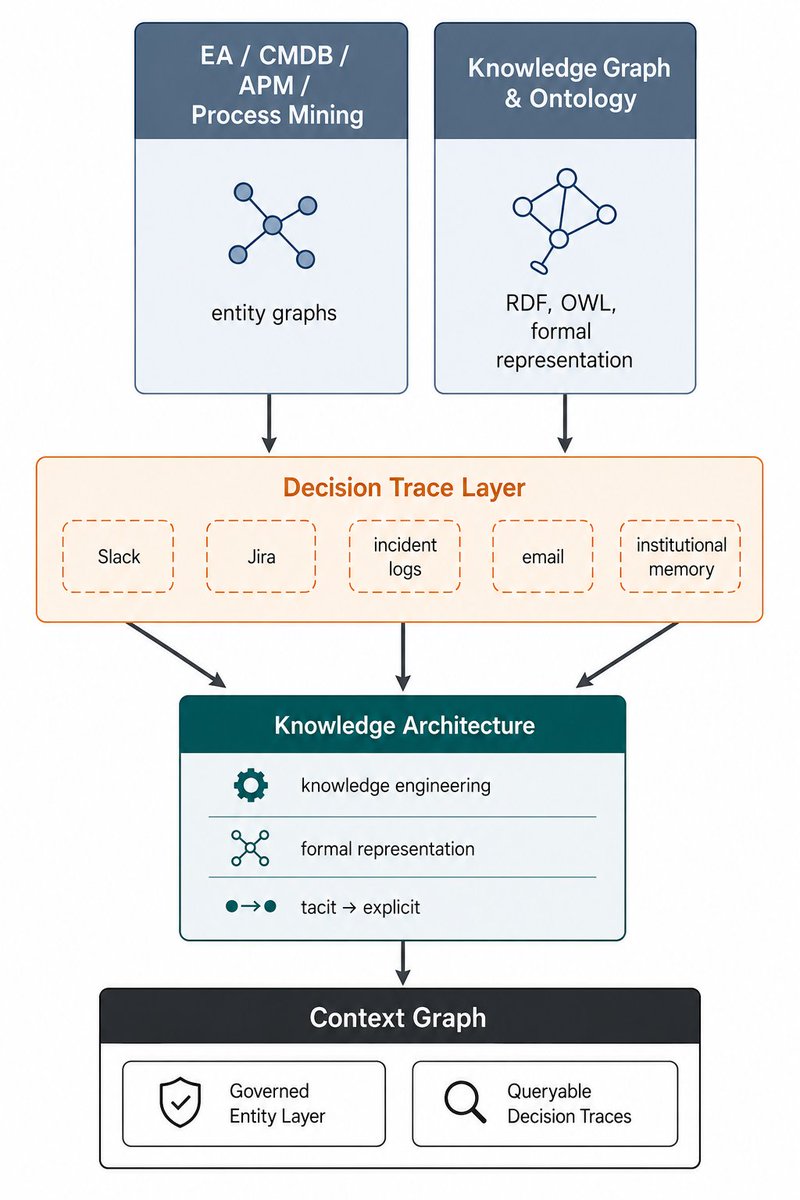
Forrester's Charles Betz cuts through the noise: EA has maintained entity graphs since Zachman (1987). CMDBs go back to ITIL v1 in the 1990s. APM, process mining, ChatOps, architecture decision records -- these disciplines have been assembling the pieces of a unified context graph in isolation for decades. The graph was never missing. It's fragmented.
George Anadiotis takes the argument further. The decision trace layer -- who decided what, why, under what authority -- isn't absent from organisations. It lives in Slack threads, incident postmortems, Jira tickets, and people's heads. Extracting it and making it queryable is not a database problem. It requires knowledge engineering: observing work practices, interviewing domain experts, encoding tacit reasoning in formal, machine-readable representations.
That's the missing layer. Not the graph itself -- the knowledge architecture that makes it governable.
The infrastructure answer is not exotic either. RDF/OWL provides typed entities and governed relationships. Named graphs handle provenance and versioning. SPARQL enables queryability. These are the building blocks that turn an entity layer from a drawing into something that can actually satisfy governance requirements. Alberto D. Mendoza's conversion of ArchiMate 3.2 to an RDF ontology is a direct, working instantiation of this approach.
On the tooling side: the LLM Wiki pattern -- extracting discrete facts from unstructured sources into a graph, then synthesising into structured queryable form -- is being adopted at scale as a population accelerator for enterprise Agentic AI implementations. The Semantic Web has a 25-year library of patterns, vocabularies and tools to build on.
The key reframe: ontological modeling was never meant to be a runtime. Its value is in defining consistent logic aligned with domain knowledge -- ensuring concepts don't contradict each other across different data schemas.
Entity graphs anchored in EA, EA anchored in knowledge representation, decision traces made queryable: that's context graph architecture grounded in something that can actually hold.
The question isn't whether context graphs are real. It's whether organisations will start building the knowledge architecture they require now, or wait until their competitors have a three-year head start.
By @linked_do
https://t.co/U0bkxg0P69
#KnowledgeArchitecture #EnterpriseArchitecture #ContextGraphs #AgenticAI #Ontology
--
💬 ‘A great newsletter’ - Claudia Remlinger, former Sr. Marketing Director, Neo4j.
Join readers from Amazon, Capgemini, Michelin, Neo4j & more
Subscribe to the Year of the Graph newsletter for quarterly updates and insights on all things #KnowledgeGraph, #GraphDB, Graph #Analytics / #DataScience / #AI and #SemTech 👇
https://t.co/7pg6gqWYvw
Knowing what your data means is the foundation. Getting people and agents to act on that meaning, and proving it was allowed, is what gets built on it.
Welcome to the Autumn 2026 issue of the Year of the Graph Newsletter, where we explore what context is, and how graphs can power the Agentic AI stack.
Three signals from the same quarter that context is going mainstream:
- Forrester and Gartner published competing context layer definitions
- Google paid $10 million for a defunct airline's internal business data
- W3C and Google released competing formats for machine-readable wikis
Mainstream doesn’t mean settled, but whichever way you cut it, semantics is a key part of context. Context spans semantics, state, and controls. The need to define semantics is what led to the resurgence of ontology.
Inside this issue:
- Ontology as the guardrail, not the prompt: what moving agents from retrieval to governed execution requires
- Graph engineering: from loops to mapped systems that remember what happened and who owns what
- Graph memory for agents
- Vault-LD, YAML-LD and the Open Knowledge Format for LLM wikis
- Ontology readiness and automation: generating an ontology is getting cheap, validating one is not
- GraphRAG: where it works, and where it is going
- Market traction: Oakley Capital's agreement to acquire Graphwise, and a forecast growing from $1.34 billion in 2025 to $19.16 billion by 2035
- New tools, releases and use cases
This issue brought to you by @metaphacts , Graphwise, @CambridgeIntel, @TENTRIS_DB , @yworks , packt, State of the Graph, and @Connected_Data London.
Special offer for YotG subscribers: Get Jessica Talisman's new book, Ontology Pipeline, at a special price till October 15.
https://t.co/YfrPw2nFzS
#Ontology #ContextGraphs #GraphRAG #AIAgents #ContextEngineering
We also got into:
→ The evolutionary ladder of AI, and where this may lead
→ Roles, departments and specialized agent roles under the lens of legibility vs. fluidity
→ Graphs and how "loop engineering" is giving way to "graph engineering"
👇
https://t.co/mileCFxnvn
Ship captains used to hold formation in battle; not because it was good tactics, but so admirals could verify everyone followed orders
Nelson gave individual commanders the freedom to engage as the situation demanded
@IntuitMachine says enterprises are facing the same choice 🧵
His claim:
In an AI-native organization, enterprise architecture & #AI harness become the same artifact
Traditional EA documents are after the fact, go stale instantly. Native AI EA keeps enterprise structure - decisions, boundaries, accountability lines - explicit & queryable
We live in a world fraught with interfaces designed to work against you. Most people sense it. Few can prove it, and fewer still are trying to fix it.
By @linked_do#ai#darkpatterns...Show more
Context Graph Architecture pt.2: Linked Data Orchestration and the Thin Red Line
Context graphs need knowledge architecture. But what does it take to build one? The answer has been hiding in plain sight for years. Why context graph knowledge architecture need an inference layer
Context Graph Architecture in 2026: Linked Data Orchestration and the Thin Red Line
Context graphs need knowledge architecture. But what does it take to build one? The answer has been hiding in plain sight for years.
Why context graph knowledge architecture need an inference layer, not just an entity layer, to deliver on their promise for enterprise architecture
How ArchiMate 3.2 as an RDF ontology provides the knowledge architecture substrate: federation, derivation rules, and the relationship no architect ever draws
Why hydration remains the practical barrier, and what’s changed since the problem was first named in 2012
How to manage the RDF reasoning cost as an engineering choice between forward and backward chaining
When Foundation Capital declared context graphs AI’s next trillion-dollar opportunity, the hype engine ran with it and the industry rushed to build. But Enterprise Architecture practitioners recognized the problem immediately: they’d been solving it for 40 years.
The real challenge isn’t inventing a new category. The challenge is connecting what EA has always done – mapping organizations’ technology, capabilities, and decisions – with the knowledge architecture layer that turns those fragmented traces into governed, machine-queryable intelligence.
As Forrester’s Charles Betz notes, the center of gravity in enterprise architecture is shifting from documentation to decision velocity. The pain was never that architects couldn’t find issues. Issues arrive daily from linters, scanners, peer reviews. The pain was delay and unpredictability. Designs disappearing into queues. Governance becoming friction.
So what’s the infrastructure that can make decision velocity possible at architectural scale?
In “Beyond the Decision Trace“, we argued that three approaches – the BI semantic layer, context graph/EA, and knowledge graph/ontology – are tackling the same problem from different angles and not talking to each other. The connecting thread is context graph knowledge architecture: formal representation of concepts, relationships, constraints, and inference rules, in machine-queryable form.
We pointed out a concrete piece of that infrastructure – Alberto Mendoza’s work on ArchiMate 3.2 as an RDF ontology. Now is the time to ask what it would take to put it to work. Not as an academic exercise. As engineering.
The answer leads somewhere unexpected: back to 2012, and a problem that keeps coming back under different names.
By George Anadiotis
https://t.co/940ONctzKY
--
🤝 Put your graph tech brand in front of the people who matter
Your graph technology deserves to be seen by buyers, analysts, and builders who are actively shaping the space.
The Year of the Graph is the independent hub that this community trusts.
Slots for the upcoming Summer 2026 Issue are filling fast. Reach out and book yours now 👇
https://t.co/LCvoLhhBBt
On the effects of #AI beyond the market
First #softwareengineering and now #machinelearning offer a glimpse of how this works
We explored this in The Engineer in the Machine: How Neo Is Rewriting What It Means to Build AI, using Acemoglu's framing 👇
https://t.co/sIt7AJUOOK
Dario is wrong.
He knows absolutely nothing about the effects of technological revolutions on the labor market.
Don't listen to him, Sam, Yoshua, Geoff, or me on this topic.
Listen to economists who have spent their career studying this, like @Ph_Aghion , @erikbryn , @DAcemogluMIT , @amcafee , @davidautor
A team of ML engineers spent 6 months building a model with a 2-hour ETA error margin.
One junior engineer using Neo got to 90 minutes in one week.
Neo is a fully autonomous ML engineering agent. It handles the entire pipeline, from raw data to deployed model 🧵
The multi-agent architecture, the hallucination suppression, the human-in-the-loop design, and the question that matters the most:
When an agent does the engineering work, does the engineer still learn?
Their answer is built into the system. Whether it holds at scale is open
Connected Thinking Monday Quotes: Two Civilizational Operating Systems
"The Western mind, shaped by Aristotelian logic and Judeo-Christian narrative traditions, instinctively reaches for stories to explain complex phenomena. We need heroes and villains, beginnings and endings, moral arcs and resolutions.
Our entire political discourse operates through competing narratives: the story of democratic progress, the story of market efficiency, the story of individual liberty triumphing over collective oppression. Even our economic theories are essentially stories — Adam Smith's invisible hand is a narrative device, not a mechanism you can diagram.
The Chinese mind, influenced by Confucian pragmatism and Daoist flow, sees reality as patterns and positions rather than narratives. Where Westerners ask "What's the story?" Chinese strategists ask "What's the situation?"
This isn't merely linguistic — it represents a deeper cognitive framework that perceives reality as a dynamic field of forces and relationships rather than a sequence of events with moral meaning."
— Carlos E. Perez. The Story and the Map: Two Civilizational Operating Systems. 2025
What if understanding how civilizations think is the key to understanding what comes next?
Macrohistory doesn't ask "who won?" - it asks "what patterns repeat, and why?" When we zoom out from narratives to patterns, something shifts: we stop looking for heroes and start reading the field. That's precisely the lens of Civilizational Patterns & Macrohistory - and it's where Connected Thinking begins.
From there, we follow the pattern forward: into the Pulsation of the Commons, the rise of P2P and cooperative logics, and ultimately the question that matters most right now: What is the Next System, and what can we actually know about it?
Ancient wisdom. Contemporary synthesis. Future vision. Lived experience.
Learn more and register here 👇🏻
https://t.co/OQipm7necz
🌿 Seminars on foot reviving the peripatetic tradition of ancient philosophers, where walking, thinking, and dialogue converge to explore civilizational patterns and future systems.
📍 Lake Kaiafas, Greece | 🗓️ May 17–23, 2026
In this series of short posts we introduce concepts and quotes from Michel Bauwens and the P2P Foundation's Civilizational Analysis, on which Connected Thinking is based.
#ConnectedThinking #MondayQuotes #MacroHistory #PeerToPeer #TheCommons #PeripateticLearning #SystemsThinking #CivilizationalPatterns #TransformativeLearning #FutureOfWork #ConsciousLeadership #RegenerativeFuture #Sensemaking #MetaCrisis #Sustainability
Connected Thinking Monday: Civilizations, Values & the Passage of Time
"Let us remember, ladies and gentlemen, that all civilization is based on an immense, broad and beautiful coherence of values, that is to say of life forces ("valor" in Latin means "life force", "life energy"). Each civilization is distinguished from one another by a system of values ordered differently.
These values, they have always been the same since humans have inhabited the Earth. They are therefore all present in each civilization, but the key values, those which are privileged are not the same.
Let us also remember that a civilization, tell us the historians of the great periods, lasts about 500 years. And that the transition from one to the other is generally chaotic or even dramatic."
— Olivier Frerot, La Transgression éthique
Frerot's insight sits at the heart of what we explore at Connected Thinking. If every civilization rests on a shifting hierarchy of the same deep values, and if ours is mid-transition, then the urgent questions become:
What patterns govern civilizational change? What is pulsating beneath the surface of today's crises? And what comes next?
These are precisely the questions Michel Bauwens and the P2P Foundation have spent decades mapping through civilizational analysis and macrohistory. From the recurring rise and fall of the commons, to the emergence of peer-to-peer as a structural force for the next system.
At Connected Thinking 2026, we walk these questions - literally - through seminars on foot in the peripatetic tradition, weaving together philosophy, macrohistory, and futures thinking into a lived, embodied inquiry.
Ancient wisdom. Contemporary synthesis. Future vision. Lived experience.
Learn more and register here 👇🏻
https://t.co/OQipm7necz
🌿 Seminars on foot reviving the peripatetic tradition of ancient philosophers, where walking, thinking, and dialogue converge to explore civilizational patterns and future systems.
📍 Lake Kaiafas, Greece | 🗓️ May 17–23, 2026
In this series of short posts we introduce concepts and quotes from Michel Bauwens and the P2P Foundation's Civilizational Analysis, on which Connected Thinking is based.
#ConnectedThinking #MondayQuotes #MacroHistory #PeerToPeer #TheCommons #PeripateticLearning #SystemsThinking #CivilizationalPatterns #TransformativeLearning #FutureOfWork #ConsciousLeadership #RegenerativeFuture #Sensemaking #MetaCrisis #Sustainability
Connected Thinking Friday: Civilizational Surges, Critical Thresholds, and the Wisdom Born from Failure
"Civilizations might be viewed as surges of history that rise toward this level of abundant living, but always fall back because social institutions are not appropriately modified at that time of crisis when accumulated resources – material, social and spiritual, open the way to it.
Yet it is just at the same time when the surge of history breaks and fails that most wisdom is attained concerning the conduct of life. Failure is always the supreme teacher, if accompanied by faith and courage."
— Henry Nelson Wieman, The Directive in History, 1949
Wieman names something that macro-history confirms again and again: civilizations collapse because their institutions — the structures meant to channel collective energy — fail to evolve at the very moment the opening appears. The surge crests. The window closes. And the fall begins.
But Wieman also offers something rarer than diagnosis: hope grounded in pattern. Because if failure recurs across civilizations, so does its fruit — the accumulated wisdom about what went wrong, and what could be done differently. This is the gift that serious civilizational analysis offers us right now, at our own moment of institutional crisis.
The Commons, P2P, and the emergent next system are not utopian dreams. They are the lessons of previous surges, encoded and ready — if we have the faith and courage to act on them.
👉 Explore the talks that map these patterns:
→ Civilizational Patterns: An Introduction to Macro-History
https://t.co/ael2pCxFEh
→ The Pulsation of the Commons Hypothesis
https://t.co/5WDWzeJkHk
→ P2P and the Commons
https://t.co/aMAen6hk1s
→ The Next System: What Can We Know?
https://t.co/T8C2rYtvMv
Ancient wisdom. Contemporary synthesis. Future vision. Lived experience.
Learn more and register here 👇🏻
https://t.co/2VcNrvCSIc
🌿 Seminars on foot reviving the peripatetic tradition of ancient philosophers, where walking, thinking, and dialogue converge to explore civilizational patterns and future systems.
📍 Lake Kaiafas, Greece | 🗓️ May 17–23, 2026
In this series of short posts we introduce concepts and quotes from the P2P Foundation's Civilizational Analysis, on which Connected Thinking is based.
#ConnectedThinking #FridayQuotes #MacroHistory #PeerToPeer #TheCommons #PeripateticLearning #SystemsThinking #CivilizationalPatterns #TransformativeLearning #FutureOfWork #ConsciousLeadership #RegenerativeFuture #Sensemaking #MetaCrisis #Sustainability
Principles and Applications of Pragmatic AI: Interactive 🤝
What's the most common reason well-funded AI projects underdeliver?
It's not the algorithm. It's not the data pipeline. It's the room - or rather, everyone in it pulling in different directions, speaking different languages, working from different assumptions.
So why is most AI training a solo experience?
Learning in isolation has a ceiling. And in AI, that ceiling arrives faster than in most fields.
AI doesn't happen in a vacuum. It happens in organizations, teams, and ecosystems, with people who have different backgrounds, different goals, and different definitions of success.
That's the Interactive Principle of Pragmatic AI: offer real opportunities for feedback, networking, and follow-up. Building knowledge is better together, and real-world use cases always involve more than one stakeholder.
Being Interactive is the Sixth Principle of Pragmatic AI. 🔢
What does it look like in practice? Interaction is built into every layer of the experience, not bolted on at the end. 🔗
🔹 The course is delivered live, to a limited-seats cohort. Not a recording. Not a self-paced module. A real room, real people, real conversation - where questions get answered and perspectives get challenged in the moment.
🔹 Real-world datasets and scenarios are at the center of the labs. Participants don't work on abstract exercises - they work on the kind of messy, multi-stakeholder problems that look like actual work, because they are.
🔹 Feedback flows in both directions throughout. The course adapts to the cohort. Participants adapt to each other. That dynamic is itself one of the most valuable things you'll take away.
🔹 The relationship doesn't end when the week does. Follow-up, networking, and continued exchange are part of what makes the learning stick, and what turns a course into a community.
The people in the room are part of the curriculum. 🧩
Pragmatic AI is built on experience and research, designed for busy professionals, validated by leading global organizations, and delivered in person at an all-inclusive resort, where the conversations that happen outside the sessions are just as formative as the ones inside.
Check the full agenda and reserve your seat here 👇🏻
https://t.co/Qqn3r8pRz5
🌿 A course for people who want to understand the first principles of AI, and learn how to use it to get results.
📍 Lake Kaiafas, Greece | 🗓️ May 24–30, 2026
#PragmaticAI #AITraining #MachineLearning #CollaborativeLearning #AIForBusiness #ExecutiveEducation #AIImplementation #Greece2026
Connected Thinking Monday: Biology, Culture, and Cosmic Evolution - Rethinking the Foundations of Human Futures
"The failure to understand culture, and in particular the relationship between biology and culture as part of cosmic evolution, may be one of the primary failings of science in the modern world. This is a factor in holding back progress in our understanding of both the nature of humanity and the future of humanity. Therefore, in my approach to the deep future I focus on the emergence of the big historical cultural era."
- Cadell Last, Big Historical Foundations for Deep Future Speculations: Cosmic Evolution, Atechnogenesis, and Technocultural Civilization, 2015
Modern science has been extraordinarily powerful at breaking things apart - isolating variables, specialising disciplines, optimising subsystems.
What it has been far less capable of is synthesis: understanding how biology becomes culture, how culture becomes civilisation, how civilisation becomes a force in cosmic evolution.
This fragmentation is not merely an academic problem. It produces leaders, institutions, and policies that optimise for the measurable and the immediate, while remaining blind to the deep patterns that actually determine where humanity is heading.
Cadell Last's intervention points to what macro-history and big history offer that conventional analysis cannot: a frame wide enough to hold biology, culture, and deep time together in a single coherent view.
Only from that altitude can we begin to ask - and answer - meaningful questions about the next system. Not as a policy adjustment, but as a phase transition in the long arc of human becoming.
This is the intellectual foundation on which Connected Thinking is built.
👉 We explore how to bring this synthesis to life:
→ Civilizational Patterns: An Introduction to Macro-History
https://t.co/D1l59upDc3
→ The Pulsation of the Commons Hypothesis
https://t.co/oiIifxeqd3
→ P2P and the Commons
https://t.co/98GmaRn18k
→ The Next System: What Can We Know?
https://t.co/yqVsrAJoje
Ancient wisdom. Contemporary synthesis. Future vision. Lived experience.
Learn more and register here 👇🏻
https://t.co/OQipm7necz
🌿 Seminars on foot reviving the peripatetic tradition of ancient philosophers, where walking, thinking, and dialogue converge to explore civilizational patterns and future systems.
📍 Lake Kaiafas, Greece | 🗓️ May 17–23, 2026
In this series of short posts we introduce concepts and quotes from the @mbauwens P2P Foundation's Civilizational Analysis, on which Connected Thinking is based.
#ConnectedThinking #MondayQuotes #MacroHistory #PeerToPeer #TheCommons #PeripateticLearning #SystemsThinking #CivilizationalPatterns #TransformativeLearning #FutureOfWork #ConsciousLeadership #RegenerativeFuture #Sensemaking #MetaCrisis #Sustainability