Introducing Chainlink Fulcrum: the gateway connecting the world’s largest financial institutions to onchain financing.
As tokenized assets and financing venues expand across public and private blockchains, institutions need to mobilize collateral and access liquidity without building bespoke infrastructure for every market.
Chainlink Fulcrum solves this with an end-to-end solution that separates where financing agreements are managed from where cash & collateral settle. Counterparties define the eligible assets, financing terms, and the settlement networks through which the assets move.
For institutions, this unlocks:
• Faster collateral mobilization that enables intraday financing, including on holidays and weekends.
• 24/7 risk management through automated collateral coverage checks throughout the day, extending beyond end-of-day processes.
• Greater capital efficiency by making assets across networks available for financing, helping institutions free up balance sheet capacity.
• Lower operational complexity through reusable workflows that connect existing systems across public and private blockchains.
The solution combines multiple aspects of the Chainlink platform, including the Chainlink Runtime Environment (orchestrates transaction lifecycle), CCIP (cross-chain data and asset transfers), and Data Streams (collateral valuation data).
Chainlink Fulcrum is designed to serve all market participants, including banks, dealers, prime brokers, agent lenders, custodians, hedge funds, pension funds, insurers, sovereign wealth funds, money market funds, asset managers, tokenized fund and stablecoin issuers, and corporate treasuries.
Each can lend, borrow, or mobilize collateral on terms that fit its mandate and risk parameters.
Fulcrum is in the process of being integrated with leading TradFi environments, providing a single platform where participants can compare financing terms and route transactions to the venue of their choice, where the agreement is executed and governed.
This is a foundational step toward global financing markets, where an asset’s utility extends beyond the network on which it was issued.
🧵↓
INSIGHT: @swiftcommunity CEO Javier Perez-Tasso at Sibos 2026: "The question isn't TradFi or DeFi anymore. The Swift platform will allow you to move any form of regulated value, whether fiat or tokenized, at global scale."
Wen Staking v1.0 / Full Economics 2.0? (a thread) 🧵
Everybody in the $LINK community is asking the same question.
$LINK economics are not just a theorethical concept. Since the release of the Chainlink 2.0 Whitepaper the authors published a series of groundbreaking academic papers solving the core computer science problems required to make the future rollout of Economics 2.0 actually possible.
Here are the 6 peer-reviewed breakdowns that will make full Economics 2.0 actually possible: ⬇️
TODAY: Chainlink announced it is working to enable financial institutions to connect to @swiftcommunity’s blockchain ledger through the Chainlink platform.
Swift moves the equivalent of the world's GDP roughly every three days ⬇️
xStocks everywhere, powered by @Chainlink.
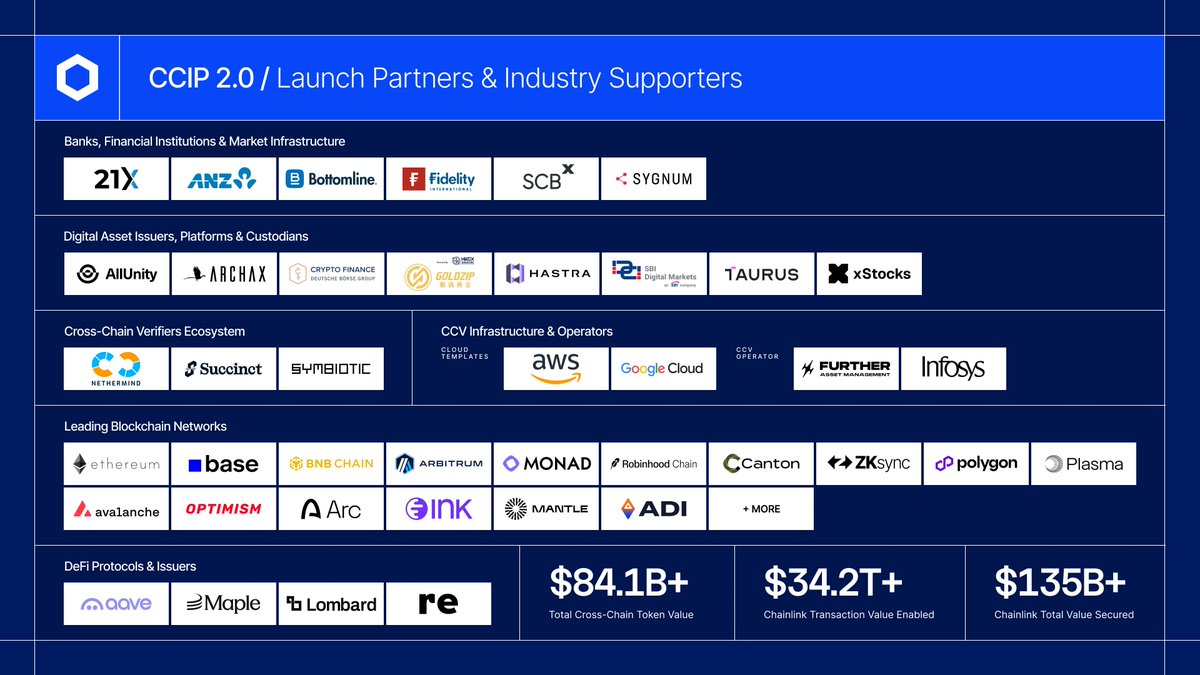
With CCIP 2.0, xStocks can move across chains and plug into more markets and liquidity through a common interoperability standard and unlock greater utility for tokenized equities onchain.
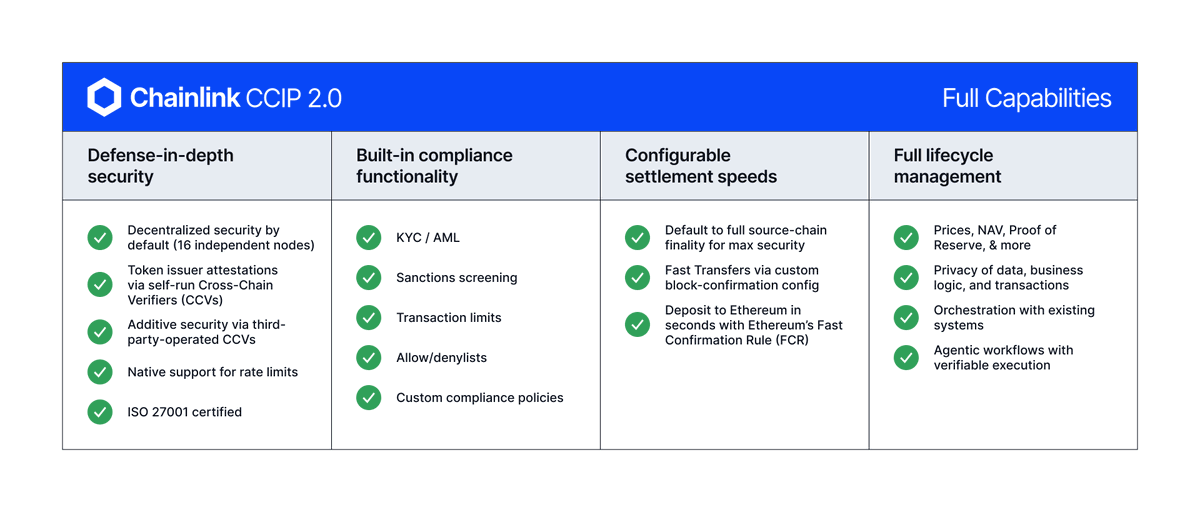
1. Institutional risk controls: Add an independent layer of verification on top of CCIP by deploying custom Cross-Chain Verifiers (CCVs) directly within Amazon Web Services and Google Cloud, or by utilizing enterprise-grade operators like Infosys and Nethermind.
2. Flexible settlement: Asset issuers get direct control over execution speed and parameters to run fast paths for high-frequency flows, or full finality and time-delayed approvals for high-value settlement.
3. Always-on compliance functionality: Native integration with Chainlink ACE embeds policy controls directly into cross-chain transfers, enforcing issuer-defined KYC, AML, sanctions screening, allowlists, exposure limits, and more.
Interoperability used to mean choosing between insecure legacy bridges that have been exploited for $3.3B+ or over half a year of custom engineering work per chain.
CCIP 2.0 marks a new era as the only standard designed to meet the security, compliance, & speed requirements of the world's largest financial institutions.