Ukraine's Defense Minister Fedorov: "Ukraine aims to enter the world’s top 3 by 2030 in integrating AI into public administration and defense tech.
Every company must become an AI company and every government - an AI government"
Ukraine is building its own LLM, Siaivo - EP.
1/
Sui’s programmable object model is built for universal compatibility.
@kostascrypto: "We're the only one who can be so flexible."
With 128KB capacity, it supports complex multi-sigs and batch execution; ready for whatever math comes next.
Your $SOL bags are probably fine. Your $SUI bags might 5x them.
Hear me out:
$SOL is a proven ecosystem with strong gravity. Hold it.
$SUI is where I'd put my next dollar:
→ Move language safety advantage
→ Object-centric model for parallel processing
→ Institutional partnerships accelerating
→ Still in price discovery vs SOL
Both in the stack. Different roles.
DYOR
when a government can force a model offline, you don't control your access to it
someone else decides whether you can access it or not
now imagine losing the context your agents build up every day, the memory they depend on
what's that worth to you?
if that memory sits inside the provider, it's locked in their system, and your access to it is decided by the same people who can pull the model
that's why we built https://t.co/sZNxAtqJdJ
your agent's memory is encrypted and stored on @WalrusProtocol, spread across hundreds of nodes no single company owns, and you hold the keys
add it to the agent you're already running. it works with all the ai the tools you already use
Why panic when history keeps saying the same thing?
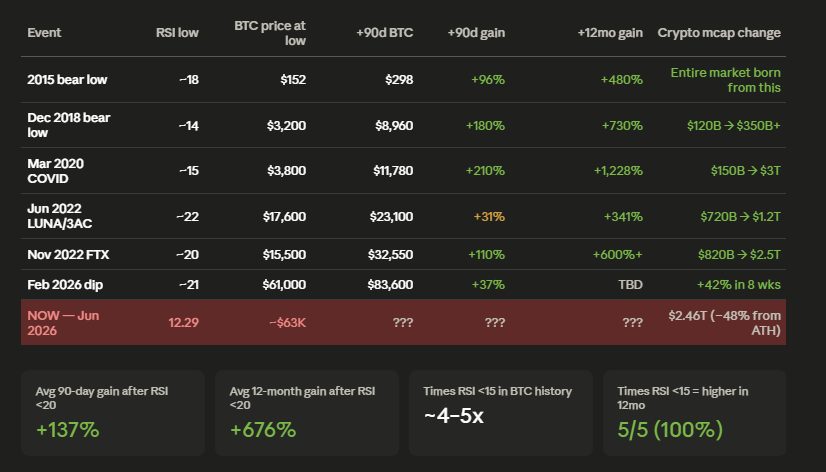
bitcoin:native RSI just hit 12.29 on the daily, one of the most extreme oversold readings ever recorded. Fear index is flashing red. Everyone's losing their mind.
Here's what the data actually says:
Every single time bitcoin:native daily RSI has dropped to ~20 or below, it has recovered. No exceptions.
→ Average gain within 90 days: 100%+
→ Minimum gain within 1 year: 300%+
→ Times this signal has failed: 0
The crowd panics at the exact moment history says to buy.
This isn't a sell event. It's one of the rarest entry signals in crypto. 😉
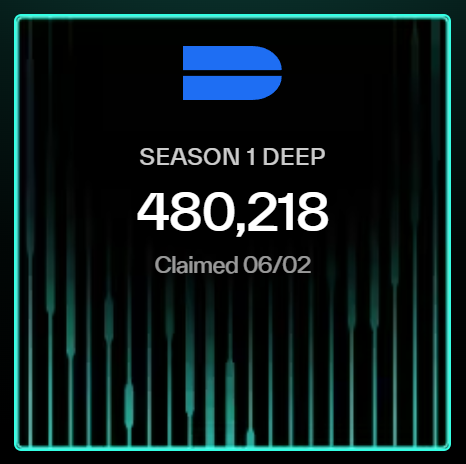
Season 1 of the DeepBook Points Program is complete. DEEP is now claimable.
Connect the wallet you used during Season 1 (Jan. 22 - Apr. 17) to view your allocation.
Claim: https://t.co/oHObcj5vCJ
Only use the official URL above. We will never DM or email claim links.
🚨 I'M SORRY BUT WHY IS NOBODY TALKING ABOUT THIS ALTCOIN RIGHT NOW.
$SUI is forming a 100 year old trading pattern and it's entering the most important phase.
Livermore's Speculative pattern comes in 14 phases with phase 7 being the last bottom.
SUI is almost at that exact level before the expansion.
Most people are waiting for altcoins.
They are looking in the wrong places.
This is one of the good ones.
Stay patient.
yesterday gasless stablecoin transfers went live on @SuiNetwork
you can now send USDsui, suiUSDe, AUSD, FDUSD, USDB, USDC, and USDY to anyone, for zero gas fees, without holding a single SUI
and this is the paradigm shift we have been pointing at for years
money should move as freely as messages
you do not buy credits before texting a friend on whatsapp or instagram
and you should not have to buy a separate token before sending a dollar
that gap, between how messages move and how money moves, is what we have been trying to close for years
yesterday we closed it at the protocol-level
and this is not a cheaper version of what came before
this is not a discount applied on top of the chain
this is a change to the chain itself
the protocol does not charge gas on supported wallet to wallet stablecoin transfers
and that makes sui a different category of infrastructure
because there is a real difference between less than a cent and zero
less than a cent is still a line item
less than a cent is still a gas balance to monitor
less than a cent is still a finance team asking why a small fee in a strange token is showing up in the books
zero is none of that
and that is what mass adoption of payment rails actually requires
with no gas fees, companies do not have to worry about accounting for gas fees
they do not have to worry about gas management
they do not have to worry about endless web3 compatibility infra
we want builders to ship payments products, not payments ops teams
with gasless stablecoin transfers, the entire layer of overhead around stablecoin payments just disappeared
that operational layer was the real barrier to mass adoption
removing it is what puts @SuiNetwork in a different league of payment infrastructure
and now it's time to push adoption
Most $SUI holders know one thing about the token: total supply is capped at 10 billion.
They have never read the mechanic that makes that cap matter.
It is called the Storage Fund.
And it is the most important thing in the $SUI tokenomics docs that nobody is talking about.
Here is exactly how it works:
Every time a transaction adds data to the Sui blockchain, the user pays a storage fee.
That fee does not go to validators directly.
It goes into the Storage Fund, a pool of SUI that never fully depletes.
Here is where it gets interesting.
The Storage Fund has its own stake in the network.
It earns staking rewards the same way every other stakeholder does.
Those rewards are then distributed to validators to compensate them for storing historical data.
This solves a problem every other blockchain ignores:
When a new validator joins Sui, they have to store all the historical data from transactions that happened before they existed.
Why would a new validator pay to store someone else's old data?
The Storage Fund pays them for it.
Past users who created the storage requirements in the first place funded the pool.
Future validators get compensated from that pool indefinitely.
The fund pays out only the returns on its capital, never the principal.
It cannot be drained. It is designed to survive forever.
Now here is the part that directly connects to $SUI token value.
The Sui docs state this explicitly:
Deflation is a feature of Sui, not a bug.
Here is why:
Total supply is capped at 10 billion SUI.
As network activity increases, more transactions are processed.
More transactions mean more storage fees flowing into the Storage Fund.
As the Storage Fund grows, it holds more SUI.
More SUI held in the fund means less SUI in active circulation.
Less circulating supply against the same or growing demand means the value of each SUI token increases.
Network growth directly reduces circulating supply.
That is not speculation.
That is the economic model built into the protocol at the architecture level.
One more detail worth knowing:
If you delete data you stored on chain, you receive a partial refund of your original storage fees.
The system charges for storage, rewards deletion, and compounds the fund's stake indefinitely.
Most people holding $SUI today are pricing the speed narrative:
The parallel transaction processing. The sub-second finality. The Move language safety.
They have not started pricing the storage fund deflation mechanic.
That gap between what the tokenomics actually does and what the market currently understands is where the long-term thesis lives.
The people who read the docs always buy before the people who read the price.
We’re partnering with the developers of @EveOnline to explore the next frontier of AI research in games.
EVE's complex, player-driven universe is the perfect safe sandbox to test agents on memory, continual learning, and long-term planning.
Find out more → https://t.co/8D3d6a079C