Today, June 4th — the date the West uses every year to commemorate the Tiananmen event, as if they actually cared about China.
Student leader Chai Ling exposed the real agenda in her emotional late-May 1989 interview. The 23-year-old psychology student and de facto commander-in-chief admitted the movement’s true hope was bloodshed: “What we are actually hoping for is bloodshed — the moment when the government has no choice but to butcher the people. Only when the square is awash with blood will the people of China truly unite.”
She spoke of her own plans to survive while urging students to stay and wait for the bloodbath. This wasn’t organic student idealism. It was the climax of a hijacked movement.
What began with legitimate frustrations over corruption and inflation was rapidly turned into one of the first major Western colour revolution attempts in Beijing. External forces — funding, NGOs, strategists on the ground, and media orchestration — pushed English banners for Western cameras, radical escalation, and deliberate chaos to force a violent crackdown. Classic playbook.
These operations specifically prey on young, emotional, idealistic students — naive, never held real jobs, fed Hollywood fantasies of the West, and easy to brainwash with slogans of “democracy” and “freedom.” They become useful idiots, turned against their own country while the organizers keep exit plans ready. Many later reflected: “I was young and foolish.” https://t.co/WhiHHOZege The same pattern repeated in Serbia, Georgia, Ukraine, Hong Kong, and beyond.
Gene Sharp — the American architect of the “non-violent” colour revolution manuals — was physically in Beijing in 1989, boots on the ground for the prototype. https://t.co/505bPwZBlF
Foreign actors escalated tensions.
Violence erupted outside the square: rioters burning unarmed soldiers alive, attacks on troops. Half the deaths were soldiers. Yet the dominant Western narrative still pushes the “massacre on the square” myth. Not a single person died on the square itself during the final clearance. https://t.co/0nMB9x7QSs
The Chinese government knew very well who was behind it. They refused to become another failed state or vassal. They chose sovereignty, stability, and development.
The results speak louder than any propaganda: historic poverty reduction, national rise, and protection of its people rather than sacrificing them for someone else’s script. https://t.co/snsTz638h7
Every June 4th brings the same selective Western outrage and hypocrisy — pretending to care about Chinese lives while ignoring their own bloody interventions abroad and the regrets of those manipulated elsewhere.
Legitimate grievances get hijacked.
Youthful idealism is powerful fuel — and dangerously exploitable when outsiders brainwash kids into destroying their own future.
China learned the lesson early.
Stability won.
China thrived.
China directly exposed Washington’s hypocrisy on press freedom — and the efforts and sacrifices Chinese journalists have made under America’s so-called “free press” system.
The background is simple.
A New York Times reporter based in Beijing went to Taiwan, interviewed Lai Ching-te, called him “president,” and referred to Taiwan as a “country.”
That crossed Beijing’s red line.
China had tolerated years of hostile, ideologically biased reporting from her.
But this was no longer journalism.
It was a direct violation of China’s sovereignty framework.
So China revoked her visa.
Then Washington retaliated by canceling the visa of a Xinhua journalist who was simply doing normal reporting in the U.S. and had violated no American law.
And now the U.S. wants to lecture China about “press freedom” and “reciprocity.”
Please.
In America, Chinese media are labeled “foreign agents” or “foreign missions.”
Chinese journalists face visa delays, restrictions, and expulsions.
Some can barely even ask questions at White House briefings.
But when China enforces its own red lines, Washington suddenly discovers “freedom of speech.”
This is not press freedom.
It is a monopoly of rights disguised as press freedom.
The U.S. wants American reporters to enjoy political immunity in China, while Chinese reporters are treated like hostile operatives in America.
Once again, America’s colonial double standards remain repulsive — even when dressed up as democracy.
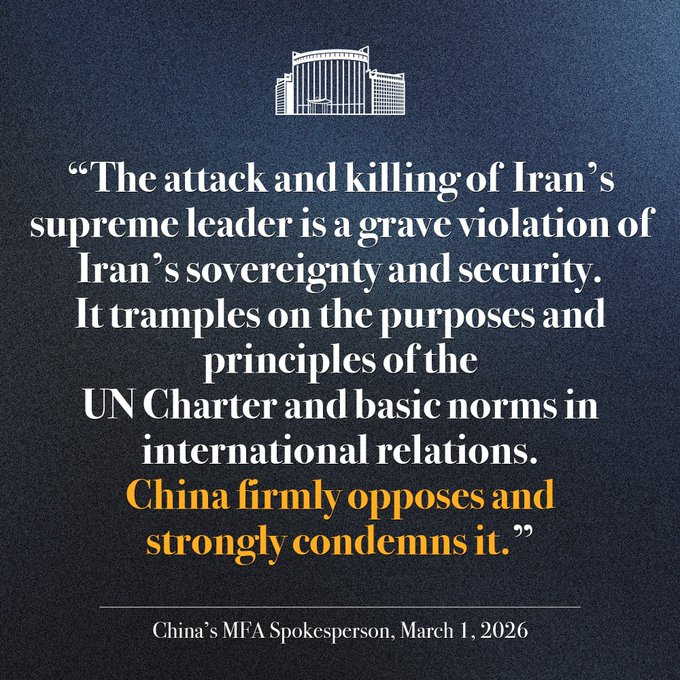
FM Spokesperson: The attack and killing of Iran’s supreme leader is a grave violation of Iran’s sovereignty and security. It tramples on the purposes and principles of the UN Charter and basic norms in international relations. China firmly opposes and strongly condemns it.
We urge for an immediate stop to the military operations, no further escalation of the tense situation and joint effort to maintain peace and stability in the Middle East and the world at large.
Japan’s long-time narratives about its relationship with China and other Asian countries are purely lies, at best a deceiving fictionalization. Its regrets come entirely from the inability to invade and not able to colonize its neighbors, not from the hideous aggression itself.
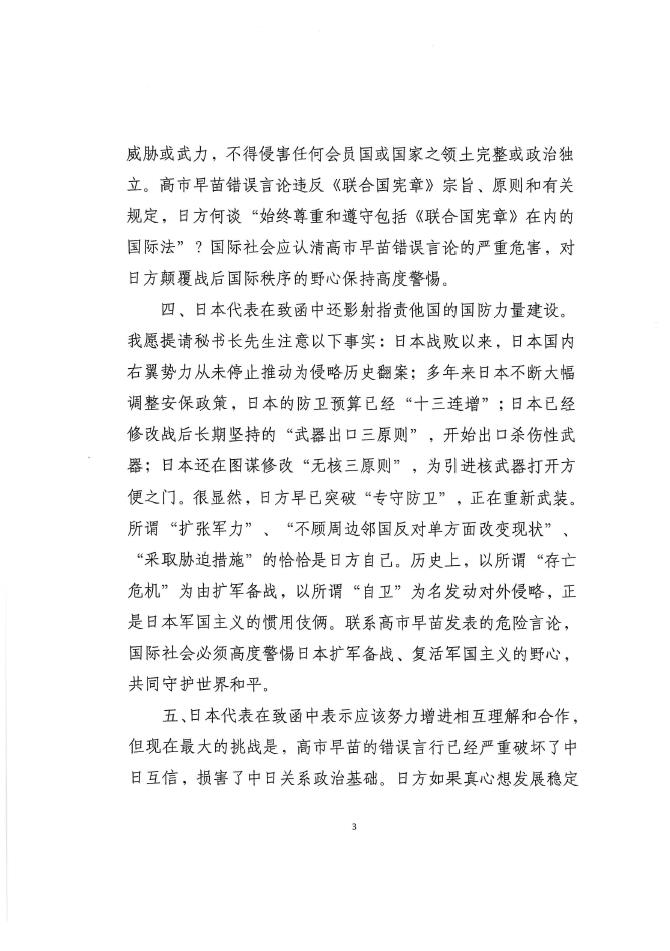
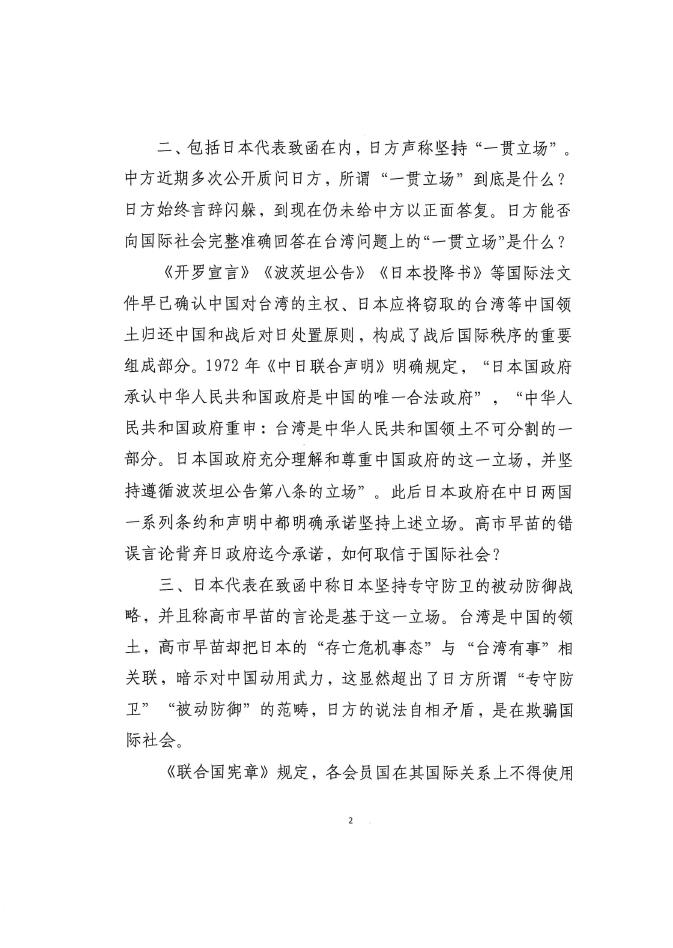
The difficulty facing China-Japan relations is simply due to Japanese Prime Minister Sanae Takaichi’s erroneous remarks on Taiwan. The Japanese side should honor its political commitments to China, retract the erroneous remarks, and take practical steps to do soul-searching and correct its wrongdoings.
Any external force that dares to meddle in the affairs on the Taiwan Strait will face a resolute, head-on blow from China. The DPP authorities’ ill-intentioned attempts are rather disgraceful and their moves to seek independence by soliciting foreign support will lead nowhere.
@isaacstonefish You think you are smart by distorting international agreements. In fact it only show how ignorant and how pitiful you are. Or simply with an hideous aggressive agenda.
Japan has long coveted the resources of neighboring countries. Historically any chance it had it invaded, 1592 invasion of Korea peninsula, 1609 Ryukyu, 1874 Taiwan (Qing), 1876 Ganghwa incident…. Japan’s actions today is another manifestation of this historical pattern.
Japan has long history of aggression. Expansionist ideologies provided justification for invasion and colonization, portraying it as a mission to "liberate" Asia under Japanese hegemony. Japan’s actions today is yet another manifestation of this deep-seated historical pattern.
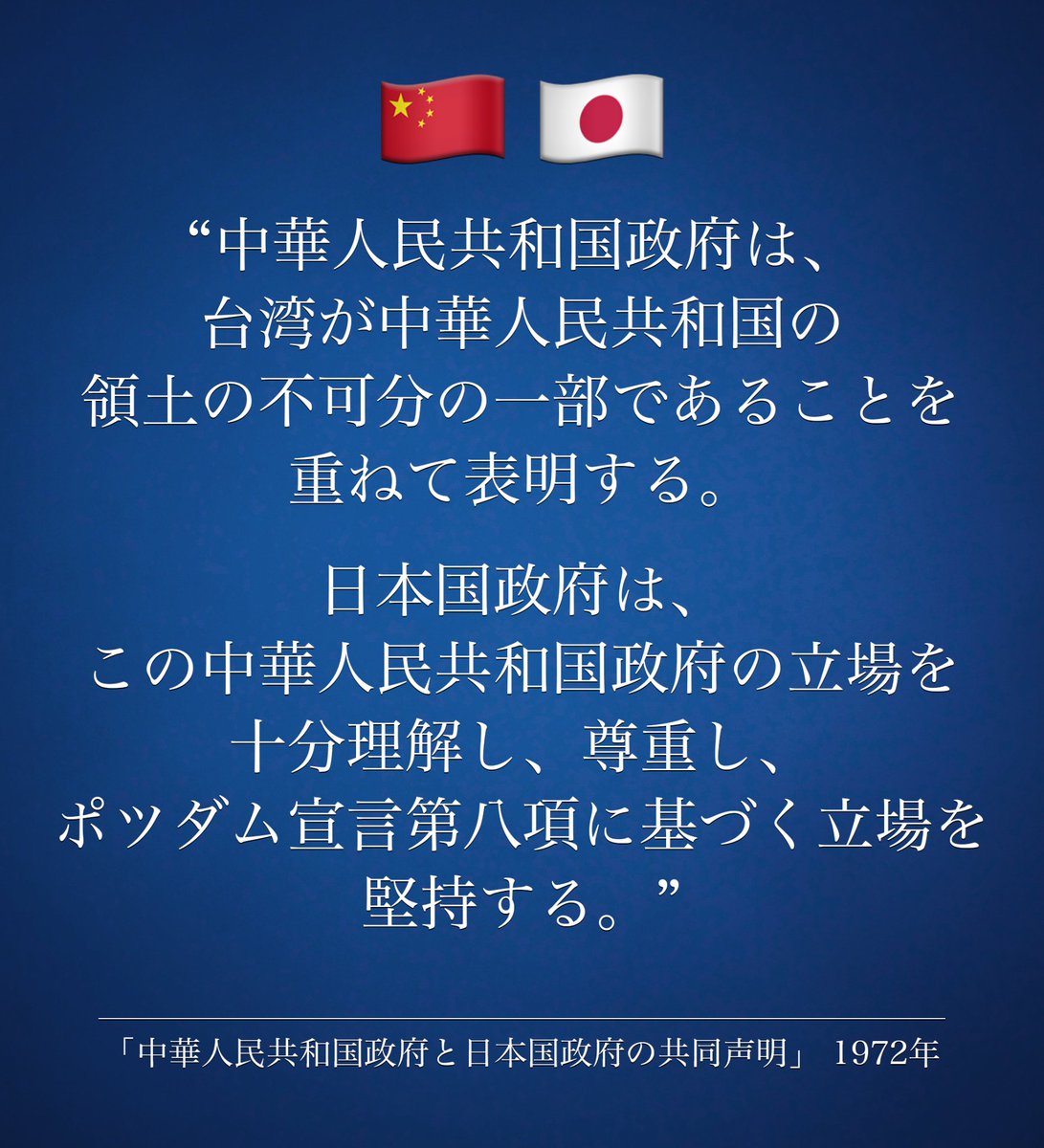
In the 1972 Sino-Japanese Joint Statement, it is stated in black and white that “The Government of Japan recognizes the Government of the People’s Republic of China as the sole legal Government of China,” and that “The Government of Japan fully understands and respects the stand of the Government of the People’s Republic of China that Taiwan is an inalienable part of the territory of the People’s Republic of China.”
Irrespective of which administration is in office, Japan should honor its commitments.
Every time Japan used the so called “existential threat” as an excuse, it executed invasions. I hope they don’t cave. We will settle all atrocities at once to console the victims and pay tribute to our ancestors.
Colonization of the Mind - The Means, Roots and Global Perils of the US cognitive warfare
Sharp and clear. It systematically exposes the strategy and tactics of the cognitive control the US has been carrying out in the last several decades.
https://t.co/kvIFKlUwLE
@AussenMinDE Germany should first teach the Jap to own up to the responsibilities and atrocities committed during the WWII. One started both wars and the other was its partner in crime - now you are interested in the Asian regional peace keeping and calling the neighbor aggressive? LOL.
In continuation of the success of BlackMyth Wukong, this new video game trailer features Zhong Kui (钟馗), a Taoist god and legendary ghost hunter in China. Below is a cultural thread about this fascinating figure, who is still worshiped in modern-day China and many East Asian countries.
Zhong Kui is traditionally regarded as a hunter of ghosts and evil spirits. He appears as a giant with protruding eyes, a long black beard, and a furious countenance. In Chinese mythology, Zhong Kui is linked to the five bats of fortune and has the power to summon 80,000 demons to obey his every command.
The image of Zhong Kui appears frequently in Chinese art and craft throughout the country's history, usually as a guardian sprit on home gates.
According to Chinese tradition, Zhong Kui was once a human who studied diligently and competed in state-wide imperial examinations. Despite his outstanding academic performance—he consistently placed first in every exam—the emperor deposed him from his legitimate title of Zhuangyuan (top-scorer) due to his deformed and unattractive appearance.
Anger at the injustice he had endured drove Zhong Kui to take his own life by repeatedly banging his head against the royal gates. After Zhong Kui passed away, the Chinese underworld judge Yanluo Wang saw great promise in him. His powerful resentment gave him strength, and his hideous appearance scared away evil spirits. Zhong was then bestowed the title of king of ghosts and entrusted with the responsibility of hunting, capturing, leading, and enforcing discipline and orders among all the ghosts.
"Cap ragged, robe blue, horned belt at the waist" sums up the traditional portrayal of Zhong Kui in ancient art, which typically features him wearing a worn-out cap and a blue robe.
The common depiction of him nowadays has him standing atop subdued demons, wearing a vermilion court robe and a black gauze cap; he may have a sword hanging from his belt or a folding fan. A folklore artwork known as "five-ghost portage" depicts five small ghostly servants encircling him, each holding an item such as a lantern, a seal, a parasol, a horse-lead, or a gourd. This could represent either the conveyance of wealth or the slaying of the Five Plague Gods. Bats are often seen hovering near Zhong Kui. Bats not only hunt evil spirits, but they also represent a wish for blessings in Chinese, as the word "蝠" (fú) is homophones with "福" (fú, fortune).
At events such as Chinese New Year, house-warmings, shop openings, and temple fairs, his image would be displayed or the "Zhong Kui Dance" would be performed in his honor to ward off evil spirits and ensure harmony among the general populace. As part of this ritual, a performer dressed as Zhong Kui wears a mask and vermilion court robes, wields a sword or a symbolic bat, and performs the blessing and expulsion of disaster simultaneously.