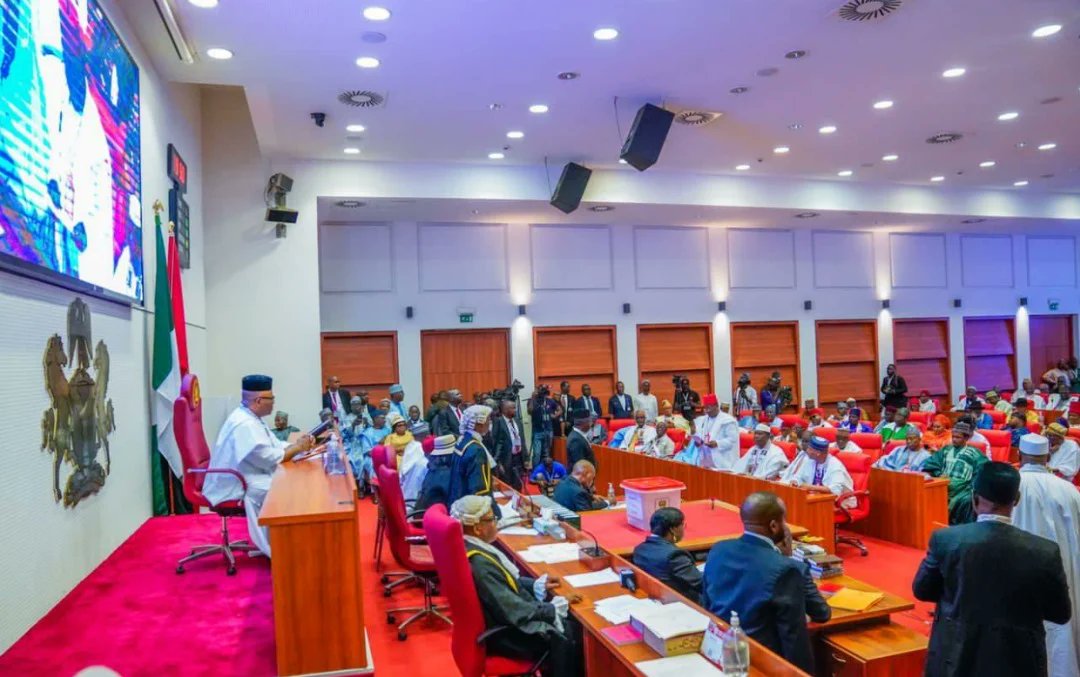
From Senator Natasha Akpoti Uduaghan
As President Tinubu signs the Electoral Act Amendment Bill 2026 into Law, citizens should note the following 7 major changes:
1. Voter registration: Documents required for voter registration are narrowed to 3 : a birth certificate, a Nigerian passport and a National Identification Number (NIN).
2. Downloadable voter card: Voters can download their voter card from INEC’s website.
3. Electronic transmission of results: Electronic transmission to IReV is compulsory.
However, if it fails, the physical result sheet (EC8A) becomes the primary source of collation and results declaration.
4. Mode of party primary election: The new bill adopts direct primaries and consensus as the only methods for political parties to nominate candidates.
5. Disbursement of funds to INEC: Election funds must be released to INEC at least 6 months before the general election. Previously: 12 months.
6. Deadline for submission of candidates’ list: Political parties must submit candidates 120 days before election day. Previously: 180 days
7. INEC’s final list of candidates; INEC must publish candidates' list 60 days before the election. Previously: 150 days.
Except for the provisor in Section 60 (3) which holds that upon network failure inhibiting electronic transmission; form EC8A becomes the primary mode of collation and result transmission . I’ll say the other amendments are fine.
At this juncture, the National Assembly has done its part. The Presidency too.
Now its left for every citizens to channel their attention to INEC and ensure it:
• Strictly complies with the law and equally treats all political parties and candidates.
• Deploys technology effectively for voter accreditation, result transmission, and real-time transparency.
• Guarantees timely logistics and efficient distribution of election materials.
• Protects the integrity of the voters’ register and prevents manipulation.
• Works closely with security agencies to ensure peaceful, violence-free polls.
• Promptly uploads and publish results to strengthen public trust.
Ultimately, Nigerians are the true government and every institution actually is accountable to the people.
The people MUST follow the money and question every kobo of the ₦873 billion to be released for the 2027 elections.
Question the quality of BVAS machines.
Insist on smarter softwares for BVAS and IREV systems.
Demand a partnership with a network provider e.g. Starlink for a sure nationwide service for the election week. Coverage over the 177,000 polling unit should cost more than ₦65billion.
Lastly, laws are dynamic not absolute. They are made by men to serve mankind and can ve challenged in the courts of law. Therefore Citizens who are dissatisfied with any or all of the amendments can challenge the Electoral Act 2026 via a judicial action.
Senator Natasha H Akpoti Uduaghan
“In the Northern part of Nigeria, Umaru Yar’ Adua ordered shoot at sight in 2009 during the uprising of Mohamed Yusuf’s people. M. Yusuf, the then Boko Haram leader was arrested by the military & handed over to the police which later shot him & other people. President Obasanjo visited & engaged some of the leaders of Boko Haram in Maiduguri & they asked what they (Boko Haram) wanted & they gave President Obasanjo 4 conditions.”
~ Hakeem Baba-Ahmed narrates how Boko Haram started in the Northern Nigeria
JUST IN: Nigerian Senate has again failed to pass the long-awaited Electoral Act Amendment Bill, despite spending more than four hours in a closed-door session.
This marks the third unsuccessful attempt in two weeks to conclude deliberations on the bill
PayPal locked Nigerians out of the global digital economy for 21 years. No receiving payments. No withdrawals. Just ‘send-only’ status while our freelancers and businesses struggled. Now that we’ve built a billion dollar fintech ecosystem without them, they want back in. The audacity.
DAVID HUNDEYIN SLAMS FRENCH-NIGERIAN ATTACK ON BENIN
On the morning of December 7, elements of Benin's military took to the airwaves to announce the overthrow of Western-backed President Patrice Talon. Calling themselves the "Military Committee for Refoundation," they condemned Talon for imprisoning his opponents and allowing the elite to control "all vital sectors of the economy." The coup leaders also criticised the deteriorating security situation in northern Benin, which has become a base for Al Qaeda-affiliated insurgents attacking neighbouring Niger and Burkina Faso.
Much like their neighbours in the Alliance of Sahel States (AES), the people of Benin spontaneously took to the streets in celebration. However, their joy was short-lived. Within hours, Nigeria — Benin's much larger eastern neighbour — began launching airstrikes on the capital, Cotonou, in explicit coordination with France, Benin's former coloniser. The rest of the Economic Community of West African States (ECOWAS) quickly rallied behind the Talon regime. This emerging anti-imperialist rebellion was swiftly crushed, and Cotonou remains under indefinite foreign occupation.
In an interview, Nigerian journalist and founder of West Africa Weekly, David Hundeyin, spoke with Ahmed Kaballo of Sovereign Media about these shocking developments. Hundeyin drew a stark contrast between ECOWAS' indifferent response to the self-coup by Western-backed President Umaro Sissoco Embaló in Guinea-Bissau less than two weeks earlier. He noted that a successful anti-imperialist uprising in Benin would have provided the landlocked AES with a crucial connection to the Atlantic Ocean.
Lastly, Hundeyin reflected on the serious implications of these events for Nigeria's domestic politics and international standing. He pointed out that the intervention was blatantly illegal under Nigeria's own constitution and exposed the government's hypocritical posturing in response to Donald Trump's threats. He concluded by discussing the unofficial rivalry between France and the United States for hegemony in the region, highlighting how Nigerian President Bola Tinubu positions himself as a compliant ally to both imperial powers.
@DavidHundeyin@VoxUmmah@venanalysis@qiaocollective@ProgIntl@KawsachunNews@OrinocoTribune@blkagendareport
🔋🚗 Leading Electric Car Brand by Country:
🇨🇭 Switzerland: Tesla
🇳🇴 Norway: Tesla
🇺🇸 USA: Tesla
🇵🇱 Poland: Tesla
🇬🇧 United Kingdom: Tesla
🇦🇪 UAE: Tesla
🇨🇦 Canada: Tesla
🇯🇵 Japan: Nissan
🇩🇪 Germany: Volkswagen
🇳🇬 Nigeria: Jet EV
🇨🇳 China: BYD
🇩🇰 Denmark: Tesla
🇫🇮 Finland: Tesla
THE AI JOB MASSACRE NOBODY'S TALKING ABOUT: YOUR COLLEGE DEGREE JUST BECAME TOILET PAPER
Let's cut through the BS: AI has eliminated 77,999 jobs in 2025 across 342 tech companies.
37% of companies using AI say the technology replaced workers in 2023 because "they were no longer needed."
And in 2024, 44% using or planning to use AI say employees will "definitely" or "probably" be laid off.
But here's what makes this different from every other tech revolution: major tech firms reduced new graduate hiring by 25% in 2024 compared to 2023.
These aren't positions getting automated - these are jobs that no longer exist.
The con everyone's selling: "AI will create new jobs!"
Sure. While 85 million jobs are projected to be displaced by 2025, 97 million new roles may emerge. Sounds great until you read the fine print:
77% of new AI-related jobs require master's degrees, and 18% require doctoral degrees. Your four-year degree? Worthless. The new entry point is a PhD most people can’t afford.
What's actually happening: A major tech CEO revealed that 30% of company code is now AI-written. At the same time, over 40% of recent layoffs targeted software engineers.
Companies are dissolving copywriting divisions and replacing substantial portions of their coding staff. More than 80% of digital marketers already fear AI will replace content writers - and they're right.
Occupations at highest risk: computer programmers, accountants, auditors, legal and administrative assistants, customer service reps, telemarketers, proofreaders, credit analysts.
Notice a pattern? White-collar, college-educated, once-stable careers - the exact jobs your parents told you were "safe."
The demographic timebomb: 79% of employed women in the U.S. work in jobs at high risk of automation, compared to 58% of men.
Globally, 4.7% of women’s jobs face severe disruption from AI versus 2.4% for men.
In high-income countries? Nearly 10% of women’s jobs are at highest risk compared to just over 3% for men. This isn't just job loss - it's systematic wealth destruction along gender lines.
The prediction nobody wants to make: Leading AI executives warn that AI could eliminate half of all entry-level white-collar jobs within 5 years.
Other global tech leaders back this projection, forecasting potential impact to half the global workforce by 2027.
We're not talking about a gradual transition. We're talking about 14% of workers already displaced by automation or AI, with estimates that AI could replace the equivalent of 300 million full-time jobs worldwide.
January 2025 saw the lowest job openings in professional services since 2013 - a 20% year-over-year drop. 40% of white-collar job seekers in 2024 failed to secure even an interview.
You're seeing the early days of something unprecedented: an entire generation locked out of the careers they trained for, watching AI do their jobs better, faster, and for pennies on the dollar.
The social contract was "get educated, work hard, build a career." AI just voided that contract.
And nobody - not universities, not politicians, not companies - has a plan for what comes next.
Sources: FinalRoundAI, AIPRM, SSRN, Fox Business, Goldman Sachs, National University, AIMultiple, WORK ON PEAK, Nexford University
“The first riot I encountered was the Zaria riot where people were killed and your only crime was that you were Igbo.”
- Pastor Matthew Ashimolowo on the Christian genocide in Nigeria.